The United States is a global leader in the oil and gas sector, especially regarding shale play development across nations. Well, this line has proven true! Each shale play has its distinct geological features and production potential, ranging from the expansive Permian Basin in Texas to the challenging terrain of the Bakken Formation in North Dakota. We are aware of the oil boom that occurred in 1901 at Spindletop. Since then, Texas has been enhancing the oil and gas industry rapidly including shale plays. This piece will help you explore some of the top oil and gas shale plays in the US with significant contributions to the nation's energy security and economic growth.
The oil boom due to these shale plays in US has brought a drastic change in the oil and gas sector. It ultimately helped the US achieve a strong economic position in the world. In the ever-expanding sector, there continues to be a rise in innovation and technology. It resulted in enhanced, secured, and sustainable production of oil and gas. The latest innovations in drilling have led to the shale revolution that introduced major shale plays in US. But first, let's explore what shale plays are.
What is Shale Plays in the Oil and Gas Sector?
Shale plays consist of various undiscovered, potential, discovered, or producing oil and gas reservoirs sharing specific geological properties. Shale plays, commonly known as shales. These shales consist of fine-grained sedimentary rock particles. Mineral feldspar decomposes and forms inside the shale. The shale holds several materials like organic matter, mica, pyrite, and quartz.
Shale plays are a primary source for hydrocarbons. Shale plays are commonly developed using innovations like horizontal drilling and hydraulic fracturing (fracking) to extract hydrocarbons from the tiny holes in shale rock. They contribute almost 40% of the total to the oil and gas industry in the country.
The following are among the top shale plays in the United States. They have generated positively high revenues for the oil and gas industry to achieve a robust economic peak for the United States. It also reduced the dependency on oil and gas imports from other countries, with a profound impact on the world energy market.
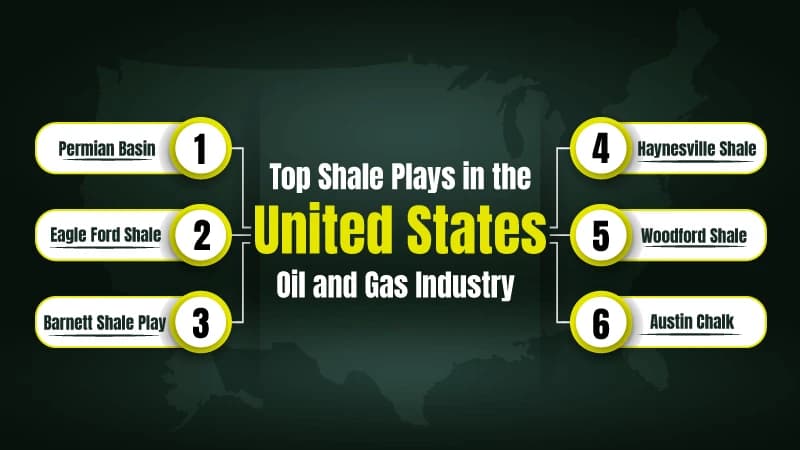
Top Shale Plays in the United States Oil and Gas Industry:
The following six shale plays in US are some of the high potential plays. The United States oil and gas industry fulfills the market’s energy needs, with these top shale plays making a buzz in the global energy sector.
Permian Basin:
The Permian Basin The recent report of 2019 concludes that the shale play has produced around 4.2 million barrels of Crude Oil per day and 5 billion cubic feet of natural gas. This shale play holds an area of around 86,000 square miles, which is 300 miles long and 250 miles wide. Due to its extensive spread, it gets split into three individual shale plays in Texas known as Delaware Basin, Midland Basin, and Central Basin.
► Delaware Basin:
As part of the Permian Basin Shale Play, the Delaware Basin significantly boosts mineral production. This basin covers an area of 6.4 million acres, which is 10,000 square miles. Stretching from Southern New Mexico to West Texas. Recent technological advancements in horizontal drilling have unlocked its potential.
► Midland Basin:
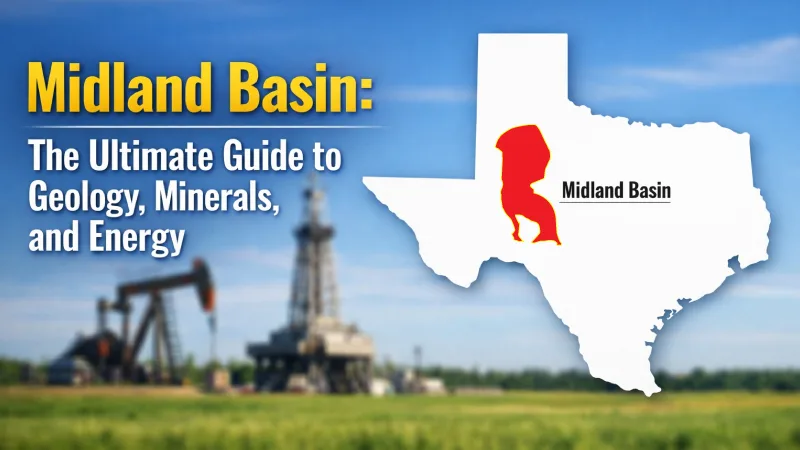
Located in West Texas, the Midland Basin, covers roughly 20,000 square miles of land. It is said to be one of the high prospective natural gas and oil generating sections.
► Central Basin:
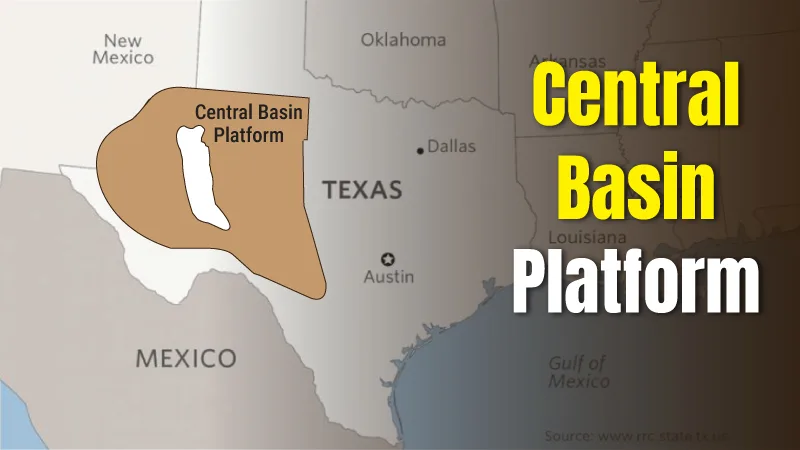
Central Basin, or the Central Basin Platform as its name indicates, lies in between the Delaware Basin and Midland Basin. It spreads in the land of west Texas and some areas of southern New Mexico. It covers an area of about 7,000 square miles.
These 3 shale plays in Texas contribute substantially to the US oil and gas sector.
-
Eagle Ford Shale
The Eagle Ford Shale, a significant geological formation in Texas, is renowned for its substantial production of natural gas and oil. Due to this potential, it has received crucial attention from several communities.
It covers an area 400 miles long and 50 miles wide, and the thickness measured is around 250 feet. This shale play consists of a large amount of carbonate, which accounts for 70% of the total shale play.
Such a large quantity of carbonate improves the brittle characteristics of a shale play. As the brittle property increases, the play becomes capable of executing hydraulic fracturing activity. It is the latest drilling technology that helps to extract more minerals from the shale plays. This shale play is named after the community, Eagle Ford.
Barnett Shale
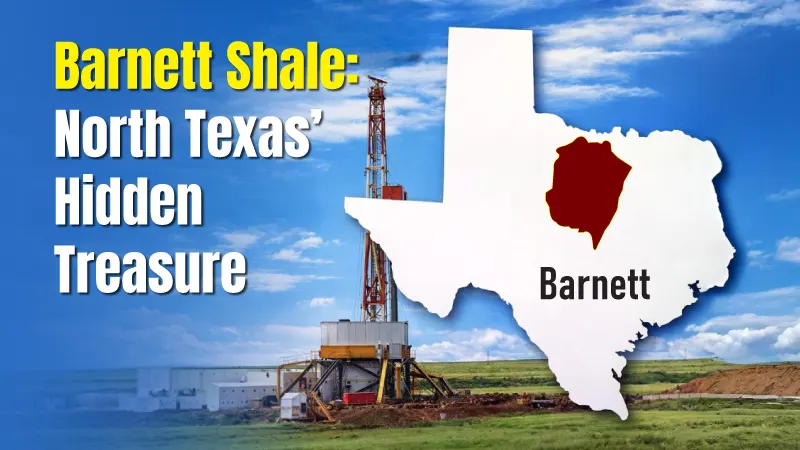
Extending west and south of Dallas, the Barnett Shale play is among the United States' most productive natural gas fields. As per the geoscientists, it is one of the most productive and larger onshore fields of natural gas. It includes the area in Texas, which is about 5000 square miles. The shale play includes rock and sand around the hydrocarbon deposits. It makes the extraction process complicated.
To enhance the extraction process, the shale play involves newly arrived horizontal drilling technology. It maximizes mineral extraction in complex onshore locations. The drillers associated with this shale play are able to generate about 15,500 barrels of crude oil per day. Also, they generate around 4.5 billion cubic feet of natural gas per day, as per the newly published report.
-
Haynesville Shale
The Haynesville Shale extends throughout East Texas, Southwest Arkansas, and North Louisiana. The depth of this shale play, calculated, is around 10,500 to 13,000 feet beneath the surface. It is part of a large rock formation. Geologists call it the Haynesville Formation. This shale play utilizes an area of around 9000 square miles and a thickness of 200 to 300 feet. Cotton Valley sandstone overlays the Haynesville Shale. This shale play includes a large amount of natural gas, which is recoverable.
The natural gas extracted from this play is referred to as 'Shale Gas'. The wells of the shale are made of low permeability mudstones. These mudstones are the origin of natural gas. The shale evolved with a rising demand for natural gas. With the latest technologies, such as directional drilling and hydraulic fracturing, it becomes convenient to extract more minerals.
-
Woodford Shale
The Woodford Shale spans Southeastern Oklahoma and extends into Texas. After Barnett shale, it is considered the second oldest formation for oil and gas production in the United States. This shale consists of natural gas in high amounts. Usually, The Woodford shale is characterized as a shallow mineral reservoir. The wells that belong to it are mainly focused on zones that have a 150-foot mark.
Within New Mexico, Texas, and Oklahoma, Woodford shale has emerged in many mineral producing reservoirs. The US Energy Information Administration published a report on shale plays in 2011. As per this report, Woodford shale holds natural gas of about 22.2 trillion cubic feet. This gas is technically recoverable.
-
Austin Chalk:

Austin Chalk Formation is known for producing both oil and gas. It covers the area from Texas near the border with Mexico in an arc through Texas, Arkansas, Louisiana, and Mississippi up to coastal Alabama. This shale play was named after a type section outcrop located near Austin, Texas.
The Austin Chalk formation consists of marl and chalk. The shale play has a thickness of about 150 to 800 ft. As per the recently published US Geological Survey, the shale plays contain minerals up to 41.5 trillion cubic feet of natural gas and 6.9 billion barrels of oil.
Production of Shale Plays:
The daily oil and gas production for each shale play is detailed in the table below. Production value is from respected years' reports.
| Name of the Shale Play | Type of Mineral | Approximate Production | Recorded Year |
|---|---|---|---|
| Permian Basin | Oil | 5.49 million barrels per day | 2023 |
| Gas | 21.0 billion cubic feet per day. | 2022 | |
| Eagle Ford Shale | Oil | 1629 barrels per day | 2024 |
|
| Gas | 6004 thousand cubic feet per day | 2024 |
| Barnett Shale Play
| Gas | 0.5-4 million cubic feet per day. | 2020 |
| Haynesville Shale | Gas | 13517, Thousand Cubic feet per day. | 2024 |
| Woodford Shale Play (Anadarko Basin) | Oil | 712 per rig | 2024 |
| Austin Chalk | Oil | 0.115 MN Barrel/Day | 2019 |
The United States Shale Revolution:
The United States shale revolution has been characterized by the adoption of sustainable drilling practices, especially hydraulic fracturing and horizontal drilling, aimed at extracting tight oil deposits. With the discovery of oil and natural gas, the revolution of the shale has come to rise. In the United States, the shale revolution has been instrumental in the sector's remarkable growth. Amongst them, tight oil formations added more value. 36% of total crude oil production was measured due to tight oil formations in the country. Such production developed an enormous economic height as well as reduced the attenuation of United States imports from overseas.
The oil and gas industry accounts for around 8% of the total US GDP in 2023. The contribution of oil and gas to GDP continues to rise, albeit not always directly. The shale revolution has definitely enhanced the extraction of oil and gas.
In 2023, the employment of about 10.3 million jobs has been generated. This is due to the positive impact of the shale revolution on the oil and gas industry. The newly arrived drilling techniques perform environmentally friendly drilling activities. Around 20% of the total global supply of dry natural gas is provided by the United States, of which 40% is extracted from shale plays. The above-mentioned shale plays in US are the best results of the shale revolution.
The shale revolution in the United States has been made possible by a range of elements. Some important factors to consider are the wealth of skills in US geology, possession of hydrocarbon assets by the landowner, having access to capital, and a regulatory framework that is favorable. The shale revolution has had a major impact on production in the United States oil and gas industry, as well as the makeup of its personnel.
Conclusion
Since the oil boom occurred, the oil and gas industry in Texas has been enhancing vigorously. They hold discovered or undiscovered mineral reservoirs. Shale plays contribute to over 40% of the country's total mineral production.
Sustainable drilling activities are integral to the shale revolution. Permian Basin, Barnett, and all such shale plays contribute to the growth of the oil and gas sector. The ongoing economic growth resulting from the oil and gas industry is expected to persist, with the inclusion of shale plays.
To sum it up, the United States shale plays have entirely transformed the oil and gas sector, propelling the US to become the top global producer of oil and gas. The shale revolution has given rise to a thriving industry in North America.
Continue following Mineral View for further insights into oil, gas, and other minerals. For those in the mineral business, our cutting-edge technology simplifies complex processes.
FAQ’s
Where is the Permian Basin?
The Permian Basin spans West Texas and Southeastern New Mexico in the United States. It covers a large area. It has spread from west Texas to southeastern New Mexico.
How much oil is left in the Permian Basin?
As per the US Energy Information Administration, the Permian Basin still consists of 5 billion barrels of oil and natural gas, which is about 19 trillion cubic feet. These values are approximate.