Before the Barnett Shale transformed North Texas, America’s natural gas supply was drying up. Experts warned that we were running out of fuel and would soon have to pay a fortune to import energy from overseas. But George Mitchell, a stubborn oilman from Houston, had a different plan. While everyone else saw a dead end, Mitchell saw a massive opportunity hidden deep underground.
The Barnett Shale was not just another gas field; it was the experimental field where the impossible had become the norm in the industry.
Beneath the suburban neighborhoods and highways of North Texas lies the Barnett Shale formation, a major natural gas reservoir, delivering outstanding production results for the last few decades.
Geologists had long been aware of the presence of the gas, but it was imprisoned in the rock in such a tight compartment that it was a tomb. It required seventeen years of failure, millions in capital, and the strategic use of the Texas High-Cost Gas Tax Abatement (Section 201.057) to eventually make the 1997 slickwater discovery economically viable. When commercial production became viable, it transformed Texas natural gas markets and helped reshape global energy supply dynamics.
The Barnett Shale is now a mature gas giant. As the headlines have changed to the Permian Basin and the Marcellus, the Barnett is the final case study on how technology, grit, and Texas mineral rights can transform the U.S. oil and gas industry.
Key Takeaways of the Barnett Play
- The Blueprint: It is the "pioneer" play where horizontal drilling and slickwater hydraulic fracturing were first combined successfully.
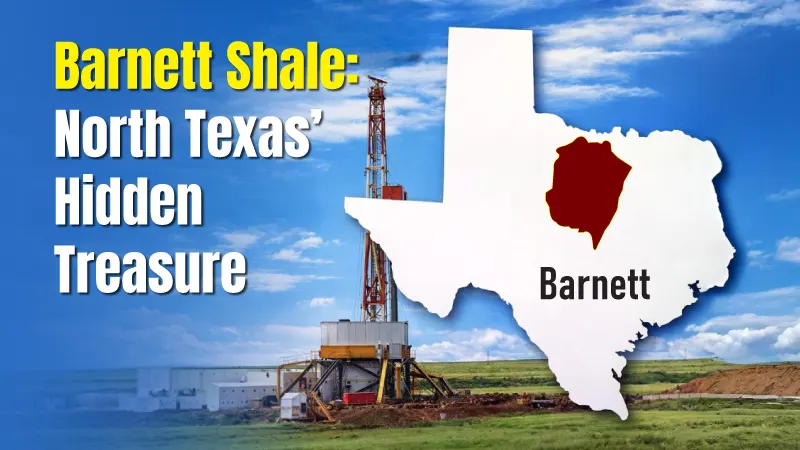
- Geography: Spans approximately 5,000 square miles across 25 counties, centered heavily under the Dallas–Fort Worth (DFW) Metroplex.
- Peak Production: Reached approximately 5 billion cubic feet per day in 2011, making it one of the most productive natural gas plays in the United States at the time.
- Current State: Transitioned from a "drilling" play to an "optimization" play, focusing on refracturing (re-fracking) and efficient midstream management.
- Permian Connection: A separate, oilier version of the Barnett exists in the Midland Basin, offering a different economic profile than the dry gas of the Fort Worth Basin.
Counties of the Barnett Shale
The Barnett formation spans a massive footprint across North Texas. If you want to access the mineral data of any of these counties, you can visit Mineral View's Lease Activity feature.
Counties in Barnett Shale Play
| Counties in Barnett Shale Play | ||
|---|---|---|
| STEPHENS | PALO PINTO | ERATH |
| MONTAGUE | EASTLAND | SOMERVELL |
| COOKE | DENTON | ELLIS |
| YOUNG | PARKER | HAMILTON |
| ARCHER | HOOD | HILL |
| JACK | COMANCHE | BOSQUE |
| WISE | JOHNSON | DALLAS |
| CLAY | TARRANT | CORYELL |
Oil and Gas Production Details of Barnett Shale
The following table provides the comprehensive overview of production details of the Barnett Shale from 2020 to 2026 to date.
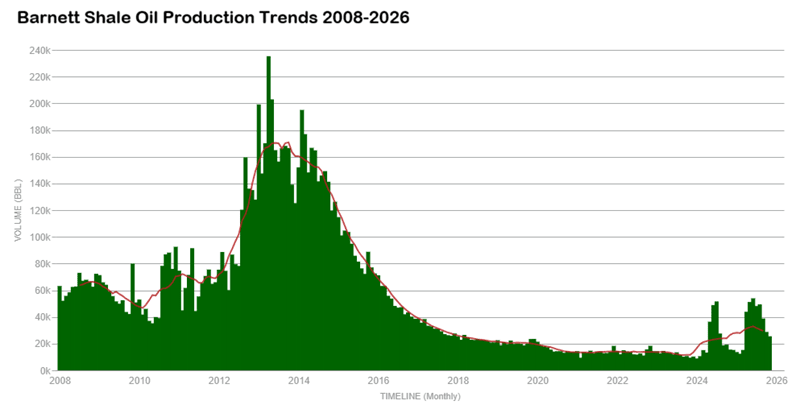
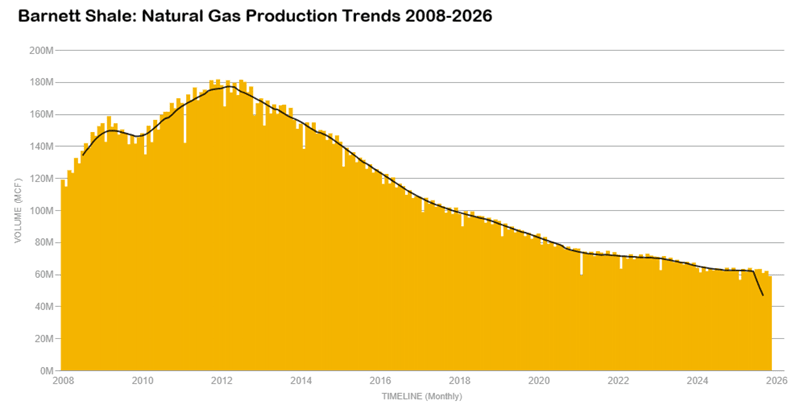
Note: These production figures are sourced from Mineral View, one of the premier oil and gas data platforms in Texas. Mineral View aggregates primary regulatory data from the Railroad Commission of Texas (RRC) and optimizes it into an accessible, user-friendly format for streamlined analysis.
History and Development
If you want to understand the Barnett Shale, you have to understand George Mitchell. He wasn't just the man in charge; he was the driving force behind Mitchell Energy. In the 1980s, while the rest of the industry looked elsewhere, Mitchell used his company as a personal laboratory.
They began drilling vertical wells into the stubborn rock of Wise County, betting millions that they could unlock a treasure chest of gas that others had written off as impossible to reach.
Did you Know?
The Pioneer: George Mitchell was a Texas A&M valedictorian and tennis captain before he became the "father of shale."
The Risk-Taker: Mitchell developed 10,000 wells in his career, including 1,000 "wildcat" wells in unproven territory.
Back then, the conventional wisdom in the industry was that shale was a source rock, where oil and gas are created, and not where they remain. You were to drill the sandstones and limestones where the gas had passed through. The team of Mitchell took almost 20 years attempting to fracture the shale.
Initial solutions involved the use of very costly, thick gels, which tended to gum up the rock instead of opening it. The economics changed only in 1997 when an engineer by the name of Nick Steinsberger chose to test a blend of high-volume and high-pressure water and sand with a combination of several friction-reducing chemicals, which he termed "slickwater."
But suddenly, the gas not only trickled out, but it roared. The combination of slickwater hydraulic fracturing and horizontal drilling allowed a single well to contact thousands of feet of reservoir, dramatically increasing production compared to earlier vertical wells. The shale gale officially started by the time Devon Energy acquired Mitchell Energy in 2002 at a cost of $3.1 billion.
Geology and Reservoir Mechanics
The Barnett Shale is a Middle to Late Mississippian-age formation. To a geologist, it’s a beautiful, organic-rich marine shale deposited roughly 350 million years ago. For mineral owners, the Barnett Shale represents a long-term producing asset that can generate royalty income over time.
Stratigraphic Structure
The formation is generally split into the Upper and Lower Barnett. In the core areas of Tarrant and Johnson counties, these layers are separated by the Forestburg Limestone.
- Lower Barnett: This is the primary target. It is thicker, more continuous, and contains the highest concentrations of gas.
- Upper Barnett: While still productive, it requires careful navigation to ensure the fracture treatments don't "leak" into adjacent water-bearing formations, like the Ellenburger Group.
The Power of Brittleness
The Barnett Shale contains a high amount of silica and quartz, which makes the rock more brittle and easier to fracture, allowing natural gas to flow more efficiently. When you pump high-pressure water into brittle rock, it shatters like glass. If the rock were too "gummy" or high in clay, the fractures would simply close back up. The quartz acts as the perfect host for the sand (proppant) that keeps those cracks open, allowing the gas to flow.
Dry Gas vs. Oil
Not all Barnett acreage is created equal. The formation follows a "thermal maturity" gradient.
- The Core (Northeast): In Tarrant, Denton, and Wise counties, the rock was buried deeper and subjected to more heat. This "cooked" the organic matter into dry natural gas (methane).
- The Tier 2 (South/West): In counties like Palo Pinto or Erath, the rock is "cooler." Here, you find more natural gas liquids (NGLs) like ethane, propane, and even some light oil.
Active Operators and Development Trends
The maturity of the play has led to a consolidated list of operators focusing on long-term efficiency. You can track their specific well performance and asset movements using Mineral View’s Operator Hub.
The table below shows the top 10 operators currently active in Barnett Shale.
| No | Operator RRC No | Operator_Name |
|---|---|---|
| 1 | 216378 | DEVON ENERGY PRODUCTION CO, L.P. |
| 2 | 945936 | XTO ENERGY INC. |
| 3 | 253162 | EOG RESOURCES, INC. |
| 4 | 147715 | CHESAPEAKE OPERATING, INC. |
| 5 | 842986 | TEP BARNETT USA, LLC |
| 6 | 72504 | BKV BARNETT, LLC |
| 7 | 684830 | QUICKSILVER RESOURCES INC. |
| 8 | 252131 | ENERVEST OPERATING, L.L.C. |
| 9 | 147699 | CHESAPEAKE OPERATING, L.L.C. |
| 10 | 109333 | BURLINGTON RESOURCES O & G CO LP |
Permits Data of Barnett Shale
Even as a mature play, permitting activity remains a key indicator of asset health and future re-completion potential. The below image shows the number of drilling permits issued in each year.
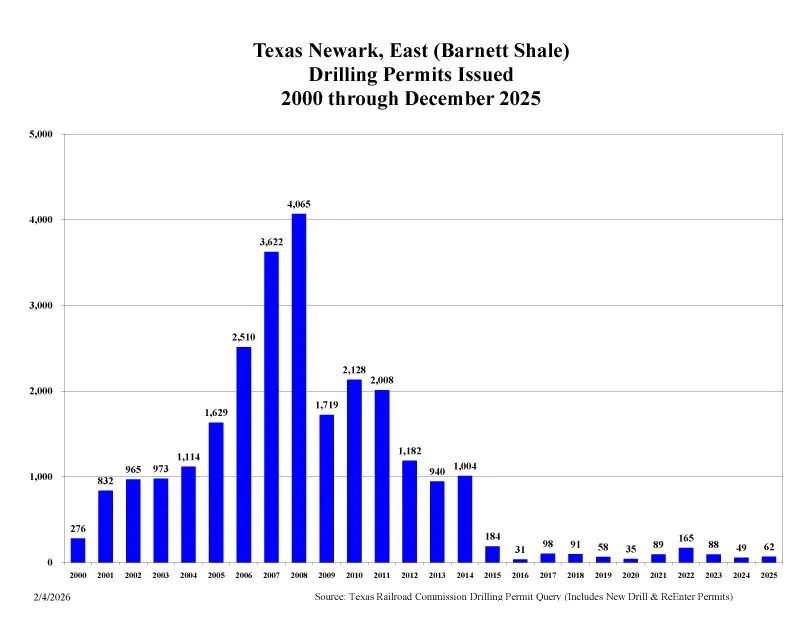
Note: The visualizations above provide a detailed analysis of Barnett Shale drilling permits, with primary data aggregated from the official records of the Railroad Commission of Texas (RRC).
The Technology That Changed Everything
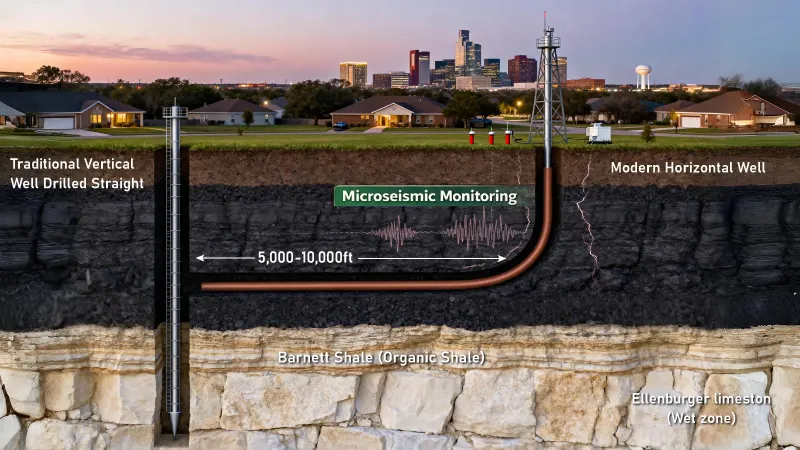
We often talk about "fracking" as a single thing, but in the Barnett Shale, it was a constantly evolving recipe.
Horizontal Drilling
In a conventional well, you drill straight down. If the shale is 300 feet thick, you only have 300 feet of "pay zone." By drilling horizontally, an operator can kick the bit sideways and run it for 5,000 to 10,000 feet through the shale. This increases the surface area contact with the reservoir by orders of magnitude.
Microseismic Monitoring
Because the Barnett was developed under a major city, precision was paramount. Operators began using microseismic "listening" devices-essentially tiny microphones in nearby wells-to "hear" the rock cracking. This allowed engineers to map exactly where their frac jobs were going, ensuring they weren't hitting faults or drilling into the "wet" Ellenburger limestone below.
Urban Drilling: The DFW Metroplex Experience
The Barnett Shale is unique because of where it sits. Unlike the desolate plains of West Texas, the Barnett core is located directly beneath one of the fastest-growing urban areas in the world. This created a fascinating and sometimes tense intersection of industry and suburbia.
Mineral Rights and the Suburban Boom
In the mid-2000s, it wasn't uncommon for suburban homeowners in Arlington or Mansfield to receive "lease bonuses" in the mail for thousands of dollars. Suddenly, every church, school district, and homeowner association was a mini-oil mogul. The "Newark East" field name became a household term.
The Logistics of City Drilling
Drilling in a city requires a level of finesse that the oil patch wasn't used to. Operators had to implement:
- Sound Walls: Massive, 20-foot padded walls to dampen the roar of the drilling engines.
- Electric Rigs: Using grid power instead of loud diesel generators.
- Water Piping: To avoid clogging neighborhood streets with water trucks, companies built elaborate temporary piping networks.
Economics: The Price of Success
The Barnett Shale actually became a victim of its own success. By proving they could pull massive amounts of gas out of the ground, companies like Mitchell, Devon, and Chesapeake Energy flooded the market. They were so successful at producing gas that they ended up with more than the market could handle at the time, which eventually caused prices to drop.
The Shift to the "Liquids" Era
In 2008, when natural gas was stuck at $8.00-10.00 per Mcf, everybody wanted to be in the Barnett. However, at the time that the prices fell below 3.00, the economics of the dry gas became hard. Capital started to drain out of the Fort Worth Basin and into the plays that were oily, such as the Eagle Ford and the Permian Basin.
Today, most Barnett Shale wells are in a mature production phase, where operators focus on maintaining output rather than large-scale new drilling. The pipelines, the saltwater disposal wells, and the processing plants are already in place, all of which are already paid for. In 2026, the Barnett functions as a high-margin 'cash cow' play; with sunk infrastructure costs, its low-decline production is now a primary feeder for Texas Gulf Coast LNG export terminals, linking North Texas mineral wealth directly to global price benchmarks.
The "Other" Barnett: Midland and Permian Basins
While the Fort Worth Basin is the historical heart of the play, the Barnett Shale also exists deep within the Midland and Delaware Basins. However, it is a very different animal out west.
In the Midland Basin, the Barnett is often found at depths of 10,000 feet or more. It is frequently drilled as part of a "stacked pay" strategy, where a company might target the Wolfcamp, the Spraberry, and the Barnett all from the same pad. The Permian version of the Barnett tends to have a much higher "oil cut," meaning it produces more liquid hydrocarbons, which are currently more valuable than dry gas.
Environmental and Community Stewardship
Environmental considerations have played a significant role in the development of the Barnett Shale. Being the first major shale play, it was also the first to face intense public scrutiny regarding groundwater safety and induced seismicity (small tremors).
Groundwater Protection
The Texas Railroad Commission (RRC) and the industry have worked to prove that "fracking" happens miles below the water table. In the Barnett, there are thousands of feet of solid rock separating the gas zones from the aquifers used for drinking water. Surface casing-steel pipe cemented into place-acts as a multi-layered shield to protect fresh water.
The Seismicity Challenge
In the early 2010s, North Texas experienced a series of small earthquakes. Research linked these not to the fracking itself, but to the disposal of produced water into deep injection wells. The RRC responded by establishing Seismic Response Areas (SRAs), implementing some of the nation’s strictest saltwater disposal (SWD) protocols, and requiring real-time pressure monitoring to decouple injection activity from tectonic triggers.
As these rules can change overnight, you need to stay informed to protect your assets.
Stay ahead of production interruptions by setting up Notification Agents for instant alerts on regulatory shifts or disposal mandates within your specific Seismic Response Area.
Re-fracking and Digital Twins
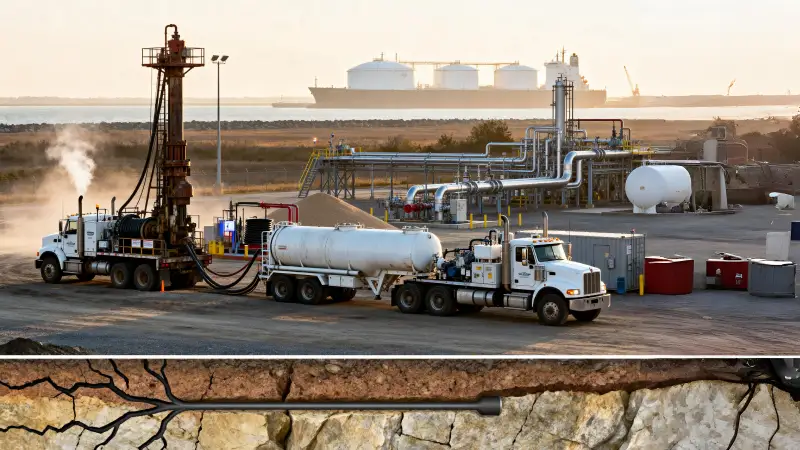
Is the Barnett Shale dead? Far from it. We are currently entering "Barnett 2.0."
The Power of the Re-Frac
Many of the wells drilled in 2005 or 2010 were "under-stimulated." We simply didn't know then what we know now about fracture density. Today, operators are utilizing Generation 3 completion designs to re-stimulate legacy wellbores, using diverted 're-fracs' to access bypassed pay zones and extend the economic life of the field by decades. This can often bring production back to near-original levels for a fraction of the cost of drilling a new well.
Natural Gas as a "Bridge Fuel"
As the world looks to decarbonize, the Barnett Shale remains a critical piece of the puzzle. Natural gas produces significantly less CO₂ than coal for power generation. With the massive LNG (Liquefied Natural Gas) export terminals on the Texas Gulf Coast, Barnett gas is now being shipped to Europe and Asia, helping the world transition away from dirtier fuels.
Evolution of Development Practices
The trajectory of the Barnett shale formation provides a definitive roadmap for other shale formations across the country. Long before the Permian became a household name, oil companies utilized the Fort Worth Basin to perfect the drilling techniques that now define the modern era.
By comparing vertical wells from the 1980s to the high-intensity horizontal wells of today, it is clear how much the industry has learned about the rock beneath the earth's surface. When large-scale production started, the Energy Information Administration and other operators closely watched how the lower Barnett shale responded to various stimulation designs.
The transition from dry gas production in the north to areas with higher oil production potential forced engineers to constantly adapt. This evolution brought new challenges, especially when navigating populated areas where logistics and community relations are as vital as performance.
Today, sophisticated production data allows firms to manage producing wells with surgical precision, ensuring that Barnett shale gas remains competitive. The legacy of the Barnett formation is visible in every successful play nationwide. By studying the history of Barnett shale wells, the industry has mastered natural gas drilling in a way that balances high gas production with environmental stewardship through advanced hydraulic fracturing applications.
Conclusion: The Enduring Legacy of the Barnett
The Barnett Shale is a classic Texas story. It is the tale of a stubborn businessman who ignored the critics to solve a geological puzzle that took 20 years to crack. This breakthrough didn't just find gas; it sparked a technological revolution that changed the global energy map.
While it may no longer be the newest trend for investors, its importance is massive. The Barnett taught the world how to drill horizontally for miles, how to manage water in busy cities, and how to find hidden treasures right under our feet. By proving we could reach over 30 trillion cubic feet of gas in this one formation alone, the Barnett provided the blueprint for the modern energy era.
Each and every person in Tarrant County who has become a mineral owner, in Houston who has become an engineer, or in London who has used Texas gas to heat their home is tied to the heritage of this great formation. The Barnett Shale remains an important case study in shale development, offering valuable insights for mineral owners and industry professionals evaluating production trends and long-term asset performance.
For North Texas mineral owners, accurately identifying whether a Barnett Shale well is in its initial growth, steady production, or decline phase is essential for effective asset management.
Whether you need to determine the market value of your mineral rights, track the latest drilling permits, or visualize regional activity on a Texas map, you can access all these Mineral View features and comprehensive insights in just three simple clicks.