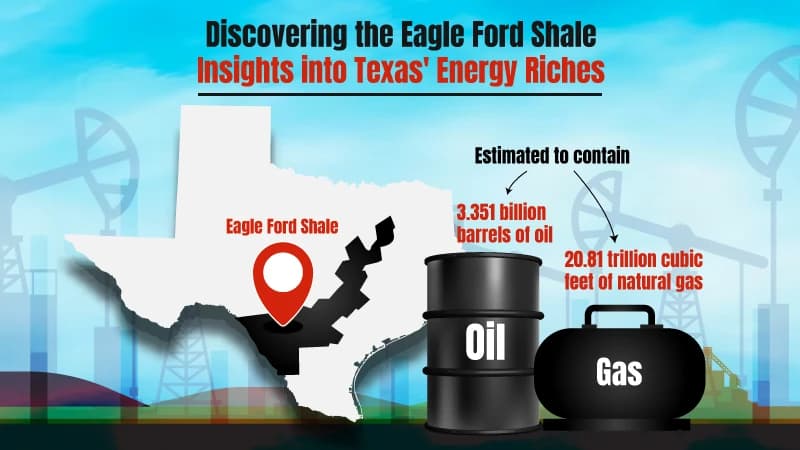
According to recent reports, the Eagle Ford Shale is estimated to contain 3.351 billion barrels of oil and 20.81 trillion cubic feet of natural gas. Stretching across an expansive area of South Texas, this formation, rich in organic material, not only offers geological advantages but also drives transformative energy innovations. With its dominant mineral reserves hidden beneath the land, this shale consistently attracts industry leaders and investors to explore and develop it. This article will help you better understand the insights of the Eagle Ford Shale.
Involving the latest drilling technologies, such as hydraulic fracturing and horizontal drilling, the Eagle Ford Shale has diversified the whole production scenario. Its significant production not only boosts the state’s economy but also has implications across the global energy sector. Let's dive deeper.
Introduction to the Eagle Ford Shale
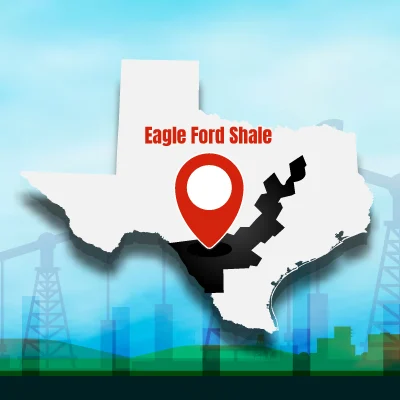
The Eagle Ford Shale, one of Texas's high-potential plays, is also known as the Eagle Ford Formation. Rich in organic carbon, this shale underlies much of South Texas, extending throughout the Southeastern Region. This shale holds a high organic rich carbon surface that lies under the Southeastern Region of Texas, especially more in South Texas. This shale produces even more oil and gas than conventional shale plays, which fascinates mineral professionals.
This organic formation has spread over Texas from the border of Mexico into East Texas. It lies under the Texas’s Railroad Commission Districts 1-6. This shale play consists of 70% Carbonate content in South Texas, as it extends towards the Northwest Region the shale content improves.
Such immense content of carbonate increases the brittle property of the shale, making it suitable to conduct the Hydraulic Fracturing activity on it. Shale play has existed since the Cretaceous Era, comprising the formations between the Buda Lime and the Austin Chalk, with an average depth of 4000-12,000 feet.
The Eagle Ford Shale is named after the town of Eagle Ford, located west of Dallas, Texas. Since the shale started producing minerals, it has continuously received positive production results.
Let's briefly understand the historical journey of the Eagle Ford Shale.
History of the Eagle Ford Shale
Here is the timeline history of the Eagle Ford Shale:
-
Before 2008:
-
The Eagle Ford Shale was identified as a major holder of hydrocarbons and assumed to be the source rock for Austin Chalk.
-
Regardless of its hydrocarbon potential, the Eagle Ford was not pondered as a commercial oil and gas producer due to its extremely low permeability.
-
-
2008:
-
The first Eagle Ford well was successfully drilled in La Salle County by Petrohawk, with an impressive gas rate of 7.6 MMCFD.
-
This achievement proved that modern drilling techniques such as horizontal drilling and hydraulic fracturing can be implemented for enhanced gas production in the Eagle Ford Shale.
-
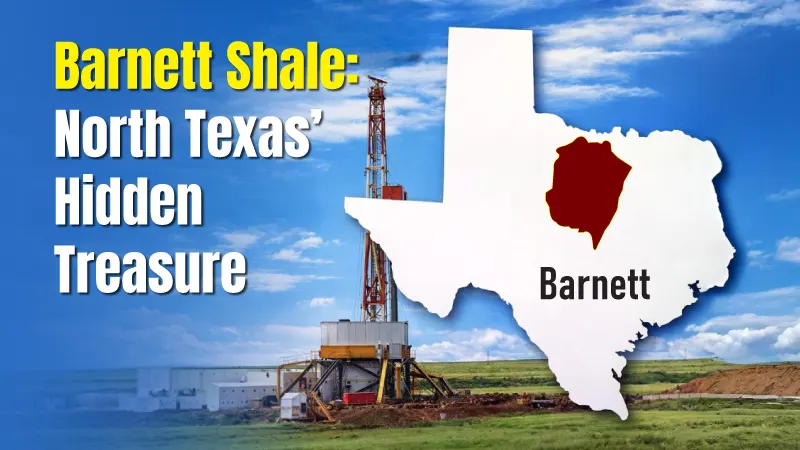
Mitchell Energy utilized similar drilling methods earlier in the development of the Barnett Shale.
-
-
After 2008:
-
Following the encouraging results of Petrohawk, several operators started to extensively acquire permits to explore with horizontal drilling and hydraulic fracturing techniques in further development of the Eagle Ford Shale.
-
Horizontal drilling included generating a long “Pay Zone” through the rock formation’s organic-rich area (typically 5000’-10,000’ in length), whereas the fracking generated micro-pathways for the commercial flow of oil and gas into the wells.
-
The combination of these two techniques drastically improved the efficiency and production outputs of wells compared to earlier vertical wells.
-
-
2008-2010:
-
The early wells illustrated the enhanced productivity that began the extensive drilling and leasing practices.
-
Due to the significant rise in oil and gas production and the accessibility of mineral rights and permits by various drilling companies, this region grabbed a lot of media attention.
-
Within the United States, the Eagle Ford Shale has been ranked as one of the most intensively drilled units.
-
-
Present Day:
-
The Eagle Ford Shale continues offering major oil and gas production in the United States owing to its favorable structure and thickness.
-
The Eagle Ford Shale Structure and Thickness
The Eagle Ford Shale is a rock formation during the Cretaceous period. It ranges from 50 to 400 feet thick in its high potential land. It lies under the subsurface of Texas below the Austin Chalk Region and above Buda Limestone. In other areas, the thickness of the Eagle Ford can be around 1000 feet.
The Eagle Ford Shale submerges acutely into the subsurface and exceeds the depth of about 14,000 feet below sea level, between the Gulf of Mexico and the outcrop area. It covers a wide range of areas below the sea. Much of the current production comes from zones where the Eagle Ford Shale is between 4000 feet and 14,000 feet below sea level.
Within the shale, the existence of oil and natural gas production is associated with burial depth. The production outcomes are based on the depth of the shale. The shale has been uncovered to appropriate pressure and heat at depths of around 4000 feet to transform some of the organic material into oil.
At deeper depths, the formation of natural gas occurred. At deeper depths over 14,000 feet the extreme pressure and heat can cause the breakdown of the oil and natural gas reserves though not completely. Such a landscape of the Eagle Ford Shale attracts new technologies to be implemented in the region.
New Technologies and Strategies are Being Developed
Technological Advancements in the Eagle Ford Shale
-
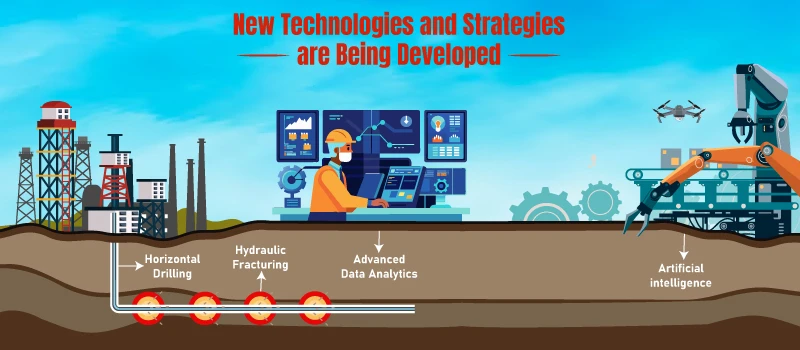
With its vast reserves of oil and gas, the Eagle Ford producers are leveraging technological advancements to enhance production outcomes. The technological advancements include the latest drilling techniques like Horizontal Drilling, Hydraulic Fracturing, Secured Data Collection, Advanced Data Analytics, the use of AI ML algorithms, the use of IoT, and so on.
Execution of New Strategies by Operators
Some of the main operators in Texas, including Crimson Energy Partners, BPX, Ranger Oil Corporation, and others, are executing new drilling strategies for better production results. Those strategies are:
-
Appending the smaller adjacent tracks to current producing leases.
Exceeding the lateral lengths of drills.
-
Instead of conventional 5.5-inch pipe, utilizing 6” casing for fast execution.
Increasing the proponent loading practices.
Minimizing stage spacings.
-
Implementing high-tech diagnostics to detect the drilling progress systematically.
Implementing Refracs
-
The primary goal of implementing re-fracs is to optimize asset value. This is achieved by tapping into the remaining hydrocarbons from initial fracking efforts. Utilizing re-frac techniques offers several benefits such as reduced geological risk, minimized supply chain pressure, and better alignment with capital allocation principles and EVG (Environmental Social and Governance). It helps achieve more sustainable operations.
Counties in the Eagle Ford Shale
Here are the counties encompassed by the Eagle Ford Shale:
| Atascosa | Counties In the Eagle Ford Shale | Bastrop | ||
|---|---|---|---|---|
| Bastrop | Bee | Brazos | Burleson | De Witt |
| Dimmitt | Fayette | Frio | Gonzales | Grimes |
| Karnes | La Salle | Lavaca | Lee | Leon |
| Live Oak | Madison | Maverick | McMullen | Milam |
| Robertson | Walker | Washington | Webb | Wilson |
| Zavala | ||||
For detailed insights on counties and oil and gas data analytics, visit our Mineral Rolls Data or Production Data pages with just a click. Mineral View utilizes cutting-edge technology to offer you the desired statistics and data crunching at one stop to forecast future investment potential. We provide mineral owner names, RI, property details, and appraisal data associated with the county. You can download this data for future reference in a customizable and standard format.
Operators in the Eagle Ford Shale
The following table will help you understand the names of the top 10 oil and gas operators.
| Names of the operators for Oil | Names of the operators for Gas |
|---|---|
| EOG RESOURCES, INC. | LEWIS PETRO PROPERTIES, INC. |
| BURLINGTON RESOURCES O & G CO LP | BPX OPERATING COMPANY |
| MARATHON OIL EF LLC | MARATHON OIL EF LLC |
| DEVON ENERGY PRODUCTION CO, L.P. | BURLINGTON RESOURCES O & G CO LP |
| ROCC OIL & GAS, L.P. | REPSOL OIL & GAS USA, LLC |
| INEOS USA OIL & GAS LLC | SILVERBOW RESOURCES OPER, LLC |
| WILDFIRE ENERGY OPERATING LLC | SM ENERGY COMPANY |
| MURPHY EXPL. & PROD. CO. - USA | KIMMERIDGE TEXAS GAS, LLC |
| CHESAPEAKE OPERATING, L.L.C. | EOG RESOURCES, INC. |
| TRINITY OPERATING (USG), LLC | PURSUIT OIL & GAS STX, LLC |
The Eagle Ford Shale Drilling Permits Issued
Below is the graphical image of drilling permits issued in the Eagle Ford Shale.It provides an interesting picture of the shifts in permits from 2008 to 2024.
Here, you can observe the number of permits issued every year, with a major peak between 2012 and 2014 and then a drop in permits.
2014 stands out with the maximum number of permits issued, 5613. In contradiction, there was a significant fall, with only 132 permits issued in January 2024.
The Eagle Ford Shale Production
The production data presented herein is sourced from the Texas Railroad Commission.
The Graph below shows the production details from 2008 to 2023, specifically for December. These details are based on Production Reports of recent years. (PR in the graph below represents the ‘Production Report’.)
The table below shows the production details for 2024 from January to April. These details are based on the Production Reports of 2024. (PR in the table below represents the ‘Production Report’.)
| Month | PR Oil Production Volume (BBL) | PR Gas Production Volume (MCF) |
|---|---|---|
| January | 20,366,445 | 106,687,224 |
| February | 0 | 0 |
| March | 0 | 0 |
| March | 0 | 0 |
Conclusion
The Eagle Ford Shale is one of the leading shale plays that has revolutionized the energy industry. From its initial discovery as a major hydrocarbon reservoir to its current production outcomes, this shale play has achieved remarkable success. With strategic involvement of latest drilling techniques mineral operators continue to uncover the high potential mineral of this formation. This shale play has demonstrated significant production results in recent years, though there has been a slight decline in output over the past few months.
Stay tuned to Mineral View for the most current data on the Eagle Ford Shale and other shale plays. By integrating the latest innovations, our professionals strive to provide you with the most accurate and current information on shale plays.
FAQ's
Where is the Eagle Ford Shale in Texas?
This shale play has spread across Texas from the Mexican border into East Texas. It lies under Texas’s Railroad Commission districts 1-6.
When was the Eagle Ford Shale discovered?
The Eagle Ford Shale was first discovered by an independent oil and gas company, Petrohawk, in 2008.
How much Oil is in the Eagle Ford Shale?
Based on recent data, the Eagle Ford Shale contains 3.351 billion barrels of oil.