If you own the mineral rights in West Texas, there is a high possibility that your property is located in or adjacent to the Permian Basin, which is one of the most prolific oil reserves in the world. The true test, however, for many of the mineral owners in Texas lies not with geology or production history.
It’s about income.
- ➢ What impact do the operations in the Permian Basin have on your royalty checks?
- ➢ Is drilling by the operators still aggressive?
- ➢ And most importantly, what will be the future of your Permian Basin mineral rights in 2026?
The Permian Basin is more than mere energy bling. It is a financial machine that affects thousands of families in Texas on a monthly basis. Herein, we are going to deconstruct what the Permian Basin actually means to the mineral owners, the production trends that will impact your royalties, and what opportunities and risks you ought to be aware of.
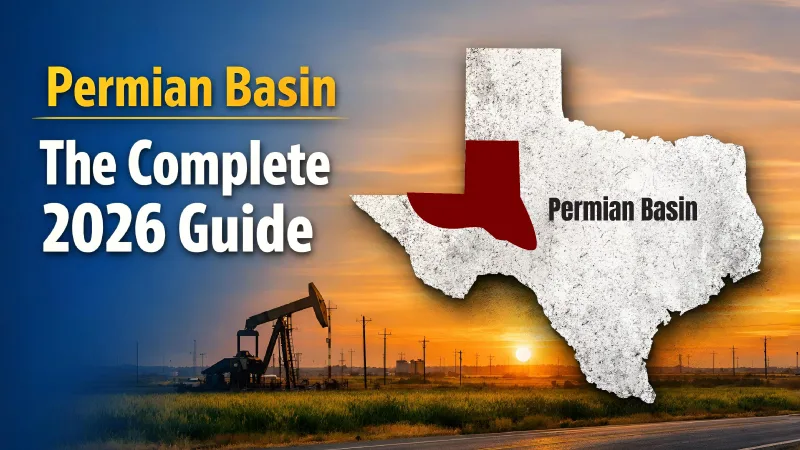
What Is the Permian Basin?
The Permian Basin is the most prolific oil-producing region in the United States, spanning West Texas and Southeast New Mexico. It includes the highly productive Midland Basin and Delaware Basin and remains a critical hub for both oil and natural gas production.
Geologically, the Permian Basin is a large sedimentary basin formed during the Permian Period, when the region was located near the equator. Reef-building activity and tectonic shifts over millions of years created the complex, stacked formations that make the basin so resource-rich today. Modern horizontal drilling has unlocked these stacked-pay zones, including formations such as the Wolfcamp Shale.
According to the U.S. Energy Information Administration’s Short-Term Energy Outlook, the Permian Basin is projected to account for roughly 50% of total U.S. crude oil production in 2026, contributing to a national output forecast of 13.7 million barrels per day, reinforcing its position as the most strategically important oil-producing region in the United States.
For Texas mineral owners, the Permian Basin includes major producing counties such as:
| Midland | Upton | Reagan | Scurry |
| Martin | Howard | Ward | Crane |
| Reeves | Yoakum | Glasscock | Culberson |
| Loving | Gaines | Hockley | Winkler |
| Andrews | Ector | Pecos | Crockett |
| Dawson | Irion | Borden | Kent |
| Garza | Terry | Cochran | Mitchell |
| King | Hale | Stonewall | Nolan |
The counties listed above fall within the Permian Basin region. To analyze activity within any of these counties, you can use Mineral View’s mapping tool. With customizable filters, the platform allows you to view county-specific production data, well locations, and operational insights in a clear, interactive format.
Permian Sub-Basins: Midland, Delaware, and Central Basin
The Permian Basin is not a single, uniform area-it’s a collection of distinct sub-basins, each with its own geological character and production profile.
1. The Midland Basin (East)
Location & Geology: Situated on the eastern side, this area is characterized by thick layers of sandstone, shale, and limestone.
Development: It is a major “hotspot” for both oil and gas, known for its consistent and prolific rock sequences.
Operator Focus: Because of its unique rock types, drilling strategies here are specifically tailored to maximize recovery from these thick sedimentary layers.
Permian Production Outlook: According to the U.S. EIA’s forecast, the Permian Basin is projected to average around 6.6 million barrels per day of crude oil production in 2026 and 6.5 million barrels per day in 2027, reflecting its continued importance to U.S. output and its role in driving roughly half of the nation’s total crude production.
2. The Delaware Basin (West)
Location & Geology: Located to the west, this basin also features massive sedimentary layers but has its own distinct geological character.
Production: It is world-renowned for “robust” output, specifically leading in both high-volume crude oil and natural gas production.
Technical Profile: Its depth and reservoir quality often require different drilling approaches compared to its eastern neighbor.
3. The Central Basin Platform & Others
The Divider: The Central Basin Platform is a raised geological ridge that sits between the Midland and Delaware basins, acting as a structural “wall.”
Migration: This platform is crucial because it influences how oil and gas move and settle underground.
Additional Regions: The 'Greater Permian' also includes smaller but important areas like the Marfa and Val Verde basins, which add to the region's total energy output.
Geology and History of the Permian Basin
Geological Timeline: How It Formed
- 250+ Million Years Ago: Ancient seas deposited layers of organic matter and sediment during the Permian Period.
- Tectonic Shifts: Natural Earth movements create a network of faults and fractures that help oil flow.
- The Sub-Basins: The region splits into the Midland and Delaware basins, separated by a central ridge.
- Layered Wealth: Over millions of years, “prolific” rock layers like the Wolfcamp Shale form, trapping massive amounts of crude oil and natural gas.
Historical Timeline: Key Milestones
Early Discovery and First Commercial Production
- In the early 1920s, W.H. Abrams drilled the first successful commercial well in West Texas, proving significant oil reserves existed in the region.
- This discovery laid the foundation for what would become one of the most productive oil basins in U.S. history.
Expansion and Infrastructure Development
- From the 1930s through the mid-1950s, drilling activity accelerated as more fields were discovered across West Texas and Southeast New Mexico.
- Pipelines, refineries, and supporting infrastructure were built, establishing the Permian as a long-term energy hub.
Peak Conventional Production Era
- During this period, the basin became a cornerstone of U.S. oil supply, contributing significantly to domestic energy security.
- Large conventional reservoirs were heavily developed, driving steady economic growth across the region.
Technological Adaptation and Mature Field Management
- As conventional production matured, operators focused on enhanced oil recovery techniques to extend well life.
- Despite oil price volatility, the basin remained productive and ultimately surpassed 30 billion barrels of cumulative output.
Shale Revolution and Horizontal Drilling Boom
- Advances in horizontal drilling and hydraulic fracturing unlocked previously trapped oil in shale formations such as the Wolfcamp and Spraberry.
- This technological breakthrough dramatically increased recoverable reserves and reignited large-scale investment.
Record-Breaking Growth and Global Significance
- Production surged to historic highs as stacked-pay formations allowed multiple productive layers from asingle drilling site.
- The Permian became the driving force behind U.S. energy growth and a major contributor to global oil supply stability.
Stabilization at Historic Highs
- By early 2026, production stabilized near record levels, accounting for roughly 50% of total U.S. crude oil output.
- Operational efficiency, advanced analytics, and disciplined capital strategies continue to sustain long-term output.
Projected Dominance in Lower 48 Production
- Looking ahead to 2040, forecasts suggest the basin could supply nearly 70% of oil production from the Lower 48 states.
- Continued technological innovation and optimized resource development are expected to extend its strategic importance for decades.
Why the Permian Basin Matters for Texas Mineral Owners
The Permian Basin remains a premier destination for mineral owners due to its massive production growth and its role as a primary driver of the U.S. energy economy. Here are some key factors that highlight the significance of the Permian basin and why it matters for Texas mineral owners.
1. High Activity = High Opportunity
The Stats: The Permian produces over 6 million barrels a day, fueled by a massive increase in well completions (from about 350 wells per year in 2010 to more than 4,500 wells per year today.)
The Benefit: Massive production levels create a “hot” market. For a Texas owner, this means more competition for your acreage, more frequent lease offers, and a higher likelihood of consistent royalty checks.
2. Technology Unlocks More Value
The Shift: Modern 'pad drilling' and horizontal wells allow operators to reach miles of oil-rich rock from a single surface location.
The Benefit: Instead of one vertical well draining a small area, a single lease can now host multiple horizontal wells. This creates multiple royalty streams from the same piece of land and extends the productive life of your minerals.
3. Decades of Stability
The Outlook: With over 12 billion barrels in proven reserves, the Permian is projected to provide 70% of lower-48 oil by 2040.
The Benefit: Unlike “boom and bust” smaller basins, the Permian’s massive inventory provides long-term financial security. Major operators are planning drilling schedules decades in advance, ensuring your assets remain relevant for the next generation.
4. Texas-Specific Advantages
Infrastructure: Texas has the world’s most advanced pipeline and refinery network, ensuring your oil actually gets to market without the bottlenecks seen in other states.
Legal Protections: Texas law maintains the ‘dominant estate’ doctrine, though the2026 RRC Rule 8 updates now require stricter surface-use coordination and water-management reporting by operators.
Permian Basin Production Outlook
The following table provides a comprehensive overview of production details of the Permian Basin from 2020 to 2026 to date.
Note: These production figures are sourced from publicly available data published by the Texas Railroad Commission (RRC).
Major Operators in the Permian Basin
Several large and well-capitalized operators are active in the Permian Basin. Here are the top 15 operators currently active in the Permian Basin:
| Rank | Parent Company | Primary RRC Operating Entity (Subsidiary) | Subsidiary Primary RRC No. |
|---|---|---|---|
| 1 | ExxonMobil | XTO Energy Inc. / Pioneer Natural Res. USA | 945936 / 665748 |
| 2 | ConocoPhillips | ConocoPhillips Company / Marathon Oil | 170037 / 525398 |
| 3 | Occidental Petroleum (Oxy) | Oxy USA Inc. / Occidental Permian Ltd. | 630591 / 617544 |
| 4 | EOG Resources | EOG Resources, Inc. | 253162 |
| 5 | Diamondback Energy | Diamondback E&P LLC / Endeavor Energy | 217012 / 251726 |
| 6 | Devon Energy | Devon Energy Production Co. / WPX Energy | 216378 / 942623 |
| 7 | Chevron | Chevron U.S.A. Inc. | 148113 |
| 8 | Coterra Energy | Coterra Energy Inc. / Cimarex Energy Co. | 182885 / 153438 |
| 9 | Permian Resources | Permian Resources Operating, LLC | 657003 |
| 10 | Mewbourne Oil Company | Mewbourne Oil Company | 562560 |
| 11 | Ovintiv | Ovintiv USA Inc. | 628658 |
| 12 | APA Corporation (Apache) | Apache Corporation | 27200 |
| 13 | SM Energy | SM Energy Company | 788997 |
| 14 | Matador Resources | Matador Production Company | 532658 |
| 15 | Vital Energy | Vital Energy, Inc. | 486610 |
Note: This list ranks the top operators by their parent company to accurately reflect the true operational footprint following the heavy market consolidation of 2024–2026. Because the Texas Railroad Commission (RRC) assigns Form P-4 operational numbers strictly by legal subsidiary, a single parent company’s total basin production is often aggregated across multiple RRC operator numbers.
To track the major operators listed above, Mineral View's Operator Hub lets you search and compare Texas operators by drilling permits, production history, and activity levels. This helps you evaluate performance, anticipate nearby development, and negotiate lease terms with more confidence.
Permian Basin Well Permits
The following chart shows the permit details of the Permian Basin.
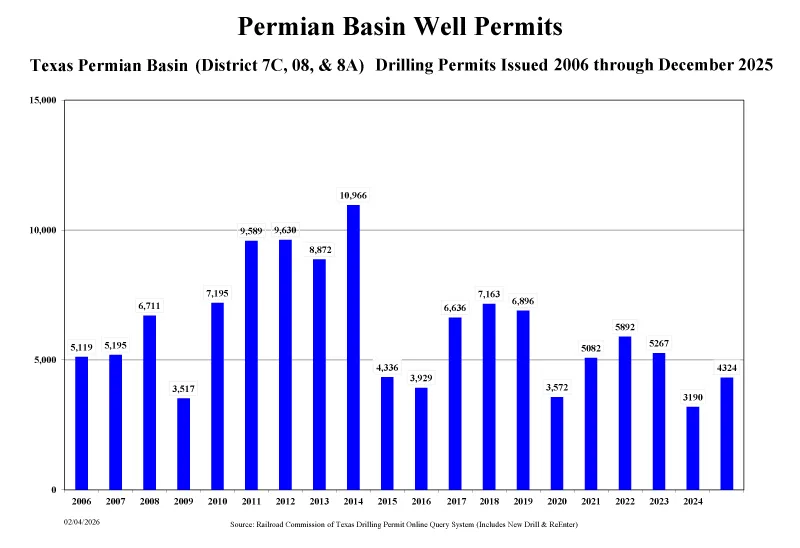
Note: The visualizations above provide a detailed analysis of Permian Basin drilling permits, with primary data aggregated from the official records of the Railroad Commission of Texas (RRC).
Stacked Pay: Unlocking Multiple Layers of Value
The stacked pay of the Permian Basin is the many layers of oil and gas-producing rock formations, most of which are over 2,000 feet thick, stacked one on top of the other beneath the surface.
This distinctive geology enables operators to access several productive areas, such as the Wolfcamp, Spraberry, and Bone Spring formations, off a single well pad with horizontal drilling.
For mineral owners, this means each acre can produce income from multiple layers underground, creating several royalty streams. That's why the region is one of the most valuable and enduring energy hubs in North America.
How Production in the Permian Basin Impacts Your Royalty Checks
Many mineral owners assume that if production is high, their checks should always increase. However, the Permian Basin has experienced a significant increase in oil and natural gas production, which has at times outpaced existing pipeline capacity.
This rapid growth has led to ongoing construction efforts to expand infrastructure and accommodate the higher output, which can impact the timing and amount of royalty payments.
Let's break it down.
1. Oil and Gas Prices
Even if your well produces the same amount every month, your royalty check can still go up or down because oil and gas prices directly affect the total revenue generated from the oil and gas sold. Simply your percentage share of the total revenue generated from the sales.
For example, if your well produces 800 barrels per day:
- At $60 per barrel, your revenue will be higher (the royalty check increases).
- At $45 per barrel, your revenue will be lower (the royalty check decreases).
So even steady production does not guarantee steady income. A data-driven valuation tool using current prices and RRC historical data provides a clearer view of your overall mineral value beyond a single month's check.
2. Production Decline Curves
Permian wells often produce strongly in the first year and then gradually decline.
This means:
- Year 1: Larger Royalty Checks
- Years 2–5: Gradual Decline
- Later years: Lower but Steady Income
Understanding this decline pattern helps mineral owners set realistic expectations.
3. Post-Production Deductions
Some leases allow operators to deduct:
- Transportation Costs
- Processing Fees
- Compression
- Marketing Expenses
These deductions can reduce your net royalty amount. Always review your lease terms carefully.
4. Ownership Percentage
Your royalty depends on:
- Net Mineral Acres
- Lease Royalty Percentage (20%, 22.5%, 25%, etc.)
- Pooling Arrangements
Even in the highly productive Permian Basin, your check reflects your ownership share, not just total production.
Keeping track of oil and gas prices, estimating decline curves for each well, reviewing post-production deductions, and confirming ownership share can require hours of research and manual work. Mineral View simplifies this process.
MVEstimate helps you understand potential mineral value using market pricing and RRC historical data, while the Lease Report and Well Report provide clear insights into lease trends and performance data for the Permian.
Leasing Trends in the Permian Basin (2026 Outlook)
Leasing activity in the Permian Basin remains strong, especially incore counties like Midland and Reeves.
Here's what mineral owners are generally seeing:
- Royalty rates commonly range between 20% and 25%
- Bonus amounts vary depending on location and competition
- Core acreage commands stronger offers
- Non-core areas may see slower activity
Operators are focusing heavily on efficiency and returns. That means they prioritize acreage with the best geology and infrastructure access.
If you receive a lease offer, compare:
- Royalty Percentage
- Bonus Amount
- Deduction Clauses
- Lease Term Length
Negotiation can make a significant long-term difference.
Common Mistakes Permian Basin Mineral Owners Make
Even in a strong basin, mistakes can cost money. Here are some common ones:
Selling Too Early
Some owners sell during temporary price dips without understanding long-term development plans in the area. Market drops do not always reflect the true long-term value of your minerals.
Before making a decision, review nearby drilling activityand operator plans. Mapping tools can help you identify active permits, new wells, and multi-well development that may increase future cash flow.
Accepting Standard Lease Terms Without Review
Many mineral owners sign lease agreements without fully reviewing the fine print. Small changes in royalty percentage, deduction clauses, or depth limitations can significantly impact income over decades.
Negotiating stronger lease language can protect you from excessive post-production deductions and maximize long-term value. Always review lease terms carefully or consult a professional before signing.
Ignoring Division Orders
A division order outlines your exact ownership percentage in a well and authorizes payment. It ensures the operator pays the correct party the correct amount based on their Decimal Interest.
Errors in ownership percentages can delay payments or reduce your royalties. Always review division orders carefully to confirm your net mineral acres and royalty split are correct.
Not Monitoring Lease, Operator & County Activity
Some owners assume that once a well is producing, development is complete. In reality, operators often plan additional wells in the same area over time.
Staying informed about new permits, drilling activity, and operator movements gives you leverage in future lease negotiations or sale decisions. Websites like Mineral View offer the Lease notification hub that can help you track updates for your lease, operator, or even an entire county.
The Long-Term Outlook for the Permian Basin
Despite market fluctuations, the Permian Basin remains one of the most economically viable oil regions in North America.
Reasons Include:
- Established Infrastructure:
The Permian Basin has decades of built infrastructure, including roads, storage facilities, processing plants, and service networks. This reduces operational delays and supports consistent production, which helps stabilize royalty payments for mineral owners.
- Pipeline Networks:
Extensive pipeline systems move oil and gas efficiently to refineries and market hubs. Strong takeaway capacity reduces bottlenecks, helping ensure your production reaches the market without major pricing discounts.
- Export Capacity:
With direct access to Gulf Coast export terminals,Permian oil can reach global markets. This global demand exposure can support stronger pricing, which directly influences your royalty revenue.
- Advanced Drilling Technology:
Operators use precision drilling, data analytics, and modern completion techniques to maximize recovery from each well. Higher efficiency often means better long-term production performance, supporting sustained royalty income.
- Continuous Operator Investment:
Major operators continue investing billions into Permian development and new wells. Ongoing capital investment signals long-term confidence in the basin, which supports future drilling activity near your minerals.
- Horizontal & Unconventional Development:
The shift from vertical wells to horizontal drilling unlocked oil from multiple stacked formations like the Wolfcamp and Spraberry. This allows operators to produce from several layers beneath a single tract of land, increasing the royalty potential per acre.
- Efficiency Innovations in Drilling:
Technologies such as pad drilling, 24/7 operations, and simul-frac have improved drilling speed and output. Greater efficiency lowers costs and increases production volumes, which can have a positively impact long-term royalty value.
While no basin is immune to commodity cycles, the Permian's scale and efficiency provide resilience. For Texas mineral owners, that makes it one of the most strategically important regions in which to own minerals.
Final Thoughts: What the Permian Basin Really Means for You
The Permian Basin is not just a map position in West Texas. To the mineral owners, it is an opportunity, income, and long-term valuation of assets.
Owning minerals in the Permian, though, does not necessarily mean good returns. Your results depend on:
- Lease Terms
- Operator Activity
- Market Prices
- Production Performance
- Ownership Structure
The better you know how the Permian Basin functions, whether in terms of finances or operations, the more you can make when deciding to lease, retain, or sell your mineral rights.
To bridge the gap between complex data and confident decisions, utilizing Mineral View Features —such as personalized monthly reports and active well insights— ensures you stay in control of your assets. By turning raw regulatory data into clear answers, these tools help you navigate the 2026 Texas energy landscape without guesswork.