In recent years, there has been significant growth observed in the oil and gas industry. The major aspects in achieving such notable growth are technological advancements and high demand for cost efficient equipment. Mineral specialists and operators frequently favor solutions that require less time and provide higher production.
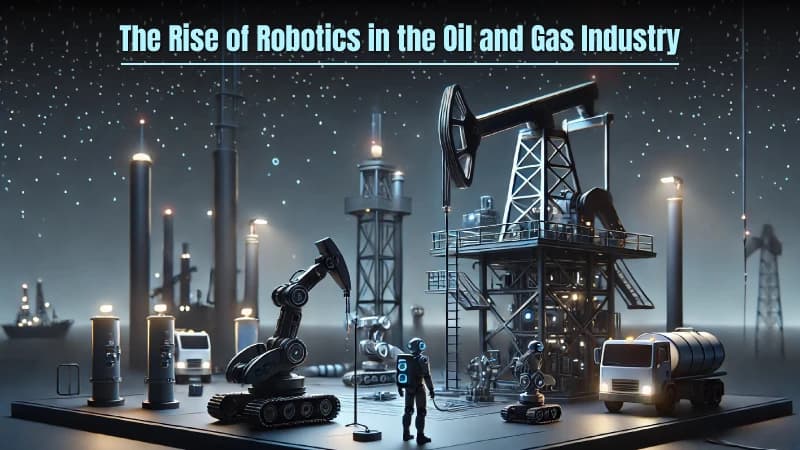
Currently, one of the most important trends is the implementation of robotics in the oil and gas industry. The oil and gas sectors have prioritized the use of robotics to carry out operations with little effort and time.
Robotics in the oil and gas industry helps to improve the crucial tasks including drilling, maintenance, monitoring and inspection. Additionally, robotic systems perform their task efficiently where there is risk to human workers, both in onshore as well as offshore drilling areas.
Robotics in oil and gas greatly benefit the restructuring of energy industries and bolster state finances. Let's explore further, seeing the benefits and understanding how robotics have transformed the landscape of the oil and gas industry.
The Benefits of Using Robotics in the Oil and Gas Industry
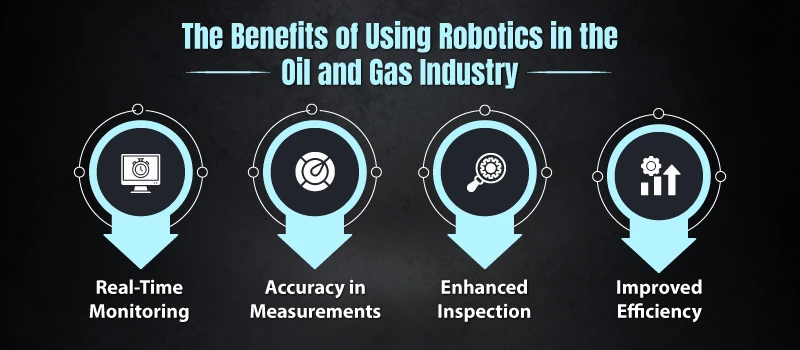
sing-Robotics-in-the-oIL-AND-GASINDUSTRY.webp The robotics in the oil and gas industry are preferred in improving quality control and increased safety. Below are some key benefits of robotics in the oil and gas industry associated with quality control improvement and providing safety.
Improved Quality Control
Quality control is essential across all industries. Quality control plays an important role in ensuring that the products match industrial standards and regulations. In the oil and gas industry, the implementation of robotics and automation has transformed the outlook of all the crucial tasks, improving quality control. Below are some major factors where robotics and automation contributed to quality control:
-
Real-Time Monitoring
Industrial robots and automation can monitor critical parameters in the oil and gas sector. They detect changes in key variables like pressure and temperature, adjusting to optimize operations. This results in improved product quality and reduced downtime.
-
Accuracy in Measurements
Robotics in the oil and gas industry can obtain accurate and precise measurement results. They accurately measure the pressure, flow rates, temperatures and other such parameters, reducing errors and improving the quality of product.
-
Enhanced Inspection
The use of robots significantly improves inspections within the oil and gas industry. The robots are programmed to monitor equipment, facilities, and pipelines to detect leakages or fractures. It leads to immediate response to such concerns before they convert into severe issues, minimizing maintenance costs and additional time.
Additionally, robots utilize advanced sensors and imaging systems that provide real-time images of any abnormal conditions that may not be visible to the human eye, resulting in accurate and enhanced inspection outputs.
-
Improved Efficiency
The deployment of robots helps improve the efficiency of the tasks in the oil and gas industry. Robots perform repetitive tasks within a fraction of the time, reducing downtime and errors. This approach helps minimize human interference, offering faster processing time and decreased labor expenses.
Along with this, robots help improve safety in the oil and gas industry. Below are some crucial factors where robots offer safety:
-
Minimizing human intervention with hazardous materials offers safety to humans.
-
It reduces fire risks and explosion activities and provides safety to production plants and humans.
-
Increasing the emergency response for leakages and abnormalities, reducing downtime, and providing safety to humans from injury.
-
Increasing the monitoring activities and inspection abilities, offering safety to the production plant.
-
Optimizing overall safety procedures and minimizing human errors.
The Different Types of Robots Used in the Oil and Gas Industry
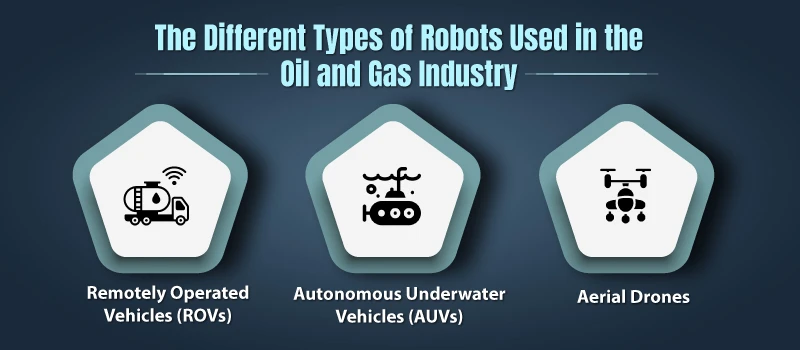
Remotely Operated Vehicles (ROVs)
Remotely Operated Vehicles (ROVs) have become crucial in the oil and gas industry's equipment arsenal. Such vehicles are significantly preferred in offshore oil rigs. To inspect the mineral activities under water, these vehicles are put into service. These vehicles are operated by a pilot on the surface vessel with the help of a control panel.
ROV consists of digital cameras and sensors, which captures the high definition images and sends the real time data, supporting pilots to observe and perform the complicated tasks in the underwater area. It helps detect the abnormalities underwater, providing safety to the humans and improving productivity.
Autonomous Underwater Vehicles (AUVs)
Another pivotal robotic system in offshore oil and gas exploration is the Autonomous Underwater Vehicle (AUV). Utilizing AUVs along with autonomous gliders precisely accumulates a vast range of data compared to manned vessels in less time, helping drillers and mineralogists to streamline their attempts.
Moreover, such AUVs and gliders can be easily installed from any ship with minimal training compared to oceanographic sampling techniques. AUVs consist of four sensors that quickly spot the existence of minerals in the water bodies, reducing downtime and human intervention.
Aerial Drones
Aerial Drones are utilized in every sector, including oil and gas. Drones have become the preferred choice for inspecting offshore platforms. In the early times, human workers were used to inspecting offshore platforms, which was a time-consuming and challenging task. Today, drones are responsible for performing such tasks within a short time.
They inspect any leakages and monitor pipelines, wells, and infrastructure, detecting any concerns without human interference. Additionally, it reduces the requirement for additional workforce to carry out the task in water or at heights. Drone robots effectively deliver accurate data to identify prospective safety concerns.
The Challenges of Using Robotics in the Oil and Gas Industry
-
Higher Capital Expenses
The robots involve compact electronic circuitry and some robots may require to be programmed, which leads to higher initial cost, ultimately generating higher capital expenses in the oil and gas industry. The costs required to install, procure, monitor and maintain the robotic systems can be higher, which makes it challenging to implement robots in the oil and gas industry.
To resolve this challenge, the robotic systems can only be implemented in high potential areas which may help reduce capital expenses.
-
Complicated Working Environment
The oil and gas industry consists of complicated working environments such as high temperature, high pressure, and corrosive environments, which can be dangerous for humans. In such an environment, specialized robots and other equipment are put into service. To operate efficiently in such harsh environments, robots are required to deploy specialized software and hardware, which increases the additional expenses, making it challenging to develop.
To overcome this challenge newly designed robots can be utilized which already includes the necessary software to operate in such an environment. It may reduce the additional cost required to develop software in existing robots. It may reduce the additional cost required to develop software in existing robots.
-
Integration with Existing Systems and Requirement of Skilled Workforce
Robot systems function differently than that of existing systems. Even though utilizing robots enhances productivity, it is challenging to integrate it with existing systems. While implementing robots, the existing system may fail to perform properly and production may stop for a while.
To integrate robots into existing systems is a complex process and requires a skilled workforce with expertise in robotic systems. To mitigate this challenge more training programs can be arranged for existing employees to attain expertship in robotic systems.
The Future of Robotics in the Oil and Gas Industry
The oil and gas industry is expanding its influence both statewide and globally, bolstering the economy through growing employment opportunities and tax revenue. As this industry continues to grow, the usage of the latest innovations and implementation of robotics will add significant efforts to shaping its outlook, according to mineral experts. Due to the ability of robotic systems to perform tasks with less human intervention, offering safety and enhancing productivity, it will always be one of the prioritized requirements within the oil and gas industry.
Moreover, new technology like Artificial Intelligence (AI), Cloud Computing, and the Internet of Things (IoT) plays an important role in driving robotic applications efficiently. Currently, numerous robotic systems are being used across all divisions of the oil and gas industry, and they will increase in the coming years as oil and gas companies require the latest systems and processes to automate the maximum possible tasks and reduce human intervention. The implementation of robotics in the oil and gas market is expected to achieve substantial economic results between 2024 and 2031.
Conclusion
The adoption of robotics in the oil and gas industry has enhanced the outlook of the energy sector, providing substantial benefits. The integration of modern robotic systems can increase efficiency, production, and security in the oil and gas sector.
Although robotics offers numerous benefits, it also holds challenges like higher capital costs and the need for skilled workers. Regardless of these challenges, robotics in oil and gas have delivered magnificent advantages, highlighting the economic profits at the state as well as global levels.
According to mineral experts, robotics in the oil and gas industry anticipates giving stronger financial profits between 2024 and 2031 and may continue to do so in future years.
The transition to robotics is a big step toward a more intelligent, more capable industry ready to face the upcoming energy fears.
FAQ’s
Why are Robots Important in the Oil and Gas Industry?
Robots play an important role in achieving better operating efficiency, providing safety, increasing productivity, reducing downtime, and offering other such advantages.
What is Robotic Process Automation in the Oil and Gas Industry?
Robotic Process Automation abbreviated as RPA is the system that utilizes the computer softwares or “robots” to carry out rule based, repetitive works to enhance the capabilities and save the additional time.
What are the Applications of Robotics in the Onshore Oil and Gas Industry?
Robotics in the onshore oil and gas industry can be used for site survey, performing automatic drilling operations, in production areas and in transportation activities.