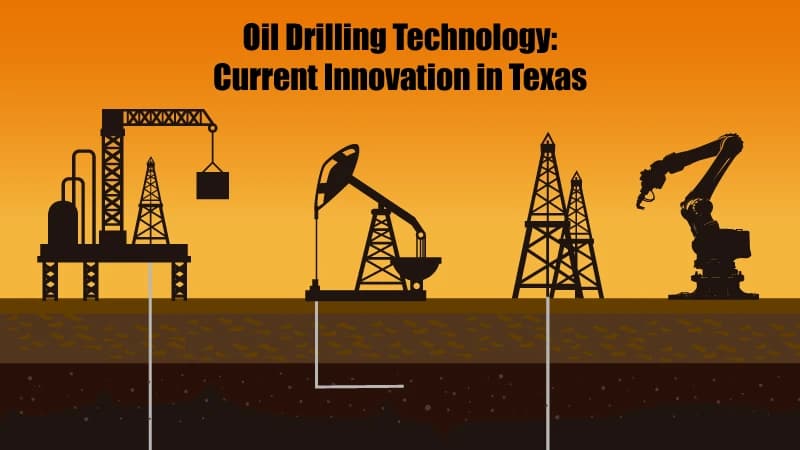
Ongoing innovations and advancements in oil drilling technology have significantly improved the efficiency, safety, and environmental impact of drilling operations in the oil and gas industry. Texas is synonymous with oil for good reason; the state is a powerhouse in the global energy sector. Explore the various advancements in oil drilling technology by diving into this article.
The state is a major contributor to the nation's energy portfolio. It holds approximately 23% of the United States' natural gas reserves and 37% of its recoverable crude oil reserves, solidifying its position as a leading oil and gas producer. Let's get to know more about oil drilling and oil drilling technology.
About Oil Drilling
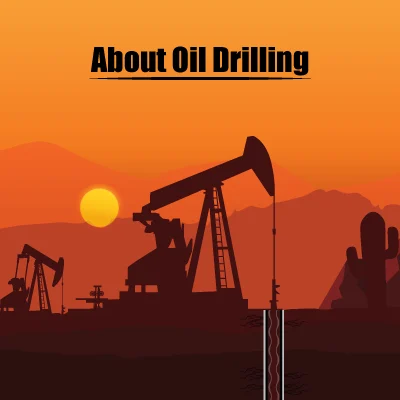
Oil drilling is the process of oil extraction, which is drilling an oil well through the earth’s surface to reach potential fossil fuel reservoirs. The drilling process uses the drill bits that get connected to the drill pipes to puncture the hard rock surface.
Before commencing, drillers will thread the pipes onto a drill string and lower it to extensive depths in the ground, after which they will screw the pipe connections together. In order to halt the extraction operation, drillers cut the pipelines. In addition to drilling, the task also involves cementing hole filling and removing pump head caps.
Texas is one of the highest oil producing states at global level that delivers significant oil, extracted from Eagle Ford and Oermian Basin Shale plays. According to the reports from 2023, Texas accounted for 42% of the total US oil production in that year. In 2018, the state accounted for 40%.
The significant oil production in this state can be attributed to the oil boom incident in Spindletop in 1901. Following that incident, Texas played a crucial role in supporting the nation's efforts to reduce its reliance on foreign petroleum imports. First, let us have a closer look at the historical evolution of oil drilling in Texas.
Historical Evolution of Oil Drilling in Texas
The early 20th-century oil boom in Texas, often referred to as the "Gusher Age," catalyzed a period of dramatic economic growth following the discovery of a substantial petroleum reserve near Beaumont. With few parallels in American history, the discovery began an era of rapid regional development and industrialization. Its production capacity was significant for its time.
European settlers utilized naturally occurring oil seeps in Texas as early as the 1500s for ship repairs. Lyne Barret drilled the first oil well in Nacogdoches County in 1866. A rich oil field near Corsicana was discovered in 1894, prompting the drilling of numerous wells in the late 1800s. In Texas, the first two refineries were established in 1896 and 1898. In 1899, Corsicana Refinery shipped its first barrel of oil.
A significant event in Texas oil history occurred on January 10, 1901, at the Spindletop oil field. This event marked the start of the “Gusher Age” and Texas’ ascent to prominence in oil production. During this period, people purchased land in Texas in the hopes of striking it rich with their oil wells, which led to the construction of numerous refineries and drilling projects.
The Spindletop gusher alone contributed significantly to Texas' oil output at the time, which led to a historical decrease in oil prices to approximately $1.25 per barrel.
Early efforts to conduct offshore drilling in Texas began in the late 1890s, targeting the shallow waters of Galveston Bay, but these attempts did not yield success. It was not until 1938 when a significant oil discovery was made offshore, that the offshore drilling industry began in earnest. The oil boom in Texas, both onshore and offshore, resulted in the founding of numerous towns throughout the state.
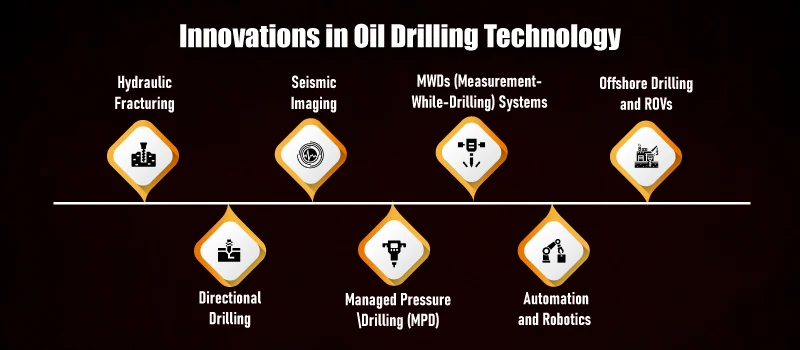
Innovations in Oil Drilling Technology
Comprehensive Development Plans
Fracking, or hydraulic fracturing, is a method of stimulating wells that involves forcing a pressurized liquid into bedrock formations. The procedure entails pumping "Fracking fluid," a mixture primarily of water, sand, or other proppants, and specific chemical additives—at high pressure into a wellbore to fracture the deep rock formations and allow more natural gas, oil, and brine to flow through.
Tiny particles of hydraulic fracturing proppants, such as sand or aluminum oxide, keep the fractures open when the hydraulic pressure is released from the well.
Seismic Imaging
Finding where oil had bubbled to the surface was initially the only criterion for selecting a suitable drilling site. However, oil reservoirs may be hidden deep beneath the surface, making them invisible. Drilling wells can be costly, so having a way to image the subsurface better can increase the success rate in drilling a commercial well.
In the end, geologists & geophysicists were called in to map the subsurface and predict likely oil & gas reservoirs using subsurface seismic imaging. Other unconventional methods have been used, such as examining magnetic fields, surface rock formation outcrops, radar anomalies, and even minute changes in the gravitational field.
MWDs (Measurement-While-Drilling) Systems
As we are aware, operators still find it challenging to predict what they'll encounter when drilling an oil well, even with today's sophisticated seismic imaging technologies. Furthermore, until the 1980s, it took a lot of work to understand what the drill bit was doing while the hole was being drilled.
To overcome such concern the MWD can be put into service. This permits operators to steer the drill bit in real time, reducing additional expenses that might be observed to be non-productive reservoirs.
Offshore Drilling and ROVs
In offshore drilling, drillers often face concerns such as exploring underwater areas for longer time, tolerating the extrem pressure of tides etc. Therefore in order to minimize such issues ROVs are the best solution. ROVs (Remotely Operated Vehicles). ROVs can be sent in hard to reach areas and operated remotely. It helps minimize human intervention and deliver better outputs with less errors.
Directional Drilling
The directional drilling is the modern drilling method that helps extract maximum minerals beneath the earth’s surface. In this method, the drilling is executed in the targeted direction only. It is aslo said to be an Extended Reach Drill. The directional drilling has two types; Horizontal drilling and vertical drilling. With the help of this technique it is possible to extract maximum possible minerals.
Managed Pressure Drilling (MPD)
It is the foremost drilling method utilized by several drillers while drilling a well. This method makes use of a real time monitoring approach and latest smart devices in order to manage the wellbore pressure effectively. Additionally it also reduces wellbore instability, helps prevent blowouts and minimizes formation damage properly, providing enhanced safety.
Automation and Robotics
With the increased demand and major requirement for minerals, mineral specialists consider including automation and robotics in drilling initiatives broadly. Automation and robotics helps obtain improved drilling performance and is able to perform complex tasks such as haldling of pipes, tripping and drilling in lesser human intervention and reduced time.
Additionally they are put into service to uplift the heavy materials easily. Integration of this technology not only helps attain enhanced drilling practices but also offers safety to the human workers, ultimately improving economic output.
Conclusion
Texas has undergone a major transformation in oil drilling technology in recent periods. These technologies including digitalization, automation, robotics and others put their attempts in the enhancement of drilling tasks, while reducing human interference and offering improved safety approaches. Along with enhanced drilling operations, the implementation of technologies also helps obtain sustainable drilling practices, reducing environmental impact.
In the previous year 2023, Texas witnessed outstanding production results of around 2 billion barrels by implementing advancements in oil drilling. The present day and forthcoming innovations in oil drilling technology will help reshape the outlook of drilling projects, highlighting enhanced production results.