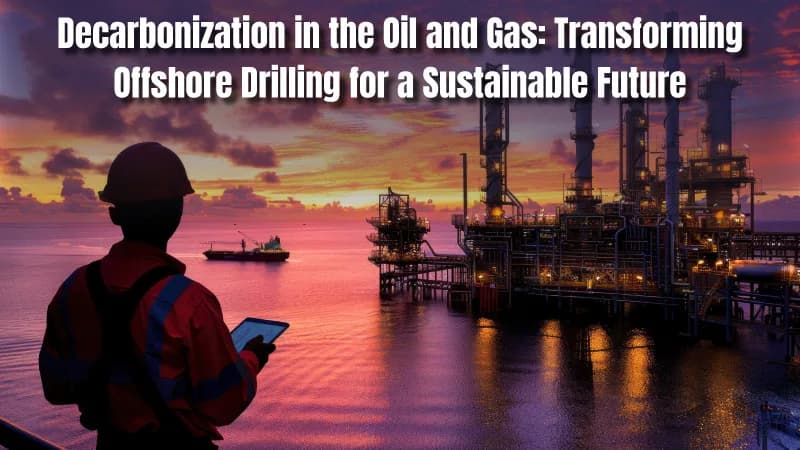
Offshore drilling—the most important thing in the oil and gas industry—has given positive outcomes in the enhancement of the economy through its major contribution to the energy industry. As this industry gives such positive results, it also brings some environmental issues like pollution of water and air.
To overcome these concerns, the mineral experts have started implementing decarbonization in the oil and gas industry. In this piece we will learn how decarbonization helps minimize the environmental impacts produced by the offshore industry and transform it for a sustainable future. Let's first understand how offshore drilling affects the environment.
How Offshore Drilling Affects the Environment: Key Insights
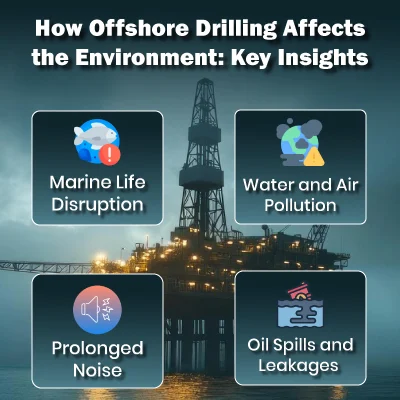
Offshore drilling has greatly contributed to the enhancement of the oil and gas industry as well as the economy. Yet the environmental impacts caused by offshore drilling cannot be neglected. These impacts depend upon the drilling site, level of water and type of equipment/rig used for drilling. Below are some major impacts of offshore drilling on the environment.
Marine Life Disruption
Before implementing the offshore drilling, seismic surveys are carried out. Once the survey is done, the platform and pipelines are assembled on water bodies. These can disturb the fish below and other aquatic animals, damaging sensitive species like seagrass meadows, mangroves and coral reefs.
The damage to these species results in several aquatic life forms dying, as they heavily depend on this as a primary food source. Additionally, the drilling fluid utilized during well stabilization and lubrication is discharged into the water that contains hazardous chemicals, which ultimately results in marine species death.
Water and Air Pollution
Offshore drilling doesn’t get directly responsible for greenhouse gas emissions, yet the extracted oil and gas heavily affect the climate when burnt. During the process of offshore extraction, the toxic chemicals get released in the water and air, causing air and water pollution.
These toxic chemicals may also involve volatile organic compounds (VOCs), particulate matter and nitrogen oxides, which leads to acid rain and the formation of smog. This greatly impacts the nearby coastal communities, causing respiratory and health problems. Additionally, infrastructure on water bodies needs maximum energy to build and effectively operate, which leaves behind carbon footprints, causing additional damage to the environment.
Prolonged Noise
The continued noise during offshore activities due to support vessels, seismic surveys and the operation of rigs can distract the communication between marine mammals. This may result in abnormal behavior of marine animals, loss of ability to navigate properly, lack of breeding and giving up the hunting capability. The prolonged noise also results in physical damage to some species, even causing death.
Oil Spills and Leakages
The accidental oil spills and leakages from pipelines or tankers can distract the underwater food chains and interfere with natural activities such as nutrient cycling and photosynthesis. This results in overall marine health damage that comes in contact with oil.
Along with this, the water bodies affected by oil spills can strongly influence the lives of nearby sea communities that are heavily dependent on tourism, fishing and other activities associated with marine life for their primary income. This not only results in affecting their income source but also causes severe effects on their health.
These are some major impacts caused by offshore drilling. To mitigate the above impacts, mineral experts are adding multiple efforts, bringing technological advancements and executing marine species translocation.
Among these initiatives, one effective and sustainable way to reduce the above impacts is implementing decarbonization strategies. Decarbonization in the oil and gas industry impacts both offshore and onshore drilling undertakings positively while maintaining the natural balance and offering effective mineral extraction.
Pioneering Decarbonization Strategies in the Oil and Gas Industry
Looking at the current effects of offshore drilling on the environment, executing decarbonization strategies can bring a positive step in the oil and gas industry. Decarbonization strategies—the sustainable way of mineral extraction—help oil and gas industries in enhanced productivity as well as reduced ecological concerns.
Below are some decarbonization strategies that can be taken into account to reduce the spreading of harmful greenhouse gases and environmental impact.
-
Implementing renewable sources such as solar and wind in drilling operations to minimize the excessive burning of fuels.
-
Optimizing the drilling undertaking with the latest technologies reduces human intervention and ultimately minimizes errors, leading to less greenhouse gas spread.
-
Using Carbon Capture, Utilization and Storage (CCUS) techniques to capture the greenhouse gases and reduce emissions.
-
Using natural gas as a short-term transition fuel to minimize the harmful gases spread in the atmosphere.
-
Generating low-carbon products such as recycled plastic-based petrochemicals, biofuels and sustainable aviation fuels to minimize excessive carbon release in the air.
-
Forming decarbonization solutions and strategic alliances for innovation to reduce the impact of greenhouse gases.
-
Adopting crucial Environmental, Social and Governance (ESG) reporting to build trust among oil and gas industries, highlighting commitment to fulfill decarbonization objectives.
By implementing the above decarbonization strategies, oil and gas industries can enhance their position while being less responsible for environmental concerns.
These strategies also help in attaining improved stakeholder relations, reducing environmental emissions and ultimately leading to sustainable drilling operations. Although decarbonization in the oil and gas industry brings positive hopes, it also raises some potential challenges.
Challenges Faced by the Oil and Gas Industry While Meeting Decarbonization Goals
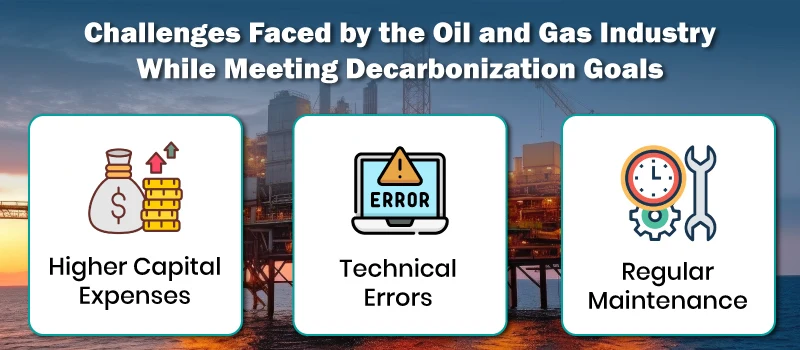
Decarbonization helps reduce environmental concerns yet comes with potential challenges. The challenges while implementing decarbonization in the oil and gas industry are listed below.
Higher Capital Expenses
Oil and gas industries generally require a lot of capital to invest in low-carbon technologies like decarbonization. As in the decarbonization process, there are several factors, such as CCUS techniques, developing low-carbon products and renewable energy integration are involved, which leads to higher capital expenses during implementation.
Technical Errors
While developing and integrating the latest technologies like green hydrogen production and large-scale CCUS, they require proper installation, as there are major chances of technical error occurrence, which may further result in inappropriate decarbonization.
Regular Maintenance
When decarbonization is implemented in the oil and gas industry, systems associated with decarbonization need to be maintained regularly. This requires additional time which may further result in delayed production.
These are the three major challenges faced by the oil and gas industry while achieving decarbonization objectives. However, to overcome the above challenges oil and gas industries are now shaking hands with DNV (Det Norske Veritas)-an international company that provides various services for oil and gas industries. By following the classification of DNV for offshore drilling, the above challenges can be minimized.
The Role of DNV Offshore Class in Modern Offshore Drilling Standards
The DNV (Det Norske Veritas) plays an important role in implementing decarbonization in the oil and gas industry. It provides the classification for offshore drilling initiatives according to industrial standards and norms. The offshore classification of DNV offers the independent certification and verification of offshore assets, operations and systems.
This classification is also suitable for various types of offshore units, including drilling units, floating production, storage, and offloading (FPSO) vessels, floating wind turbines, offshore fish farms and any other offshore infrastructure.
The DNV’s offshore classification aims to ensure that offshore undertakings and assets are in safe condition, not influencing the environment in a significant amount, and meeting the production expectations.
Some essential roles of DNA in implementing decarbonization in offshore drilling are mentioned below.
-
It looks upon the proper implementation of decarbonization in the oil and gas industry to reduce greenhouse gases and emissions with technologies like CCUS.
-
It supports decarbonization by offering industry standards and guidelines for renewable offshore projects (solar and wind).
-
It ensures secure and reliable operations on offshore platforms while providing safety to overall offshore assets.
-
It provides advisory services such as decarbonization roadmaps, environmental assessments, and feasibility studies.
-
It helps in conducting thorough research and innovations for upgraded decarbonization technologies.
-
It provides the capital for cybersecurity on offshore platforms to give protection against cybertheft.
-
It uses data analytics and AI/ML algorithms for quick drilling operations and to minimize greenhouse gas emissions.
The DNV helps oil and gas industries in this way by offering better offshore classification. Along with the DNV, the integration of upcoming technologies, and relying on sustainable ways like decarbonization to reduce environmental impact, the offshore industry will surely put one step forward, contributing to energy generation and the enhancement of the economy at the global level.
What is the Future of the Offshore Industry?
The offshore industry has a challenging but fascinating and hopeful future, as it has been giving positive results through significant mineral exploration. It will take new abilities, capabilities, and mindsets to deal with the energy transition and the growing demand for digitalization.
In order to develop new markets, collaborations, and business models, the conventional oil and gas sector will also need to adopt new technologies and opportunities, including decarbonization, offshore wind, green hydrogen, and CCUS. Offshore industry is now stepping forward towards sustainable initiatives while also showing its worth and significance to society and striking a balance between its social, environmental, and economic responsibilities.
By taking a proactive and strategic approach and enlisting the support and assistance of dependable and knowledgeable partners such as DNV, the offshore sector can get ready for a better future.
Conclusion
By resolving environmental issues like pollution, interruption of marine life, and carbon emissions, decarbonization in the oil and gas industry is revolutionizing the offshore oil and gas sector. The industry may reduce its environmental effect while preserving productivity by implementing sustainable practices like carbon capture, low-carbon technologies, and the integration of renewable energy.
Algorithms like Mineral View’s Mineral Potentials play a key role in this transition by helping stakeholders identify and assess lower-impact extraction zones. By evaluating areas with high yield and minimal disruption potential, operators can strategically align resource development with sustainability targets.
High prices, technological difficulties, and regular maintenance are some challenges while implementing decarbonization. Regardless of this, the offshore sector is heading toward a sustainable future with the help of groups like DNV, which ensure safety, innovation, and standard compliance.
The industry may drive global energy and economic growth while balancing social, economic, and environmental responsibilities by adopting these improvements.
People Also Ask
What are the Decarbonization Strategies for the Oil and Gas Industry?
The oil and gas industry includes a range of decarbonization strategies. Some of them are carbon capture utilization and storage, utilizing renewable energy sources, utilizing low-carbon fuels, reducing greenhouse gas emissions, and many more.
How to Decarbonize Gas?
To decarbonize the gas, the use of fossil fuels is reduced and the use of renewable energy sources is increased. It can be achieved by considering renewable energy sources like solar and wind for drilling and other activities.
How much does Oil Contribute to Greenhouse Gases?
Oil releases an extreme amount of carbon when burnt. Approximately it contributes to greenhouse gases—a third of the total carbon emissions globally.