Oil and gas, one of the top sectors in the US, is revolutionizing rapidly. The latest technological innovations have created a new landscape for this industry. In the early days, when there was no modern-day technology, this industry faced several challenges. One of the severe issues in those days was discovering leakage in mineral pipelines. Workers previously spent nearly half their day detecting leakages. Thanks to modern drone technology, these devices have cut the time needed to detect such leaks by almost 90%.
To streamline leakage detection, operators began deploying drones within the oil and gas sector. Today, drones are employed across the oil and gas industry for a range of tasks, from remote monitoring to emergency responses. This piece will assist in detailed comprehension of application of drones in the oil and gas industry.
Let's start with an introduction to drones.
What are Drones?
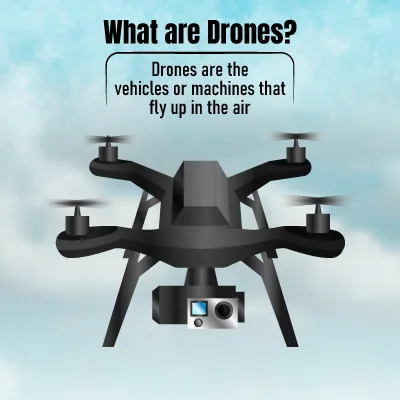
Commonly known as Unmanned Aerial Vehicles (UAVs), drones are the flying devices that operate in the airspace above us. To drive drones, there is no requirement for a human pilot. They can be operated both manually and automatically. They are adequate to monitor a sustained and controlled level of flight. It integrates aeronautics with robotic algorithms.
They are powered by jet, electric, or combustion engines to ensure optimal functionality. The fundamental role of drones is to capture environmental dynamics through video recording. Today, technological advancements have brought significant transformations to drone mechanisms. Modern drones are equipped with Radar Control, GPS Systems, Infrared Radiation Detection, and high-resolution cameras.
Drones have become increasingly popular across various industries. Industries including Defense, E-Commerce, and Entertainment extensively use drones. Due to its automatic working and effortless detection abilities, oil and gas industries have also started implementing drones to enhance operations.
Drones play a crucial role in the oil and gas industry, simplifying complex operations. They oversee extensive oil and gas pipeline networks over long distances, equipped with various devices and sensors. The infrared thermography sensor is able to spot thermal abnormalities. This aids in identifying leaks or corrosion on pipeline surfaces.
Similarly, drones in the oil and gas industry have several other benefits. However, drones were not utilized in the oil and gas industries in the early periods. Let us explore the historical background of drones in the oil and gas industry.
History of Drones in the Oil and Gas Industry
Today, we see drones in compact sizes. They are so compact that we can hold them in our hands. Historically, drones were much larger in size. These were also known as pilotless aircraft. By the late 1920s, the US and Britain had developed the first pilotless vehicles, tracing back to innovations during World War I.
A portable radio-controlled drone ‘Aerial Target’ from Britain was first tested successfully in March 1917. In 1918, the American compact aircraft, the ‘Kettering Bug,’ successfully took flight for the first time. Even though both aircraft were driven successfully, none of them had been put into service during the War Period.
Later, people started using drones for multiple purposes like remote monitoring, inspecting pipelines etc in the oil and gas industry. Chevron, ExxonMobil, and BP were some of the companies that initially embraced drone technology to enhance operations in the energy sector. Regulatory bodies like the United States Federal Aviation Administration (FAA) were instrumental in developing guidelines and norms for commercial drone use.
By the early 2000s, drones had begun to be practically implemented in the oil and gas industry. Before being implemented in this sector, they were normal flying machines with fewer abilities.
In a few years, they became demanding equipment and several oil and gas industries started using drones significantly. The reason behind its popularity was its capability to perform complex and dangerous tasks efficiently without causing any harm to the human workforce. Below is given the chronological sequence of how drones evolved in the oil and gas industry.
-
2002:
To monitor the pipelines, BP started the use of drones.
-
2005:
To detect the flares, Chevron began using drones.
-
2008:
Shell utilized drones to survey and map.
-
2010:
To observe the environmental conditions, Exxonmobil started the practical use of drones.
-
2012:
To search and save humans in hard to reach areas, ConocoPhillips made use of drones.
In later years, from 2013 to 2024, the use of drones continued in the oil and gas industry. Today, drones are integrated with advanced sensors, cameras, and other equipment. Their popularity has surged rapidly, offering numerous practical applications across the industry.
Applications of Drones in the Oil and Gas Industry
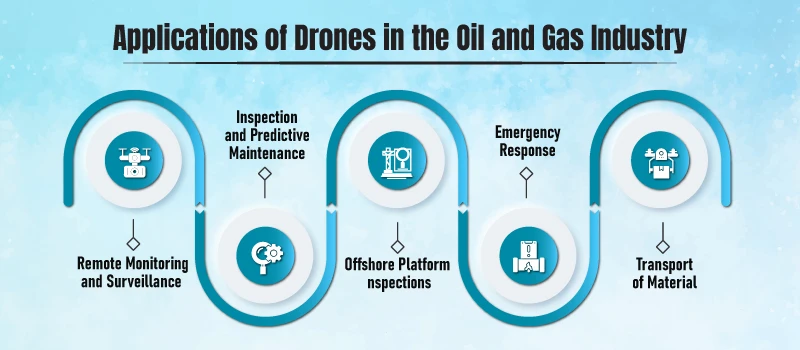
Drones provide the following applications to enhance the overall performance of the plant.
Remote Monitoring and Surveillance
Drones in the oil and gas industry mainly focus on 24-hour surveillance inspection. They operate continuously to ensure the integrity and accuracy of their monitoring tasks. They aim to provide remote monitoring of cruise ships, infrastructure, trucks, equipment, and other assets and devices. Drones provide comprehensive 360-degree views of their surroundings.
This panoramic view allows operators to closely monitor production levels, extraction processes, and detect any leakages. It also keeps an eye on railroads, longer pipelines, and other important company belongings. Moreover, today, drone surveillance is prepending its attempts to accurately monitor completely automated offshore oil and gas drilling rigs.
Inspection and Predictive Maintenance
Drone platforms are equipped with various sensors, each with unique capabilities. They help monitor and inspect the oil and gas assets to minimize damage. Using the latest digital sensors, drones can spot oil spills and leakages and determine how much area has been covered.
Drones can be put into service to ensure the pipeline status, perform comprehensive inspections, and carry out safety audits. As drones inspect the overall area, they immediately spot leakage or faulty areas. This enables operators to implement predictive maintenance schedules for their equipment. Ultimately, the unwanted damage to equipment can be avoided.
Offshore Platform Inspections
Prior to the introduction of drones, human workers were responsible for inspecting offshore platforms. Due to the large spread area, it was a time-consuming task to inspect. Sometimes, it is even more challenging for workers.
Work personnel conduct the deed inspection on offshore platforms as well as on pipelines, wells, and infrastructures. The work is performed automatically with the help of drones, without the intervention of humans.
Also, there is no requirement for an extra workforce to work in the water or at heights. Drone systems deliver precious data to detect prospective security concerns.
Emergency Response
Occasionally, incidents such as oil spills or pipeline damage can lead to significant resource loss. In such emergencies, drones provide emergency response in order to minimize further loss. Involving drones in emergency response can support the operators or authorities providing emergency medical service and performing appropriate damage assessments.
Real-time drone video footage and images provide operators with clear, immediate visual evidence of oil spills, pipeline damage, or fire incidents. Drones consist of special water hoses that sprinkle anti-fire foam at a site of fire incidents.
Transport of Material
Additionally, the oil and gas sectors employ logistical drones for specialized tasks. Such drones are specifically utilized to monitor the supply chain delivery path. These drones oversee the condition of vehicles, machinery, and equipment during transport. This helps supply chain management minimize expenditures and enhance efficiency.
Benefits of Drones in Oil and Gas
Here are some significant benefits of drones in the oil and gas industry:
| Benefits of Drones in Oil and Gas | |
|---|---|
| Better Leak Detection Capabilities |
|
| Safer & Faster Inspections |
|
| Reduced Maintenance Costs |
|
| More Accurate and Real-Time Data Collection |
|
| Increased Safety |
|
The Challenges in Implementing Drones in the Oil and Gas Industry
Though drones offer several advantages, the oil and gas industry may face the following challenges when implementing drones.
Limited Time and Range for Drone Flight
Commercial drones are made to operate until a specific time. They have a limited flight time, between 20 and 30 minutes, which may affect their performance in large spaces and prolonged tasks.
They are even designed to operate in specific and limited ranges. They can only be operated in specific areas, minimizing the extent to which they could be placed to replace manual inspections and monitoring tasks.
Need for Expert and Skilled Employees for Drone Analysis and Operations.
Drones are digital equipment with a few fragile components. They can get damaged instantly when they collide with any object. Therefore, to operate drones, there is a need for skilled and expert employees, which makes it challenging for oil and gas industries to hire such employees.
They are required to have trained drone pilots to operate drones safely, follow the flight routes properly, and analyze the collected data. Moreover, they also require a skilled data scientist to analyze deep information and offer actionable insights.
Security Issues and Regulatory Observance.
Oil and gas companies frequently encounter regulatory compliance challenges when deploying drones to boost performance. Operators need to observe drones frequently as they are compact and can enter unnecessary areas. To drive a drone, companies must follow several international and national standard regulations.
These can include flight restrictions, registration, or operator certification. Moreover, drone security issues cannot be neglected. Drones may collide with other aircraft or enter restricted areas, affecting operations.
Conclusion
The applications of drones in the oil and gas industry have helped bring a major shift in the way that operates. As a result, the mineral industry is actively seeking more advanced uses for this technology. Drone systems have flourished the overall landscape of the oil and gas industries. It offers multiple applications that result in secure and improved performance.
From remote inspection to material transport, drones provide effective solutions that speed up overall activities. It delivers advantages like enhanced safety, reduced maintenance cost, and others. Even though it benefits the industry, it holds some challenges.
Utilizing drones may cause security issues and have limited flight time. It also requires an expert to handle the drones. Regardless of such concerns, the way drones have transformed the operational scenario is quite a substantial fact. In 2023, they recorded a value of $8.09 billion. Mineral industry experts believe this value will exceed $87.02 billion by 2029.
FAQ’s
Which Industry Currently Uses Drones?
Oil and Gas, Mining, Construction, Agriculture, and Energy industries are widely using drones. These industries use drones to enhance performance, improve safety, and save cost and time.
How are Drones used in the Oil and Gas Industry?
Drones help capture clear, high-resolution images of surrounding areas. By watching the drone images, operators can detect leakages. They are used for various objectives, such as monitoring, emergency response, mapping, logistics, environmental monitoring, and cost efficiency.