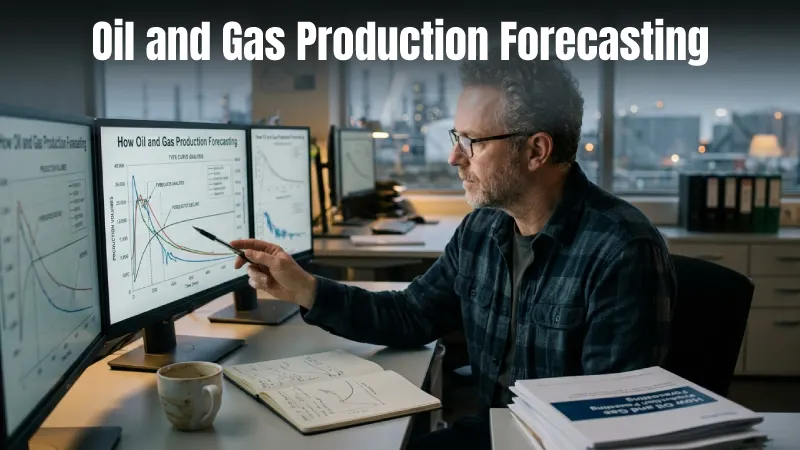
Enhanced oil recovery (EOR) is a set of tertiary techniques that extract oil left behind after primary and secondary production. By injecting CO₂, steam or chemicals into a reservoir, operators raise total recovery from roughly 20–40% of the original oil in place to 30–60% or more.
Once the traditional well runs dry, it does not necessarily go dry. As a matter of fact, by the time the pumps cease bobbing, two-thirds of the oil is usually still holding onto the rock, miles underneath, recalcitrant and immobile.
It is at this point that Enhanced Oil Recovery (EOR) alters everything. It represents the final stage of a well’s life, where advanced techniques are used to extend production and increase long-term royalty potential. While early production relies mainly on natural pressure and water injection, Enhanced Oil Recovery uses advanced methods to mobilize oil that would otherwise remain trapped.
If you are a mineral rights owner in the Permian Basin, understanding Enhanced Oil Recovery is critical to knowing how long your wells may continue producing and generating royalties.

Key Takeaways
- The Tertiary Tier: Enhanced Oil Recovery targets oil that remains trapped after standard production methods, often recovering an additional 10–25% of the oil originally present in the reservoir.
- Three Pillars: The industry relies on Gas Injection (CO₂), Thermal Recovery (Steam), and Chemical Flooding.
- Economic Sensitivity: EOR is "expensive oil." It thrives when crude prices are high and requires massive upfront capital.
- The CCUS Bridge: Carbon Dioxide EOR is currently the most viable pathway for large-scale carbon capture and storage.
What Is Enhanced Oil Recovery?
To understand Enhanced Oil Recovery, we have to look at the physics of a reservoir. Imagine a giant underground sponge made of stone. In the beginning (Primary Recovery), natural pressure drives production; however, In shale plays, this early production phase declines quickly, making Enhanced Oil Recovery important for extending well life and stabilizing royalty income. Eventually, that pressure fades. Then the process moves to Secondary Recovery, typically waterflooding, where the water is pumped into the ground to "push" the oil toward the production wells.
But even after waterflooding, a massive amount of oil remains trapped in the microscopic pores of the rock, held there by surface tension or because the oil is too thick (viscous) to move.
Enhanced Oil Recovery is the collection of "tertiary" techniques designed to change the very nature of the fluid in the reservoir. It isn't just pushing the oil anymore; it is altering its chemistry, heating it up, or mixing it with gases to make it flow like water. It is the difference between trying to blow a marble through a straw and melting a stick of butter so it slides right out.
In the United States, the Permian’s 'Super Basin' status is maintained by EOR, while the Eagle Ford has seen a 2026 resurgence through Cyclic Gas Injection (CGI) in unconventional shale plays. Without it, the massive horizontal well networks of the Permian and Eagle Ford would face rapid depletion; today, ‘Huff-n-Puff’ gas injection is helping extend the productive life of many shale wells well beyond their original expectations.
The Three Stages of a Well’s Life: A Progression of Pressure
Every oil field follows a predictable lifecycle. Understanding where Enhanced Oil Recovery fits requires a quick look at the "before" stages.
Primary Recovery: The Natural Rush
This is the "gusher" era, though modern wells are far more controlled. It relies on natural reservoir energy—expanding gas, water drive from an underlying aquifer, or gravity. In this stage, the oil wants to come out.
Recovery Factor: Usually only 5% to 15%.
The End Point: When the bottom-hole pressure drops to the point that the oil can no longer reach the surface, even with the help of a pump jack (artificial lift).
Secondary Recovery: The Big Push
Once the natural "oomph" is gone, operators inject water or natural gas into the reservoir. This re-pressurizes the formation and physically displaces the oil.
Recovery Factor: Brings the total to 20%–40%.
The Problem: Water is "thin," and oil is "thick." Eventually, the water finds the easiest path to the production well, bypassing the oil entirely. When a well starts producing 95% water and only 5% oil, secondary recovery has reached its economic limit.
Tertiary Recovery: Enhanced Oil Recovery
This is the final frontier. The EOR is applied when the "easy" oil is gone. It targets the immobile residual oil trapped by capillary forces, utilizing nanotechnology-enhanced surfactants to release droplets that waterflooding simply bypasses. By the time Enhanced Oil Recovery techniques are implemented, which is often looking at a total recovery factor of 30% to 60% and, in some world-class Permian reservoirs, even higher.
The "Big Three" Methods of EOR
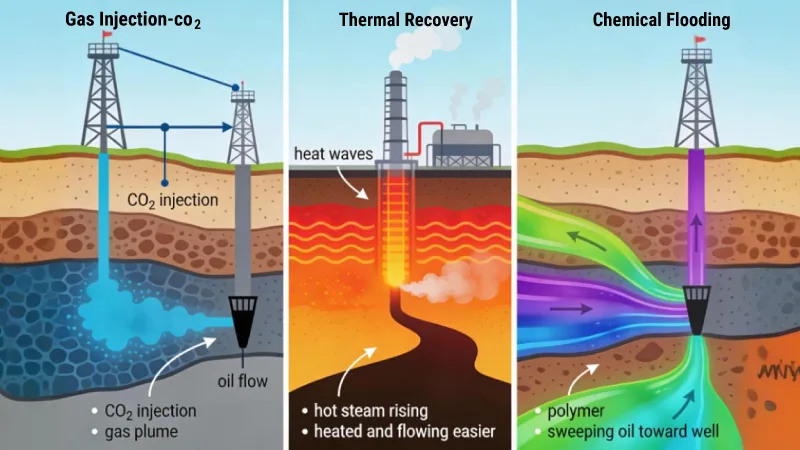
In the oil patch, there isn’t any one-size-fits-all solution. The method an engineer chooses depends entirely on the "flavor" of the oil and the "personality" of the rock.
Gas Injection (The King of Texas EOR)
By far the most common method in the U.S., gas injection, specifically Carbon Dioxide (CO₂), is the gold standard for light to medium crude.
Miscible Displacement: At the right pressure, CO₂ acts like a solvent (think of it like paint thinner). When CO₂ reaches Minimum Miscibility Pressure (MMP), it acts as a solvent to eliminate interfacial tension, swelling the oil and reducing viscosity for higher mobility. This allows the oil to detach from the rock and flow toward the wellbore.
The Sources: Initially, Texas operators piped naturally occurring CO₂ from domes in Colorado. Today, there is a massive shift toward "anthropogenic" CO₂: capturing emissions from industrial plants and putting them to work underground.
Thermal Recovery (The Heavy Lifter)
If you're in the San Joaquin Valley of California or the heavy oil sands of Canada, gas won't work. The oil is too thick, sometimes with the consistency of molasses or even peanut butter. You have to heat it.
Steam Injection: The high-pressure steam is injected into the reservoir. The heat thins the oil (reduces viscosity), allowing it to flow.
In-Situ Combustion: In some cases, a portion of the oil underground is actually ignited. The fire moves through the reservoir, pushing a bank of thinned oil ahead of it. It sounds extreme, but it’s an incredibly effective way to recover heavy crude.
Chemical Flooding (The Precision Tool)
This is the most complex and often the most expensive EOR method. It involves creating a "cocktail" of chemicals to wash the oil out of the rock.
Polymers: These make the injected water "thicker" so it doesn't just bypass the oil.
Surfactants: These act like dish soap, breaking the surface tension that keeps oil droplets stuck in tiny rock pores.
Alkalines: These react with the oil itself to create "soap" in situ.
ASP Flooding: Most modern chemical EOR uses a combination: Alkaline-Surfactant-Polymer.
The Permian Basin: The Global Laboratory for CO₂-EOR
In order to witness Enhanced Oil Recovery in practice, one looks at West Texas. Since 1972 (since the inception of the SACROC unit), the world has had the most successful CO₂ injection projects in the Permian Basin.
The discovery of Residual oil Zones (ROZs) is what is special about the Permian. Geologists believed that some areas were wet in nature (they only contained water) and neglected them. This technology, EOR, confirmed that these areas do have very huge volumes of oil, which can be extracted with the CO₂. This has successfully provided a new supply of oil fields to the map without the need to drill in new areas.
The Hard Truth About EOR Economics
Here is the part where I have to be blunt: Enhanced Oil Recovery is not cheap. In a primary recovery well, your main cost is drilling. In EOR, the drilling is just the beginning.
The Cost Barriers
Injectant Costs: CO₂ isn't free. Whether you're buying it from a pipeline or capturing it from a smokestack, the cost per thousand cubic feet (MCF) can make or break a project.
Infrastructure: You need specialized compressors, high-pressure pipelines, and separation facilities to pull the gas back out of the produced oil so you can recycle it.
The "Time Lag": Unlike a shale well, which gives you a huge "flush" of oil in the first month, EOR is a slow burn. You might inject gas for a year before you see a significant uptick in production.
Price Sensitivity
Because EOR is now a decarbonization strategy, these projects often receive 'green' capital funding, making them more resilient to oil price volatility than traditional exploration.
In the 2026 'Carbon-as-a-Service' model, even at $40/barrel, EOR remains viable if the operator collects the $85/tonne 45Q tax credit for sequestering third-party industrial emissions
In 2026, the Brent/WTI price is only half the story; with the 45Q tax credit providing $85 per tonne for sequestered CO₂, EOR projects are economically viable even when crude dips toward $55/barrel.
In 2026, the driver isn't $100 crude but rather 'Blue Oil' premiums and federal subsidies that make exotic ASP (Alkaline-Surfactant-Polymer) floods profitable at moderate price points.
The Legal and Business Maze of EOR
Texas is not the place where you can make a decision to launch an EOR project. Due to the process of EOR, which is the flooding of a reservoir, the injected fluids do not obey property lines. In case I spray CO₂ on my lease, it will spill oil on your lease.
Unitization
It is a legal procedure of combining dozens or even hundreds of different individual leases into a single giant unit. This guarantees that all the mineral rights owners receive a reasonable payment of the total reservoir amount and not the one whose particular well the oil has decided to flow out of. In Texas, this involves the RRC’s Form H-12 certification process, which grants a 2.3% reduced severance tax rate for 10 years, with an additional 50% reduction available for projects utilizing anthropogenic CO₂ as certified via RRC Form H-12A.
The Liability Factor
When you are pumping high-pressure CO₂ or chemicals into the ground, you must be sure that you are not contaminating groundwater. These are known as Class II injection wells, which are regulated by the Safe Drinking Water Act. EOR wells are subject to stricter mechanical integrity testing and regulatory oversight than typical production wells.
Environmental Impact: The CCUS Debate
The narrative around Enhanced Oil Recovery is shifting. For years, it was seen purely as a way to get more fossil fuels. By 2026, some EOR projects are designed to store more carbon dioxide underground than is released during the oil’s production, creating lower-carbon barrels of oil.
Is EOR "Green"?
It depends on who you ask.
The Pro-EOR Argument: By using CO₂ that would have gone into the atmosphere (from a cement plant or power plant) and "sequestering" it permanently underground in an oil reservoir, "lower-carbon" oil is created. The reservoir acts as a permanent vault for the carbon.
The Skeptic Argument: Critics argue that the CO₂ stored is cancelled out by the fact that we are producing more oil, which will eventually be burned in a car or plane.
Regardless of the debate, the tax incentives—specifically the 45Q Tax Credit—have made it incredibly profitable for companies to capture carbon and use it for Enhanced Oil Recovery. This has turned EOR into a bridge technology, connecting the old oil industry with the new "carbon management" industry.
The Future: "Smart" EOR and Nanotechnology
We are currently entering the era of EOR 4.0. The "brute force" methods of the 70s are being replaced by high-tech solutions:
- Nanoparticles: Scientists are developing microscopic particles that can be injected into the reservoir to change the rock's "wettability" or to act as tiny sensors that tell us exactly where the oil is hiding.
- AI and Digital Twins: We now create 4D models of the reservoir. We can run a thousand "what-if" scenarios on a computer before we ever turn on a CO₂ compressor.
- Microbial EOR: Using specific types of bacteria to "eat" the heavy parts of the oil and poop out natural surfactants and gases that help the oil flow. (Yes, you read that right—bacteria are the next generation of oilfield workers).
Final Words: The Enduring Value of Enhanced Oil Recovery
Enhanced Oil Recovery is all about stewardship. It is the fact that it is a known fact that an oil deposit is a limited, valuable resource and 60 percent of it buried away in the ground is an engineering nightmare that we just cannot afford any more.
The role of EOR will continue to increase as we get deeper into the 21st century. A win-win is the capacity to put away carbon and, at the same time, get maximum out of the available oil reserves in a world that requires more energy and less pollution. To the owner of the mineral, it represents decades of extra royalty payments. It represents a predictable, stable asset to the operator. And to the world, this is the ability to make the best of the found resources.
Enhanced Oil Recovery is no longer a niche technique; it has become a central strategy for extending the productive life of mature wells and preserving long-term royalty value. It is complicated, it is costly, and it is legally thorny, but it is the only means of making sure that when we declare a well to be done, we have really done work.