If you can see a drilling rig operating on or near your Texas acreage, one of the first questions that naturally comes to mind is: How Long Does It Take to Drill an Oil Well? More importantly for mineral owners, how long will it take before the well actually starts producing and royalty payments begin? Drilling a modern horizontal oil well in Texas typically takes 15 to 60 days from spud date to total depth.
After drilling, operators still need another 30 to 60 days for completion work, including casing, cementing, perforating, and hydraulic fracturing, before the well can begin producing oil or gas. Even after first production, mineral owners often wait several more months before receiving their first royalty check.
For Texas mineral owners, the timeline between visible drilling activity and actual royalty income can feel surprisingly long.
This guide breaks down each stage of the drilling process, what affects drilling timelines, and what mineral owners should realistically expect between spud date and first royalty payment.

Quick-Reference Timeline
| Phase | Typical Duration | What's Happening |
|---|---|---|
| Permitting & site preparation | 2 weeks – 6 months | Permits filed with Texas Railroad Commission, pad built, equipment moved on-site |
| Rig mobilization & rig-up | A few days – 4 weeks | Rig transported, assembled, and prepared on location before spud |
| Spud to total depth (drilling) | 15 – 60 days | Drill bit reaches target formation |
| Completion | 30 – 60 days | Casing, cementing, perforation, hydraulic fracturing |
| Flowback and tie-in | 1 – 4 weeks | Well brought online, connected to pipeline or tank battery |
| First oil to first royalty check | 60 – 180 days | Operator reconciles production, division orders sent, payments begin |
| Total: lease signing to first check | 6 – 18 months typical | Varies widely by basin, operator, and well complexity |
Keep these numbers as a baseline. Real-world timelines vary considerably depending on the formation, the operator, and how complex the well is.
Stages of Drilling an Oil Well
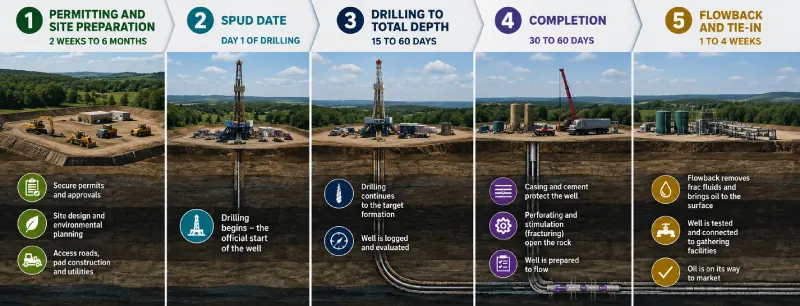
Stage 1 - Permitting and Site Preparation (2 weeks to 6 months)
Before the rig ever shows up, the operator must file a drilling permit (Form W-1) with the Texas Railroad Commission. If your land is in an unpermitted area or the well plan crosses regulatory thresholds, permitting can take several months. Once approved, the operator clears the site, builds an access road, levels a drilling pad (usually 3 to 5 acres for a horizontal well), and trucks in the rig, mud system, and supporting equipment.
For mineral owners: this is when you'll likely see the most surface activity. If you also own surface rights, this is when surface use damages and access agreements come into play.
Before the official spud date, operators also need time to mobilize and assemble the drilling rig on location. Rig mobilization includes transporting the derrick, drill pipe, mud tanks, generators, living quarters, and support equipment to the pad, then rigging everything up for drilling operations.
Depending on the rig size, road access, weather, and how far the rig is being relocated, mobilization and rig-up can take anywhere from a few days to several weeks. Rigs moving between nearby pads may mobilize quickly, while rigs transported from other regions of Texas often require 1 to 4 weeks for transport, assembly, and rig-up. On multi-well pad projects, operators may also spend additional time skidding or repositioning the rig between wells before drilling resumes.
Stage 2 - Spud Date (Day 1 of drilling)
"Spud" is the industry term for the moment the drill bit first touches the ground. The spud date is the official start of drilling and is recorded with the Texas Railroad Commission. For mineral owners, the spud date matters because many lease habendum clauses count drilling activity from spud - once drilling has commenced, the lease may be held even if the well doesn't produce immediately.
Stage 3 - Drilling to Total Depth (15 to 60 days)
This is the active drilling phase. For a typical Permian Basin horizontal well, drilling proceeds in roughly three sections:
- Surface hole (1–3 days): The first few thousand feet, drilled with a larger-diameter bit to set surface casing that protects freshwater aquifers.
- Intermediate / curve section (5–15 days): Drilling continues vertically, then curves to horizontal as the bit approaches the target formation.
- Lateral section (10–30 days): The horizontal portion through the producing zone, often extending 7,500 to 15,000 feet.
Modern rigs in the Permian routinely drill horizontal wells in 15 to 25 days. A decade ago, the same well took 30 to 45 days, drilling technology has compressed timelines dramatically.
Stage 4 - Completion (30 to 60 days)
After the well reaches total depth, the rig is moved off and completion crews come in. This phase includes:
- Running production casing the full length of the well
- Cementing the casing in place
- Perforating the casing in the lateral section
- Hydraulic fracturing (also called fracking or stimulation) to create pathways for oil and gas to flow into the wellbore
- Installing the wellhead and surface equipment
Completion is often more time-consuming than drilling itself. For some long-lateral horizontal wells in the Permian Basin, completion operations may also cost more than the drilling phase.
Stage 5 - Flowback and Tie-in (1 to 4 weeks)
Once completed, the well undergoes flowback — initial production where fracking fluid and water return to surface, followed by oil and gas. The operator then connects the wellhead to a pipeline, gathering system, or tank battery so production can be measured and sold.
The date oil or gas first flows to a sales point is the first production date, and this is the moment mineral owners have been waiting for.
Factors that Affect Drilling Time
Drilling timelines vary widely. The factors that matter most:
Well Type — Horizontal vs Vertical
Vertical wells in conventional formations can be drilled in 5 to 15 days. Modern horizontal wells take 15 to 60 days because of the lateral section. In Texas, more than 90% of new wells are horizontal.
Basin and Formation
Drilling times differ significantly by play:
- Permian Basin (Midland and Delaware): 15–30 days typical for a horizontal well
- Eagle Ford Shale: 12–25 days typical
- Barnett Shale: 10–20 days typical (mostly mature, fewer new wells)
- Austin Chalk: 20–40 days typical
- Haynesville Shale: 30–60 days typical (deeper, hotter, more challenging)
Lateral Length
A 7,500-foot lateral might take 12 days. A 15,000-foot lateral might take 25 days. Operators are increasingly drilling longer laterals (up to 3 miles) to maximize production per well.
Geological Complexity
Hard formations, faulted zones, or unexpected pressure changes can add days or weeks. So can equipment failures and weather delays.
Operator Efficiency
Major operators with dedicated rig fleets often drill faster than smaller operators using contracted rigs. Drilling efficiency has improved roughly 20% over the past five years.
Pad Drilling
When operators drill multiple wells from one pad, drilling time per well drops but total project time extends. A six-well pad might take 4 to 6 months from first spud to last completion.
What is a DUC Well and Why does it Matter to Mineral Owners?
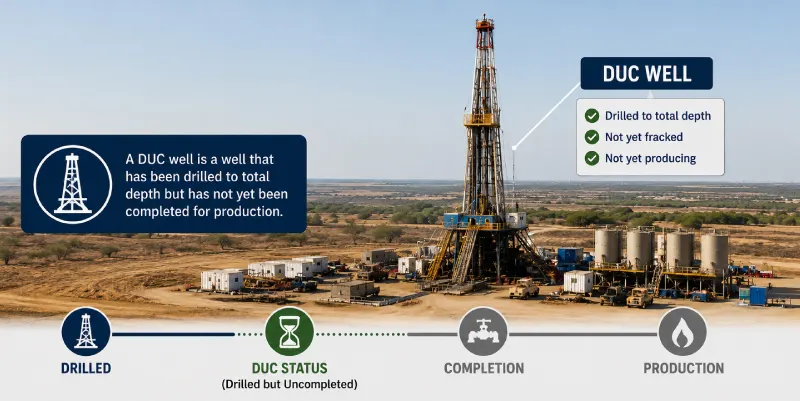
A DUC (“Drilled but Uncompleted”) well is a well that has already been drilled to total depth but has not yet gone through completion operations like hydraulic fracturing, flowback, and final tie-in to production infrastructure. In other words, the drilling phase is finished, but the well is not yet producing oil or gas for sale.
Operators sometimes leave wells in DUC status for weeks or months due to commodity prices, pipeline constraints, budgeting decisions, labor shortages, or delays in scheduling hydraulic fracturing crews. In major shale plays like the Permian Basin, operators may intentionally build an inventory of DUC wells and complete them later when market conditions are more favorable.
For Texas mineral owners, this distinction is important because royalty payments do not begin when drilling ends. Royalties begin only after the well is completed, producing hydrocarbons, and connected to a sales point. A well may appear “finished” on-site while still generating no royalty income.
DUC status can significantly extend the timeline between spud date and first royalty check, especially during periods of low oil prices or regional infrastructure bottlenecks. If a well near your acreage has been drilled but no production has appeared for several months, it may still be waiting on completion.
From Spud to Your First Royalty Check: What Texas Mineral Owners Need to Know
This is the part most drilling-timeline articles skip. If you're a mineral owner with an operator drilling on your leased acreage, here's what the timeline looks like from your perspective:
Spud Date → First Oil: Typically 60 to 120 Days
This is the operator's clock — drilling plus completion plus tie-in. You won't receive any royalty income during this window because there's nothing to pay royalties on yet.
First Oil → Division Order: Typically 30 to 90 Days
Once production begins, the operator (or its purchaser) must determine ownership across all interests in the well. This involves a title search, calculation of each owner's decimal interest, and preparation of division orders that are mailed to every mineral owner, royalty owner, and overriding royalty interest holder. Mineral owners can use Mineral View's Lease Report to review their lease details and verify their ownership information before division orders arrive.
Division Order Signed and Returned → First Royalty Payment: Typically 30 to 60 Days
Once you sign and return the division order, the operator adds you to its pay schedule. Texas Natural Resources Code §91.402 generally requires operators to pay the first royalty payment within 60 days of first oil sales and 120 days of first gas sales (though this clock can be tolled in some circumstances).
Realistic Total: 4 to 7 Months from Spud to First Royalty Check
Sometimes faster. Often slower. Plan accordingly.
A Few Important Nuances:
Royalties Owed before your First Check are not Lost
They accumulate. When the first check arrives, it usually covers all production from first oil through the pay-period cutoff.
Interest Applies in Some Cases
Under Texas law, if an operator doesn't pay within the statutory window, the unpaid amount may accrue interest - though enforcement requires you to know your rights and follow up.
Your First Check is Often your Largest
Subsequent monthly checks reflect a single month's production, which is usually much less than the cumulative amount on the first payment.
If a well has already been permitted, spud, or completed near your acreage, this is the best time to review your mineral ownership records and confirm your expected royalty interest. Lease Activity and Texas Oil & Gas Map tools can help mineral owners monitor nearby drilling activity and operator movement while the well is progressing toward production. Many royalty payment delays happen long before the first check is issued, especially when title issues or ownership discrepancies are discovered during division order preparation.
Example Timeline for a Texas Mineral Owner
Suppose a mineral owner in Reeves County signs a lease with an operator developing a new horizontal well in the Delaware Basin. Here’s what happens step by step.
- January: The operator files the drilling permit for a new horizontal well in Reeves County, Delaware Basin.
- February: The drilling pad is built and the rig is mobilized to the site.
- Early March: The well is spudded and active drilling begins.
- Late March: Drilling reaches total depth.
- April: Completion operations, including casing, cementing, and hydraulic fracturing, take place.
- May: The well begins producing oil, but no royalty payments are issued yet.
- June–July: The operator prepares division orders and verifies ownership interests across the drilling unit.
- August: After the signed division order is returned, the mineral owner receives the first royalty check, roughly five months after the original spud date.
This type of timeline is common in active Texas shale plays and illustrates why there is often a significant delay between visible drilling activity and the first royalty payment received by mineral owners.
What This Means for Texas Mineral Owners
Understanding the drilling timeline is only part of the picture. The bigger question is what you should be doing while drilling is underway:
Confirm What you Actually Own
Before the operator's title attorney makes their own determination, make sure your own ownership records are clean. A mineral rights title search is the standard way to verify decimal interest, identify any cloud on title, and avoid suspense delays.
Review your Lease for Drilling and Royalty Terms
Your oil and gas lease defines your royalty rate, how it's calculated, what deductions are permitted, and what happens if drilling is delayed past the primary term. If you signed without reviewing these clauses, now is a good time to read the document carefully, what you find there determines what shows up on your check.
Understand the Difference between Mineral Interest and Royalty Interest
If you're unsure exactly what you own, the mineral interest vs royalty interest distinction affects what you're paid and what costs (if any) can be deducted.
Prepare to Read your Division Order Carefully
When the division order arrives, do not sign it without checking the decimal interest, the property description, and the operator's stated terms. The division order guide walks through what to verify before signing.
Know What to Expect on Your First Royalty Check
Once payments begin, the calculation isn't always straightforward. Oil and gas royalty payments breaks down how check stubs work, common deductions, and how to spot underpayments.
Common Delays and What to do About Them
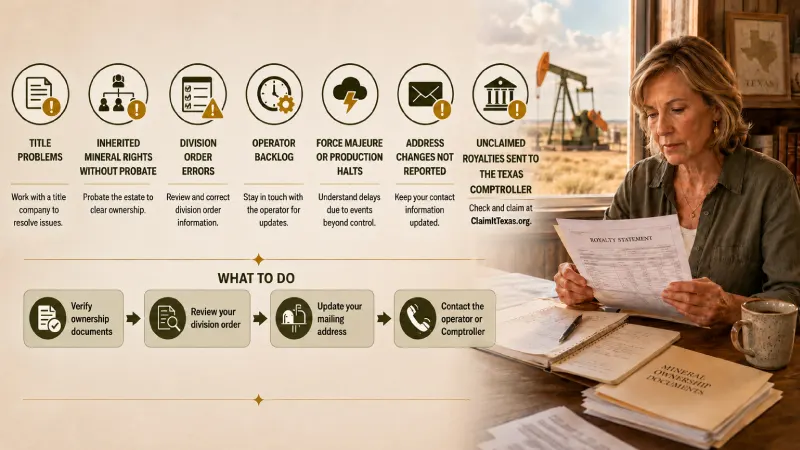
Most royalty timelines slip. Here are the common reasons and what you can do as a mineral owner:
Title Problems
If there's any cloud on title, an unprobated estate, a missing deed, conflicting heirships, the operator's title attorney will place your interest in suspense. The fix is on you: clear the title issue, then notify the operator. Suspense can drag royalty payment by 6 to 24 months if ignored.
Inherited Mineral Rights without Probate
If you inherited rights but never probated the estate or filed an affidavit of heirship, the operator may suspend payments until ownership is documented. See inherited mineral rights in Texas for how heirs can clear this.
Division Order Errors
Wrong decimal interest, wrong property description, or wrong payee information can delay payment indefinitely. Always check the math against your lease and your own title work before signing.
Operator Backlog
Large operators handling many new wells can run behind on paperwork. Polite but persistent follow-up usually moves things along.
Force Majeure or Production Halts
If the well is shut in due to pricing, pipeline access, or regulatory issues, royalties pause. Check your lease for a shut-in royalty clause, many leases require a small annual payment to maintain the lease during shut-in periods.
Address Changes not Reported
If you've moved since signing the lease and didn't update the operator, your check may be returned or held. This is a common cause of "unclaimed" royalty.
Unclaimed Royalties Sent to the Texas Comptroller
If royalty payments remain undeliverable for an extended period, often because of outdated mailing addresses, deceased owners, or unresolved title issues, operators may eventually transfer the funds to the Texas Comptroller's unclaimed property program.
Mineral owners and heirs can search for missing royalty payments through ClaimItTexas.org, the official Texas unclaimed property database.
That’s why it is important to keep your address, probate records, and ownership documents updated with both the operator and county records, especially during active drilling and production periods.
What to do Next as a Mineral Owner
Drilling an oil well is a multi-stage process that extends far beyond the spud date. While the drilling phase itself may take only a few weeks, completion work, flowback, pipeline connection, and royalty processing can stretch the total timeline from lease activity to first royalty payment into several months. For Texas mineral owners, understanding each stage of the process helps set realistic expectations and reduces confusion when activity begins on or near your acreage.
If drilling activity has already started on or near your acreage, now is the time to verify your mineral ownership and review nearby operator activity before division orders and royalty payments begin. Title issues, incorrect ownership records, or decimal-interest disputes can delay royalty income for months after first production.
If drilling has already started on your acreage, now is the time to act — before division orders arrive. Ownership errors and title discrepancies are far easier to resolve before the operator finalizes their records than after. Use MineralView to verify your mineral ownership, track active wells on your acreage, and monitor operator activity so you're ready when the division order lands. Visit Mineral View →