An oil rig construction is a challenging yet crucial task for oil exploration. Oil rigs are incredible feats of engineering and resilience, found everywhere from the tall platforms on land to the deep depths of offshore drilling. But beneath these enormous obstacles are enormous difficulties, such as overcoming hostile environmental conditions and figuring out tricky logistical concerns. In this piece, we go deeply into the intriguing realm of oil rig construction, examining the challenges encountered and the ground-breaking inventions influencing the sector's future.
Although oil rig construction influences the environment and comes up with potential concerns, the latest inventions are far enough to tackle them. Modern architecture and cutting-edge technology have revolutionized the construction of oil rigs in recent years, improving safety, efficiency, and environmental consciousness. Let's dive deeper and understand what an oil rig is.
What is an Oil Rig?
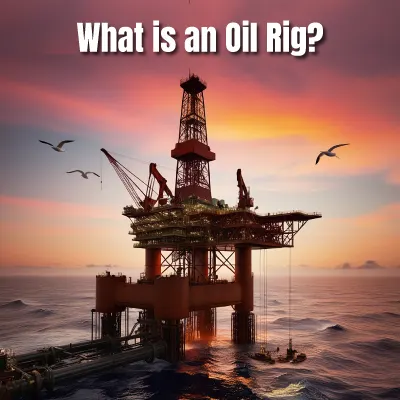
A large piece of equipment called an oil rig is used to drill wells and harvest natural gas or oil from the Earth's interior. The majority of the world's oil reserves are discovered offshore, in the water, although these rigs can also be found on land. Because they may access oil reserves that are otherwise inaccessible from land, offshore rigs are very important.
Oil rigs are movable construction. The rig is shifted to a new position when the oil in one spot runs out. Oil rigs are complicated structures that need a wide range of specialized equipment to run well, even though they are only temporary. Offshore rigs are extremely adaptable to various situations because their size and design are determined by criteria such as seabed conditions and water depth, making it difficult to understand their construction for workers.
Understanding Oil Rig Construction
Building an oil rig is a challenging project that requires meticulous design, modern machinery, and a skilled crew. The main objective is to construct a sturdy platform that can withstand the harsh conditions of the open sea and facilitate the recovery of oil and gas deposits beneath the ocean floor. Oil rigs come in two primary varieties: stationary platforms and floating constructions.
Stationary Platforms
Because these rigs are attached to the ocean floor, they are suitable for shallow waters. They are constructed from a steel or concrete basis that extends from the water's surface to its bottom. The majority of the time, these platforms are used in shallow, calm waters with a stable seafloor.
Floating Structures
Deeper oceans are the ideal place for floating rigs to be used when fixed platforms are not feasible. Drillships, tension leg platforms (TLPs), and semisubmersibles are the many kinds of structures. They use a combination of buoyancy and anchoring mechanisms to guarantee stability.
Detailed Process of Oil Rig Construction
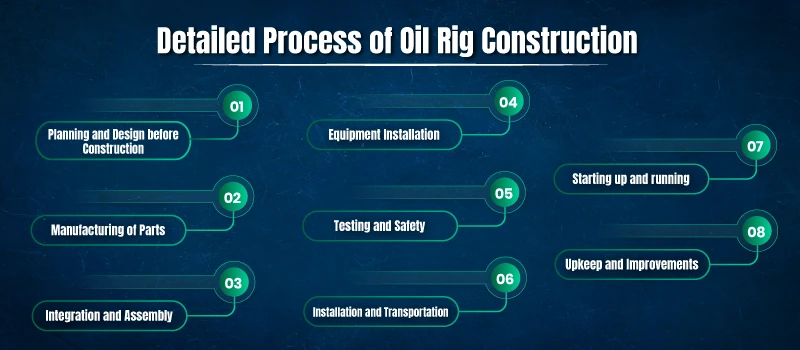
The building of oil rigs is a remarkable feat that requires collaboration between engineers, designers, technicians, and other skilled professionals. Below is the step-by-step process of constructing an oil rig:
Planning and Design before Construction
Before construction starts, careful planning and design are needed to ensure that the oil rig satisfies operating specifications and complies with safety and environmental regulations.
-
The Feasibility Study: When determining whether a project is feasible, engineers and project managers consider factors such as water depth, seabed conditions, environmental impact, and economic viability.
-
Design Development: Detailed engineering designs are used for the structural arrangement, equipment placement, and safety measures. Computer-aided design (CAD) software is used to create exact designs.
Manufacturing of Parts
The various parts that make up an oil rig each have a specific function. These parts are assembled at the rig after being constructed off-site.
-
Foundation: Initially, the foundation is designed for stationary platforms. This means building the jacket's structure, which consists of horizontal braces and vertical legs. The jacket is normally constructed onshore, frequently in sections, and then transported to the rig site for installation.
-
Superstructure: The living rooms, processing facilities, drilling equipment, and other necessary parts are all part of the superstructure. To guarantee accuracy and quality, these components are frequently constructed in specialist facilities off-site.
Integration and Assembly
After completion, the parts are transported to the rig location, where they are put together and then incorporated into the entire construction.
-
Installation of the Foundation: With fixed platforms, specialized vessels that are able to precisely lift and place the large structures are used to bring the foundation components to the site and install them.
-
Integration of the Superstructure: The superstructure's parts are lifted and placed above the foundation. To place each component exactly, heavy-lift machinery and cranes are used.
Equipment Installation
Drilling, extraction, and processing equipment installation starts once the foundation is put in place.
-
Drilling Tools: The drilling rig, derrick, drill pipes, and other tools required to drill into the ocean floor in order to reach gas and oil reserves are included in the drilling equipment.
-
Facilities for Processing: Facilities for separating water, gas, and oil have been installed. Among these are storage tanks, compressors, pumps, and separators.
-
Accommodations: The quarters for the crew have been set up, and they include dining areas, sleeping areas, recreation spaces, and medical facilities.
Testing and Safety
When building an oil rig, the environment and worker safety are of utmost importance.
-
Safety Mechanisms: On the site, evacuation routes, emergency shut-off valves, and fire detection and suppression devices are erected and tested.
-
Examining and Modeling: Oil and gas simulators are used to evaluate a variety of systems, such as emergency protocols and drilling operations, in order to guarantee their suitability for practical use.
Installation and Transportation
For floating rigs, the finished product is transported to a designated location out in open waters.
-
Positioning and Towing: Sophisticated mooring systems are used to haul floating rigs to their destination and position them. Because of dynamic positioning technology, these rigs can stay still in the face of waves and currents.
Starting up and running
The rig undergoes commissioning after installation, which entails last-minute testing and tweaks to guarantee that every system is operating as intended.
-
Drilling Operations: After the rig is commissioned, it is prepared for drilling operations. The ocean floor is mined for oil and gas utilizing cutting-edge drilling methods and equipment.
Upkeep and Improvements
Regular maintenance and upgrades are necessary for oil rigs to maximize their effectiveness, safety, and environmental performance.
-
Typical Upkeep: To guarantee the integrity and safety of the rig, routine maintenance, repairs, and inspections are carried out.
-
Improvements in Technology: When new technologies emerge, such as automation, data analytics, and remote monitoring systems, rigs can be modified accordingly, yet it involves some challenges during construction.
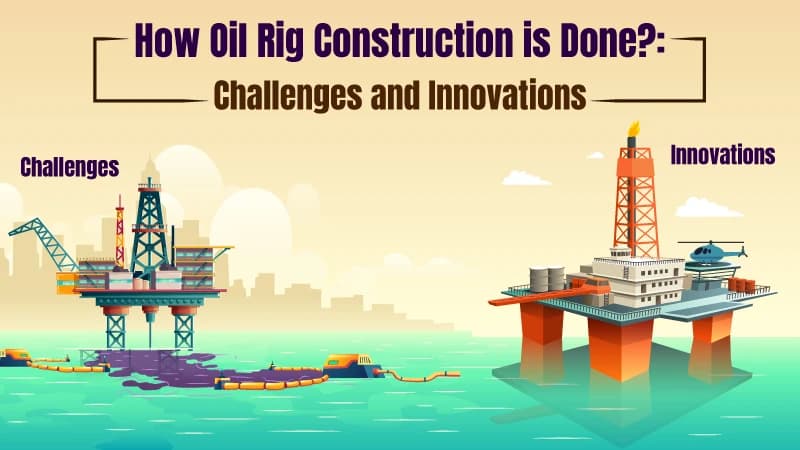
Challenges in Oil Rig Construction
Below are some challenges that may occur during oil rig construction:
Unforgiving Weather
In offshore locations, rigs are exposed to corrosive saltwater, rough seas, and severe weather. Strong designs and materials that can withstand repeated exposure are required under these circumstances.
Safety Concerns
Rig operations are hazardous by nature due to large machinery, complicated systems, and high-pressure drilling. Ensuring worker safety while minimizing environmental impact is a significant challenge.
Logistics
It's a logistical challenge to ship big rig components to far-off offshore locations. Significant cost overruns could be caused by accidents or delays in the transportation system.
Depth and Pressure
Deepwater drilling presents technical challenges because to the extreme pressures and depths involved. It is necessary to develop engineering solutions to handle these challenging circumstances.
Regulatory Compliance
The construction, use, and eventual dismantling of rigs are governed by environmental norms. Adherence to these regulations requires precise implementation and preparation.
These are some challenges that may arise during the construction of an oil rig. However, the latest innovations in oil rig construction have transformed the overall process.
Innovations in Oil Rig Construction
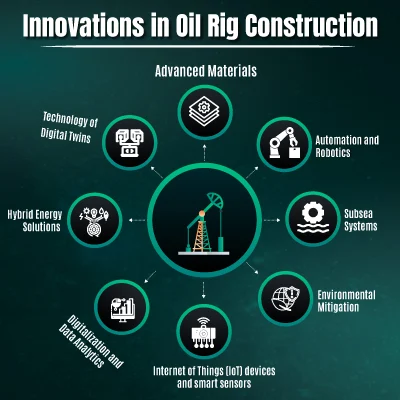
The latest innovations in the construction of an oil rig are listed below:
-
Advanced Materials
Developments in materials research have produced high-strength steels, corrosion-resistant alloys, and composite materials that extend the life of rigs used in harsh environments.
-
Automation and Robotics
These two technologies have transformed how rigs operate. In order to reduce human risk, drones, autonomous systems, and remote-controlled vehicles (ROVs) are used for maintenance, drilling, and inspections.
-
Technology of Digital Twins
Digital twins—digital copies of physical rigs—allow for drilling and well control scenario simulations, predictive maintenance, and real-time monitoring. This technology optimizes operations and improves decision-making.
-
Subsea Systems
Subsea production methods include lowering rig visibility, putting equipment on the seafloor, and reducing environmental impact. These techniques preserve ocean habitats while facilitating effective harvesting and processing.
-
Environmental Mitigation
Systems for spill response, water treatment, and waste management can lessen the negative effects of rig operations on marine environments. Biodegradable drilling fluids and enhanced leak detection systems are two examples of these advancements.
-
Digitalization and Data Analytics
To optimize operations, big data and analytics are essential. By using predictive analytics to forecast equipment failures, downtime may be minimized and preventative maintenance can be performed.
-
Hybrid Energy Solutions
By incorporating renewable energy sources like solar or wind power into rig operations, greenhouse gas emissions are decreased and dependency on fossil fuels is reduced.
-
Internet of Things (IoT) devices and smart sensors
Using IoT and smart sensor technologies across rigs enhances real-time equipment condition monitoring, enabling timely maintenance and risk mitigation.
Final Thoughts
The process of an oil rig construction is challenging and intricate, including challenges like harsh weather, potential safety hazards, and logistical difficulties. However, the advancements in design, material, and technology have significantly contributed to the effectiveness, security, and sustainability of these initiatives.
The development of oil rigs will be influenced by contemporary innovations such as automation, digital twins, subsea systems, and hybrid energy solutions. These developments will make oil rigs more durable, ecologically friendly, and able to adapt to deepwater settings. The oil rig construction undertakings, along with technological advancements, are better able to help the oil and gas industry supply the world's energy needs while reducing its environmental effects and will continue to do so in forthcoming years.