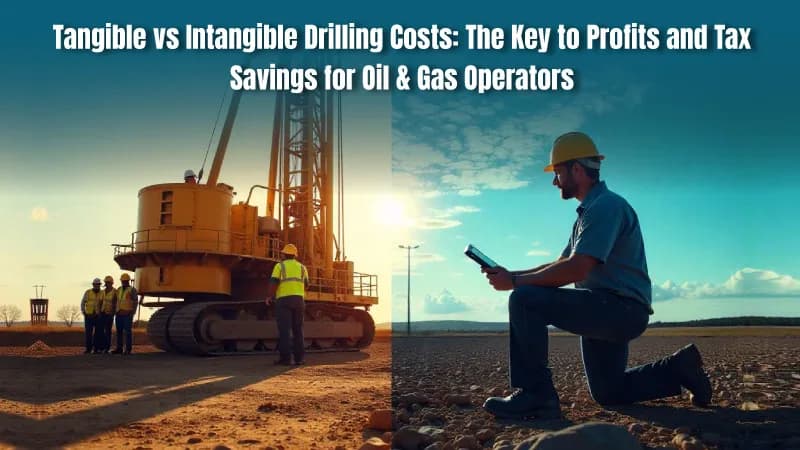
When oil and gas companies drill new wells, they spend money on many things. Some of these are physical tools and equipment, while others are services and labor, involving labor costs. These are divided into two types: tangible drilling costs and intangible drilling costs. Knowing the difference between the two is important for saving money, improving cash flow and leveraging financial advantages ultimately paying less tax.
Let’s break down what these costs mean and how they help oil and gas operators make smarter business choices.
What are Tangible Drilling Costs (TDCs)?
Tangible drilling costs are the expenses for real, physical items used in drilling an oil or gas well. These are things you can touch, like machines and equipment. Tangible costs are usually a big part of the total cost of drilling.
List of Tangible Drilling Costs
Here are some common examples of tangible drilling costs:
Drill Bits:
These are the sharp tools that dig deep into the earth to make the well.
Drilling Rig:
This is the main machine used to drill. It includes parts like mud pumps and derricks.
Casing:
This is strong metal or concrete pipe that lines the well to keep it from falling in.
Cementing:
This process uses cement to seal the well and stop oil, gas, or water from moving between rock layers.
Mud and Fluids:
These help cool the drill, move rock pieces out of the well, and make drilling safer.
Wellhead and Christmas Tree:
These control how oil or gas flows out of the well.
Fuel and Energy:
The fuel was needed to power the rig and its equipment.
Site Preparation:
Getting the land ready by clearing it, building roads, and setting up support structures.
What are Intangible Drilling Costs (IDCs)?
Intangible drilling costs are the things you can’t see or touch but are still needed to drill a well. These don’t become part of the well itself but they are important for energy projects. They include work like surveys, clearing land, paying workers, and buying supplies, fuel, and repairs.
If something used in drilling has no leftover value (no resale or “salvage” value), it is considered an intangible cost. Even though the word “intangible” might sound confusing, these are very real expenses.
Tax Benefits of IDCs
Intangible drilling costs are often fully tax-deductible in the year the money is spent. This rule has been around in the U.S. since 1913. It’s meant to help companies take the risk of drilling new wells by reducing how much tax they owe.
Tangible vs Intangible Drilling Costs
Understanding tangible vs intangible drilling costs helps you plan better. Here’s how they are different:
-
Tangible costs are for physical things—like machines, rigs, or tools.
-
Intangible costs are for services and work—like paying employees, site clearing, and other support work.
Think of it like this: if you hire a new employee, their salary is a tangible cost. But if an old employee leaves and takes all their experience with them, that knowledge is an intangible cost. It’s real, but harder to measure.
When companies make big decisions, they must look at both. Ignoring these costs—or guessing wrong—can lead to lost profits.
The Tax Implications: Tangible vs. Intangible Costs
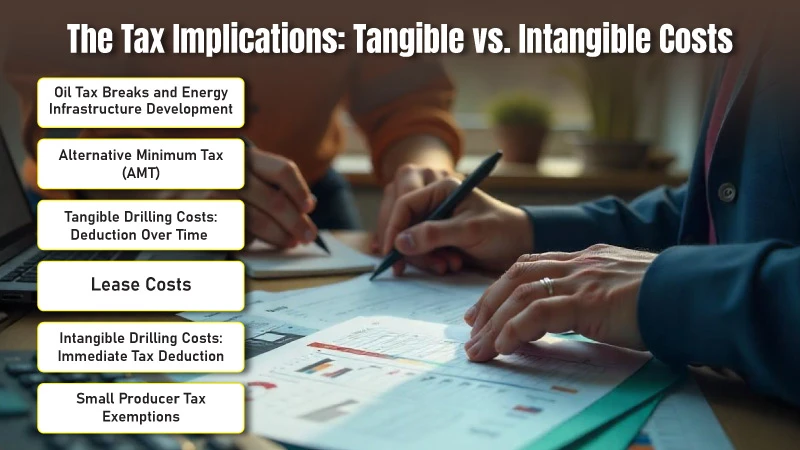
Intangible Drilling Costs: Immediate Tax Deduction
Many intangible drilling costs can be deducted from your taxes right away. These include labor, chemicals, drilling mud, and fuel—things that don’t have any leftover value. These costs can make up 70–80% of total drilling expenses.
Example: If you invest $100,000 in a drilling project and $75,000 of that qualifies as intangible costs, you can deduct that $75,000 from your taxable income for that year. That’s a big savings.
But this benefit is only for people or companies that directly own a part of the well (called a working interest). Also, tax rules may change, so it’s smart to talk to a tax expert.
Tangible Drilling Costs: Deduction Over Time
Tangible drilling costs, like rigs or casing, can’t be fully deducted right away. Instead, they are spread out over several years—usually seven—because they still have value after drilling is done.
Example: If you spend $50,000 on drilling equipment, you can deduct part of that each year until the value is gone.
This is good for people who want steady tax savings over time.
Small Producer Tax Exemptions
This rule helps smaller oil and gas producers save on taxes. It’s called the depletion allowance and lets them avoid taxes on 15% of the money they earn from wells.
But it only works for smaller producers. If a company makes more than 50,000 barrels of oil per day or owns more than 1,000 barrels/day, they can’t use this benefit. The same goes for those who produce over 6 million cubic feet of gas daily.
Lease Costs
Lease costs are the money spent to get land or mineral rights. They also include running costs and business expenses like legal and accounting fees. These aren’t deducted all at once. Instead, they’re deducted slowly over time through the depletion allowance.
Alternative Minimum Tax (AMT)
The AMT is a rule that makes sure everyone pays at least some tax, even if they have lots of deductions. But extra intangible drilling costs are not counted under AMT. This is great news for investors using intangible costs to lower taxes.
Oil Tax Breaks and Energy Infrastructure Development
All these tax rules show that the U.S. government wants to help grow the energy sector. What’s more, there are no income limits for getting these tax benefits—except for the small producer rules.
So even wealthy investors can enjoy these savings—as long as they don’t own more than 1,000 barrels of oil per day. Not many other investments in America offer this many tax advantages.
Tangible vs. Intangible Costs for Maximizing Operational Efficiency
When a company is deciding what to do next, both tangible and intangible costs matter.
Tangible costs are easy to count—like how much you’ll pay a new worker.
Intangible costs are harder to measure—like how much productivity is lost when training a new person.
For oil and gas operators, looking at tangible vs intangible drilling costs helps in choosing the best and most cost-effective way to drill and grow. These decisions can make the difference between profit and loss.
Conclusion
Exploration and production are the primary tasks in the oil and gas industry, and knowing the difference between tangible vs intangible drilling costs is key to success. Tangible costs are for tools and machines. Intangible costs cover services and support.
Both types of costs play a big role in drilling, budgeting, and tax planning. When used wisely, they can help oil and gas operators lower their taxes and improve profits.
People Also Ask
What is the Difference Between Tangible and Intangible Drilling Costs?
Tangible costs are physical items like rigs. Intangible costs are services or work that don’t become part of the well.
What are Intangible Drilling Costs?
These are costs like wages, surveys, and fuel—things needed to drill but not part of the final well.
What is a Tangible Cost vs Intangible Cost?
Tangible is something you can touch. Intangible is something real but without a physical form—like knowledge or planning.
How to Depreciate Tangible Drilling Costs?
Spread the cost over time—usually over 7 years—by deducting a portion each year.