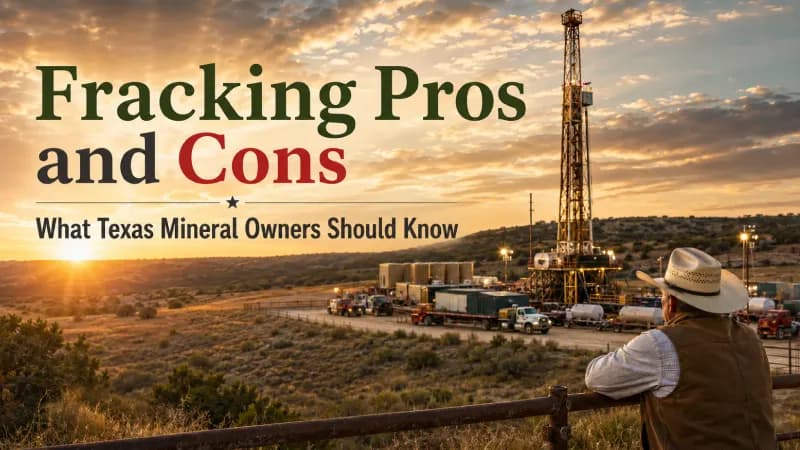
The fracking pros and cons debate looks very different depending on who you are. For Texas mineral owners, hydraulic fracturing ("fracking") has transformed oil and gas development by unlocking shale reserves that were previously considered uneconomic to produce. The benefits are substantial: access to previously unrecoverable reserves, materially higher production rates, increased royalty potential for mineral owners, and significant economic expansion across Texas. The drawbacks are also real: high water usage, water quality concerns, induced seismicity, faster well decline curves, and surface impact during drilling and completion.
For Texas mineral owners, the implications are financial, contractual, and long-term. Fracking on your leased land directly affects how much royalty income you receive, how quickly that income declines, what surface damage you may experience, and what protections your lease provides. This guide walks through both sides of the fracking debate, and what each one actually means for your decisions as a Texas mineral owner.
Fracking Pros and Cons at a Glance
| Pros | Cons |
|---|---|
| Higher initial production rates | Faster decline curves than conventional wells |
| Access to previously unrecoverable reserves | High water usage per well |
| Stronger royalty income in early years | Water quality and disposal risks |
| Smaller surface footprint per barrel produced | Induced seismicity in some areas |
| Significant economic activity in Texas | Air emissions during flowback and operations |
| Energy independence and price stability | Surface disruption during drilling and completion |
This is the short version. The rest of this guide explains each point, and then walks through what fracking specifically means if it happens on your mineral acreage.
What Hydraulic Fracturing Actually Is
Fracking is a well-completion technique, not a drilling technique. After a well has been drilled to its target depth,often through a horizontal lateral that can extend thousands of feet, and in many modern Permian wells more than 10,000 feet within the target hydrocarbon-bearing formation, the operator pumps a high-pressure mixture of water, sand, and chemical additives into the wellbore. The pressure creates conductive fractures within low-permeability shale and tight-rock formations. The proppant (typically frac sand) keeps the induced fractures mechanically open after pumping pressure is released. Oil and gas, which were previously locked in the rock, flow through the fractures into the wellbore and up to the surface.
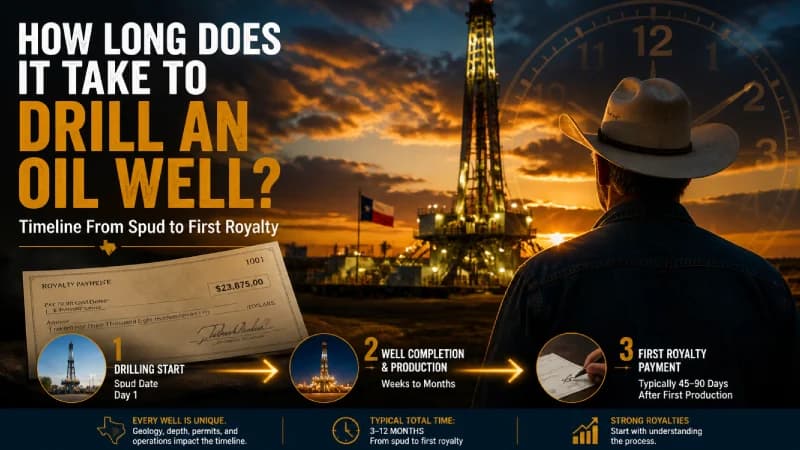
The fracturing treatment itself often takes several days per well, commonly in the 2 to 7 day range, but longer laterals and multi-well pads can extend the overall completion schedule (which takes 15 to 60 days). For a Texas mineral owner, this is the phase that turns a drilled well into a producing well that generates royalty income.
It's worth knowing the terminology. "Hydraulic fracking" and "hydraulic fracturing" are the same thing. "Fracking" is the colloquial short form. Industry sometimes uses "stimulation" or "completion" for the same process. All refer to the same operation.
How Fracking Benefits Texas Mineral Owners
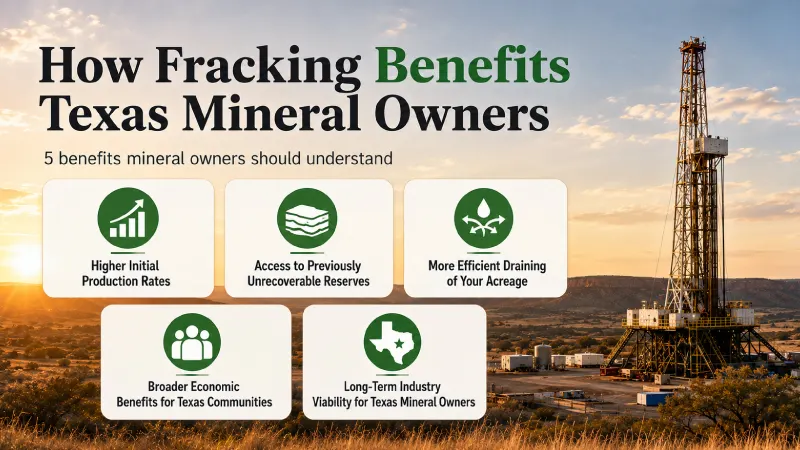
Higher Initial Production Rates
Modern horizontal shale wells typically deliver substantially higher initial production (IP) rates than conventional vertical wells. A Permian Basin horizontal well often produces 200,000 to 500,000 barrels of oil equivalent in its first 12 months. A conventional vertical well in the same formation might produce 10,000 to 30,000 barrels in the same period.
For mineral owners, this means much higher royalty income in the early years of a well's life. The first 12 to 24 months typically generate the largest royalty checks the owner will ever receive from that well.
Access to Previously Unrecoverable Reserves
Before hydraulic fracking became widespread in the late 2000s, vast quantities of oil and gas in Texas shale formations, the Permian, Eagle Ford, Barnett, and Austin Chalk — were considered uneconomic to produce. Conventional drilling couldn't access the oil locked tightly in low-permeability rock.
Fracking changed that. Reserves that sat untouched for decades became commercially viable. For mineral owners on shale acreage, this transformed previously low-value or marginal mineral interests into significantly more valuable assets, particularly in counties across West Texas, South Texas, and North Texas where shale plays underlie large amounts of privately owned mineral acreage.
More Efficient Draining of Your Acreage
A modern fracked horizontal well produces from a much larger underground area than a conventional vertical well, while using a smaller surface pad. Operators can often drill multiple horizontal wells from a single pad, with each lateral extending in different directions to reach more reservoir rock from a smaller surface location.
For surface landowners, this means less land disturbance per unit of production. For mineral owners, this means more efficient draining of their acreage.
Broader Economic Benefits for Texas Communities
The fracking boom has produced significant tax revenue, employment, and supply-chain activity across Texas. Counties with active drilling typically see meaningful increases in property tax revenue, school funding, and local employment. The Texas Railroad Commission, the Texas Comptroller, and university economic studies have all documented this in detail.
This matters indirectly for mineral owners because it strengthens the political and regulatory environment that supports continued production - which in turn supports continued royalty income.
Long-Term Industry Viability for Texas Mineral Owners
US oil and gas production, much of it from fracked wells in Texas and other shale states, has reduced dependence on foreign imports and contributed to more stable energy prices. While oil and gas prices remain volatile, the production capacity created by fracking provides a cushion against supply shocks.
Fracking turned the United States into the world's largest oil producer by 2023, with Texas leading that output. For Texas mineral owners, this matters in one concrete way: sustained domestic demand for oil and gas production keeps operators drilling, keeps royalties flowing, and supports mineral rights valuations. The long-term risk is price volatility - oil and gas markets remain cyclical - but the production infrastructure built around Texas shale plays represents decades of continued development on leased acreage.
The Real Downsides Texas Mineral Owners Should Know
Faster Decline Curves than Conventional Wells
This is the most important downside for mineral owners, and the one most commonly missed in general-audience pro/con articles. Fracked horizontal wells decline much faster than conventional wells. A typical Permian Basin horizontal well may experience a first-year production decline of approximately 60–75% from its peak initial production rate. By year three, production may be only a small fraction of peak output, and some Midland-style shale examples show declines approaching 90% from early peak rates.
For a mineral owner, this means royalty checks that start large in year one shrink rapidly. Total well economics can still be good, the front-loaded production often generates more total revenue than a slower-declining conventional well, but the income pattern is very different. Owners who don't understand decline curves often assume their first-year royalty income will continue indefinitely. It won't.
High Water Usage Per Well
A modern fracked Permian well uses 5 to 15 million gallons of water to complete. Multiplied across thousands of wells per year, this represents significant water demand, particularly in West Texas where water is scarce. Some of this water is sourced from local aquifers, some from surface water, and some from recycled produced water.
For mineral owners, water usage is generally not a direct concern unless they also own surface rights and the operator is sourcing water from their property. It is, however, a real environmental concern that affects how the industry is regulated.
Water Quality and Disposal Risks
Two distinct concerns sit under this heading. First, groundwater contamination concerns are typically associated with casing or cement integrity failures, surface spills, or improper wastewater handling rather than fracture growth itself or if surface spills occur. Documented cases of contamination have occurred, though the frequency and causes remain heavily debated within regulatory and scientific discussions. Second, produced water, formation water and flowback fluids that return to the surface during production operations, is typically disposed of through deep injection wells, which has been linked to induced seismicity in some areas (see below).
For mineral owners, these risks primarily matter if you also own surface rights or have a residence near drilling activity. Lease clauses on water sourcing, waste disposal, and damages can address some of these concerns if negotiated upfront.
Induced Seismicity
Some areas of Texas have experienced increased small earthquake activity that researchers have linked to wastewater injection (not the fracking itself in most cases, but the disposal of produced water afterward). The U.S. Geological Survey has documented this in detail. Most induced earthquakes are small (magnitude 2-3), but some have been larger.
The Texas Railroad Commission has imposed restrictions on disposal well operations in seismicity-prone areas. For mineral owners, this isn't typically a direct concern unless your property is in an affected county and you're worried about structural damage.
Air Emissions During Flowback and Operations
Fracked wells release methane, volatile organic compounds, and other emissions during the initial flowback period and during ongoing operations. Modern operators use "green completions" and vapor recovery systems to capture much of this, but emissions still occur.
For surface landowners and nearby residents, this can affect air quality during active drilling and completion. The Texas Commission on Environmental Quality regulates these emissions.
Surface Disruption During Drilling and Completion
Drilling and completing a fracked horizontal well is industrial-scale work. Heavy equipment, hundreds of truck trips, noise, lighting, dust, and traffic continue for weeks to months. Multi-well pad sites typically occupy 3–5 acres and require extensive grading, graveling, infrastructure installation, and heavy-equipment access. Access roads are built. Water and produced-water lines are run.
For surface owners, this is significant. For mineral owners without surface rights, the disruption is someone else's problem, but the lease may still have surface-use provisions that affect both sides.
What Fracking Means for Your Lease and Royalties
This is the section most general-audience fracking articles don't cover. If fracking is happening or planned on your Texas mineral acreage, here's what the technique actually means for you as an owner.
Royalty Income is Heavily Front Loaded
The decline curve issue mentioned above translates directly to your check pattern. Expect royalty income to look something like this for a typical Permian horizontal well:
- Year 1: Highest income — Often 40 to 50 percent of total expected royalty payments across the well's productive life
- Year 2: Significantly lower — typically 20 to 30 percent of year one
- Year 3: Lower still — typically 15 to 25 percent of year one
- Years 4-15+: Slowly declining tail production
This pattern is fundamentally different from conventional vertical wells, which often produce at relatively stable rates for many years before declining gradually. To make this concrete — a Permian Basin mineral owner with 40 net mineral acres at a 1/5 royalty rate might see approximately $4,000 per month in Year 1, $1,100 per month by Year 2, and $600 per month by Year 3. The well may still produce for another 15 years after that, but at a slowly declining tail rate. Plan your finances accordingly. Your Year 1 royalty check is not your long-term income — it is the highest check you will likely ever receive from that well. To make this concrete, here is what a typical decline pattern looks like in dollar terms for a Permian Basin horizontal well at a 1/5 (20%) royalty rate:
| Period | Approximate monthly royalty | Notes |
|---|---|---|
| Year 1 (peak) | ~$4,000/month | First 12 months — highest checks you will receive |
| Year 2 | ~$1,200/month | Steep decline from peak; 70–80% drop is common |
| Year 3 | ~$700/month | Decline slows; long-tail production begins |
| Years 4–15+ | $200–$500/month | Slowly declining tail - can last 10–20 years |
These figures are illustrative and vary with oil price, lateral length, and royalty rate - but the pattern is consistent across Permian Basin wells. A mineral owner who budgets based on Year 1 income and doesn't account for decline will face a significant financial adjustment by Year 2.
Your Lease Determines What You Actually Receive
Your royalty revenue is ultimately governed by the lease terms negotiated before drilling and completion operations begin. Two leases on the same well, with the same production, can pay out very differently. Key clauses to understand:
- Royalty rate - your percentage of production. Standard is 1/8 (12.5%), but modern Texas leases often achieve 1/5 (20%) or higher
- Royalty deductions - what the operator can deduct before calculating your share. Post-production costs (gathering, transportation, processing) can significantly reduce what you receive if the lease doesn't prohibit them
- Market enhancement and proceeds calculations - how your share is valued
- Audit rights - your ability to verify the operator's math
If you haven't reviewed your oil and gas lease since signing, do so now. The clauses inside it determine what fracking-driven production actually delivers to your bank account.
Lease Protections that Matter When Fracking Happens
Several specific lease clauses are particularly relevant when fracking is being done on your acreage:
- Pugh clause - releases undrilled portions of your acreage when the primary term ends, so the operator can't hold all your mineral rights with one fracked well in a corner
- Shut-in royalty clause - pays you a small annual fee if the well is temporarily shut in (common with fracked wells during low-price periods)
- Surface use clauses - if you also own surface rights, these clauses control where pads, roads, and water lines go
- Continuous drilling clauses - require the operator to keep drilling new wells or release undrilled acreage
A Pugh clause is particularly important on multi-pad fracked development. Without one, an operator can frack one well on a small portion of your acreage and hold all of it indefinitely.
Royalty Payment Timing
Texas Natural Resources Code §91.402 generally requires operators to pay the first oil royalty within 60 days of first sales and the first gas royalty within 120 days, though title issues and division order processing frequently delay the first check beyond these windows. After that, payment timing depends on the lease or written agreement. If no timing is stated, later proceeds are generally due within 60 days for oil and 90 days for gas. Title issues, division order processing, or ownership disputes can still delay payment. See how royalty payments work for the full breakdown.
The division order you'll be asked to sign before payments begin must accurately reflect your decimal interest. Errors here delay payments and, if not caught, can underpay you for the life of the well.
Can a Texas Mineral Owner Refuse Fracking?
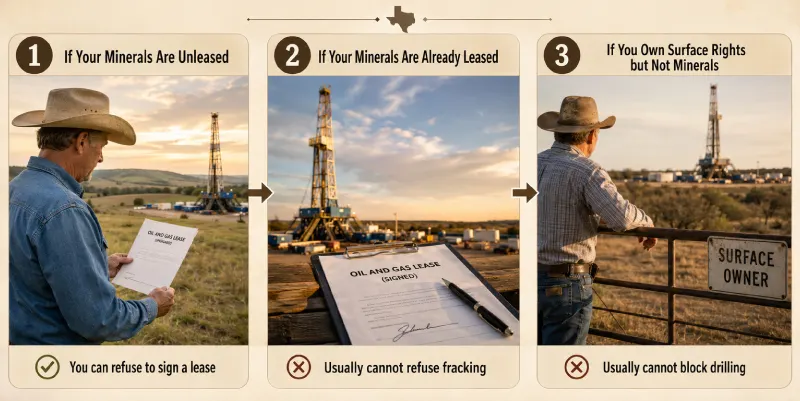
This is one of the most common questions Texas mineral owners ask. The honest answer depends on three things: your lease status, whether forced pooling applies, and what your lease actually says.
If Your Minerals are Unleased
You can refuse to sign a lease, which generally prevents direct development of your mineral interest absent pooling or other legal mechanisms (or any drilling) on your acreage. However, this doesn't always prevent fracking. Texas permits limited compulsory pooling under the Mineral Interest Pooling Act (MIPA), though its use is far less common than in many other oil-producing states, which can force an unleased owner into a drilling unit. The Mineral Interest Pooling Act (MIPA) is infrequently used in Texas and requires approval from the Texas Railroad Commission.
For most owners, refusing to lease simply means no royalty income — and likely no fracking either, since most operators won't drill without lease rights.
If Your Minerals are Already Leased
You generally cannot refuse fracking on a leased property if the lease grants the operator the right to drill and produce. The standard oil and gas lease gives the operator broad rights to develop minerals, including using modern completion techniques like fracking.
However, your lease may restrict specific aspects of the operation. Common restrictions you can negotiate before signing include:
- Surface use limitations (where pads, roads, and lines can go)
- Water sourcing restrictions
- Noise and lighting restrictions during operations
- Notification requirements before specific activities
- Compensation for surface damage beyond statutory minimums
If you're considering a new lease, see how to negotiate an oil and gas lease for the leverage points worth pushing.
If You Own Surface Rights but not Minerals
If someone else owns the minerals under your land (the mineral estate was severed), you generally cannot prevent the mineral owner or their lessee from drilling on your surface. Texas law gives the mineral estate dominance over the surface estate, meaning mineral owners (and their operators) have the right to use as much of the surface as is reasonably necessary to develop the minerals.
You may have rights to surface use compensation under specific circumstances, but you generally cannot block the drilling itself. The Texas accommodation doctrine provides some protection if reasonable alternatives exist that wouldn't disrupt your existing surface use, but it's a high legal bar.
What to Do Next as a Texas Mineral Owner
If fracking is happening, planned, or possible on your acreage, these are the practical next steps:
- Review your lease in detail. Check the royalty rate, deduction clauses, and protective provisions. What's in your lease determines what fracking actually delivers to your check.
- Understand your division order. When the operator sends a division order after first production, verify the decimal interest, property description, and payment terms before signing. Errors here can underpay you for the life of the well.
- Plan around decline curves. Use early royalty income to pay down debt or build reserves, not to fund permanent lifestyle changes. Year-one income is not your long-term cash flow.
- Track your royalty payments. How royalty payments work walks through statement reading, common deductions, and what to do if payments stop or seem wrong.
- If considering selling. Front-loaded fracked-well income makes valuation tricky. How to value mineral rights covers the methods used and what buyers actually pay.
- If leasing for the first time. Read how to negotiate an oil and gas lease before signing anything. The leverage points are real, and the time to use them is before drilling starts.
For broader background on Texas mineral ownership, see mineral rights in Texas.
Once fracking begins and royalties start flowing, the most common mistake Texas mineral owners make is trusting the royalty statement without verifying it. Your operator reports monthly production to the Texas Railroad Commission. That number and your royalty check should align. When they don't, that gap is where underpayment begins - and it often goes unnoticed for years.
MineralView lets you view the production data your operator files with the Texas Railroad Commission, so you can compare it directly against your royalty statement. Check your well's reported production on Mineral View →