Once drilling is completed and the wellhead equipment (commonly known as the “Christmas Tree”) is installed, your role as a mineral owner shifts from leasing to production. Months, and sometimes years later, you may receive a formal document from the operator’s land department: the division order in oil and gas document.
This document often looks complex, combining contractual terms, ownership calculations, and payment authorization details. For many mineral owners across the United States, especially in Texas and the Permian Basin, the division order in oil and gas is the final step before receiving their first royalty check. It formally confirms your ownership interest and authorizes the operator to distribute revenue based on your stated decimal interest.
However, signing a division order is not merely a routine formality. It requires careful review to ensure your ownership percentage is accurate and consistent with your lease terms and applicable state law.
In this blog, we will explain what a division order in oil and gas is, what to review before signing, and how it impacts your royalty payments.

What Is a Division Order in Oil and Gas?
According to the Texas Natural Resources Code, Title 3, Chapter 91, Section 91.401:
(3) “Division order” means an agreement signed by the payee directing the distribution of proceeds from the sale of oil, gas, casinghead gas, or other related hydrocarbons. The order directs and authorizes the payor to make payment for the products taken in accordance with the division order. When used herein, “division order” shall also include “transfer order.”
(4) “Transfer order” means an agreement signed by a payee and his transferee (new payee) directing the payor under the division order to pay another person a share in the oil or gas produced.
This statutory definition establishes that a division order is fundamentally a payment authorization document. It does not create ownership but governs how production proceeds are distributed.
At its simplest, a division order in oil and gas is a written authorization from you, the interest owner, confirming your decimal interest (your share of production revenue) and authorizing the company responsible for distributing revenue (the “payor”) to make payments based on that interest.
The payor is typically the well operator or the first purchaser of the oil or natural gas. The document confirms your exact ownership percentage in the well’s production and authorizes payment based on that interest.
It is equally important to understand what a division order in oil and gas is not.
- It is not a deed.
- It does not transfer or sell your mineral rights.
- It does not create any new mineral ownership.
Instead, it reflects the operator’s internal “pay "deck"—the detailed ownership breakdown used to ensure that 100% of production revenue is distributed accurately among all interest owners.
Note: Under Texas law, a Division Order must follow the legal rules and cannot change the terms of your lease. It simply explains how payments will be made while keeping your original lease rights unchanged.
The Mathematics of Your Wealth: Calculating the Decimal
The most common source of anxiety for mineral owners is the fear that they are being "shortchanged" on their decimal interest. In Texas, the calculation for a standard pooled unit is generall
Let’s look at a real-world example:
Imagine the drilling unit (the total area of land the well is draining) is a massive 640-acre pie.
- You own 40 acres inside that pie.
- Your original lease guarantees you a 25% (or 0.25) royalty rate.
Your math looks like this:
If your division order in oil and gas shows any number lower than this, you must pause.
This can be an indication that the operator believes your interest is "burdened" by a Non-Participating Royalty Interest (NPRI) or that your title is only partial. Never sign until the math reconciles with your records.
For example, Sarah, a mineral owner in Midland County, received her division order and noticed the decimal interest listed was lower than what she calculated. Instead of signing immediately, she reviewed her lease and ownership details and discovered a mistake in the calculation. If she had signed without checking, she could have lost thousands of dollars in royalties over time.
Why the Division Order Title Opinion (DOTO) Matters to Mineral Owners
Before your division order reaches you, thousands of dollars are spent by the operator to ensure everything is in order. This includes a Division Order Title Opinion, where an oil and gas attorney reviews land records and title issues to make sure everything is legally sound.
The title attorney scrutinizes the chain of title for 'gaps' or 'clouds,' such as unprobated estates (intestate deaths), undisclosed divorce settlements, or unrecorded mineral deeds.
When you receive a division order, it usually means the title attorney believes you legally own your minerals and your ownership is clear (this is called having “marketable title”).
But if you or even your neighbors do not receive a division order, it often means there is a title problem. This could be missing paperwork, an unprobated will, or another ownership issue.
Until that problem is fixed, the operator will hold the royalty money in suspense and will not release payment.
The "Suspense" Account: Why Payments Get Put on Hold
"Suspense" is the term used when an operator has the money but cannot legally pay it out. This frequently occurs when the division order in oil and gas has been mailed but is sent back as undeliverable or is the subject of a Title Dispute.
If a family member, such as a brother or cousin, claims ownership of part of your mineral interest, the operator may place the entire interest for that tract in suspense. Payments will remain on hold until the ownership issue is resolved and the operator receives proper documentation, such as a signed Stipulation of Interest or a court order confirming the correct ownership.
And it is upon you to be proactive. In case you cease to receive checks, refer to the lists of unclaimed property at the office of the State Comptroller or to the operator division order analyst at once.
Decoding the Anatomy of the Division Order in Oil and Gas
Every division order in oil and gas contains several "non-negotiable" fields that you must verify against your original lease. Mistakes here are common, especially when properties have been passed down through multiple generations of heirship.
1. The Property Number and Well Name:
Each operator uses its own internal property numbers and well names for accounting purposes, so these identifiers can vary from company to company. Because of this, it is important to cross-check the state-assigned API (American Petroleum Institute) number.
In Texas, the API number is issued by the Railroad Commission of Texas (RRC). Think of the API number as the Social Security Number for your well—it is a standardized, 10-to-14-digit identifier and the absolute most reliable way to track your specific well's production using the state's public RRC databases.
2. Effective Date:
This tells you exactly when your right to payment begins. If a well has been producing for six months but the division order effective date is only last month, you may be missing "back-pay'.
Ensure your division orders match your records. Use Mineral View’s Lease Reports to instantly verify every lease, well, and interest across your portfolio!
3. The Decimal Interest:
This is the "Holy Grail" of the document. It is usually expressed in eight decimal places (e.g., 0.00390625). This number determines your share of every barrel of oil equivalent (BOE) sold.
4. Interest Type:
You will likely see codes like "RI" (Royalty Interest), "ORRI" (Overriding Royalty Interest), or "WI" (Working Interest). Ensure this matches the capacity in which you own the minerals.
Is Signing the Division Order Mandatory?
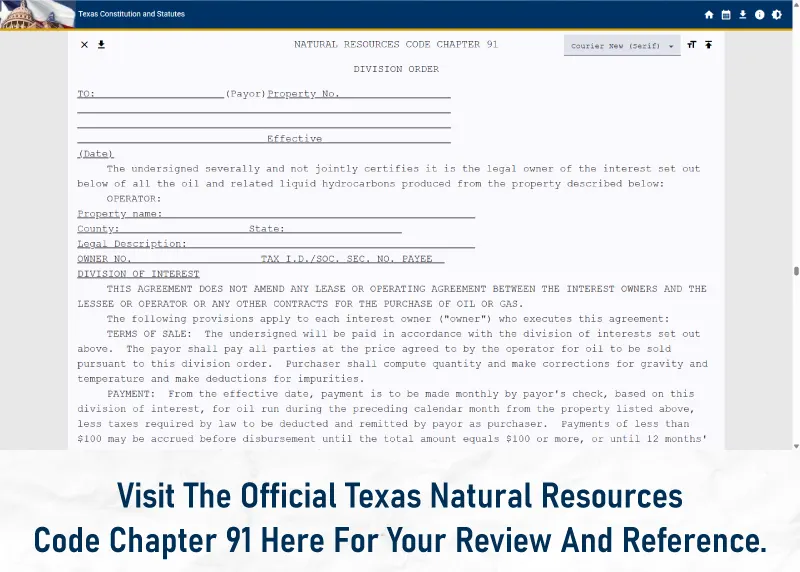 Download Division Order PDF
Note - The above PDF is a custom Division Order reference sheet created for mineral owners, summarizing the most important sections and legal protections from the official statutes, which are current through the 89th 2nd Called Legislative Session and the amendments approved by voters in November 2025.
It is provided for informational purposes only to help you understand key points like the 120-Day Rule, Authorized Provisions, Lease Supremacy Clause, and your rights regarding late interest or non-payment, but it does not replace the full official document.
In Texas, the right to payment is governed by the 1991 Division Order Statute (Natural Resources Code Section 91.402), which balances the operator’s need for indemnity with the owner’s right to timely funds.
If the operator includes "extra" language, such as a clause that changes how your gas is valued or forces you to pay for marketing costs not mentioned in your lease, you have the right to strike those lines or refuse to sign.
However, for most owners, signing the division order for oil and gas is the fastest path to payment. If you refuse to sign a "clean" statutory form, the operator can legally hold your money in a non-interest-bearing suspense account indefinitely.
Tax Implications and the W-9 Requirement
Your division order in the oil and gas package will almost always include an IRS Form W-9. This is not optional. Under federal law, if the operator does not have your Taxpayer Identification Number (TIN) or Social Security Number, they are required to perform "Backup Withholding."
Currently, the IRS mandates a withholding rate of 24%. This means nearly a quarter of your check will be sent directly to the government before you ever see it. By returning the W-9 with your division order oil and gas, you ensure you receive your full gross payment, allowing you to manage your own tax liabilities and take advantage of things like the 15% Statutory Depletion Allowance.
When to Call an Expert: Red Flags to Watch For
While many division orders are standard, some contain “unfavorable clauses”. As a mineral owner, you should seek legal or professional advice if you notice the following:
- Warranty of Title:
- Change in Valuation:
- Missing Interest:
If the document asks you to "warrant and forever defend" the title, be careful. You should only be responsible for title issues created by you, not everyone who owned the land since the 1800s.
If your lease says you get paid based on "Gross Proceeds" but the division order says "Market Value at the Well," the operator may be trying to sneak in transportation and processing deductions.
If you inherited minerals but the division order in oil and gas only shows a portion of what your ancestor owned, there may be an "unprobated will" issue that needs to be addressed in the county records.

Managing Your Division Order with Modern Technology
Managing minerals in complex plays like the Eagle Ford Shale or the Permian Basin requires more than paper records. Many owners now use digital tools to review and confirm their division order with greater accuracy. GIS mapping platforms show unit boundaries and wellbore paths, while databases from the Railroad Commission of Texas (RRC) help verify API numbers and production data.
Online title systems and lease analysis software assist in checking ownership history and recalculating decimal interests. Together, these tools help detect errors and turn a complex division order into a clear financial statement.
Final Thoughts: Your Division Order Roadmap
The arrival of a division order in oil and gas is a major milestone for a mineral owner; it marks the point when production turns into real royalty income.
However, signing it without reviewing the details is risky. While it authorizes payment, the responsibility to verify the decimal interest and terms rests with you, not the operator.
By checking your calculations, understanding your Texas statutory protections, and keeping your records organized, you protect your future royalties. Remember, you are the CEO of your mineral estate, and the operator is simply the manager of the asset.
To be ahead of the curve, the owners are to take advantage of Mineral View Features to retain the competitive advantage. The integrated Maps allow you to visually follow wellbore tracks throughout your tracts, and the MVEstimate allows you a data-driven estimate of the future value of your cash flows.
Also, you can have the transparency to demand accountability of the oil companies due to the Operator Hub and the comprehensive Lease Report capabilities.