If you own minerals in the heart of the Midland Basin or across the sprawling Texas ranchlands, you likely know the feeling of watching a massive oil company plant a single flag on your property. You sign a lease covering 640 acres, they drill one decent well in the corner, and suddenly, your entire section is "held by production." For the next forty years, that one well keeps the other 600 acres locked away, preventing you from leasing to someone else or seeing further development.
This is the "locked-in" trap, and for decades, it left landowners at a massive disadvantage. Enter the Pugh Clause.
Named after a Louisiana lawyer who grew tired of seeing his clients’ land held hostage by a single straw in the ground, this provision is arguably the most important "rider" you will ever negotiate. In the high-stakes environment of Texas oil and gas, where horizontal drilling can tap into stacked formations miles underground, a generic lease is a liability. You need a contract that breathes.
In this guide, we will break down why the Pugh Clause is your primary defense against stagnant production and how to ensure your mineral wealth isn't buried under a "zombie lease."

What Exactly is a Pugh Clause?
At its core, a Pugh Clause is a lease provision that prevents an operator from holding onto non-producing portions of your land after the primary term expires.
Think of a standard oil and gas lease as a "use it or lose it" contract. During the primary term (the initial 3–5 years), the company pays you for the right to explore. Once they find oil, the lease moves into the secondary term. Without a Pugh Clause, one producing well acts like an anchor, holding every acre and every depth of your property under the lease indefinitely, even if the company never drills another hole.
A Pugh Clause severs the connection between the producing acreage and the non-producing acreage. It says to the operator: "You can keep the land you are actually using, but you must give the rest back to me."
Why the Pugh Clause is Non-Negotiable in Modern Texas
In the Permian Basin and the Eagle Ford, we aren't just looking at the surface; we are looking at a "layer cake" of potential. You might have a well producing from the Clearfork formation at 6,000 feet, while the lucrative Wolfcamp shale sits untouched at 10,000 feet.
Without this clause, the oil company owns it all. With a properly drafted clause, you can force the company to either drill those deeper zones or release them so you can lease them to a competitor who will. This creates two distinct benefits for the landowner:
1. Increased Royalty Potential:
More wells mean more checks. By forcing the operator to "drill or drop," you ensure your minerals are being actively harvested.
2. Second Chances:
If the current operator is sitting on their hands, the released acreage can be leased again, bringing in a new signing bonus.
The Two Pillars: Horizontal vs. Vertical Protections
Not all Pugh Clauses are created equal. To truly protect a Texas mineral estate, you have to think in three dimensions.
1. The Horizontal Pugh Clause (Surface Acreage)
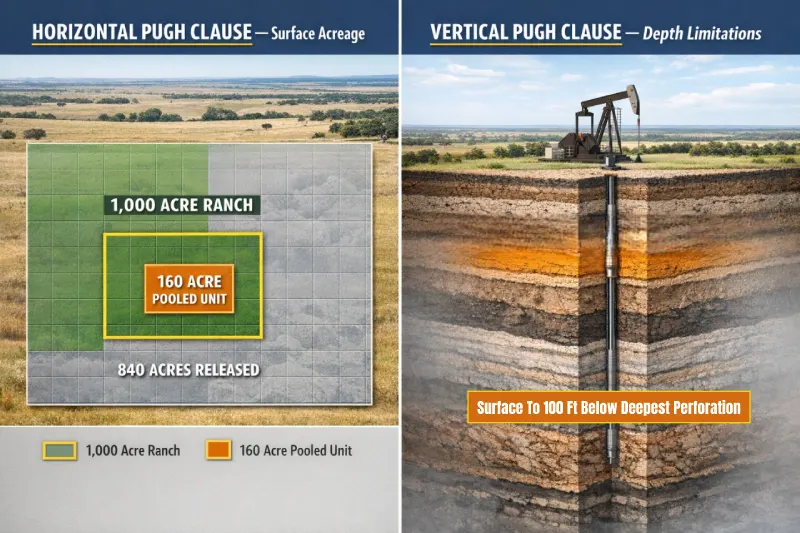
This is the most common version. It focuses on the map. If you own a 1,000-acre ranch and the operator includes 160 acres in a "pooled unit" for a specific well, a horizontal Pugh Clause ensures that at the end of the primary term, the other 840 acres are released.
In Texas, "pooling" is the operator’s best friend. They can combine your land with your neighbor's to form a drilling unit. If the unit well is on the neighbor's side but includes 10 of your acres, your entire 1,000-acre tract could be held. A horizontal clause stops this "tail-wagging-the-dog" scenario.
2. The Vertical Pugh Clause (Depth Limitations)
This is where many landowners leave money on the table. A vertical Pugh Clause—often called a "depth severance"—limits the lease to certain depths.
A common Texas standard is to allow the lessee (Operator) to keep the rights from the surface down to 100 feet below the deepest producing perforation.
Why does this matter? Imagine an operator drills a shallow well. If you don't have a vertical depth limitation, they own the rights to the center of the earth. Years later, when a new technology makes deep shale gas profitable, you can't lease those deep rights because the shallow operator still holds them. A vertical clause "severs" the deep rights and returns them to you.
Anatomy of a Texas Lease: How the Clause Triggers
The Pugh Clause doesn't just sit there; it waits for a "triggering event" to spring into action. Understanding these triggers is the difference between a protected estate and a legal headache.
| Trigger Event | What it Means for the Landowner |
|---|---|
| Expiration of Primary Term | The most common trigger. On the day the 3- or 5-year term ends, all non-producing land is automatically "cut off." |
| Continuous Development Failure | If the lease has a "Continuous Development" clause, the Pugh Clause might trigger if the operator goes 120 or 180 days without starting a new well. |
| Cessation of Production | If a well stops producing in "paying quantities" and isn’t fixed within a set window (usually 60–90 days), the acreage reverts to you. |
Proactive Monitoring: Don't Wait for a Letter
The burden of proof in Texas oil and gas law often falls squarely on the landowner to demonstrate that a lease has expired or that production has ceased in "paying quantities." You shouldn't have to drive to the wellhead every week or manually hunt through RRC filings to protect your interests.
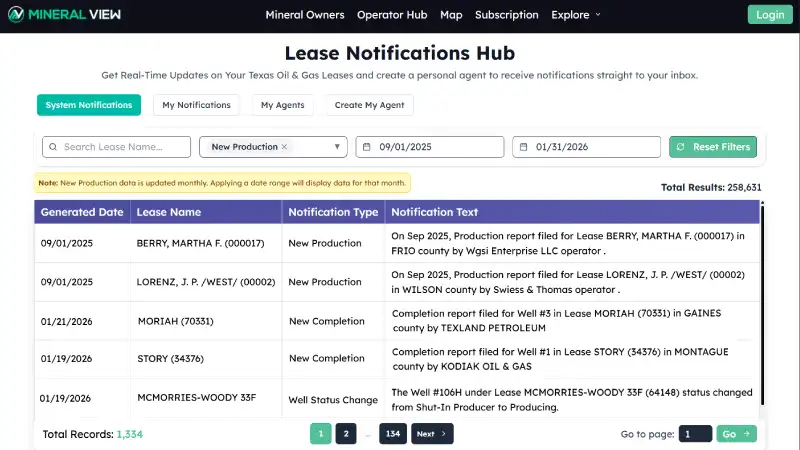
Using the Mineral View Lease Notification Agent means you get automatic alerts about what is happening on your land, such as the details of new permits, new completion, production and well status changes. Instead of guessing, you will know exactly when a well stops making enough money.
With this information in hand, you can prove the Pugh Clause has been triggered and demand the company release your lease. This helps you get your land back quickly so you can find a better deal without a protracted legal battle.
The "Paying Quantities" Nuance
In Texas, a well is only "producing" if it makes a profit over operating expenses. If an operator is running a well at a loss just to hold onto your 5,000 acres of minerals, a savvy lawyer can use the Pugh Clause in tandem with the "paying quantities" rule to terminate the lease.
Common Pitfalls: Where Landowners Get Burned
Since there is no "Standard Texas Pugh Clause" written into state law, the language is everything. Companies will often try to insert "watered-down" versions that look like protection but contain loopholes.
The "Unit" Trap:
Some clauses say they only release land "not included in a unit." The operator then creates a massive, bloated unit that covers your whole property but only drills one well. To fight this, you need to limit the size of the units (e.g., no more than 40 acres for oil or 640 for gas).
The "Automatic" vs. "Notice" Dispute:
Does the land revert to you automatically, or do you have to send a certified letter? Always aim for "automatic" reversion. You shouldn't have to ask for what is already yours.
The Missing Release of Record:
Even if a lease expires, it stays on the county books like a "cloud" on your title. Your clause should mandate that the company file a Formal Release of Lease within 30 days of the trigger. If they don't, you may have trouble selling or re-leasing the land because the title looks "dirty."
The "Retained Acreage" Clause vs. The Pugh Clause
In Texas legal circles, people often use these terms interchangeably, but there is a subtle difference.
- A Pugh Clause usually deals with land outside of a pooled unit.
- A Retained Acreage Clause deals with how much land an operator can keep around a well on your own property.
For a Texas landowner, you want both. You want to limit the acreage they can keep around each wellbore, and you want to ensure any land not actively being drilled is returned to you.
Strategic Negotiation: Tips for the Permian and Beyond
If you are sitting across the table from a landman, remember that they are paid to get as much "acreage for the buck" as possible. Use these strategies to strengthen your position:
1. Define "Depth" Precisely
Don't just say "bottom of the well." Use stratigraphic markers. For example: "The lease shall terminate as to all depths lying more than 100 feet below the stratigraphic equivalent of the base of the Wolfcamp B formation as seen in the [Specific Well Name] log." This leaves no room for guessing.
2. Address the "Stacked" Potential
If you are in a high-activity zone, consider a "rolling" Pugh Clause. This means the lease is evaluated every year. If they aren't actively drilling new layers, they lose the ones they aren't using.
3. Watch the "Shut-In" Clause
Operators often use "Shut-in Royalties" to keep a lease alive without actually producing oil. They pay you a small fee (often as low as $1.00 per acre) to keep the lease in "waiting mode." Ensure your Pugh Clause triggers even if a well is "shut-in," or at least limit how long a shut-in can hold the non-producing acreage.
4. The "Buffer" Acreage
Companies will argue they need a buffer for horizontal laterals. While this is true for safety and regulatory spacing, don't let them take 640 acres for a well that only needs 160. Align your Pugh Clause with the Texas Railroad Commission (RRC) minimum spacing rules.
Practical Checklist for Landowners
If you have an existing lease or are looking at a new one, go through this checklist:
- [ ] Does the lease mention "Horizontal" and "Vertical" severance?
- [ ] Is there a specific footage limit for depth (e.g., 100 feet below)?
- [ ] Is the operator required to file a release in the county records?
- [ ] Does the clause apply to "pooled units" specifically?
- [ ] Have you defined "paying quantities" to avoid zombie wells?
The Texas Reality: No Statutory Safety Net
It is worth repeating: Texas law will not save you if your contract is weak. In states like Oklahoma, the law provides a basic level of Pugh protection for certain units. In Texas, our courts are "freedom of contract" courts. This means if you sign a lease that lets an operator hold 10,000 acres with a single low-producing well, the judge will likely say, "You signed it; you live with it."
This makes the negotiation phase the only time you have real leverage. Once the rig is on-site and the primary term is running, the power shifts entirely to the operator.
Navigating the Nuances: Why Drafting Matters
When you draft a Pugh clause, the primary purpose of a Pugh provision is to ensure that no part of your land is "held hostage" by inactivity. It is critical to understand how horizontal Pugh clauses differ from vertical ones in practice. While a horizontal provision carves out surface acreage, a vertical one is designed to restrict the lessee's rights to only those layers where the property is producing oil or gas.
Without both vertical and horizontal Pugh protections, a property remains under lease in its entirety even if only a shallow zone is active. A well-crafted clause will restrict the lessee's rights to specific formations, effectively returning the rights to specific depths—like the deep Wolfcamp—back to the landowner. This ensures the lessor's ability to lease those undeveloped layers to a more aggressive operator.
The core clause is to protect you from "lazy" production where a single well holds hundreds of acres, yet the entire property stays tied up for decades. By specifically defining the portions of the leased premises that revert to you, you maintain the flexibility and liquidity of your mineral estate.
Conclusion: Why the Pugh Clause is Your Legacy
A Pugh Clause is more than legal jargon; it is a tool to protect your family’s most valuable asset. In Texas, mineral rights are often passed down for generations, and leaving them "locked up" in a stagnant lease hurts the future of your land.
By insisting on these protections, you ensure that if one company won't drill, you have the legal freedom to find one that will. Don’t settle for a "standard" form—give yourself an expert’s edge and never let a single well hold your acreage hostage.
Negotiating a strong Pugh Clause is the first step and managing it for the next forty years is the next step. To ensure you aren’t leaving money on the table, utilize Mineral View Features such as MVestimate (mineral rights value), Lease Report, Well Report and Texas Oil and Gas Map to manage your mineral rights effectively while avoiding the legal disputes.
Knowledge is power in the oil patch, and having a "one-stop" dashboard for your Texas mineral data ensures your "Landowner's Shield" stays sharp for generations to come.