For many Texas mineral owners, an oil and gas lease offer arrives before they fully understand what they are being asked to sign. A landman may call, a standard lease form may arrive, and the owner may feel pressure to respond quickly. This guide explains what an oil and gas lease is, which terms matter most, and what Texas mineral owners should review before signing, so they can make a more informed decision.

What Should Mineral Owners Check Before Signing an Oil and Gas Lease?
Quick Review Checklist Before Signing
Before signing an oil and gas lease, mineral owners should look beyond the upfront bonus. A lease can affect royalty income, acreage control, surface use, and future development rights for years.
- Lease bonus per net mineral acre: The lease bonus is the upfront payment offered by the operator. It is usually based on your net mineral acres, which means the actual mineral interest you own, not always the total land acres. A higher bonus may sound attractive, but it should not be the only reason to sign.
- Royalty Rate: The royalty rate is the percentage of production revenue you receive if oil or gas is produced. This can matter more than the bonus because royalties may continue for many years. Mineral owners should review both the percentage and how the royalty is calculated.
- Post-production cost language: Post-production costs are expenses after oil or gas leaves the well, such as gathering, compression, transportation, processing, and marketing. If the lease allows these deductions, your royalty check may be reduced. Look for clear language about whether deductions can be taken.
- Primary term: The primary term is the time the operator has to drill before the lease expires. Common terms may be three or five years. A longer term can keep your minerals locked up even if no drilling happens.
- Lease addendum: A lease addendum is an extra document added to the standard lease. It can include protections for the mineral owner, such as no-deductions language, surface protections, Pugh clause, depth clause, and better shut-in terms.
- Pugh clause: A Pugh clause can help release acreage that is not included in a producing unit. Without it, one producing well may hold more acreage than expected.
- Depth clause: A depth clause can release deeper or unused formations that the operator is not developing. This helps prevent one lease from holding all depths under your land forever.
- Pooling language: Pooling allows the operator to combine your minerals with nearby tracts to form a drilling unit. Mineral owners should understand how pooling affects their acreage, royalty share, and long-term control.
- Surface use protections: If you also own the surface, review how the operator can use the land for roads, pads, tanks, pipelines, and equipment. Surface protections can help reduce damage and clarify who is responsible for restoration after operations.
- Assignment language: Operators may sell or assign the lease to another company. The lease should clearly explain whether you will receive notice and whether the new operator must follow the same lease terms.
- Nearby wells, permits, and operator activity: Before signing, check what is happening around your minerals. Nearby permits, producing wells, and active operators can help you understand whether the area is quiet, developing, or highly active.
- Attorney review before signing: An oil and gas lease is a legal document. Before signing, mineral owners should consider having an oil and gas attorney review the lease, especially if the lease involves valuable acreage, unclear terms, or a strong operator interest.
What Is an Oil and Gas Lease?
An oil and gas lease is a legal contract that gives an oil and gas company the right to explore for, drill, and produce oil or gas from a specific property or mineral tract.
By signing a lease, the mineral owner does not usually sell the minerals. The owner keeps ownership of the minerals but gives the company permission to develop them. In return, the owner usually receives a lease bonus, which is an upfront payment, and a royalty, which is a share of production revenue if oil or gas is produced.
In Texas, mineral owners are often contacted by a landman working for an operator. The landman’s job is to secure enough leases in an area so the operator can move forward with drilling. The first lease form offered is often the operator’s standard form. Mineral owners should treat it as a starting point for review, questions, and possible negotiation, not as something they must sign exactly as written.
The Mineral Owner, Operator, and Landman
Lessor: The lessor is the mineral owner who signs the lease and gives the company the right to develop the minerals.
Lessee: The lessee is the company or party receiving the right to explore, drill, and produce oil or gas under the lease.
Landman: A landman is the person who contacts mineral owners, presents lease offers, answers basic questions, and helps the operator gather lease coverage in an area.
Operator: The operator is the oil and gas company responsible for drilling, managing, and producing the well. Sometimes the lessee and operator are the same company, but not always.
What Rights Does the Lease Give the Operator?
An oil and gas lease may give the operator several important rights, depending on the lease language.
These may include:
- The right to explore for oil and gas
- The right to drill wells
- The right to produce and sell oil or gas
- The right to use certain land areas for roads, well pads, tanks, pipelines, or equipment
Surface Rights vs Mineral Rights in Texas
In Texas, surface rights and mineral rights can be owned by different people. Surface rights control the land above ground. This includes the use of the land for homes, farming, roads, buildings, fencing, or other surface activities. Mineral rights control the oil, gas, and minerals below the ground.
This means a person may own the land surface but not the minerals underneath. It also means a mineral owner may own the oil and gas rights even if they do not own the surface land. For Texas mineral owners, this matters because a lease may affect underground mineral development and, depending on the lease language, certain surface activities such as roads, pads, tanks, pipelines, or equipment.
If you own both the surface and the minerals, surface use protections should be reviewed carefully before signing.
Why Texas Mineral Owners Should Not Treat the First Lease Offer as Final
The first oil and gas lease offer should not automatically be treated as the final offer. In many cases, it is the operator’s starting point. Mineral owners should take time to review the lease carefully before signing because the terms can affect royalty income, acreage control, and mineral rights for many years.
The Standard Lease Form Usually Favors the Operator
Most lease offers start with the operator’s standard lease form. This form is often written to give the operator broad rights and flexibility. It may allow long lease terms, post-production cost deductions, broad pooling rights, surface use, or the ability to hold more acreage than expected.
That does not automatically make the lease bad, but it does mean the mineral owner should read it carefully and ask questions before signing.
Why Signing Too Quickly Can Affect Royalties, Acreage, and Long-Term Control
Signing too quickly can create long-term problems. A lease does not only affect the upfront bonus. It can also affect how royalties are calculated, whether costs are deducted, how much acreage is held, which depths are controlled, and how long the operator can keep the lease active.
For example, a mineral owner may accept a good bonus but later lose money through post-production cost deductions. Another owner may sign a lease without a Pugh clause, allowing one producing well to hold more acreage than they expected.
When a Mineral Owner Should Slow Down and Review the Details
A mineral owner should slow down before signing if:
- The landman is pressuring them to sign quickly
- The lease does not include an addendum
- The royalty language is unclear
- Post-production costs are allowed
- The primary term feels too long
- The lease gives broad surface use rights
- The lease can hold all depths or large acreage
- The owner is unsure how many net mineral acres they own
- There is nearby drilling or permit activity
Before signing, mineral owners should review the lease terms, check nearby wells and operator activity, and consider having an oil and gas attorney review the document.
How the Oil and Gas Lease Process Usually Works in Texas
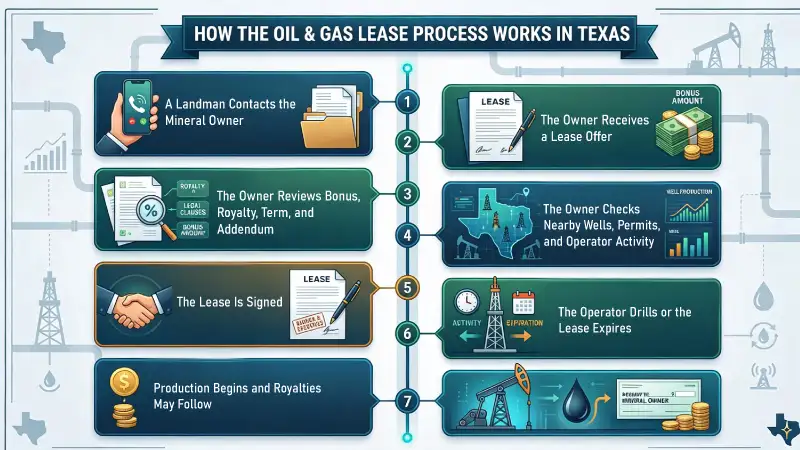
The oil and gas lease process usually starts when an operator becomes interested in drilling or developing minerals in a certain area. For mineral owners, understanding each step helps avoid rushing into a lease without knowing what the terms mean.
Step 1: A Landman Contacts the Mineral Owner
A landman may contact the mineral owner by phone, mail, email, or in person. The landman usually works for the operator or a leasing company. Their job is to contact owners, confirm ownership, and secure lease agreements in the area.
Step 2: The Owner Receives a Lease Offer
The mineral owner receives a lease offer. This usually includes a lease bonus, royalty rate, primary term, and a standard lease form.
Step 3: The Owner Reviews Bonus, Royalty, Term, and Addendum
Before signing, the owner should review the main financial and legal terms. The bonus is the upfront payment. The royalty rate is the share of production revenue the owner may receive. The primary term is how long the operator has to drill before the lease may expire.
The owner should also review or request a lease addendum, which can add important protections such as no-deductions language, Pugh clause, depth clause, and surface use limits.
Step 4: The Owner Checks Nearby Wells, Permits, and Operator Activity
Before accepting the offer, the owner should check what is happening nearby. Nearby wells, permits, operators, and production activity can help the owner understand whether the area is active or quiet.
If there is strong drilling activity nearby, the owner may have more reason to carefully review the offer before signing.
Step 5: The Lease Is Signed
Once the owner agrees to the terms, the lease is signed. After signing, the operator receives the right to explore, drill, and produce oil or gas according to the lease language.
Step 6: The Operator Drills or the Lease Expires
After the lease is signed, the operator may drill during the primary term. If no well is drilled and the lease is not extended, the lease may expire.
If a well is drilled and produces in paying quantities, the lease may continue into the secondary term and stay active as long as qualifying production continues.
Step 7: Production Begins and Royalties May Follow
If the well produces oil or gas, the mineral owner may begin receiving royalty payments. The amount depends on the lease royalty rate, ownership share, production volume, product price, taxes, and whether post-production costs are deducted.
Key Oil and Gas Lease Terms Every Mineral Owner Should Know
Most leases share the same small set of terms. Knowing them by name makes the rest of this article, and any conversation with a landman, far easier to follow.
Lease Bonus
A one-time, upfront payment from the operator to the mineral owner, usually quoted as a lease bonus per acre of net mineral acres. Bonus amounts vary widely by basin, formation, and current drilling activity. A reasonable bonus in an active area is very different from a reasonable bonus in a quiet one.
Royalty Rate
The percentage of production revenue the mineral owner receives once a well is producing. Oil and gas royalty rates are often written as a fraction or percentage, such as 1/8, 3/16, 1/5, or 1/4. The right rate depends on the location, operator interest, current activity, and lease language. Between the bonus and royalty rate, the royalty rate may have a larger long-term impact if the well produces for many years.
Primary Term
Fixed period, usually three or five years, during which the lessee has the right to drill without producing. If no well is drilled by the end of the primary term, the lease typically expires. If a well produces in paying quantities, the lease typically continues into its secondary term under the habendum clause.
Shut-in Payments
When a well is capable of producing but is temporarily not, a shut-in royalty may be paid to keep the lease alive. The size and frequency of shut-in payments are specified in the lease itself.
These four terms are the foundation of most oil and gas leases. Once mineral owners understand them, the rest of the lease becomes easier to review.
A standard oil and gas lease may not fully protect the mineral owner on its first draft. The lease addendum is often where important owner protections are added.
What Is a Lease Addendum and Why It Protects You
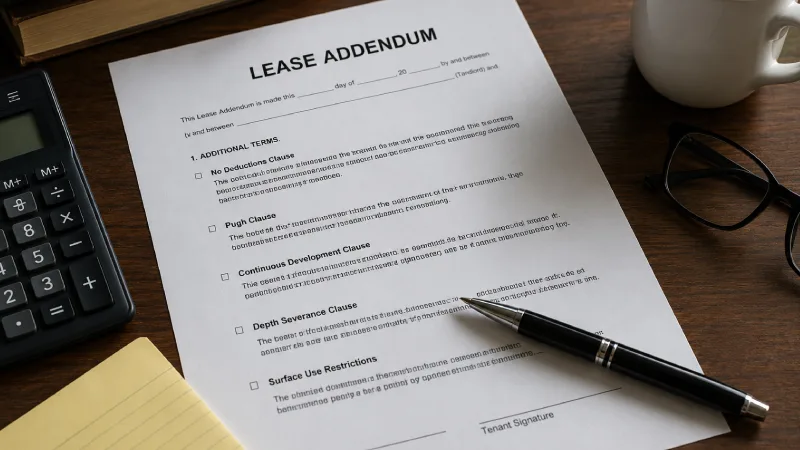
The standard form is written by the operator's lawyers. A lease addendum is the additional document an owner attaches to the standard form to change, restrict, or add to its terms. It is one of the most important tools a mineral owner has before signing.
A lease addendum can add protections that are missing from the standard form and can modify terms that are too broad or unclear.
Common protective clauses found in addenda include:
- A no-deductions clause limiting or eliminating post-production cost deductions from royalty.
- A Pugh clause releasing acreage that is not included in a producing unit at the end of the primary term.
- A continuous development clause requiring ongoing drilling activity to keep undeveloped acreage held.
- A depth severance clause limiting the lease to the formations being developed, releasing depths that are not.
- Restrictions on surface use, if the owner also owns the surface.
Post-Production Costs: Where Mineral Owners Lose Royalty Money
A royalty rate may look straightforward on paper. In practice, it often is not, because post-production costs are commonly deducted from the royalty before it reaches the owner.
Post-production costs are the expenses incurred between the wellhead and the point of sale: gathering, compressing, dehydrating, transporting, processing, and marketing the oil or gas. Depending on the lease language, these costs can reduce the amount that actually reaches the mineral owner.
Rules around post-production costs can vary by state, and lease language is often critical. Texas mineral owners should pay close attention to how the lease defines royalty calculation and deductions.
Over the life of a producing well, the difference between royalty with deductions and royalty without deductions can become meaningful.
Pooling, Pugh Clauses, and Depth Clauses: Terms That Can Control Your Minerals for Years
Crucial terms like pooling, Pugh clauses, and depth clauses ultimately dictate how much of your acreage, depth, and future royalty income stay tied to a lease. To fully understand how these specific terms protect your mineral rights from being held indefinitely without development, check out our comprehensive guide, What are the Oil, Gas, and Mineral Lease Clauses?
Why These Clauses Matter Before Signing
Pooling, Pugh clauses, and depth clauses all affect long-term control. They can decide whether your minerals stay locked under one lease or whether unused acreage and formations can be released.
Before signing, mineral owners should ask:
- Can my minerals be pooled with other tracts?
- How large can the pooled unit be?
- Will unused acreage be released?
- Will unused depths or formations be released?
- Can one producing well hold more than expected?
These clauses may look technical, but they can have a major impact on future lease opportunities, royalty income, and control of your mineral rights.
Red Flags Before Signing an Oil and Gas Lease
Not every oil and gas lease offer is owner-friendly. Some terms may look normal at first but can affect royalty income, acreage control, surface use, or future leasing options. Before signing, mineral owners should watch for these red flags.
The Landman Is Pressuring You to Sign Quickly
If a landman is pushing for an immediate signature, take time to review the lease carefully. A lease is a long-term legal agreement. You should have time to review the terms, compare the offer, check nearby activity, and ask questions before signing.
The Lease Does Not Include an Addendum
A standard lease form usually favors the operator. A lease addendum allows the mineral owner to add protections, such as no-deductions language, Pugh clause, depth clause, better shut-in terms, and surface use limits. If no addendum is included, important owner protections may be missing.
The Royalty Looks High, But Deductions Are Allowed
A high royalty rate can look attractive, but the actual payment may be lower if the lease allows post-production cost deductions. These deductions may include transportation, compression, processing, gathering, and marketing costs. Mineral owners should review whether the royalty is paid on gross proceeds or reduced by costs.
The Primary Term Is Too Long for an Active Area
The primary term is the time the operator has to drill before the lease may expire. If the area already has strong drilling or permit activity, a long primary term may give the operator more time than needed while keeping your minerals locked up.
The Lease Can Hold Too Much Acreage or Too Many Depths
Without a Pugh clause or depth clause, one producing well may hold more acreage or more underground formations than expected. This can prevent you from leasing unused acreage or deeper formations to another operator later.
Shut-in Payments Are Too Low
A shut-in royalty may allow the operator to keep the lease active when a well is capable of producing but is temporarily not producing. If shut-in payments are very low, the operator may be able to hold the lease without meaningful payment to the owner.
Surface Use Language Is Too Broad
If you own the surface, broad surface use language can allow roads, well pads, tanks, pipelines, or equipment on your land with limited restrictions. Surface protections should clearly explain how the land can be used, how damage is handled, and what restoration is required.
The Lease Allows Assignment Without Clear Notice
Operators often sell or assign leases to other companies. The lease should explain whether the mineral owner will receive notice and whether the new operator must follow the same lease terms. Without clear assignment language, you may not know who controls the lease later.
The Lease Includes Broad Warranty Language
A broad warranty clause may require the mineral owner to guarantee ownership of the minerals. This can be risky, especially if ownership was inherited or title history is unclear. Mineral owners should be careful about signing broad warranty language without review.
How Nearby Wells, Operators, and Production Activity Can Help You Ask Better Lease Questions
Before signing an oil and gas lease, mineral owners should also review nearby wells, operators, permits, production history, and county activity. This information can help you ask better questions before agreeing to lease terms.
Why Nearby Drilling Activity Matters Before Signing
Nearby drilling activity can show whether your area is quiet, slowly developing, or actively being targeted by operators. If wells are being drilled close to your minerals, it may mean the area has stronger development interest.
Nearby activity does not guarantee future drilling on your minerals, but it can help you understand local development interest. In an active area, mineral owners may want to review the lease bonus, royalty rate, primary term, and addendum more carefully.
Why Operator Activity Matters
The operator matters because different companies may have different drilling plans, production history, and development strategies. If an operator is already filing permits, completing wells, or producing nearby, that can tell you they may be serious about the area.
Mineral owners can ask questions like:
- Is this operator active near my minerals?
- Has this operator drilled nearby wells?
- Are they producing oil or gas in this area?
- Are they leasing acreage for future drilling?
Why Production History Matters
Production history shows how nearby wells have performed over time. It can help mineral owners understand whether wells in the area have produced strongly, declined quickly, or remained active for many years.
This is important because royalty income usually depends on production volume, product prices, royalty rate, ownership share, taxes, and lease deductions. Nearby production history does not predict your exact royalty income, but it gives useful context before signing.
Why Permit Activity Matters Before Signing
A drilling permit can show that an operator may be preparing to drill in a specific area. If permits are being filed near your minerals, it may suggest increased development interest.
This can help mineral owners ask stronger questions, such as:
- Are there new permits near my minerals?
- Which operator filed the permit?
- Is the permit close to my tract?
- Is the operator leasing more acreage nearby?
Why County and Basin Activity Can Affect Lease Conversations
Oil and gas activity often changes by county, basin, and formation. A lease offer in an active county or basin may need to be reviewed differently than an offer in a quiet area.
For example, if a county has strong drilling, new permits, and active operators, mineral owners may want to pay closer attention to lease terms like royalty rate, primary term, Pugh clause, depth clause, and post-production cost language.
How Mineral View Helps You Review Lease Activity Before Signing
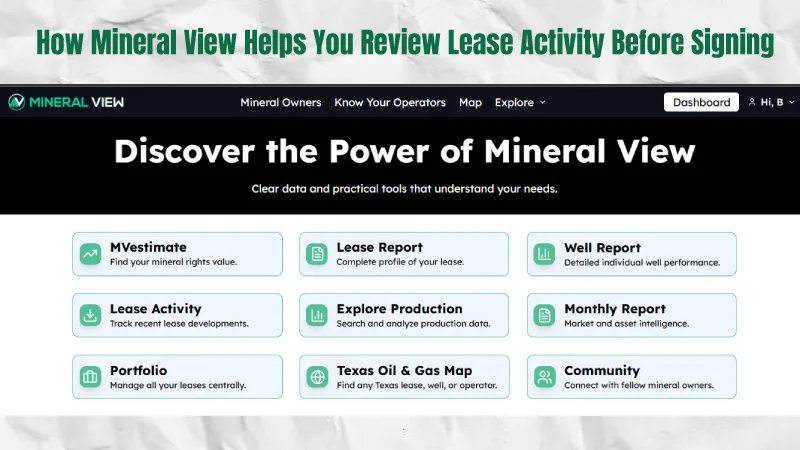
Many mineral owners navigate lease decisions with significantly less market visibility than operators. Mineral View addresses this information gap by consolidating regional permits, regulatory filings, and historical production data into a single platform. This consolidated data helps owners gather clear context before finalizing any paperwork.
Regional Data Analysis Before Signing
Reviewing Nearby Wells:
The platform integrates the interactive Texas Oil & Gas Map alongside comprehensive Well Reports. This allows owners to track permitted, drilling, completed, and producing wells in their immediate vicinity.
Tracking Operator Activity:
Users can research active operators by searching via county, company name, or API number. This reveals whether the firm offering the lease is currently drilling or filing new permits nearby.
Analyzing Production Context:
By displaying regional production trends and current well statuses in one place, the platform provides real-world context for ongoing discussions.
Post-Claim Monitoring and Forecasting
Tracking Lease Activity:
After a lease is claimed, the Lease Activity feed monitors regulatory updates filed with the Railroad Commission of Texas, providing brief explanations of what changed and why it matters.
Utilizing MVestimate:
Once a lease is claimed, the MVestimate feature generates data-driven royalty income forecasts using historical production data and decline analysis, offering a baseline for understanding potential asset value.
Data-Driven Insights
While the platform does not replace professional legal advice, it provides objective insights regarding local activity, active operators, and nearby production.
If you already received a lease offer and want to understand what to discuss with a landman, read our guide on how to negotiate an oil and gas lease in Texas.
Final Lease Review Checklist for Texas Mineral Owners
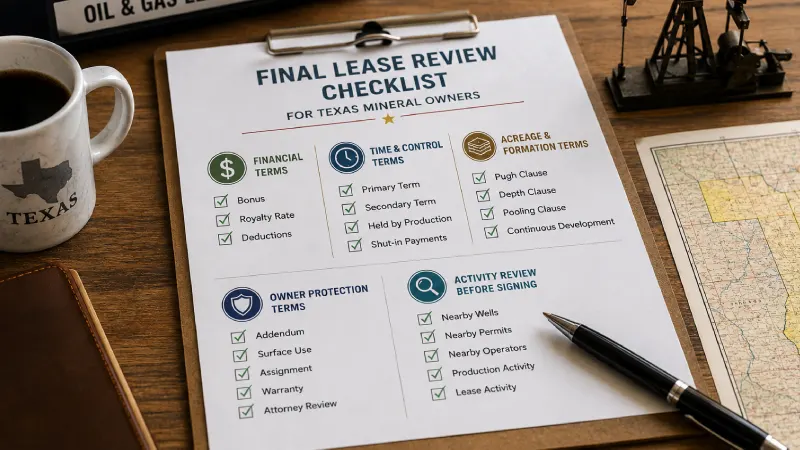
Before signing an oil and gas lease, mineral owners should review the lease as a long-term agreement, not just a one-time payment. Use this checklist to confirm the most important terms are clear before you sign.
Financial Terms
Bonus: Check the lease bonus amount and confirm whether it is based on your net mineral acres. The bonus is the upfront payment, but it should be reviewed alongside royalty rate, deductions, term length, and owner protections.
Royalty rate: Review the royalty percentage you will receive from production revenue. A strong royalty rate can be more valuable over time than a higher upfront bonus, depending on production and lease language.
Deductions: Check whether the lease allows post-production cost deductions for gathering, transportation, compression, processing, or marketing. These costs can reduce your royalty check.
Time and Control Terms
Primary term: The primary term is the time the operator has to drill before the lease may expire. A longer primary term can keep your minerals tied up even if no drilling happens.
Secondary term: The secondary term begins if production starts. The lease may continue as long as the well produces according to the lease terms.
Held by production: Held by production, or HBP, means a producing well may keep the lease active beyond the primary term. Mineral owners should understand how much acreage and which depths can be held.
Shut-in payments: A shut-in payment may keep the lease active when a well is capable of producing but is temporarily not producing. Make sure the payment amount and time limits are reasonable.
Acreage and Formation Terms
Pugh clause: A Pugh clause can release acreage that is not included in a producing unit. This helps prevent one well from holding more acreage than expected.
Depth clause: A depth clause can release deeper or unused formations that the operator is not developing. This helps protect future leasing opportunities.
Pooling clause: Pooling allows the operator to combine your minerals with nearby tracts into one drilling unit. Review how pooling affects your royalty share and acreage control.
Continuous development clause: A continuous development clause can require the operator to keep drilling within certain time periods if they want to hold more acreage. This helps prevent undeveloped minerals from being locked up for too long.
Owner Protection Terms
Addendum: A lease addendum adds owner-friendly protections to the standard lease form. Important protections may include no-deductions language, Pugh clause, depth clause, surface protections, and assignment terms.
Surface use: If you own the surface, review how the operator can use the land for roads, pads, tanks, pipelines, and equipment. The lease should also address damages and restoration.
Assignment: Operators may assign or sell the lease to another company. Check whether you will receive notice and whether the new operator must follow the same lease terms.
Warranty: Be careful with broad warranty language. It may require you to guarantee ownership of the minerals, which can be risky if ownership history is unclear.
Attorney review: An oil and gas lease is a legal document. If the lease involves valuable minerals, unclear terms, or strong operator interest, consider having an oil and gas attorney review it before signing.
Activity Review Before Signing
Nearby wells: Check whether wells are already permitted, drilling, completed, or producing near your minerals.
Nearby permits: New permits may show that operators are preparing for drilling activity in the area.
Nearby operators: Review which operators are active nearby and whether the operator offering the lease has activity in the same area.
Production activity: Nearby production history can help you understand whether the area has active wells and ongoing development.
Lease activity: Review local lease and operator activity before signing. This can help you ask better questions and understand whether your offer reflects what is happening around your minerals.
Final Thoughts: Review the Lease Before You Sign
An oil and gas lease is not just a routine document. It is a long-term agreement that can affect royalty income, mineral control, and future development opportunities. Understanding the core lease terms, using an addendum when needed, and reviewing key protections can help mineral owners make a more informed decision.
Many owners also use tools like Mineral View to better understand nearby activity and evaluate lease opportunities with more context before signing.