Owning a piece of the Lone Star State is a dream for many, but in Texas, what you see on the surface is often only half the story. If you’ve ever walked across a Texas ranch and wondered if there’s a fortune sitting thousands of feet below your boots, you’re thinking about mineral rights in Texas.
Whether you are a multi-generational landowner or a first-time investor, the rules of the game have changed significantly as we move through 2026.
From new court rulings on who owns the "empty space" underground to the RRC’s latest environmental overhauls, staying informed isn't just a good idea-it’s a financial necessity.
This comprehensive guide will help you understand the detailed insights of mineral rights in Texas.
What Are Mineral Rights In Texas?
At its core, owning mineral rights means you have the legal authority to explore, extract, and sell the natural resources found beneath a specific tract of land. In Texas, "minerals" typically refers to oil and gas, but the definition can also include coal, lignite, and sulfur.
One of the most unique aspects of mineral rights in Texas is that they are considered "real property." This means they can be sold, gifted, or leased just like the house you live in.
However, unlike your house, these rights often stay hidden until a landman knocks on your door with a lease agreement. In 2026, we are also seeing an increased interest in "non-traditional" minerals like lithium found in produced water, which is adding a new layer of value to the traditional mineral estate.
Mineral and Surface Rights: Two Separate Estates
Texas is a "split estate" state. This is the concept that often trips up new buyers. You can buy 100 acres in the Permian Basin and own every blade of grass, but you might own zero percent of the oil beneath it.
The Surface Estate: This includes the dirt, the trees, the water (usually), and any structures.
The Mineral Estate: This includes the oil, gas, and other minerals.
According to The Railroad Commission Texas (RRC), Texas law recognizes the mineral estate as the dominant estate. This means that while a mineral owner does not have unlimited rights over the surface, they do have an implied right to use as much of the surface as is reasonably necessary to explore for and produce minerals. The RRC outlines this relationship between surface and mineral ownership in its Oil & Gas FAQ guidance (rrc.texas.gov).
When managing these overlapping interests, understanding where surface boundaries and mineral rights intersect is critical. Disputes often arise from unclear boundaries or development activity near property lines.
Digital mapping tools can help visualize these intersections and reduce the risk of costly misunderstandings. Mineral View’s mapping features provide interactive maps that allow users to clearly see surface tracts, well locations, and related activity in one place.
You can utilize Mineral View’s mapping features for interactive maps.
Ownership and Transfer of Mineral Rights in Texas
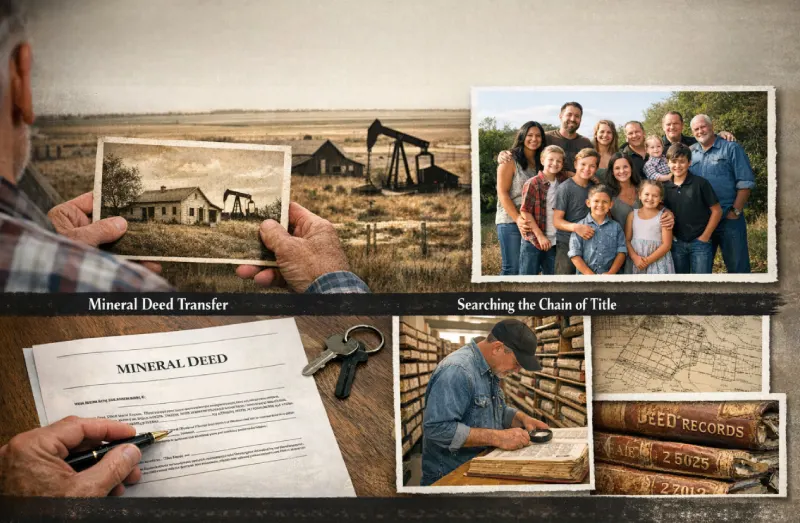
Back in the 1800s, most people owned both the surface and the minerals (known as "fee simple"). Over the decades, however, those rights were "severed." A grandfather might have sold the land but kept the minerals for his kids. Fast forward three generations, and those minerals might be owned by 50 different cousins spread across the country.
Transferring mineral rights in Texas usually happens through a Mineral Deed. Because ownership can become so fragmented, understanding how to find who owns mineral rights in Texas and performing a proper "title search" is non-negotiable. You have to trace the "chain of title" all the way back to the original sovereign grant.
Mineral Leases and Gas Leases
Unless you own a drilling rig, you probably won't be extracting the oil yourself. Instead, you’ll sign a mineral lease. Think of this as a temporary "rental agreement" where you give an oil company (the lessee) the right to drill in exchange for:
- A Signing Bonus: An upfront, per-acre payment.
- Royalties: A percentage of the revenue from every barrel produced.
- Delay Rentals: Payments made if they don't start drilling within a certain timeframe.
In 2026, a "standard" royalty is often 20% to 25%, though this varies by region. It’s important to watch out for "post-production deductions," where companies try to subtract the cost of transporting and cleaning the gas from your check.
Rights and Responsibilities of Mineral Owners and Surface Owners
Being the "dominant" estate doesn't give a mineral owner a blank check. They are bound by the Accommodation Doctrine. This rule states that if a surface owner has an existing use (like a pivot irrigation system) and the mineral owner can reasonably drill somewhere else that doesn't break the bank, they must accommodate the surface owner.
Furthermore, a 2025 Texas Supreme Court ruling clarified that the "pore space"-the actual physical cavities left behind after minerals are extracted-belongs to the surface owner. This is huge for 2026, as these spaces are now being used for Carbon Capture and Storage (CCS). If a company wants to pump CO₂ into a void under your land, they may need to pay you, the surface owner, even if you don't own the minerals.
How to Buy Mineral Rights in Texas
Buying mineral rights in Texas today is a mix of networking, due diligence, and data analysis. You can buy "producing" rights (where a well is already pumping money) or "non-producing" rights (a risk on future drilling), and many owners also consider selling mineral rights in Texas when market conditions are favorable.
The smartest investors in 2026 don't just guess; they use data-driven tools. Mineral View Features provides the latest production data and permit tracking, which helps you see where the rigs are moving before the rest of the market catches on. Due diligence is your best friend here.
You should review reliable production data sources and current regional output forecasts to ensure the price you’re paying aligns with realistic return expectations and overall market conditions.
Benefits and Risks of Owning Mineral Rights in Texas
The Benefits
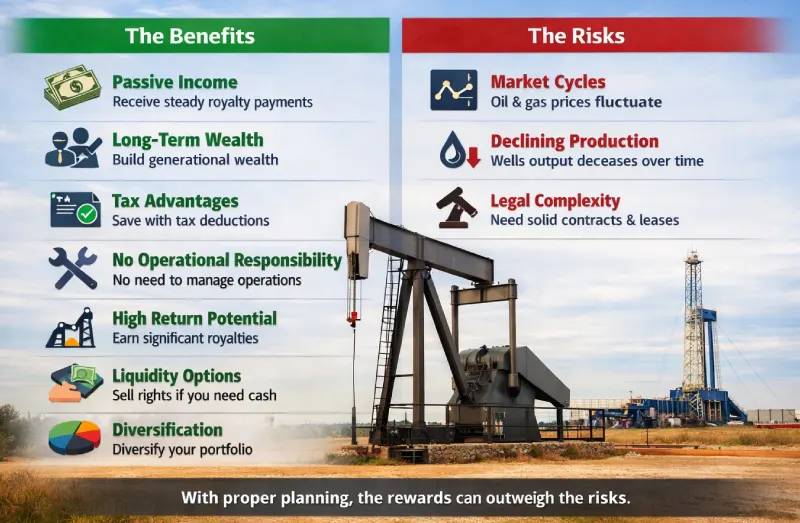
1. Passive Income:
Mineral rights can generate steady royalty payments without you having to drill or operate a well yourself. Once a well is producing, you may receive monthly income for many years. This “mailbox money” can help support retirement, pay off debt, or build additional investments.
2. Long-Term Wealth:
Mineral rights are a real asset that can increase in value over time, especially in active oil and gas areas. They can also be passed down to children or grandchildren, creating generational wealth. In some cases, future drilling activity can unlock new value even years later.
3. Tax Advantages:
Mineral owners may qualify for certain tax benefits, including depletion deductions and other industry-related incentives. These benefits can help reduce taxable income and improve overall returns. With proper planning, mineral ownership can be tax-efficient compared to many other investments.
4. No Operational Responsibility:
As a mineral owner, you are not responsible for drilling costs, equipment maintenance, or daily operations. The operator handles the technical and financial risks of production. You benefit from the revenue without managing the project yourself.
5. High Return Potential:
If a strong well is drilled on your property, royalty income can exceed what many traditional investments provide. In active areas, even a small ownership percentage can produce meaningful income.
6. Liquidity Options:
Mineral rights can be sold fully or partially if you ever need access to cash. Owners have the flexibility to sell a portion of their interest while keeping the rest for future income.
7. Diversification:
Mineral rights are not directly tied to the stock market or real estate trends. This makes them a useful way to diversify an investment portfolio and spread financial risk.
8. Future Development Upside:
Advances in drilling technology and new exploration zones can create value where none existed before. Land that once seemed inactive may become productive years later.
The Risks
1. Market Cycles Create Opportunity:
Income from mineral rights depends on oil and gas prices, which naturally rise and fall. While this can cause short-term changes in revenue, strong market cycles can also lead to periods of higher-than-expected earnings. Long-term owners often benefit by holding through different price cycles.
2. Production Naturally Changes Over Time:
Every well has a life cycle, and production will eventually decline, but many wells can produce for 20 to 40 years depending on the field and technology used.
While output typically decreases over time, new drilling, improved technology, and enhanced recovery methods can extend production or add new wells to the property. Planning ahead allows owners to make the most of peak production years while preparing for long-term income changes.
3. Legal Structure Provides Protection:
Mineral ownership involves contracts and lease agreements, which must be properly written. The good news is that clear and well-negotiated agreements provide strong legal protection. With professional guidance and careful review, most disputes can be avoided or minimized.
Even though owning mineral rights involves certain risks, it also offers significant long-term benefits. For many Texans, owning mineral rights is a source of pride and a powerful wealth-building opportunity. With proper due diligence, strong lease agreements, and informed decision-making, these risks can be effectively managed and substantially reduced.
The Role of the Railroad Commission of Texas
Despite the name, the Texas Railroad Commission (RRC) has nothing to do with trains. They are the primary regulators of the oil and gas industry. Their job is to prevent waste of oil and gas and protect the correlative rights of owners (which means making sure each mineral owner gets their fair share of production without harming the rights of others).
In 2026, the RRC is heavily focused on the new Chapter 4 environmental rules. These regulations require stronger liners for waste pits and encourage the recycling of produced water, the salty water that comes up along with oil during production. For mineral owners, it is important to ensure that the operator working on your minerals is fully compliant with RRC regulations, because environmental violations can lead to production shut-ins that may temporarily stop your royalty payments.
To avoid such risks and stay informed about what is happening around your minerals. Mineral owners are increasingly moving beyond traditional paper records and relying on modern digital intelligence tools for better oversight and decision-making.
From Paper Trails to Digital Intelligence
Managing mineral rights in 2026 is a high-stakes puzzle where staying ahead of the curve is a strategy, not an option. By syncing directly with RRC data, Mineral View bridges the gap between raw industry files and the peace of mind every owner deserves. Our interactive mapping and Permit Tracking features allow you to visualize exactly where rigs are moving in relation to your property lines.
Whether you use Notification Agents for Delaware Basin permits or MVestimate to project your mineral rights value, the platform replaces guesswork with precision. These automated alerts and professional Lease Reports ensure you are never the last to know about activity on your land.
By transforming complex geological data into actionable insights, the platform provides a professional-grade clarity that ensures every decision regarding a Texas estate is backed by industry-level precision.
A Legacy Built on 75 Years of Texas Oil & Gas

At Mineral View, we are more than just developers, we are a family of Texas oil and gas veterans. Built on over 75 years of combined family experience in the industry, our platform reflects real-world knowledge gained from generations of working with mineral rights. The founders and CEO created Mineral View with a clear purpose: to address the real challenges Texas landowners have faced for decades when managing and protecting their mineral assets.
By turning decades of boots-on-the-ground industry experience into modern digital tools, Mineral View brings trusted expertise and practical intelligence together to help mineral owners make smarter, more confident decisions.
Final Thoughts
Navigating mineral rights in Texas is a journey through history, law, and geology. As we’ve seen, the landscape in 2026 is more sophisticated than ever. The "dominant" status of the mineral estate still holds, but new protections for surface owners and stricter RRC environmental standards mean that both parties must play by a more refined set of rules
Success in the Texas oil patch comes down to three things: clear title, a strong lease, and constant monitoring. Whether you are negotiating a new lease in the Haynesville Shale or managing an inherited interest in West Texas, having access to reliable data and Mineral View features can help you track production, monitor activity, and stay informed about changes that affect your revenue.
Knowledge is your most valuable asset. The minerals under the ground are a finite resource, but the wealth they generate can last generations when you manage your mineral rights in Texas with precision, informed decisions, and the the right digital tools to safeguard your future.