As of January 2026, thousands of feet beneath your property, pressurized reservoirs of crude and natural gas are seeing a major resurgence due to new federal leasing incentives and export demand. You do not own the drilling rig, you did not employ the engineers, and you are not putting a penny of your savings on the job of getting that oil to the surface. But once a month, a check is included in the mail.
This is no gift; it is a Royalty Payment.
The royalty payment is a life-altering source of passive income to many Americans, especially in such states as Texas, Oklahoma, and Pennsylvania. However, the one between a hole in the ground and a deposit in your bank account is covered with a complex jargon of the law and hard math. To safeguard your interests, however, you must know very clearly how royalties are made in the oil and gas business.
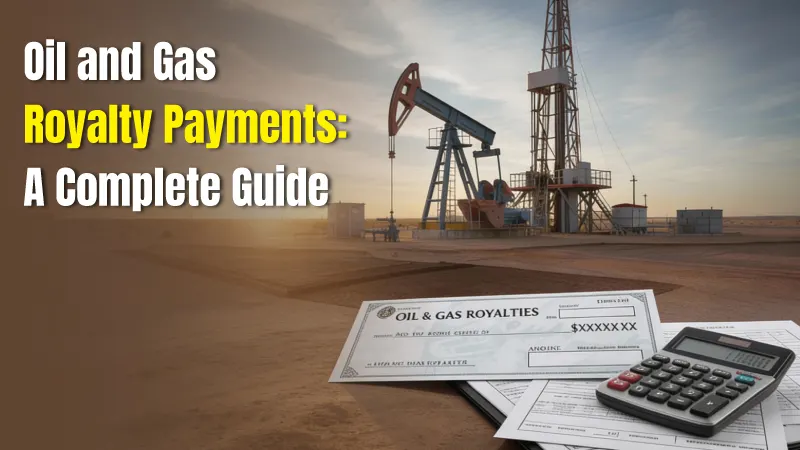
What Is an Oil and Gas Royalty Payments?
An oil and gas royalty payments is a cost-free share of production revenue paid to a mineral owner. In 2026, Texas rates typically range from 18.75% to 25%. Unlike working interests, royalty owners bear no drilling costs and may qualify for new 2026 severance tax exemptions on restimulated wells. When you sign an Oil and Gas Lease, you aren't selling your minerals.
Instead, you are granting an operator (the "Lessee") the right to explore and produce those minerals for a specific window of time. In exchange for taking the risk and covering the costs of drilling, the company keeps the majority of the revenue.
However, they must pay you a "carved out" percentage of the gross production, free of the costs of drilling or operating the well. This is the defining characteristic of a royalty: it is "cost-free" regarding the actual extraction. While the oil company has to pay for the multimillion-dollar drill bit and the crew, your Royalty Payment starts from the very first drop of oil sold.
How Royalties Work in the Oil and Gas Industry
To understand the lifecycle of a payment, you have to look at the transition from "Minerals in Place" to "Cash in Hand."
- The Lease Agreement: This is the contract that sets your royalty rate (e.g., 18.75%).
- Production: The operator drills a well and connects it to a pipeline.
- The Division Order: Before you get paid, the company sends a "Division Order." This document confirms your Decimal Interest (your specific slice of the pie) and ensures you agree with the company's ownership records.
- The Sale: The operator sells the oil or gas to a midstream company or refinery.
- Distribution: The operator calculates the total revenue and distributes a Royalty Payment to every interest owner, usually 60 to 90 days after the month of production.
Types of Royalties in Oil and Gas
Not all royalty interests are created equal. Depending on how you acquired your rights, you might hold one of several types of interests:
- Lessor’s Royalty: This is the most common type. It is the interest retained by a landowner when they execute an oil and gas lease.
- Non-Participating Royalty Interest (NPRI): This is a 'stripped' right that, in 2026, is frequently being audited by owners to ensure that 'Carbon Pore Space' rights weren't accidentally bundled into the old mineral deed. An NPRI owner gets a check when production happens, but they don't have the right to sign leases or collect "bonus" money. This often happens when a previous landowner sells the land but keeps a portion of the future royalty.
- Overriding Royalty Interest (ORRI): Unlike the first two, an ORRI is carved out of the working interest (the company’s share). These are often given to geologists or landmen as a commission. They expire when the lease expires.
| Type | Paid From | Can Lease? | Expires? |
|---|---|---|---|
| Lessor’s Royalty | Production | Yes | No |
| NPRI | Production | No | No |
| ORRI | Working Interest | No | Yes |
How to Calculate Your Oil & Gas Royalty Payments
If you’ve ever looked at a royalty check stub, it looks like a foreign language. However, learning how to calculate your oil & gas royalty is the only way to ensure the operator isn't underpaying you.
The basic formula relies on four variables:
- Your Net Mineral Acres (NMA): How much of the "mineral estate" you actually own.
- The Unit Size: The total acreage dedicated to the well (often 640 or 1,280 acres).
- The Royalty Rate: The percentage stated in your lease (e.g., 20% or 1/5th).
- The Price of Oil/Gas: The market value at the time of sale.
The calculation for your "Decimal Interest" looks like this:

Once you have your Decimal Interest, you can determine your payment:
Gross Royalty Payment = Decimal Interest × Total Revenue
For example,
Assume the following:
-
Net Mineral Acres (NMA) = 40 acres
-
Unit Size = 640 acres
-
Royalty Rate = 25% (0.25)
-
Total Monthly Revenue = $100,000

Gross Royalty Payment = 0.015625 × 100,000 = $1,562.50
This amount represents your expected royalty payment before taxes and permitted deductions. Understanding how to calculate your oil & gas royalty keeps the "check-cutter" honest.
Estimate Potential Royalty Income Using Well-Level Production and Ownership Data.

Post-Production Deductions
You have to be wary of deductions when learning how to calculate your oil & gas royalty. Almost all the leases enable the oil company to deduct the expenses that are incurred in terms of transporting, dehydrating, and compressing the gas to the market.
Following the 2025 Texas legal shifts, 'Gross Proceeds' language must be strictly enforced; check your 2026 stubs to ensure operators aren't 're-labeling' transportation costs as 'marketing fees' to circumvent your lease terms. Nevertheless, when your lease is silent or contains Net Proceeds language, then your Royalty Payment can be very much less than it should have been. Check your check stub: Is it Taxes or Deductions?
Royalty Interest vs. Working Interest
It is vital to distinguish between these two.
-
Royalty Interest:
-
Working Interest:
You have "skin in the game" for the profit, but no liability for the bills. If the well is a "dry hole" (it fails), you lose nothing but time.
This is what the oil company holds. They get the lion's share of the money (usually 75-85%), but they also pay 100% of the costs. If a well costs $\$10$ million to drill and fails, the working interest owner loses that money.
Typical Oil and Gas Royalty Rates
While everything is negotiable, the market dictates "standard" rates based on the risk of the area:
| Region/Type | Common Royalty Rate |
|---|---|
| Federal Onshore Leases | 12.5% (The OBBBA (One Big Beautiful Bill Act) of 2025 officially restored the 12.5% minimum for new leases, reversing the 2022 16.67% floor) |
| Established Basins (Permian/Bakken) | 18.75% to 25% |
| Wildcat/Unproven Areas | 12.5% (The traditional "1/8th") |
In the modern era, a 1/8th royalty is generally considered "low" for private landowners. Most savvy owners push for at least 3/16ths (18.75%) or 1/5th (20%).
Understanding Lease Payments
Before a single drop of oil is produced, you receive a Lease Payment, commonly called a "signing bonus."
This is a one-time, upfront payment made per acre.
The Lease Bonus Payment is calculated as:
Lease Bonus = Bonus per Acre × Net Mineral Acres
Example
Assume the following:
-
Bonus per Acre = $1,000
-
Net Mineral Acres = 20 acres
Lease Bonus = 1000 × 20 = $20,000
This amount is paid one time upon signing the lease and is separate from royalty income. Royalty Payments begin only after the well is drilled and is producing.
You can think of the lease bonus as the entry fee, while royalties represent your long-term residual income.
Reporting and Tax Obligations
The IRS views a Royalty Payment as ordinary income, not capital gains. This is a common point of confusion for new owners.
-
1099-MISC:
-
Depletion Allowance:
-
Severance Taxes:
- Incorrect Decimal Interests: The company might have your acreage count wrong.
- Market Enhancement Clauses: The company is charging you for "processing" that actually happened before the gas was in a marketable state.
- Shut-in Royalties: If a well is capable of producing but the company hasn't turned it on, they might owe you a "Shut-in Royalty" to keep the lease active.
- Performance Royalties: Triggered when a song is played or a patent is used in a product.
- Fixed Fee Structures: A set dollar amount per unit, rather than a percentage of the revenue generated.
- Tiered Structures: Where rates change based on royalty transactions hitting certain milestones.
Every year, the operator will send you a Form 1099-MISC if you earned more than $10.
This is the "silver lining." Because the oil in the ground is a wasting asset (once it’s gone, it’s gone), the IRS allows you to deduct a portion of your royalty income (usually 15%) from your taxable total. This is a massive benefit for royalty owners.
While Texas normally takes a 4.6% oil severance tax, HB 3159 (effective Jan 1, 2026) provides a 100% exemption for up to 36 months for 'Restimulation Wells' that were previously inactive.
Auditing and Common Disputes
Do not assume the oil company's math is always correct. From "clerical errors" to aggressive deduction accounting, mistakes happen.
As a royalty owner, you usually have the "Right to Audit" in your lease. With the January 2026 price spike to $65, any 'flat' or 'declining' royalty checks are a red flag; use the RRC’s 2026 Production Data Query (PDQ) to verify that the volumes on your check match the state’s official records. Common disputes involve:
Compare Reported Well Production with Your Royalty Records for Better Transparency.
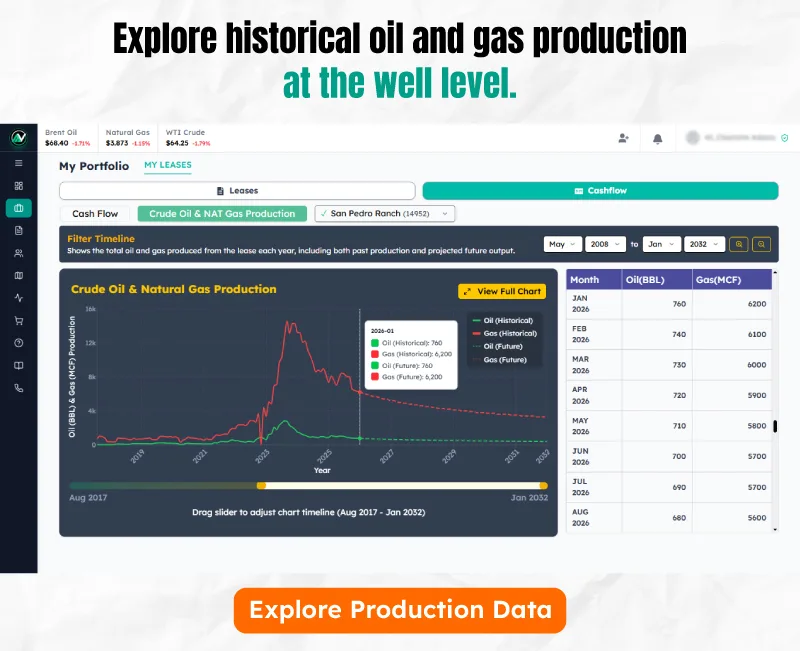
The Role of Technology in Modern Royalties
The industry is moving away from paper ledgers. Today, many royalty owners use online portals to track their royalty payment history. These platforms allow you to see production volumes in real time and compare them against state regulatory data (such as the Texas Railroad Commission or the Oklahoma Corporation Commission).
Analyze Royalty Performance Through Interactive Cash-Flow Charts
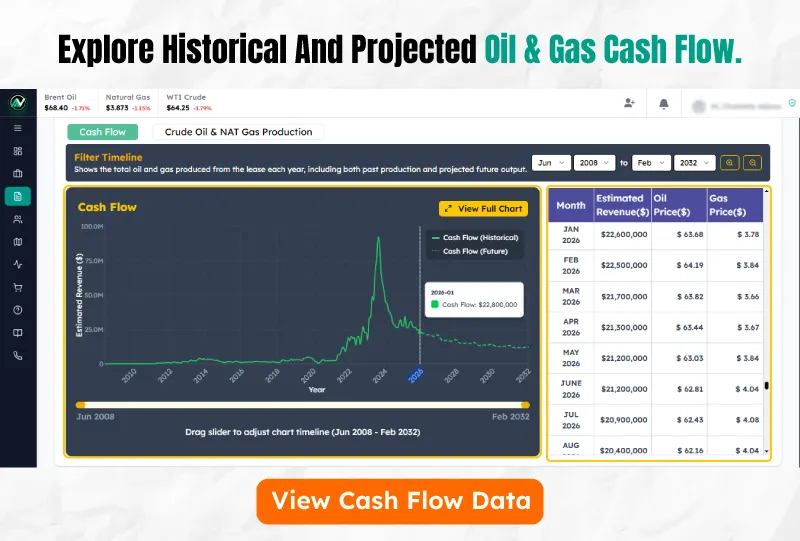
Knowing how to calculate your oil and gas royalty using this third-party data is one of the best ways to ensure transparency. If the state reports that a well produced 1,000 barrels, but your check reflects only 800, that discrepancy deserves immediate attention.
As technology continues to modernize every part of the energy industry, royalty management no longer has to lag behind. With Mineral View’s advanced MVEstimate feature, owners can view an estimated projection of their future royalty income for the next six years. Leveraging tools like this helps reduce manual effort, saves time, and gives owners a clearer financial outlook, without waiting for surprises to show up on a check.
Comparing Mineral Rights and Intellectual Property
While this guide focuses on natural resources, it is helpful to understand that a royalty payment works on a similar legal foundation across many industries. Whether you are dealing with mineral royalties or intellectual property, the core concept is the same: one party owns a licensed asset and allows another to use it for a specific time period.
In the world of intangible assets, companies may pay royalties for patent royalties or software through a licensing agreement. Much like an oil lease, a royalty agreement in these sectors defines the payment schedule, geographic limitations, and whether the cash flow is based on gross or net revenues. For example, in the music or tech world, you might see:
Regardless of the asset, you must be diligent about monitoring your payment status. Just as oil companies audit their wells, tech companies audit their licensees to ensure all royalties are paid accurately. However, the legal implications of a mineral lease are often more "permanent" than a software license, as they involve real property rights rather than just "use" rights.
Ultimately, whether you receive royalties for a book or a barrel of oil, the terms are negotiated on a case-by-case basis. Understanding the broader context of how these payments function ensures you treat your mineral rights with the same professional scrutiny as any other high-value investment.
Conclusion
Navigating the world of mineral rights can feel like learning a new language. However, the effort is worth it. A Royalty Payment is more than just a check; it is a financial legacy tied to the very earth you own.
Understanding how royalties work in the oil and gas industry, from the initial lease bonus to the complexities of post-production deductions, is the only way to ensure you aren't leaving money on the table. Whether you are calculating your first check or auditing a decade of history, remember that you are a partner in the energy production of this country.
By mastering how to calculate your oil & gas royalty, you transform from a passive observer into an informed mineral manager, capable of protecting your property for generations to come.