A mineral lease may look like a standard document, but in reality, it’s where the true value of your minerals is decided. Certain important terms can determine how much you earn, how long your land stays locked, and whether you benefit from future opportunities or miss them entirely.
That’s why understanding oil, gas, and mineral lease clauses is essential.
These specific lease provisions act as the rules of mineral ownership. Think of them as the "terms of service" for your minerals. Let’s understand them in detail.

Key Oil, Gas, and Mineral Lease Clauses Every Texas Mineral Owner Should Know
To truly protect your legacy, you must distinguish between the "Base Lease" (which favors the oil company) and the "Addendum" (where you build your defense).
Standard Form Clauses (Base Lease)
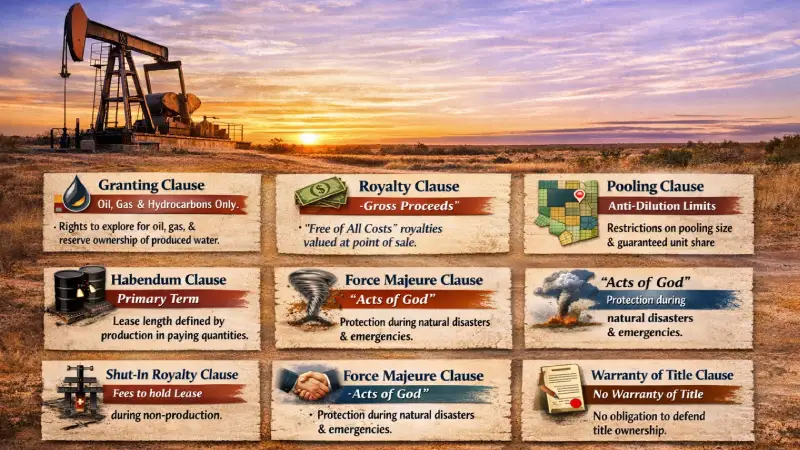
The base lease, often called a "Producers 88," is the initial form a landman will hand you. It is designed by the industry, for the industry. While these clauses are necessary for a lease to function, they often lack the specific protections a mineral owner needs to ensure they are paid fairly.
Granting Clause:
Granting clause identifies the specific minerals and substances the lessee is allowed to explore for and produce. It also defines the scope of the lessee's "implied easement" to use your surface. In 2026, it is vital to limit this to 'oil, gas, and associated hydrocarbons' and expressly reserve ownership of produced water to the lessor; otherwise, under recent Texas Supreme Court precedent (Cactus Water Services), the operator may claim full ownership and disposal rights of this byproduct by default.
Royalty Clause:
This is the heart of the financial agreement, establishing the percentage of production revenue you will receive. In the base lease, this often lacks "no-deduction" language, potentially allowing the company to subtract costs for gathering and transportation.
A strong 2026 lease must avoid 'market value at the well' language entirely, as Texas courts use this to allow 'net-back' deductions (subtract transportation and processing costs before paying you). Instead, stipulate a 'Gross Proceeds' royalty valued at the point of sale, explicitly stating that the royalty shall be 'free of all costs' regardless of any conflicting printed terms.
Habendum Clause:
This clause defines the "Primary Term" (the exploration phase) and the "Secondary Term" (the production phase). It dictates that the lease will remain in effect as long as oil or gas is produced in "paying quantities." If a well stops being profitable, the habendum clause is what allows the mineral owner to potentially terminate the lease and regain their rights.
Pooling Clause:
This provision allows the oil company to combine your acreage with neighboring tracts to form a single "unit" for a well. While pooling meets RRC Statewide Rules 37 and 38, owners in 2026 should require 'anti-dilution' provisions to ensure that if only a small portion of their land is pooled, the operator must still pay a minimum guaranteed percentage of the unit's total production. You must ensure the lease limits the size of these pools to prevent your land from being "tied up" by a well that is barely on your property.
Closely related to this is the Mother Hubbard (Cover-All) Clause, which is designed to include small, contiguous strips of land that may have been unintentionally omitted from the legal description. While useful for correcting minor survey gaps, this clause should be carefully limited to avoid unintentionally covering additional acreage. Without proper restrictions, it can result in more of your land being held under the lease than originally intended.
Shut-In Royalty Clause:
This allows a lessee to keep a lease alive even if a gas well is completed but not currently producing due to a lack of pipeline access. The company pays a "shut-in" fee in lieu of actual production royalties. Without strict time limits in this clause, a company could theoretically hold your land for years without ever selling a drop of gas.
To address operational gaps, leases often work alongside Cessation of Production and Dry Hole Clauses, which define a grace period (typically 60 to 90 days) for the operator to resume drilling, reworking, or production if a well stops producing or is deemed non-commercial. This balance protects the operator from temporary setbacks while ensuring your acreage is not left idle indefinitely without continued development.
Force Majeure Clause:
This acts as a "get out of jail free" card for the oil company during extraordinary events like hurricanes or government shutdowns. If an "Act of God" prevents drilling, the lease clock stops ticking. Texas owners should ensure this clause cannot be triggered by the company’s own financial failures or simple equipment breakdowns.
Assignment Clause:
This gives the oil company the right to sell your lease to another operator. While common, you want to ensure the original company remains liable for any damage and that you are notified in writing when the lease changes hands. Without a "consent to assign" provision, you could end up dealing with a sub-par operator you never vetted.
Warranty of Title Clause:
This is a trap for the unwary, where the mineral owner "warrants and defends" the title to the minerals. If a title dispute arises later, the company could sue you to recover their bonus and legal fees. Professional Texas mineral owners usually strike this clause or limit it to "by, through, and under" their own ownership.
Proportionate Reduction Clause:
This protects the oil company if it turns out you own less than 100% of the mineral estate. It allows them to reduce your royalty and bonus payments proportionately to your actual ownership. It is a standard "math" clause, but you should verify your ownership via a professional lease report to ensure the company’s math is actually correct.
Surrender Clause:
This allows the company to release the lease (or parts of it) back to you at any time. This is beneficial if they decide not to drill, as it clears your title for the next company. However, you should ensure that surrendering the lease doesn't absolve them of their duty to clean up the surface or plug old wells.
Negotiated Addendum Clauses
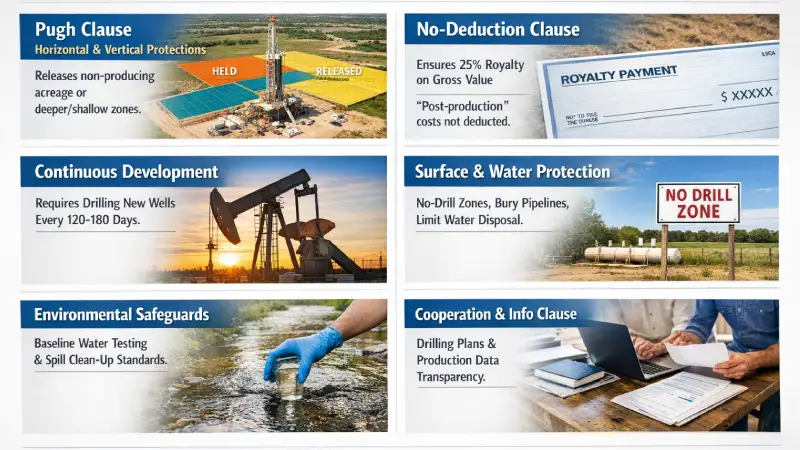
The addendum is where the "real" lease lives. This is a separate document you attach to the base lease that overrides the printed form. If there is a conflict between the addendum and the base lease, the addendum wins. This is where you insert the protections that savvy Texas owners use to maximize their value.
Pugh Clause:
This is one of the most important negotiated provisions for a Texas landowner, designed to prevent large portions of your acreage from being held by limited production activity.
A horizontal Pugh clause ensures that only the acreage included within a producing unit remains under lease, while any land outside that unit is released back to you at the end of the primary term.
A Vertical Pugh Clause further refines this protection by limiting the lease to specific producing depths or geological formations, allowing you to lease deeper or shallower zones separately as new technologies emerge.
By combining both horizontal and vertical protections, mineral owners retain greater control over undeveloped acreage and maximize future leasing opportunities across multiple zones.
Depth Clause:
Similar to a Pugh Clause, this "slices the cake" vertically. It stipulates that the company only keeps the rights to the specific formations they are actually producing from (like the Wolfcamp). Rights to deeper or shallower formations are returned to you, allowing you to sign new leases for different geological layers as technology evolves.
No-Deduction Clause:
This clause explicitly forbids the oil company from taking "post-production" costs out of your royalty check. In Texas, the default is often that you share in these costs, so you must use clear, "heritage-proof" language. This ensures your 25% royalty is actually 25% of the gross value, not 25% of what’s left after the company pays itself for transportation.
To further protect your revenue, strong leases also include audit and inspection rights, allowing mineral owners to review the operator’s books and verify that royalty payments are calculated correctly. In addition, late payment penalties can require interest on delayed payments in accordance with the Texas Natural Resources Code, helping ensure timely and accurate disbursements.
Continuous Development Clause:
This prevents a company from "sitting" on your land after the primary term expires. It requires them to keep drilling new wells within a specific timeframe (often 120 or 180 days) to keep the lease active for the undeveloped acreage. This is the best way to ensure your minerals are fully developed and your income is maximized.
Surface Protection Clauses:
If you own the surface, these clauses are your only defense against pipelines, roads, and tank batteries. You can specify "no-drill" zones, require the company to bury lines below "plow depth," and mandate that they use "closed-loop" systems. These provisions preserve the future value of your Texas ranch or homestead.
Water Disposal Restrictions:
With the rise of horizontal drilling, companies produce massive amounts of saltwater. This clause must also address Seismic Response Area (SRA) compliance; as of 2026, the RRC frequently curtails injection volumes in West Texas, so your lease should specify that the operator bears all costs and liabilities if disposal activities trigger local regulatory shutdowns or tremors. It ensures your land isn't turned into a regional industrial hub without your express and highly compensated permission.
Environmental Protection Clauses:
This goes beyond standard RRC rules to protect your soil and groundwater. It requires the company to perform baseline water testing before they drill and sets strict standards for cleaning up spills. In the event of a leak, this clause gives you the legal "teeth" to demand immediate and thorough remediation of your property.
To ensure enforceability, leases often include a Notice and Cure Provision, which requires the mineral owner to notify the operator in writing if a breach occurs. The operator is then given a defined grace period (commonly around 60 days) to resolve the issue before legal action or lease termination can proceed. This creates a structured process for resolving disputes while still protecting the owner’s rights.
Cooperation and Information Clause:
This clause ensures the lessee provides reasonable information about drilling plans and production data and responds to the mineral owner’s reasonable requests. It promotes transparency and cooperation. By having this data, you can use tools like an Operator Hub to track if the company is meeting its obligations or if you need to file a formal inquiry with the RRC.
Note: These are the most common and vital clauses found in the Texas oil patch, but every property and every deal is different. As oil and gas law changes depending on your specific situation, there may be "hidden" or specialized mineral rights agreements not listed here that are crucial for your unique land.
To make sure you aren't leaving money on the table or accidentally signing away your rights, it is always a smart move to have a mineral expert or a Texas oil and gas attorney review your contract for any extra protective lease terms that could further secure your interests.
How These Clauses Affect Mineral Rights Valuation in Texas
With WTI Crude testing the $100 per barrel mark in March 2026, the difference between a 1/8th and 1/4th royalty isn't just a percentage; it represents a massive capture of the current price rally and protection against inflation-driven service costs.
| Feature | Operator-Friendly (Standard) | Owner-Friendly (Negotiated) |
|---|---|---|
| Royalty | 12.5% (1/8th) | 25% (1/4th) |
| Deductions | Allowed (Post-production costs) | No-Deduction / Gross Proceeds |
| Pugh Clause | None (1 well holds 100% acreage) | Horizontal & Vertical Pugh included |
| Term | 5+ Year Primary Term | 3-Year Primary Term |
Even small differences in lease terms, such as royalty percentage or the presence of a Pugh Clause, can lead to substantial changes in long-term income.
Understanding these variations allows mineral owners to evaluate offers more strategically and avoid leaving significant value on the table.
Contracts Define Mineral Value
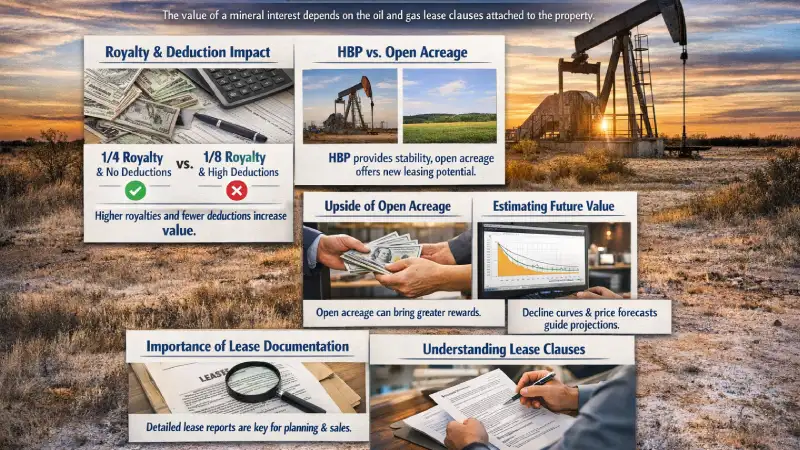
The value of a mineral interest largely depends on the contract that governs it, especially the oil, gas, and mineral lease clauses attached to the property.
Royalty and Deduction Impact
A lease with a 1/4 royalty and a no-deduction clause is generally worth more than a lease with a 1/8 royalty and high post-production deductions.
HBP vs. Open Acreage
Properties that are held by production (HBP) are valued differently than open (unleased) acreage.
Upside of Open Acreage
Open acreage may have greater upside because mineral owners can negotiate a new lease and potentially receive a large bonus payment.
Stability of HBP Properties
HBP acreage often provides more stable value because it generates steady monthly royalty income.
Estimating Future Value
Professionals often project future mineral value using production decline curves and oil price forecasts. Tools like MVEstimate apply these same principles to provide data-driven projections, helping owners better understand potential long-term value.
Importance of Lease Documentation
Having a clear lease report that summarizes royalties, clauses, and production details is useful for estate planning or before deciding to sell.
Understanding Lease Clauses
Knowing how lease clauses affect royalties and property value helps mineral owners avoid leaving money on the table when evaluating their assets.
Real-World Impact of Oil, Gas, and Mineral Lease Clauses
The true impact of a mineral lease is not just in the wording-it’s in the numbers those terms produce over time. Even small differences in lease terms can significantly change your total income.
For example, consider a well that generates $1,000,000 in total revenue.
At a 12.5% royalty, your share would be $125,000
At a 25% royalty, your share increases to $250,000
Now factor in deductions. If post-production costs reduce your revenue by 20%, your effective earnings drop further:
25% royalty with deductions → $200,000
25% royalty without deductions → $250,000
That’s a $50,000 difference from deductions alone and a $125,000 difference based purely on royalty rate, from the same well.
Over multiple wells and years of production, these differences compound, potentially resulting in hundreds of thousands of dollars gained or lost.
This is why understanding and negotiating these energy contracts is not just a legal exercise; it’s a direct financial decision that shapes the long-term value of your mineral assets.
Practical Guidance for Mineral Owners
Making the right decisions about your mineral assets starts with understanding how your specific lease conditions directly impact your income, control, and long-term value. A careful, informed approach can help you avoid costly mistakes and maximize the potential of your minerals.
- Review lease clauses carefully before signing or selling.
- Understand how each clause affects your income and rights.
- Consider current and projected production and market conditions.
- Seek legal counsel experienced in Texas oil and gas law.
- Use Mineral View’s data and features for accurate valuation and market intelligence.