

Loading article
Understanding oil and gas leasing in Texas demands a thorough knowledge of state laws, customs, and industry benchmarks, from mineral rights ownership to lease agreements to royalty rates. The complexities of Texas' oil and gas leasing law play a crucial role in the state's economic growth. Leasing affords mineral landowners diverse bonuses and royalty payments. Often, mineral owners find themselves pondering questions like: How do I get maximum profit from leases? Does it hold any legal aspects? This comprehensive guide will assist mineral landowners as a significant resource for navigating the nuances of oil and gas leasing in Texas and optimizing maximum profits. The aspects include multiple factors such as regulations, agreements, etc. They contribute to the safe exploration, extraction, and production of oil and gas.
Let us first understand what oil and gas leases in Texas are.
Oil and gas leasing in Texas is a routine affair for individuals in the industry or those with mineral rights. Texas distinguishes between two types of leases: public and private. In public leasing, oil and gas development is accessible and owned by the government or other authorities. Another category refers to private leasing. In such leasing, only the person or landowner is eligible for the profits generated from his lease. Here, we have focused on the private leasing of minerals.
Numerous investors and mineral-holding landowners secure considerable profits from leases. An oil and gas lease represents a legally binding agreement sanctioned by US regulatory bodies. As per the agreement, an entity or oil and gas lease company can extract the oil and gas from the owner’s land. The owner permits them to extract minerals beneath his surface. This agreement lies between the company and the landowner. The landowner included in the agreement is addressed as a lessor. However, the company involved in the agreement is known as the lessee.
This agreement consists of two main terms: Primary Term and Secondary Term. The primary term can last anywhere from a month to ten years. The company can extract minerals only until the primary term expires. The agreement includes the secondary term if the owner wants to continue the exploration.
Oil and gas leasing may be complicated. At times, agreements are signed without the landowner's full comprehension, impacting potential earnings. Below are some key points associated with oil and gas leasing that the lessor and lessee should be aware of.
Occasionally, landowners enter agreements without a complete grasp of the rights they're relinquishing, such as permitting undertakings beyond just drilling.
The language of leases encompasses various activities, such as equipment placement, surface usage, and pipeline construction, which may continue even after the lease expires.
In some cases, companies may assign, purchase, or sell the leases without the surface owner's permission.
Extending the primary term can have implications for the mineral estate. It also may have an impact on royalty bonuses.
Understanding the lease provisions is somewhat complex as they may affect the surface rights for a longer time.
The development of oil and gas leasing in Texas has markedly enhanced both the state's and the nation's economy. Here’s a quick historical review of oil and gas leasing in Texas.
The exploration of oil started in Texas.
The Texas Railroad Commission was established.
Spindletop experienced its historic oil boom. It brought a drastic change in oil exploration.
Texas formed numerous oil companies and discovered several oil fields in West Texas.
Leasing practices came to rise. Landowners started allowing companies to explore the minerals beneath their land.
King Ranch entered into Texas' largest private oil lease agreement.
The onset of the Shale Revolution was marked by advancements in hydraulic fracturing and horizontal drilling, which helped enhance leasing practices.
The Financial Accounting Standards Board (FASB) issued the new lease standard.
Transformation is done in the new lease standard ASC 842. With this lease standard, leases can be categorized as finance leases or operating leases.
Texas remains the leading state in oil and gas production with the maximum number of leases.
When it comes to leasing, the landowner should understand all the legal procedures and aspects properly. These aspects are incorporated to offer benefits to the landowner. In some cases, the landowner fails to receive the desired bonus or amount due to a lack of knowledge of leasing terms. Below are some important legal aspects that the landowner needs to understand thoroughly. By following them, the landowner may be able to catch up to the expected profit from his mineral land.
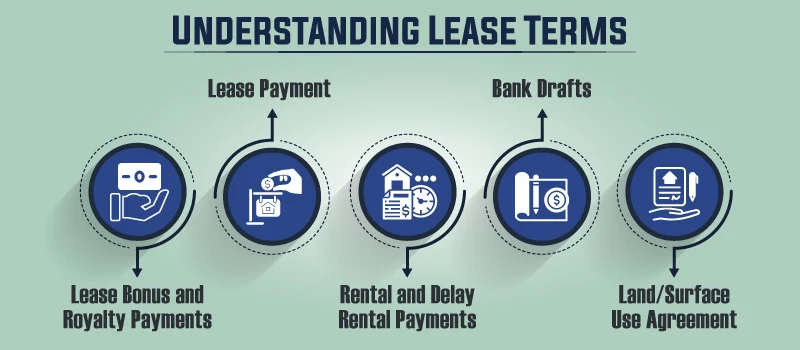
Numerous investors find themselves weighing the choice between lease bonuses and royalty payments. These two payment methods vary. A lease bonus is a one-time payment made at the time of lease signing. Mineral royalty payments are made every month, according to the production sale. It depends on the investor what to choose. He or she may choose a higher bonus at the start, a monthly royalty payment, or both.
An elevated bonus guarantees quick cash distribution to the investor post-lease signing. However, royalty payments are only provided after drilling succeeds. I This choice hinges on the potential yield of the minerals. If you choose a higher bonus, you may receive poor royalty. The lease bonus is evaluated on a dollar per net mineral acre basis. Let’s assume that if the mineral owner possesses a 50% mineral interest in a 640-acre field, he will retain 640 gross acres and 320 (50% * 640) net mineral acres.
Lease payment specifics are detailed in the right-of-way grant provisions, as well as oil and gas leases. It may be a complicated factor for a grant or lease. Signing bonuses are awarded to landowners in exchange for right-of-way considerations or permitting a lease in the latest oil and gas transaction activities.
Offering such payments is common for companies. Once a contract is notarized and signed, they proceed with the payments in bank draft form. Landowners comfortable with personalized payment checks or cash for purchase can prefer bank drafts. A bank draft would be a new financial experience for such landowners.
During shale development, for surface leasing agreements, some companies prefer utilizing bank drafts. Such bank drafts are like personalized payment checks. However, it’s essential to know landowners generally decide the payment standards. In some cases, the bank drafts might cause cancellations or delays in payment. They strictly follow their written statements.
The payment between landowners and landmen includes bank drafts; however, some banks are unaware of this. Therefore, for successful transactions, the landowner should acquire the contact information of the company’s bank and send the draft according to it. This process may involve additional costs. Bank drafts clearly inform the payment schedule along with the limits of business days.
Moreover, the bank drafts keep the record of the lease memorandum, showing the title cloud when there is a delay in payment. The landowner must review the bank draft in detail before signing. He should focus on limiting liability, minimizing payment delays, and clear title in the bank draft. It’s better to delay recording until the complete payment is made successfully.
In oil and gas leasing, the landowner also receives rental and delayed rental payments. The lessee gives the rental payment to the lessor. Such payments primarily serve to preserve the lease's validity. The rental payments depend on different periods. These payments can be carried out annually, quarterly, or monthly. Rental payments maintain oil and gas leases when there is no drilling undertaking on wells, or non-producing wells fail to develop revenue.
Moreover, the leases also include delayed rental payments given to landowners by the operator or company at the time of the primary term. This payment is being delivered as compensation for drilling that will be delayed. Rental and delay rental payments are among the most important aspects of Texas’s oil and gas leasing.
Oil and gas leasing includes land or surface use agreements. The surface owner and mineral owner with separate surface and mineral rights are eligible to prepare such an agreement. This agreement provides real-time usage data on the owner’s land or surface.
The data includes information about how much surface is used and how the drilling and exploration activities are happening. The agreement also includes compensation and reclamation for additional land usage. Landowners can also claim security for land. This agreement only applies to a single person with separate mineral and surface rights.
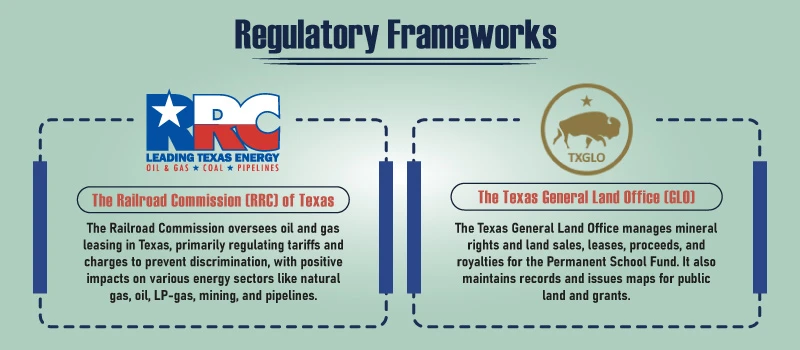
Below are two crucial agencies that carry out the regulatory framework regarding oil and gas leasing in Texas. These frameworks follow the above-motioned legal aspects associated with oil and gas leasing. They include leasing regulations, guidelines, and rules the Texas government implements. Let us understand these agencies and their functions below:
The Railroad Commission plays a key role in supervising oil and gas leasing in Texas. Founded in 1891, it recently marked 130 years of dedicated service to Texans. The RRC primarily focuses on regulating tariffs and railroad charges to avoid discrimination. RRC has had a positive impact on several energy sectors. That includes natural gas, oil, LP-gas, mining activities, and pipeline undertakings. RRC operates under federal as well as state laws. It ensures enforcement and compliance in the above energy sectors. It also secures the environmental standards and crucial infrastructure.
The Texas General Land Office serves as the state's agency. It looks after the mineral rights and land possessed in the state. It oversees the sale of public lands and various leases. GLO manages the proceeds and royalty amounts that go toward funds for the Permanent School of State.
It is utilized for public education purposes. The GLO also keeps records of issuing maps and surveys of public land and land grants. Moreover, it helps to manage the grant funding of federal disaster recovery. The GLO also adds its efforts to appropriately implement oil and gas leasing in Texas. The landowners should consider the GLO as a legal aspect of oil and gas leasing.
The processes of oil and gas lease termination and renewal are notably complex. Oil and gas leases mainly include primary term and secondary term. The lease gets terminated at the end of the primary terms unless the operator or company starts production and drilling activities. The primary term may be extended for up to 10 years.
Landowners and leasing companies should consider the below key factors regarding oil and gas lease termination and renewal:
Typically, the lease can be extended for another term of equal length before the primary term expires.
The bonus payment for the lease extension is often equal to the amount the landowner received during the lease signing, as it is matched or negotiated.
The primary term usually spans five years, except when the Bureau of Ocean Energy Management (BOEM) dictates otherwise:
The lease is in extremely deep water, or it is having another unusual adverse situation.
For the exploration and development of the lease, a longer lease term is needed.
The years may vary based on location or BOEM regulations.
When a well stops producing within three months of the primary term end, the lease ends 90 days after operations stop. This is generally termed ‘Shut-in Royalty,’ the lease terminates when production stops.
Before the 90-day grace period ends, the lease operator must renew the drilling undertakings beyond the initial terms. If he fails to renew, the operator may lose the lease.
The operators must strictly follow the terms of risk termination and option language during the renewal of the lease or risk termination.
For landowners, understanding Texas's oil and gas leasing legalities is crucial. They are considered to receive strong financial benefits from minerals without legal issues. When concerns such as lease terms, royalty conflicts, or environmental regulations arise, they might disrupt both the parties' outcomes in terms of production and profits. Some key legal aspects include royalty payments, bank drafts, lease payments, etc. The landowner must go through a detailed understanding of lease renewal and termination.
Given the rise in the oil and gas industry, leases are contributing to an economic boost. Through leasing, landowners can secure the signing bonuses and royalties they aim for, providing financial gains. Legal aspects of Texas oil and gas leasing have been amended. The Supreme Court of Texas has recently directed major problems like post-production expenses in oil and gas leases, stressing the need for precise and thorough agreements.
It's crucial for the mineral landowner to stay informed about the latest legal aspects of Texas oil and gas leasing. At MineralView.com, we'll keep you updated on the latest lease information and present you with the most up-to-date leasing activities. If you purchase our subscription, you can quickly access and download the ‘Purchase Data’ for Mineral Owner Rolls in standard or customizable format.
Natural gas was discovered during the further development of North Texas. It was considered the byproduct of oil production. The first gas well was successfully discovered in 1918 in North Texas. The production of the well recorded is 10 million cubic feet of natural gas per day.
Texas’s Railroad Commission regulates the oil and gas industry. The RCC’s oil and gas divisions regulate the exploration, transportation, and production of oil and natural gas in Texas.
To find the possession of mineral rights in Texas, you can look at property records, historical documents, and deeds at the county clerk’s office or refer to some online government internet sites.
Another swift option is to buy our subscription plan. Our Purchase and Download feature delivers a detailed overview of mineral possession from county and name of owner to lease essentials, as well as royalty types. You can download information in standard sets or customizable data formats according to your preference. It will reduce your additional research time, and you will easily find who owns Mineral Rights in Texas.
A lease bonus is the payment given to the landowner by the leasing company or operator. This payment is given in consideration for the conveyance and execution of the lease.
Informational only — not legal, tax, or investment advice.