The Texas oil and gas industry has reached a remarkable milestone, over $27 billion in state and local taxes and royalties, according to TXOGA’s 2025 Annual Energy & Economic Impact Report. Behind these numbers are thousands of mineral owners receiving income from the resources beneath their land. For many landowners, oil and gas royalties provide long-term financial benefits that can last for years or even decades. But understanding how these payments work is essential.
Whether you recently inherited mineral rights or have been receiving royalty checks for years, knowing how royalties are calculated and what affects their value can help you make smarter decisions about your mineral assets.
In this guide, we explain how oil and gas royalties work and what mineral owners should know about managing their payments.

What are Oil and Gas Royalties?
Oil and gas royalties are payments made to mineral rights owners when oil or gas is produced from land they own. When a mineral owner leases their property to an oil and gas company, the company gains the right to explore and produce the minerals. In return, the mineral owner receives a share of the revenue generated from production.
This payment is typically expressed as a percentage of the value of oil or gas produced. In Texas, royalty rates commonly range from 12.5% (one-eighth) to 25% (one-fourth), depending on the lease agreement and the location of the property.
The exact royalty rate often depends on several factors, including drilling activity in the area, the expected productivity of the reservoir, and the level of competition among operators seeking leases.
Royalty income is influenced by many elements, including production volumes, commodity prices, and the specific terms written into the lease agreement. Understanding these factors helps mineral owners better evaluate the payments they receive.
Like any resource-based income, royalties also carry some uncertainty. Changes in production levels or crude oil and natural gas prices can affect monthly royalty payments. However, when wells produce consistently, royalty income can provide a stable financial benefit for many years.
What are the Different Types of Oil and Gas Royalties?
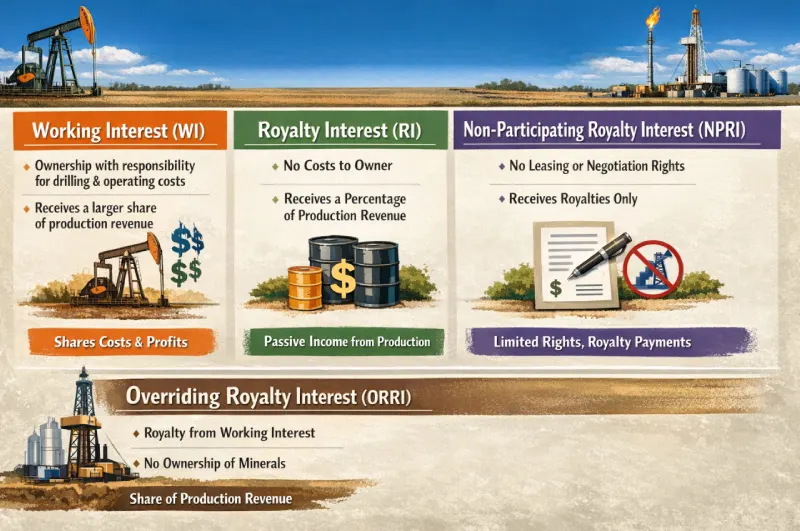
Different types of ownership interests exist within oil & gas leases. While most mineral owners receive a royalty interest, other types of interests may also be involved in the development of a lease.
Working Interest (WI)
A working interest represents the share of ownership held by the operator or investors responsible for drilling and operating the well. Working interest owners pay a portion of the drilling and operating costs, but they also receive a larger share of the production revenue.
Because working interest owners carry financial risk, their potential returns can be higher if production is successful.
Royalty Interest (RI)
A royalty interest owner receives a percentage of production revenue without paying the costs of drilling or operating the well. Most mineral owners who lease their mineral rights hold this type of interest.
Royalty interest owners may also receive lease bonuses and other payments depending on the terms of the lease agreement.
Non-Participating Royalty Interest (NPRI)
A Non-Participating Royalty Interest allows an individual to receive royalties from production without having the authority to sign leases or negotiate lease terms. NPRI owners also do not receive lease bonuses.
These interests are often created when mineral rights are partially transferred while retaining a share of future production revenue.
Overriding Royalty Interest (ORRI)
An Overriding Royalty Interest is a royalty paid from the working interest. It entitles the holder to receive a share of production revenue without owning the underlying minerals. ORRIs are sometimes granted as compensation for services such as geological analysis, land acquisition, or financing.
Being familiar with these ownership structures helps mineral owners better understand how production revenue is distributed among different parties involved in a lease.
How Oil and Gas Royalties Are Calculated
Royalty payments are calculated using three main factors:
Production Volume
Commodity Price
Royalty Percentage in the Lease
The royalty rate is a percentage, but the payment depends on the value of oil or gas produced from the well.
Let’s understand the royalty calculation with following examples.
Example 1: Partial Acreage Lease (50 out of 250 Acres)
In this scenario, the owner has leased 50 acres that have been pooled into a larger 250-acre production unit.
- Production: 1,000 barrels of oil
- Oil Price: $80 per barrel
- Royalty Rate: 20%
Step 1: Calculate Gross Revenue
Step 2: Calculate Total Unit Royalty
Step 3: Calculate Owner's Proportionate Share
Example 2: Full Acreage Lease (250 out of 250 Acres)
In this scenario, the owner’s entire 250-acre tract makes up the full production unit.
- Production: 1,000 barrels of oil
- Oil Price: $80 per barrel
- Royalty Rate: 20%
Step 1: Calculate Gross Revenue
Step 2: Calculate Total Royalty Payment
Step 3: Calculate Owner's Full Share
These examples show how royalty payments are calculated based on production value, royalty rate, and the mineral owner's share of acreage in the drilling unit. Depending on these factors, the final royalty payment may vary each month, before any deductions allowed by the lease agreement.
Understanding this process helps mineral owners better verify whether the payments they receive match the production levels reported by the operator.
Tools such as Lease Reports can help estimate royalties at the lease level, while features like Portfolio allow mineral owners to review cash flow and estimate potential royalty income based on their decimal interest across multiple assets.

Common Lease Deductions That Affect Royalty Payments
Some lease agreements allow operators to deduct certain costs before calculating royalty payments.
Common Deductions Include:
Post-Production Costs
The Post-Production Cost are expenses incurred after oil or gas is produced from the well. They may include costs for treating, compressing, storing, transporting, or marketing the hydrocarbons so they can reach buyers. Depending on the lease terms, these costs may be deducted before royalties are paid.
Gathering and Pipeline Fees
Oil and natural gas often need to travel through gathering systems and pipelines before reaching processing plants or refineries. Operators may charge fees for using these transportation networks. If the lease agreement allows it, these pipeline and gathering costs can reduce the final royalty payment.
Processing Costs
Natural gas frequently requires additional processing before it can be sold. This may include separating natural gas liquids (NGLs), removing impurities, or preparing the gas to meet market specifications. The expenses associated with these processes may sometimes be deducted from royalty calculations.
Lease Duration and Extensions
The length of an oil and natural gas lease can also influence royalty payments over time. Most leases have a primary term during which the operator must begin drilling to keep the lease active. If production begins, the lease may continue for many years under the production term. Some leases also include extension options that allow operators to keep the lease active by paying additional fees or meeting certain conditions.
Whether any of these deductions apply ultimately depends on the specific language written in the lease agreement. Mineral owners should carefully review lease terms to understand how their royalty payments may be calculated.
Key Factors That Determine Oil and Gas Royalty Value
Location of the Mineral Land
Mineral properties located in productive regions such as the Permian Basin or Eagle Ford Shale often generate higher royalty income due to strong drilling activity and favorable geology.
Productivity of the Mineral Rights
The geological characteristics of the reservoir play a major role in production levels. Factors such as reservoir depth, rock formations, and historical production data help determine how productive a property may be.
Higher production generally leads to higher royalty payments.
Current Prices of Oil and Gas in the Market
Commodity prices directly affect royalty income. When gas and oil prices rise, the value of production increases, which results in higher royalty payments.
When prices decline, royalty income may decrease.
Any Legal or Regulatory Issue
Lease agreements, environmental rules, and ownership disputes can directly impact royalty distributions. It is crucial to note that while the Texas Railroad Commission (RRC) oversees drilling and production, they do not have jurisdiction over lease disputes or royalty payments; unpaid or disputed royalties are ultimately managed by the Texas Comptroller as unclaimed property.
How and When Royalty Payments Are Made
Most oil & gas companies distribute royalty payments monthly. Under Texas law, unless a lease explicitly dictates otherwise, operators must issue initial payments within 120 days of the end of the month of the first sale, and subsequent ongoing payments within 60 days for oil and 90 days for gas.
Each payment usually includes a royalty statement that provides details such as:
- Production Volumes
- Commodity Prices
- Deducted Costs
- Net Royalty Payment
Keeping organized records of royalty statements, lease agreements, and production reports helps mineral owners track their income and confirm that payments are accurate.
Common Challenges for Royalty Owners
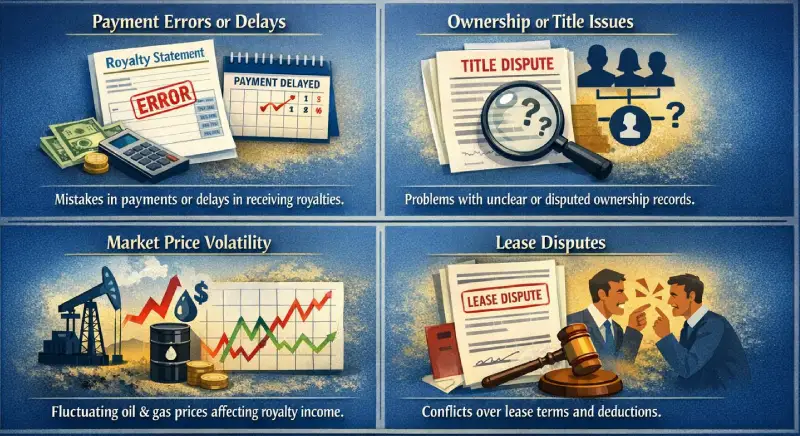
Although royalty income can be valuable, mineral owners sometimes encounter challenges.
Payment Errors or Delays
In some cases, administrative issues, reporting mistakes, or processing delays can affect the timing of royalty payments. Errors in production data or payment calculations may also occur. Reviewing royalty statements carefully helps mineral owners ensure that payments are accurate and received on time.
Ownership or Title Issues
Royalty payments depend on clear mineral ownership records. If ownership documents are incomplete, outdated, or disputed, operators may delay payments until the title is verified. These issues can occur when mineral rights are inherited, transferred, or divided among multiple heirs.
Market Price Volatility
Crude Oil and natural gas prices often fluctuate due to changes in global supply, demand, and economic conditions. Because royalty payments are tied to the market value of production, these price changes can cause royalty income to increase or decrease from month to month.
Lease Disputes
Disagreements may arise over the interpretation of lease terms, royalty deductions, or reported production volumes. Misunderstandings about the lease agreement can sometimes lead to disputes between mineral owners and operators.
Staying informed, reviewing royalty statements regularly, and maintaining accurate ownership records can help mineral owners identify potential issues early and protect their royalty income.
How to Buy Oil and Gas Royalties?
In some cases, mineral owners choose to sell part of their future royalty income to investors in exchange for an upfront payment.
Investors interested in purchasing oil and gas royalties typically analyze several factors before making a purchase, including production history, location of the property, and expected future drilling activity.
Anyone considering purchasing royalties should carefully research the property and understand the financial risks involved.
Key considerations include:
- Studying the Oil and Gas Industry
- Reviewing Production Records
- Understanding Tax Implications
- Evaluating Expected Cash Flow
- Consulting Experienced Advisors
Careful evaluation helps buyers determine whether a royalty investment aligns with their financial goals.
Did You Know?

Top American States that Earn the Most Oil and Gas Royalties
- Texas
- New Mexico
- North Dakota
- Colorado
- Alaska
- Oklahoma
- California
- Wyoming
- Utah
- Louisiana
Tips and Strategies for Better Oil and Gas Royalty Income
Although many factors influencing royalties are outside the control of mineral owners, there are still steps that can help improve royalty outcomes.
Pay Attention to Production and Stay Informed
Mineral owners should monitor production reports and stay aware of drilling activity near their property. Changes in production volumes or nearby development may affect royalty income.
Focus on Negotiating Favorable Terms of Lease
When negotiating a lease agreement, mineral owners should review key terms such as royalty rates, lease duration, escalation clauses, and minimum royalty provisions.
Professional guidance from experienced oil and gas attorneys or land professionals can be helpful during lease negotiations.
Understand the Potential of Reservoirs and Geological Condition of the Land
Geological studies and reservoir analysis can provide valuable insight into the long-term potential of a property. Understanding the geology of the land helps mineral owners make informed leasing decisions.
Conclusion
Oil and gas royalties are one of the main ways mineral owners earn from natural resources. Royalty rates usually range from 12.5% to 25% of production revenue, providing long-term income from oil and natural gas production.
Understanding how royalties are calculated and how lease agreements affect payments helps owners make better decisions about their mineral assets. As energy demand grows and drilling expands, staying informed becomes even more important.
To simplify your research and improve the value of your assets, mineral owners can use Mineral View Features to access latest, reliable data on local leases, well performance, and regional production activity. This helps them track developments on their land and better understand their royalty income.
Overall, having the right knowledge and tools allows mineral owners to manage their assets wisely and make the most of their royalty income.