
Loading article
In Texas, a range of rights are granted to landowners through state regulations. As a leading state in energy production, Texas also grants mineral rights to property owners. Mineral rights grant ownership of specific subsurface resources, including oil, natural gas, coal, and other fossil fuels. This article provides an in-depth look at 'How Mineral Rights Work in Texas'.
Additionally, Federal legislation defines surface rights. In Texas, however, surface rights are distinctly different from mineral rights. Surface rights cover land used for residential, agricultural, commercial, and other purposes. But mineral rights are given to the land or surface having fossil fuels underground. Understanding how mineral rights work in Texas can be complicated, so consult with an experienced oil and gas attorney.
Mineral rights are the rights given to a person with fossil fuels underground in his land. This person owns the land or surface in question. However, if an individual is not interested in the land, they can sell or lease their property to someone else, and the mineral rights get transferred to that person.
Legal experts in the oil and gas sector recommend that clients or leaseholders ascertain who possesses the mineral rights to their land. Sometimes, people retain their mineral rights even if they have sold their property or land to others. To avoid such situations, these lawyers have made a simple official process of owning land between both parties.
The government has also introduced surface rights to people. In some cases, people claim the land or property as a mineral right property without any underground fossil fuels. These surface rights are given for the land that can be used for agriculture, commercial, or residential purposes. Such rights are not mineral rights.

Mineral rights have a complicated and variable history since early human civilizations. The dynamics of mineral rights have evolved over the years and continue to adapt today. The fast growing societies, modern communities, and multiple human advancements have been involved in the evolution of mineral rights. Mineral rights have evolved with the recently invented technologies and developments in the production of minerals.
Historically, Texas was one of the colonies under New Spain. As a result, the minerals found beneath Texas were officially claimed by the Spanish Empire. In 1824, the constitution of Mexico declared the land of Texas as Mexican land. Ultimately, the mineral and metal rights were transferred to the Mexican government. Later, in 1845, Texas became a state in the US, and the US government owned mineral rights.
The mineral rights in the Lone Star State officially came into practice in the 1860s. Even before a formal declaration of mineral rights, residents were already utilizing the state’s minerals. Landowners with mineral land benefited with high profits. This process of obtaining minerals was rapidly expanding. Over time, there were instances of individuals submitting fraudulent land claims to profit from minerals, an illegal practice. By observing these conditions, Texas officially wrote privately held mineral rights in the constitution in 1866. These rights were legally recognized 34 years before the first oil well was drilled in Texas. Mineral rights developed alongside cultures and modern societies, contributing to economic growth to the present day.
The following is a vital timeline associated with Texas's history:
The Coastline of Texas was mapped by Spanish Experts.
Texas was a part of New Spain, and so were the mineral resources.
Texas’s land owned by the Mexican government.
The Republic of Texas is its own country.
Texas gained statehood in the United States.
The 1866 Constitution authorized the state to grant mineral rights to landowners.
Mineral rights were separated from surface rights.
Texas provides two fundamental mineral rights to mineral owners. These rights comprise 'Severed Mineral Rights' and 'Executive Rights'. Severed Mineral Rights occur when ownership of minerals is legally separated from surface property. Whereas, the Executive Rights are associated with leasing or selling the minerals. Let's have a brief look into these types of rights.
Severed rights occur when different owners hold the mineral and surface rights for the same parcel of land. This separation can result from a variety of causes such as historical land grants, transfers by previous property owners, and deeds.
When mineral rights are separated from surface rights, the mineral owner maintains ownership of the minerals associated with the surface or land. The mineral owner is permitted to explore the minerals on their land in hopes of earning a profit. On the other hand, the surface right owner can claim ownership and management of the surface or land.
The surface owner encounters more restrictions than the mineral owner. Surface owners may not be a barrier to the exploration of land and the profit of the mineral owners. However, mineral owners must conduct exploration activities in a manner that minimizes disruption to the surface owner's use of the land.
Complicated legal and financial arrangements can arise from severed mineral rights, particularly in cases where the surface owner and mineral owner hold conflicting interests. In this situation, they can negotiate leases and other legal activities to get better compensation considering all the environmental aspects and usage of land.
Executive rights specifically authorize the negotiation and execution of leases for mineral exploration and production, along with decision-making regarding the mineral property. A holder of executive rights has the legal authority to lease his mineral rights to oil and gas production companies or other mineral companies. Executive rights are kept aside from surface rights and actual ownership of minerals.
Let's consider an example: the mineral rights are separated from the surface rights, and the second person or company gets the executive rights. In such instances, that individual or entity can lease or sell the minerals to any third party. They qualify for lease bonuses and profits from minerals, even without owning the mineral property outright. In Texas, it is typical for individuals to possess severed mineral rights, surface rights, and executive rights concurrently for the same tract of land.
Before diving into how mineral rights function in Texas, let's first examine their evolution within the state. During the Spanish and Mexican eras, the Crown reserves its rights to minerals. After that, with the interference of indigenous tribes, a major transformation occurred. Eventually, in 1836, Texas officially became a republic nation. The Republic of Texas promoted the ownership of surface land, including mineral rights, to attract settlers. To attract settlers, the Republic of Texas promoted the acquisition of both surface and mineral rights.
Afterward, in 1845, the United States, with its invasion, continued the process of possession of mineral rights, allowing local people to explore the minerals under their land. Upon becoming a state, Texas reserved lands with mineral rights under sovereign ownership.
Meanwhile, the state had legal permission to lease or sell the land and minerals to an entity. In 1901, oil was discovered significantly at Spindletop, which led to a transformative shift in oil exploration. Eventually, individuals who had minerals beneath their land came to own the mineral rights.
Since that time, mineral rights have continued to evolve. It also includes the environmental considerations and management of mineral sources. Nowadays, people realize that owning mineral rights can be highly profitable due to the increasing demand for minerals such as oil, gas, coal, etc.
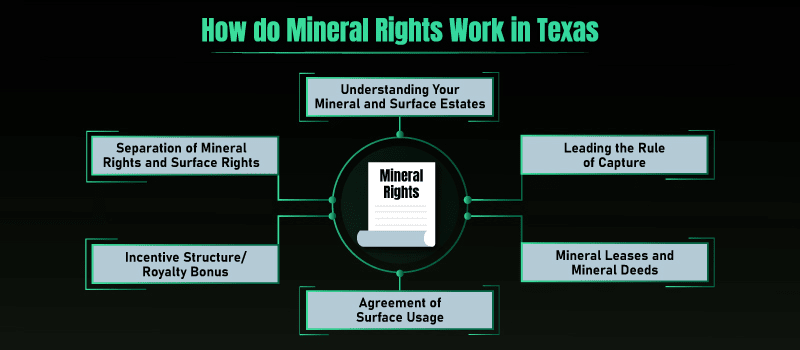
Below are some points that represent how do mineral rights work in Texas.
If your property has minerals beneath it, you will get mineral rights. Such land is referred to as mineral estate. With the ownership of the mineral estate, you are eligible for any kind of profit that belongs to those minerals. On the other hand, the surface estate is the ownership of the surface. A person with surface estate will be responsible for performing any activity on his surface. The surface estate owner can only claim for the surface, not for minerals beneath it if he doesn't have mineral rights.
As mentioned above, surface rights and mineral rights can be divided between two different entities. They have the right to separate ownership of the property and minerals. The division of rights is convenient, so any landowner may not claim the minerals if he doesn't have mineral rights on the same land.
Texas upholds the Rule of Capture within its jurisdiction, facilitating enhanced exploration of minerals such as oil and gas for landowners. The Rule of Capture, a legal doctrine, allows landowners with underground fossil fuels and mineral rights to extract oil and gas from their property even though the reservoir may be underneath neighboring land or property.
The owner of the neighboring property may not file any case or take legal action against the mineral owner. The mineral owner can also ask for the expenses from the neighbor to explore his land. This rule has made it easier to profit from oil and gas exploration.
Mineral rights encompass both deeds and leases. The owner of the land has legal consent to sell, lease, or keep mineral rights separately from surface rights. Mineral deeds transfer ownership of minerals, while mineral leases grant the rights to extract and explore oil and gas for a specified duration.
When a mineral owner sells or leases the mineral rights to their property to the energy production industry, he will be eligible for good profits /royalty bonuses from the company to which the mineral rights were leased. Typically, the incentive structure operates on a percentage basis. The owner's role is simply to sell or lease their property to the company, with further exploration and excavation undertaken by the company itself.
The landowner and mineral owners, having separate surface rights and mineral rights, can prepare an agreement for their surface use. This agreement specifies how their land is utilized for drilling and exploration activities. This agreement also involves compensation amount and reclamation for excessive usage of the surface, and also the owner can claim for the security of the surface. This agreement is eligible only for a single person with surface rights and mineral rights separately.
Texas is home to mineral basins and shale formations that are valuable resources for energy production. Mineral basins are generally indigenous to storing coal, petroleum, and fuel gas under a deeper surface of the earth. These storage areas are bowl-shaped, which is why they are referred to as mineral basins.
On the other hand, mineral shale is a sedimentary rock composed of very fine clay particles. The clay in the shale is formed by the decomposition of mineral feldspar. Quartz, Mica, Pyrite, and Organic Matter are the materials that can be found inside a shale. Below are three well-known mineral basins and shells in Texas.
The Permian Basin is a huge sedimentary basin that is located in Western Texas and Southeastern New Mexico in the US. It is renowned as the state's most prolific and profitable oil-producing basin. As per the recent reports, the experts found that it has produced 4.2 Million Barrels of crude oil per day in the year 2019.
This basin spans over 86,000 square miles, extending nearly 250 miles wide and 300 miles long. This basin is so large that it has been divided into three separate parts, namely the Delaware Basin, Midland Basin, and Central Basin.
The Eagle Ford Shale, a geological formation, contains hydrocarbons that produce natural gas and oil. It is capable of producing more oil and natural gas as compared to traditional shale plays. This shale has spread over the Mexican border in east Texas. It covers an area about 50 miles wide and 400 miles long with a thickness of 250 feet. This shale is named after the nearby town of Eagle Ford where the formation outcrops at the surface.
Barnett Shale Play is said to be one of the largest onshore natural gas fields in the US. It has covered 5000 square miles of area in Texas. The oil and gas extraction process in this shale play is considered a complex process as it has sand and rock around the hydrocarbon deposits.
Fortunately, the latest technology has been introduced, such as horizontal drilling and hydraulic fracturing; with this technology, it is possible to get the maximum resources in such a complex onshore area. Recent reports indicate that drillers in this area can produce 4.5 billion cubic feet of natural gas and around 15,500 Barrels of crude oil every single day.
When it comes to oil and gas, Texas often comes to mind first. Texas has supported itself in being the highest energy generation sector using oil and natural gas as compared to other states in the country. Mineral rights assertion has seen consistent progress over a long period. Currently, there is a strong interest among individuals seeking mineral rights, driven by the potential financial benefits from the oil and gas industries.
Owners of mineral rights are always cautious when selling their rights, as they seek to obtain the best value from other parties. When we understand the market and its top earning source, the energy sector leads the market. As the demand for energy increases, the production of oil and gas also increases (as they are energy-efficient and affordable resources), ultimately expanding the oil and gas industries.

When new exploration initiatives commence, the value of mineral rights increases significantly. It gets complicated to decide whom to sell mineral rights. Several people get wrong information about mineral rights' value and sell the rights at almost nonprofitable prices.
In the future, the prices and value of mineral rights will become high, according to experts. The latest survey report on mineral rights exposes the prices per acre in Texas for mineral rights. As per the general thumb rule, the cost per acre ranges from $0 to $250 for the non-producing mineral rights, and it is above $250,000 for producing mineral rights. These prices vary yearly and depend on the demand for oil and gas.
Texas’s mineral rights are subject to various circumstances, including changing rules, technological advances, and market dynamics. Some of the novel methods of mineral rights management that have arisen in recent years include community mining and shared resource management.
The region's geological diversity, characterized by various rock formations and events, has led to a robust legislative framework governing mineral exploration, production, ownership, and value distribution. The future of mineral rights in lone star state is likely to be shaped by ongoing legal and regulatory developments, technological advancements, market trends, and the need for sustainable resource management.
The Texas state constitution of 1866 recognized private mineral rights thirty-four years prior to the first oil well being drilled at Spindletop. You are eligible for the profit if you sell or lease your mineral rights to another entity. These rights include claiming a surface having minerals under it. However, surface rights are different from mineral rights. The mineral rights are subdivided into two additional rights that are Severed Mineral Rights and Executive Mineral Rights. Texas holds multiple mineral basins and shales that ultimately help to get more profit from oil and gas.
The rapid expansion of oil and gas production in Texas has generated unprecedented opportunities and challenges for resource owners. However, the industry faces several challenges, including environmental concerns, market volatility, and the necessity for long-term resource management. To address these issues, Texas has attempted to balance the economic advantages of mineral exploration and extraction and preserve the environment and public health.
A dedication to well-informed decision-making and ethical resource management becomes imperative for a sustainable future as we get a deeper understanding of this intricate question: "How do Mineral Rights Work in Texas?".
You are eligible to own the mineral rights if your land or property has minerals beneath it. If you are not interested in minerals, you can sell or lease your mineral rights to individuals or entities. When you sell your mineral rights, the second person will own the mineral rights.
Unless specifically separated, Texas mineral rights are passed down with surface rights. If there is no will, Texas rules of heirship determine their inheritance. Property holders must correctly identify and record the separation or inclusion of mineral rights in legal papers to prevent title ambiguity.
There is no specific period to keep mineral rights. They can last forever. The person with surface rights may also ask for mineral rights of his land, if mineral rights are given to another person.
Mineral rights in Texas are those owned by the mineral owner with minerals under his land. The person with a surface having minerals under his land would be eligible for mineral rights.
Informational only — not legal, tax, or investment advice.