Drilling rigs in Oklahoma are pivotal to the state's robust economic development. As a result, the state is ranked 8th in oil & gas production in the United States. Oklahoma prioritizes environmentally conscious drilling methods. This article will introduce you to the evolution of drilling rigs in Oklahoma. Also, it will assist you in knowing how drilling rigs in Oklahoma are shaping the overall development of the state.
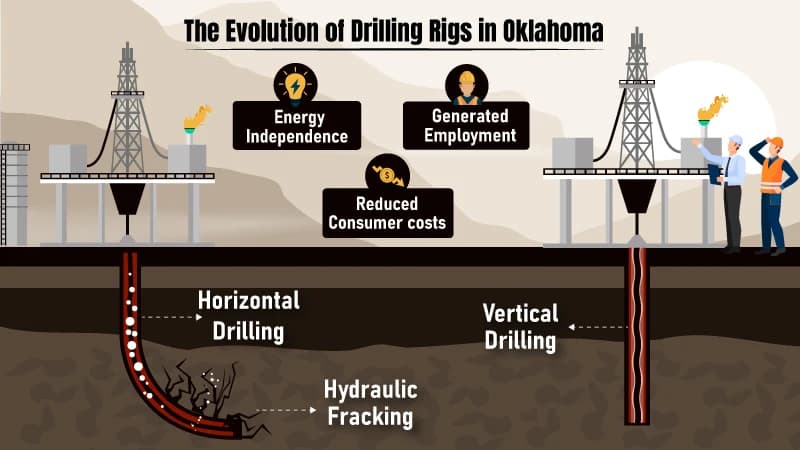
Oklahoma mainly utilizes vertical drilling, horizontal drilling, and hydraulic fracking to enhance drilling practices. Combination of horizontal drilling and hydraulic fracking caused the shale revolution. The shale revolution in the United States increased energy independence, reduced consumer costs, and generated employment. Let’s have a closer look at the historical overview of drilling rigs in Oklahoma.
Historical Overview of Drilling in Oklahoma
Drilling rigs have propelled Oklahoma into a new era, bolstering its economy. The state spans a portion of the Mid-Continent Region, rich in potential mineral reserves. That region is shared with other states such as Louisiana, Arkansas, Kansas, New Mexico, and Texas. From 1900 to 1935, Oklahoma was a defining force in the oil E&P sector. According to the reports, the state accounted for $5.28 billion, with the production of 906 million barrels of oil during those years. Let's dive deeper into the historical timeline of drilling rigs in Oklahoma.
-
1859:
Lewis Ross stumbled upon oil by chance. He was drilling his saltwater well on the Grand River near Neosho crossing in the Cherokee nation.
-
1872:
The first petroleum trade was organized by Robert M. Darden. It was named Chickasaw Oil Company.
-
1885-1888:
Oklahoma’s first oil well came into practice. It was drilled in Atika County in Choctaw Nation, Indian Territory, between 1885 to 1888. This well is known as “Old Faucett Well.”
-
1889:
The driller was searching for a water well and accidentally discovered an oil well. This well was the first well in Oklahoma City. The driller later abandoned it.
-
1897:
Many exploration companies scurried to Indian Territory (now Oklahoma) when the oil erupted from the well near Bartlesville instantly. This incident was recorded as the birth of a great oil boom in that sector.
-
1907:
Oklahoma led U.S. states in oil production. It occurred when Oklahoma was not a state.
-
1920s:
Tulsa, Oklahoma, was dubbed the “Oil Capital of the World.” It had measured significant economic growth in those years.
-
1928:
Indian Territory Illuminating Oil Company (ITIO) and Foster Petroleum Company (FPC) brought Oklahoma City as a number one Gusher. It was one of the essential discoveries in the state. In the same year, the big oilfield in Oklahoma City had arrived. This oilfield added its efforts to stabilize the economic conditions in the state.
-
1972:
Oklahoma introduced deep drilling activity. The inaugural deep well breached the 30,000 feet mark. This hole was drilled in Beckham County for commercial production purposes.
-
1974:
The deep drilling continued. The hole at a depth of 31,441 feet had been drilled in Texas’s Bertha Rogers 1-27 in Washita County. This drilling achievement shattered world records.
-
2023:
Oklahoma claimed the 8th spot in the US for production measured in Barrels of Equivalent.
Today, Oklahoma consists of 1,879 active well producers. The average well is drilled at a depth of 13,696 feet.
Technological Advancements in Drilling Equipment
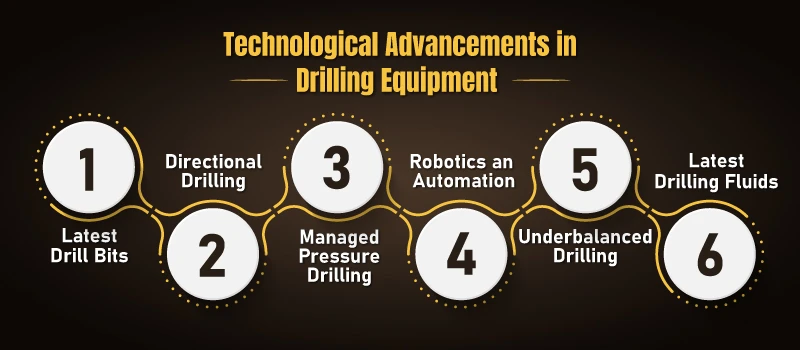
Drilling rigs in Oklahoma involve the latest technologies that offer sustainable and enhanced drilling options. With the involvement of technology, drilling operations become more efficient, secure, and environmentally friendly. Technological improvements have provided the state with growing economic income. Here are some major technological advancements in drilling equipment in Oklahoma:
Latest Drill Bits:
The emergence of the latest drilling bits provides improved and efficient drilling. One of the prioritized drill bits, ‘Diamond-Impregnated Drill Bits,’ improves the drilling operations. Such drill bits are capable of tolerating high pressure and higher temperatures during drilling. These bits add value to more efficient and faster drilling practices.
Directional Drilling:
This drilling technique explores oil and gas reserves by drilling horizontally. This undertaking minimizes the additional wells to be drilled. It is also referred to as directional boring. Such drilling extracts more minerals compared to conventional drilling. The involvement of these techniques has helped the oil and gas sector flourish with engrossed hydrocarbon reserve recovery.
Managed Pressure Drilling (MPD):
MPD technique involves using real-time monitoring and advanced equipment. The primary purpose of MPD is to minimize the damage formation risks, monitor the blowouts, control the wellbore instability, and reduce the excessive pressure in the wellbore. MPD helps to carry out safe and efficient drilling operations, especially in complex areas.
Robotics and Automation:
Involvement of automation systems reduces human interference and ultimately improves accuracy. The programmed robots and drones perform tasks like material handling, monitoring data and so on. Automated drilling is able to perform the work of tripping and pipe handling as well. This method significantly enhances safety for workers. It also includes Artificial Intelligence (AI)and Machine Learning (ML) algorithms to analyze the data precisely and receive improved operations.
Underbalanced Drilling (UBD):
This technique helps to monitor the pressure inside the wellbore below that of the formation being drilled. It provides improved efficiency and minimizes the risk of unnecessary damage to the formation. Unconventional drilling practices like tight oil and shale gas formations mainly use UBD to improve well productivity.
Latest Drilling Fluids:
The latest drilling fluids involve high-performance synthetic-based muds as well as water-based muds. It aims to minimize environmental concerns and perform efficient operations. These drilling fluids allow better cooling, proper hole-cleaning characteristics, and better lubrication. This results in enhanced wellbore stability and quick drilling rates.
The Shift from Vertical Drilling to Horizontal Drilling
Oklahoma has achieved enormous growth in the mineral sector in the past few years. The oil and gas sector arrived with a magnificent transformation from conventional vertical drilling techniques to the latest horizontal drilling methods. This shift has brought economic stability to the state. The impact of this shift specifically addressed the popular Anadarko Basin. This basin holds vertical drilling practices targeting several formations. Hoxbar Marchand Reservoir also comes under Anadarko Basin.
In the past few years, it has been observed that Anadarko Basin focuses on horizontal drilling within its existing legacy fields. For instance, a major player in the USA, Lynx Oklahoma Operating Company has adapted to this shift. They are utilizing horizontal drilling projects to enhance their previously underutilized reserves. Now, they are targeting the Hoxbar Marchand, particularly for the extraction of crude oil. Furthermore, key companies in the United States, including Cordillera III, Aresco LP, and Apache Corp., have adopted horizontal drilling in the Anadarko Basin to enhance productivity and optimize resource extraction.
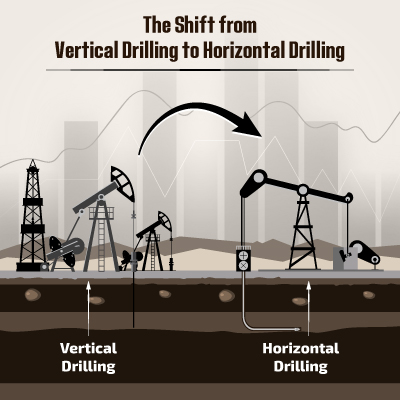
The shift from vertical to horizontal drilling aims to elevate economic gains and boost hydrocarbon recovery. Previously used vertical drilling delivers subsurface data. Although it provides data, it also leaves certain oil reserves untapped. It may affect the whole drilling process. However, horizontal drilling is considered to overcome such inconvenience. Horizontal drilling covers the maximum surface area of the reservoir. This large coverage improves the efficiency and productivity of resource extraction.
To capture the revolutionized results of horizontal drilling, many companies involve detailed mapping of sandstone benches. It is carried out from sophisticated geological perspectives. Such a non-conventional approach is exploited in conventionally unproductive and thinner formations to extract hydrocarbons. It also contributes to overall resource recovery enhancement.
Oklahoma’s decision to shift from vertical to horizontal drilling brought significant economic growth. The EIA report of 2023 states that the shale well production of Oklahoma has achieved 1.5 trillion cubic feet of natural gas between 2007 and 2019. This enhanced production is due to horizontal drilling. Horizontal drilling plays a vital role in achieving such drastic heights. The shift from vertical to horizontal drilling indicates the improved productivity of drilling rigs along with strong economic outputs.
Future Trends and Predictions for Drilling in Oklahoma
Knowing future trends and predictions for drilling in Oklahoma is quite strenuous. Oklahoma holds two major plays, STACK (Sooner Trend, Anadarko Basin, Canadian, and Kingfisher Counties) and SCOOP (South Central Oklahoma Oil Province), which belong to Woodford Shale in the Anadarko Basin. These two plays yield the resurgence of gas and oil drilling in Oklahoma. Along with these plays, the drilling in Oklahoma has proceeded in later years.
STACK consists of formations like Hunton, Osage, Woodford, Meramec, Chester, and Oswego. Due to the oil window, the Meramec layer is in high demand. When it gets fractured, it is capable of generating the overpressured oil with the most negligible water content.
As per the experts, STACK and SCOOP continue to be a future trend due to their production abilities. In 2023, the Permian basin accounted for almost 50% of all drilling in Oklahoma. Demand for energy in Oklahoma would result in enhanced drilling numbers along with maximum production. The reports have indicated that drilling for natural gas has increased in Oklahoma in 2022. These drilling projects are less compared to the nation's drilling projects. STACK and SCOOP influence such achievements. These two shale plays will shape the future trends of drilling in Oklahoma.
As per the Energy Information Administration of the US, the following table shows the current production data along with future predictions. It belongs to the Anadarko basin in Oklahoma.
New-Well Production Per Rig by Region:
| Region | New well oil production | New well gas production | Month | Year |
|---|---|---|---|---|
| Anadarko | 712 per rig | 4,775 per rig | January | 2024 |
| Anadarko | 713 per rig barrels/day | 4895 per rig thousand cubic feet/day | February | 2024 |
Conclusion
Oklahoma is now at the 8th spot for total mineral oil & gas production in the US. The evolution of drilling rigs in Oklahoma has brought a drastic transformation in the overall state. Drilling rigs in Oklahoma are now involving the latest technological innovations. They contribute to more efficient, sustainable, and secured drilling with more resource extraction and productivity. The state has made a major decision of shifting from vertical drilling to horizontal drilling. In 2022, Oklahoma witnessed an 86% surge in the number of wells drilled, demonstrating a transition to modern drilling methods such as horizontal drilling. This shift added to its efforts to improve the economy as well as better hydrocarbon recovery.
Effective asset management is essential for optimizing drilling practices. It helps to optimize the mineral evaluation. Our feature ‘Mineral Evaluation’ at MineralView.com lets you calculate the accurate potential of minerals in an oil and gas reservoir. It can be helpful to minimize drilling rigs' cost. Together with future projections and value, we provide you with thorough analysis and dynamic assessment.
Looking forward to the future trends of drilling in Oklahoma, STACK and SCOOP are significant players. These shales provide maximum productivity to the state. Geologists and oil experts predicted that the drilling rig in Oklahoma will shape the mineral production activities in upcoming years.
Ultimately, the evolution of drilling rigs in Oklahoma is a wonderful narrative of progress and adaptation. Oklahoma's oil and gas business has been shaped by drilling rigs' growth from humble beginnings to cutting-edge technology.
FAQ’s
How many drilling rigs are there in Oklahoma?
The rig count for inland is currently at the level of 42.00 in Oklahoma. One year ago, the count was 64.00.
Where is the largest oil field in Oklahoma?
The largest oil field is located in Oklahoma City. In today’s scenario, the Wilcox oil field reserve is considered the largest Oklahoma City field.
How deep has the oil well been drilled in Oklahoma?
The deepest oil well was recorded in 1974 by Texas’s Bertha Rogers No.1. The well had a depth of 31,441 Feet. It was drilled in the Anadarko Basin in Washita County, Oklahoma.