In the vast landscape of the US oil and gas industry, onshore drilling is crucial for mineral extraction and significantly impacts global crude oil production.
In Texas, onshore drilling has been a cornerstone of the state's economy ever since the first practical oil well was established in Nacogdoches County in 1866.
However, the true transformation of the state came with the Spindletop gusher in 1901. It established the landscape of onshore drilling in the state. This article will guide you through the role of onshore drilling in Texas.
Onshore drilling not only efficiently extracts minerals but also boosts production and drives economic growth by creating numerous employment opportunities. Let’s dive deeper into this topic.
Introduction to Onshore Drilling
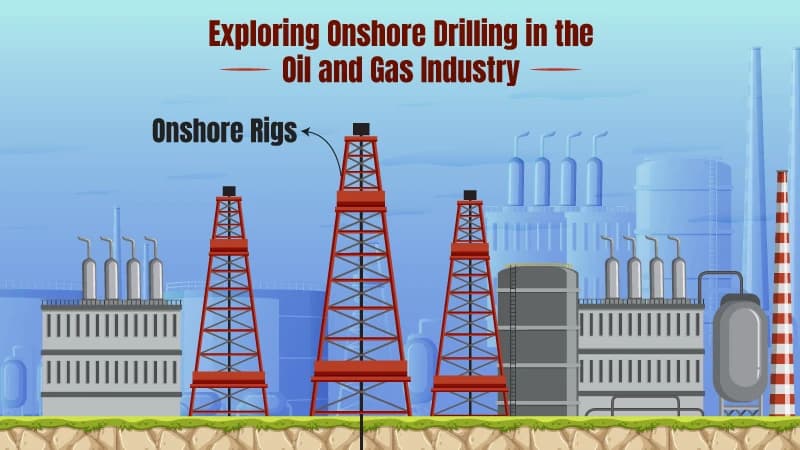
In the US, most mineral companies primarily focus on two important techniques for extracting oil and gas: Offshore Drilling and Onshore Drilling.
Offshore drilling taps into oil and gas reserves located beneath the ocean floor, increasing output and economic development, but has substantial expenses, risks, and environmental implications. On the other hand, as the name indicates, the onshore drilling method focuses on onshore or land-based drilling operations.
The onshore drilling process begins with the creation of a wellbore, a primary stage of mineral extraction. Either horizontal or vertical drilling methods have been considered.
The drillers utilize either of them, depending upon the type of oil and gas present beneath the land. For example, hydraulic fracturing is employed to extract oil and gas from shale formations. Often, rigs are slightly relocated to drill multiple wells close together on the same tract of land. These closely spaced wells are typically drilled for crude oil. These wells are linked together with carbon steel tubing.
The performance of onshore drilling ranges from:
Shallow Wells to Deeper Wells.
Extended Reach Wells to Ultra Extended Reach Wells.
Vertical Wells to Deviated Wells.
This approach adapts to geographical complexities, driving energy security and promoting sustainable growth.
Types of Onshore Drilling Rigs
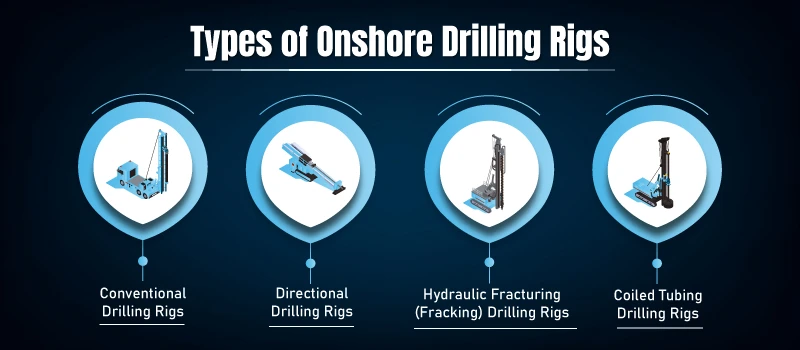
Various types of onshore drilling rigs can be utilized to perform onshore drilling tasks effectively. The type of rig is selected based on certain requirements and the geological characteristics of the land.
Geoscientists analyze the land and carry out detailed surveys, which help drillers choose the most suitable drilling rigs to get desired production values. Here are the main types of onshore drilling rigs:
1) Conventional Drilling Rigs
These rigs have been operational since the early days of well drilling. Below are its subtypes with their uses.
| Conventional Drilling Rigs | ||
|---|---|---|
| Type of Drilling Rigs | Drilling Method Type | Where is it Used? |
| Rotary Drilling Rigs | Utilizes Rotating Drill Bit | Directional, Horizontal, and Vertical Drilling |
| Cable Drilling Rigs | Utilizes Cable Extraction Method | Geotechnical Inspection, Environmental Surveys |
| Auger Drilling Rigs | Utilizes a Helical Screw-Shaped Drill Bit referred to as an Auger | Foundation Construction, Ecological Samplings, Geotechnical Analysis |
2) Directional Drilling Rigs:
Directional drilling rigs are often placed in service for drilling in targeted directions that cannot be achieved only using vertical drilling. These rigs facilitate drilling at various angles, enabling mineral extraction from areas that are otherwise hard to reach. This capability allows for increased production from each well. It is divided into three types: Steerable Rotary Drilling Rigs, Horizontal Drilling Rigs, and Multilateral Drilling Rigs.
| Directional Drilling Rig Types | How do they Operate? |
|---|---|
| Steerable Rotary Drilling Rigs | Uses the latest technologies to handle drilling direction. Allows precise navigation through formations of the subsurface. |
| Horizontal Drilling Rigs | Drills horizontally through reservoirs to extract as many minerals as possible. |
| Multilateral Drilling Rigs | Allow multiple lateral branch drilling from a single wellbore. |
3) Hydraulic Fracking (Fracturing) Drilling Rigs:
| Type of Hydraulic Fracking Drilling Rigs | Where is it Mounted? | Practical Application |
|---|---|---|
| Truck Mounted Drilling Rigs | It is mounted on trucks, enabling convenient transportation and fast set up at the drilling location. | Geotechnical Analysis, Drilling Shallow Gas or Oil Wells. |
| Skid Mounted Drilling Rigs | It is mounted on sleds or skids, enabling faster movements and installation. | Drilling Shallow as well as Medium Depth Wells, e.g., Coalbed Methane Wells, Geothermal Wells. |
| Trailer Mounted Drilling Rigs | Mounted on trailers, it is ideally suited for drilling projects that require frequent relocation. | Drilling Water Wells and sampling of Soil. |
4) Coiled Tubing Drilling Rigs:
Instead of using traditional jointed pipes, these drilling rigs use a continuous, flexible, coiled tubing string in wells. The coiled tubing is installed into the wellbore, enabling drilling, intervention, and completion activities.
This method offers several advantages, including enhanced well control, the ability to operate in active wells, and rapid rig setup and takedown times. It is classified into three types: Continuous Tubing Drilling Rigs, Joined Tubing Drilling Rigs, and Nitrogen Membrane Tubing Drilling Rigs.
| Type of Coiled Tubing Drilling Rigs | Advantages |
|---|---|
| Continuous Tubing Drilling Rigs | Enhanced space and weight efficiency, Minimized pipe connection time, Improved operational flexibility. |
| Joined Tubing Drilling Rigs | Provides flexibility for well depth, Suitable for onshore as well as offshore drilling. |
| Nitrogen Membrane Tubing Drilling Rigs | Minimize viscosity and density of drilling fluids, Improve penetration rate and Enhance drilling efficiency. |
Steps of Onshore Oil and Gas Extraction
The onshore oil rigs are generally cost friendly and have the ability to set up quickly. Below are the primary steps of onshore oil and gas extraction followed by the industry.
-
Mineral Exploration:
It is the initial step in the extraction process. It involves locating oil and gas reservoirs. Geoscientists analyze the rock formation to find out the presence of minerals. Geophysical prospecting and exploratory drilling are the methods that may be utilized to detect mineral reserves.
-
Drilling of Wells:
Once geoscientists confirm high mineral reserves at a site, drilling begins. There may be chances of drilling more than one well in the discovered site. Drilling may extend beyond initial completion if additional reserves are discovered.
-
Preparation of Rig Site:
If the drilled land contains high-potential minerals, preparation of the site is carried out. Preparing the rig site involves setting up on-site infrastructure. For this step appropriate planning to be implemented with immense attention to every detail, from generating noise barriers and traffic plans to the construction of access pads and roads. All security terms are planned and executed entailed by state and local laws accordingly.
-
Deeper Drilling and Assembly:
This step begins once the crew members are brought to the drilling site. They assess the well's condition before proceeding. When they receive positive results for minerals, they decide to drill deeper and assemble the infrastructure on the well. It needs to be done for extraction of oil and gas from a depth of a mile below the surface of earth.
-
Cementing the Well and Testing of Pipe:
Once the targeted depth is reached, the crew removes the drilling pipe. After removing the drilling pipe, they install the steel pipe in the drilled well. It acts as casing for the well and is cemented in place. The crew implements various tests to ensure the impenetrable property of the pipe.
-
Completion of Wells:
This step notifies drillers the well has sufficient minerals. Although there is a possibility of containing more minerals in the deepest area, the crew utilizes a perforating gum to drill the holes in rock formation in the deepest area of the well. These holes generate contact between the wellhead and rock-containing energy deposits.
-
Fracking Process:
Implementing the fracking process in drilled wells helps to release energy from rock formations. It is obtained by injecting a mixture of sand, chemicals, and water into the well at intense pressure, generating fractures to extract minerals.
-
Production of Oil and Gas:
Once fracking is obtained, the well gets ready to produce oil and gas. Fracking fluids are produced during production. They go through a recovery process. That recovered fluid can be considered for other fracking activities. In this step, drillers also use a production separator to separate energy deposits.
-
Abandonment of Site:
This step includes plugging of the well and restoring the location to its original form. As part of the well plugging process, fluids are either expelled from or forced deeper into the rock formation. The well with drilling fluids has strength to tolerate the pressures of an open rock bed. In site abandonment steps some common devices such as fishing tools, hydraulic cutting machines and chemical cutting devices are utilized.
Factors to Consider When Choosing an Onshore Drilling Rig:
When selecting an onshore drilling rig, the drillers need to consider several factors. It aids in optimizing drilling projects for better production outcomes. Below are some major factors that drillers ought to consider when choosing an onshore drilling rig.
Geographical Region:
It is a primary factor that geoscientists consider before proceeding with the drilling undertakings.Essential tests on land will be performed to identify mineral existence. Terrain, weather conditions, accessibility, and other such factors can be evaluated. Several types of onshore drilling rigs are designed to hold certain terrains and weather conditions. They guarantee improved performance and safety.
Diameter and Depth of the Well:
The next factor in choosing an onshore drilling rig is to ensure the diameter and depth of the well. The deeper and wider wells need higher power rigs as well as larger drilling devices. Analyzing the well specification of the drilling project ensures the selected drilling rig can efficiently operate and handle all the drilling requirements.
Rock and Soil Composition:
The composition of rock and soil can impact the drilling technique and selection of equipment. Hard rock formation may require a special-purpose rig with improved drilling abilities. Analyzing the composition of rock and soil helps drillers decide the type of onshore drilling rig that can be selected. This factor supports the appropriate selection of rigs that can efficiently pierce the formations and receive positive drilling outcomes.
Environmental Impact:
Whether it is an onshore drilling rig or an offshore drilling rig, environmental care is required while designing in the drilling industry. When choosing onshore drilling rigs, it is crucial to prioritize those with minimal environmental impact. Selecting environmentally friendly drilling rigs illustrates sustainable drilling activities.
Safety in Onshore Drilling
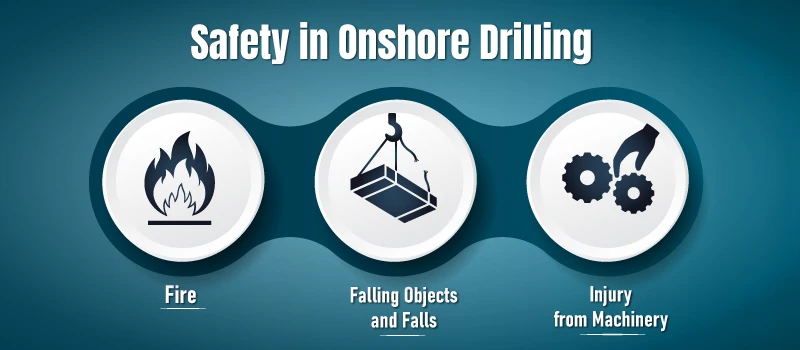
Throughout the onshore drilling processes, a dedicated team of employees, oil workers, and crew members work diligently to achieve the desired results. While working in onshore drilling sites, they face multiple hazards each day. In some cases, severe accidents may occur. To ensure the safety of workers and avoid accidents, additional precautions must be taken. Here are some areas where workers require safety measures:
Fire:
Workers perform their tasks under highly flammable chemicals every time. They may also contend with the risk of wells built up with excessive pressure. If unaddressed, this could lead to an unwanted explosion, damaging the entire drilling site.
Falling Objects and Falls:
Despite strict adherence to all safety protocols, oil rig employees working at elevated platforms still face a risk of injury. Therefore, to reduce such accidental errors every piece of equipment has to be maintained properly.
In some cases, any heavy object may fall on workers working downside of the plant. To avoid such fallen accidents, they should follow all safety norms carefully.
Injury from Machinery:
Machinery such as drills, spinning machines, and support units like cranes and forklifts are extremely heavy and generate significant noise. It makes it difficult for workers to communicate with others while they are at risk of danger.
In some instances, workers can be critically injured by moving machinery, leading to fatal accidents. Therefore, to avoid machinery accidents, every heavy machine is to be run properly and by a person with expertise in driving it accurately.
Key Technologies in Onshore Drilling
The table below provides information on the current technologies in onshore drilling and how they operate.
| Technologies in Onshore Drilling | How does it Work? |
|---|---|
| IoT Algorithms | Enables sensors present in the equipment to access the data in real-time. |
| Dual Gradient Drilling | Utilizes distinctive fluid management methods to monitor the drilling fluid’s density, permitting them to maintain constant well pressure even in high-pressure and deepwater conditions. |
| Big Data Analytics | Provide detailed analysis of large datasets to obtain insights into drilling practices. |
| 4D Seismic | Provide real-time data and clear images of surface layers to support geoscientists in understanding the condition of the land. |
| Digital Twin Technology | Predict equipment failure to avoid equipment damage and offer suitable maintenance schedules. |
| Autonomous Drilling System | Automates the drilling operations. |
| Enhanced Oil Recovery (EOR) Technique | This technique employs water, gasses, and chemicals injected into wells to enhance oil recovery and increase its volume. |
| Horizontal Drilling | Permits the wells to be drilled in a horizontal direction instead of drilling vertically. |
| Hydraulic Fracturing or Fracking | Includes the injecting fluids into a wellbore at intense pressure to fracture the rock and release oil or natural gas. |
Conclusion
For the extraction of minerals beneath the land, the onshore drilling method has become the most convenient method. From conventional drilling rigs to modern-day digital rigs, onshore drilling has diversified the overall drilling landscape.
Exploring the production outcomes of onshore drilling reveals its numerous benefits, including enhanced economic growth and increased employment opportunities. Although it offers multiple benefits, selecting the appropriate rig remains a challenge for drillers.
Onshore drilling methods are utilized for almost every new well. If you are eager to learn more about new oil and gas wells, Mineral View provides all the details you need.
We provide up-to-date well data, including total well permits, well mapping, production insights, and forecasts of future production.