Oil rigs, large vertical structures, house all the necessary facilities for mineral extraction. They extract minerals like oil and gas that are present in the rock formations. According to a report last year by C-Mor Energy Services, offshore rigs in the US could be producing as much as 3.5 billion barrels of oil daily by 2035. Although this is a projected figure, the latest innovations in oil rig technology could certainly make such production levels achievable.
In this informative guide, we will explore the fundamental concepts of oil rigs and their purpose and work. Let's briefly discuss oil rigs.

About Oil Rigs
The sophisticated process of oil well drilling requires the collaboration of drilling engineers, geologists, rig workers, and the use of advanced downhole tools and specialized drilling fluids. These specialized teams and cutting-edge technologies are crucial for the efficient and safe drilling of oil or gas wells, frequently reaching depths beyond 20,000 feet.
Despite technological advancements, the success of drilling operations heavily relies on coordinated teamwork and the strategic use of sophisticated machinery. An oil and gas well requires a large team of workers from the operating company and several service providers to drill and finish.
Drilling an oil well is done with a drilling rig, which calls for skilled labor, a range of equipment, and advanced technology. Also, these drilling rigs known for their robust design and advanced capabilities, play a pivotal role in tapping into the vast energy resources that lie beneath the state’s terrain, contributing significantly to the region’s overall oil and gas production.
Two primary objectives must be met when initiating a well drilling project: achieving cost-efficiency and ensuring safe completion without accidents or technical issues while aligning with the well’s intended purpose. This decision influences the well’s drilling location—onshore for extended reach or offshore directly above the reservoir—the drilling technology employed (be it conventional or slim-hole drilling), and the evaluation procedures to gather subsurface data for future drilling projects.
In the domain of rotary drilling, the oil and gas industry persistently integrates cutting-edge technologies, such as automated drilling systems, real-time data monitoring, and advanced blowout preventers (BOPs), to enhance efficiency and safety. This drilling technology works by continuously rotating the bit, breaking rocks in a circular motion. Drilling fluids then flow through the bit, up the wellbore, and to the surface, enabling the well to be drilled safely and effectively.
Types of Oil Rigs
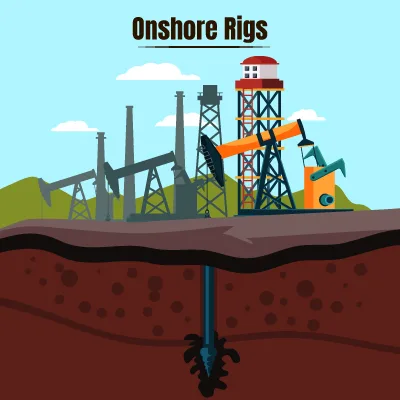
Onshore Rigs:
In the heart of US energy production, regions like Texas, New Mexico, North Dakota, and Alaska are bustling hubs for onshore drilling. The Permian Basin and Eagle Ford Shale, in particular, are giants in this realm. Onshore drilling operations mainly fall into two categories:
There are two types of onshore drilling operations:
-
Truck- or trailer-mounted rigs offer enhanced flexibility and adaptability in drilling operations. They can delve down to around 15,000 feet, though their reach can vary based on their design and the drilling environment they encounter.
-
Stationary rigs are the powerhouses of drilling, capable of reaching depths of up to 20,000 feet. They are a more permanent fixture in the landscape of oil operations.
Offshore Rigs:
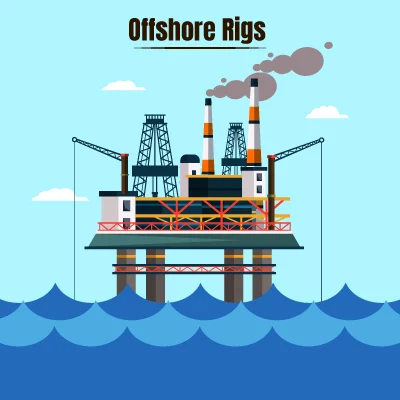
The world of offshore drilling is divided into two main categories: fixed structures and floating systems, each tailored to different marine environments.
-
Jack-Up Rig
Employed in shallower waters, these mobile platforms are towed to their location and then anchored to the seafloor, standing tall like metallic giants above the waves.
-
Barge Rig
Positioned on barges, these rigs are stabilized by filling their hulls with water once they reach their location. They are designed for calm, shallow water such as marshes and inland waterways.
-
Submersible Rig
Unique for their ability to float to a site and then submerge, these rigs are equipped with pontoons and columns resting on the seafloor for stability during drilling operations.
-
Semi-Submersible Rig
Semi-submersible rigs, pivotal in deepwater drilling, operate by floating with submerged pontoons and are stabilized using several anchors or mooring lines.
-
Drillships
Primarily employed in ultra-deep waters of remote areas, drillships can operate at depths that reach and sometimes surpass 12,000 feet. Drillships must maintain a precise drilling position. Anchors, mooring lines, and computer-controlled dynamic positioning devices make this easier.
How Do Oil Rigs Work?
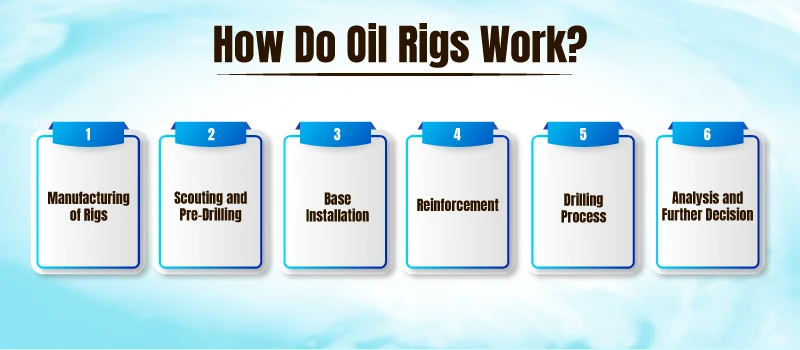
Below is detailed information on how oil rigs work, starting from its manufacturing.
Manufacturing of Rigs
-
The drilling rigs have two key sections: Base (or substructure) and the Derrick.
-
These sections are concurrently manufactured onshore to guarantee their compatibility.
-
For offshore drilling, the base and top sections are only assembled once they are out at sea.
Scouting and Pre-Drilling
-
Once the rigs get manufactured, the drilling site is scouted.
-
To ensure the mineral presence, various preliminary and pre-drilling tests are carried out.
Base Installation
-
After ensuring the presence of minerals on a particular site, the rig’s base section is installed.
-
For onshore drilling, it is directly installed on a land of mineral deposits.
-
After the base is installed, workers assemble the top section properly.
-
When it comes to offshore drilling, the bottom section is transported to the sea site, generally on its side.
-
With the help of seawater, rig workers flip the top section upright.
-
They anchor the base with the help of chains and ropes.
-
Workers make the base secure with a suction anchor, plunge it, and drive into the ocean floor.
-
The base is controlled and monitored using remote submarines.
-
Once the base section is installed perfectly, the top section is installed on it.
-
The topside is brought to the sea site on huge barges with the help of cranes.
-
Workers carefully position it on the corresponding coupling points.
-
They perform these tasks delicately to prevent any accidents.
Reinforcement
Workers ensure the reinforcement of rigs.
-
They fit the thin steel coil or Starke at the base side to prevent rocking.
-
For a low center of gravity, the iron ore is pumped into the base side.
Drilling Process
Here starts the drilling process for minerals.
-
In onshore drilling, drillers use drill bits and drill strings to puncture the surface, while in offshore drilling, the anchoring port is sent to the seabed with a tube and drill.
-
The drilling is carried down at a deeper level, and cement is sent to the pipe that is to be bordered.
-
This process continues with thinner pipes until the hitting of the reservoir rock.
-
In case of emergencies like oil spills, the drillers utilize the blowout preventer connected to the well. It shuts off the valve to stop the oil or any other liquid from coming upward.
Analysis and Further Decision
-
Workers collect some reservoir rock samples and send them for analysis.
-
Based on the results of the analysis, workers decide to continue drilling or cap the well.
Tips To Keep Oil Rigs Injury-Free
Provide Employees with Appropriate Housing
Providing your workers with a suitable shelter is one of the best ways to guarantee their safety while working there. A mining fabric building is one of the best places to house your employees who work on mining and oil rigs. They can also be utilized for health clinics, kitchen and dining areas, equipment storage, garages and auto repair facilities, and employee recreation areas.
It's imperative to instill in your employees the value of regular housekeeping. Keep the floors, work areas, walkways, and shelters accessible to superfluous objects to lower the risk of minor and deadly accidents like slipping or falling.
Always Wear Protective Gear
Always wearing protective gear is imperative when working on an oil rig. It entails donning respirator masks, hard hats, gloves, and eye protection. Wearing protective gear is something employees should always pay attention to, especially at work. After completing a task hundreds of times, most workers believe it is acceptable to forgo wearing their safety equipment. But we shouldn't put up with this. You should never allow your employees to be careless with their protective gear because you never know when a disaster may occur on an oil rig.
Perform Routine Machine Upkeep
All machinery and equipment should undergo routine maintenance inspections to reduce the danger of oil rig accidents. It assists in averting early failure, which may cause explosions. Maintaining the machinery at all times to prevent downtime also requires maintenance.
Never let a worn-out machine part put the safety of your employees at risk. That malfunctioning component could have detrimental effects on every person on the rig. Therefore, to guarantee a safer working environment, companies must try their hardest to maintain all the machinery and equipment on the rig to guarantee a safer working environment.
Additionally, ensure that every piece of machinery and equipment on the rig complies with industry standards.
Take Charge of Monitoring Your Employees' Mental Health
Oil drilling rigs must have a positive work environment, adhering to a “safety-first” mentality. The goal for the oil industry is to create a full-transparent, open, and cohesive work environment through various training initiatives. This helps instill a much-needed spirit of teamwork on the rig.
By employing a spirit of full transparency, operators can create an environment of trust and loyalty, making it easier for employees to follow instructions, ask for assistance when needed, and be open with their managers about any questions about proper procedures to follow.
Encourage Open Communication About Safety
Communication is critical, and it must be ensured that staff members are confident in conveying concerns when they notice or detect a problem in the field or the office. Safety concerns, in particular, should be brought up immediately with the site manager or supervisors so that the responsible authorities can take appropriate action. It's to make sure that everyone on the premises can handle the problem and stop it from worsening and endangering the workers' safety.
Biggest Oil Rigs in the World
Below is the List of Some Biggest Oil Rigs in the World, along with its Location and Production Data.
| Name of the Rig | Location | Production |
|---|---|---|
| Berkut Oil Rig | Russian Pacific Coast near the Island of Sakhalin. | Oil Extraction Capacity of 4.5 Million Tons Annually. |
| Stones Floating Production, Storage, and Offloading Facility (FPSO) | Shell operates the Stones FPSO in the US Gulf of Mexico, approximately 322 kilometers off the coast of New Orleans. | 60,000 Barrels of Oil Equivalent Per Day |
| Perdido Oil Platform | Located in the Gulf of Mexico, approximately 200 miles South of Galveston, Texas. | 100,000 Barrels of Oil and 200 Million Cubic Feet of Gas daily. |
| Olympus Oil Platform (Mars B) | The Olympus Oil Platform, also known as Mars B, is owned by Shell and Operates within the Mars B field in the Gulf of Mexico. | Since its inception in 2014, the Olympus Platform has produced over 700 Million Barrels of oil. |
| Hibernia Platform | The Hibernia Platform is situated about 196 miles East of Newfoundland, Canada. | 1400 Barrels of Oil Daily. |
| Petronius Platform | The Petronius Platform is located in the Gulf of Mexico, close to New Orleans. | 60,000 Barrels of Oil Equivalent and 3,100,000 Cubic Meters of Natural Gas every day. |
| Baldpate Platform | The Coast of Louisiana, US. | - |
| Troll A Platform | Located off the West Coast of Norway. | - |
Conclusion
Oil rigs play a crucial role in shaping the economic landscape of the energy industry. They represent the modernization of drilling practices, including advanced technology and skilled labor. From onshore rigs in complex oil-producing regions to offshore drilling at deeper seas, each rig supports efficient mineral production.
The drilling procedure, from first-stage manufacturing to final reinforcement and actual drilling, involves all the safety precautions to mitigate risks. Future technologies and innovation in rigs will continue to contribute to the growth of the energy industry.
Understanding how oil rigs work is important, but so is understanding where the drilling is taking place. Mineral View offers the latest data on newly drilled wells where either an onshore or offshore rig has been used. We offer the latest well data in standard and customized formats.
Stay tuned to Mineral View for more updates on oil wells and the mineral industry.