
Loading article
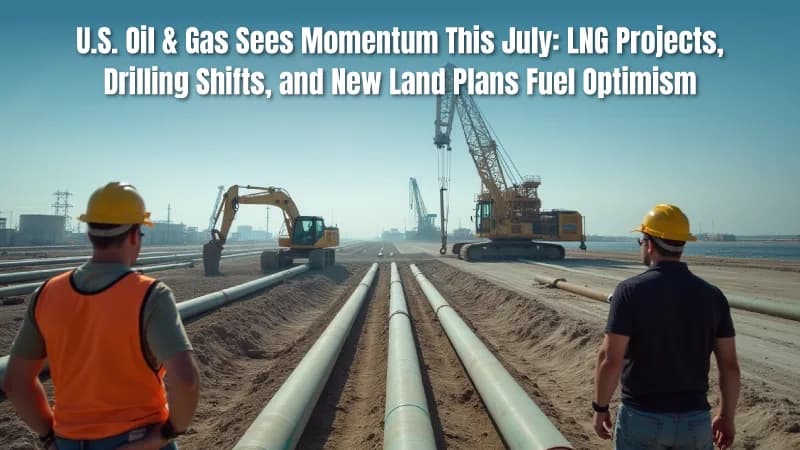
The American oil and gas sector had a frenzied and cheerful week between July 7 and July 13, 2025. While the world was busy paying attention to increasing oil prices, a few choice stories went by that are of greater significance to mineral owners and oil and gas investors.
This week, the sector prepared for the next expansion phase with new regulations, new drilling proposals, and further global interest in the sale of LNG.
Here are the major highlights that made headlines in the U.S. oil and gas industry this week.
The Bureau of Land Management (BLM) proposed a plan that would save producers time and money. Producers of oil and natural gas would be permitted to combine several leases into one producing area with the new rule.
That translates to fewer wells and less bureaucracy, particularly in Western states where drilling operations are scattered over vast areas. This can lower equipment rental charges by as much as $1.8 billion each year. It is a step in the right direction that can encourage everyone interested in maximum oil and gas investments here.
Fewer surface disruptions and joint infrastructure can lead to improved sustainability and increased royalties for mineral owners in areas like this.
In California, federal authorities are considering opening almost 1.6 million acres to oil and gas drilling. That includes property in 17 counties, even some within the Bay Area. The public has through July 23 to comment on the plan. If approved, auction sales could start as soon as 2027.
At the same time, in Alaska, the government will make 82% of the National Petroleum Reserve-Alaska (NPR-A) available for oil and gas leasing. The region contains some of the most fragile habitat in the state. It is considered a huge opportunity by most of the energy producers, though environmentalists sounded the alarm.
Both proposals are a categorical push by the government to increase domestic energy production.
Saudi petroleum giant Aramco is negotiating to buy 2 million tons of LNG per year from Commonwealth LNG's Louisiana terminal. If finalized, the transaction will further solidify Aramco's position in the US LNG market.
This is more than another trade agreement. This is increasing foreign demand for American liquefied natural gas. This trend is significant to investors in upstream natural gas businesses, pipeline infrastructure, and export terminals.
LNG remains one of the hottest industries in the energy business today. As the globe becomes more dependent on cleaner-burning fuels, U.S. natural gas, which is imported and refined in LNG form, is getting more and more attention.
The United States Energy Information Administration (EIA) updated its estimate of U.S. oil output in 2025. It now forecasts the U.S. to produce approximately 13.37 million barrels per day, just below its previous estimate of 13.42 million barrels.
This small revision demonstrates prudence given slowing rig activity and moderate demand. But offshore regions in the Gulf of Mexico will gain momentum, supported by a number of large-scale projects.
Some of the major offshore fields that will drive growth include:
Whale
Ballymore
Dover
Shenandoah (coming online in 2026)
Salamanca (coming online in 2026)
This offshore momentum will help balance slower growth onshore.
Active rigs in the United States declined for the 10th consecutive week to 539. The continued decline, monitored by Baker Hughes, indicates firms remain wary to increase operations despite bullish market indicators.
Though this is sounding problematic, it isn't all bad news for mineral owners. What firms are focusing on now is drilling for quantity, not quality. That is, they're hitting higher-priced areas and with higher-tech equipment, which still makes a positive fiscal impact.
Here’s a simple table showing the main developments from this week:
| Date | Event |
|---|---|
| July 7 | BLM proposes shared lease production rule |
| July 8 | EIA trims U.S. oil output forecast slightly |
| July 9 | Aramco discusses LNG deal with Louisiana's Commonwealth LNG terminal |
| July 10 | Rig count falls to lowest since 2021 |
| July 11 | Federal land drilling plans in California open for comment |
| July 12 | Alaska's NPR-A expansion announced |
| July 13 | Offshore production forecast gains attention |
As the world is making a transition towards cleaner fuels, LNG is proving to be a highly sought-after option. American exports have also gone up, and foreign customers are signing deals in growing numbers to purchase LNG for long terms.
Commonwealth LNG is not alone. There are a number of U.S.-located LNG terminals in the process of being built or awaiting final permits. Mineral owners and natural gas owners now have an intriguing decision. Lease bonuses and royalty payments can anticipate an increase as demand increases.
The LNG tale isn't one of international trade only—it is a rippling effect on infrastructure investment, jobs, and local communities. This is an area of investment that requires close attention.
The BLM has invited public comments for an upcoming lease sale scheduled for March 2026. The proposed parcels cover:
506 acres across Arkansas, Louisiana, Michigan, and Mississippi
4,270 acres in Montana and North Dakota
This is good news for landowners in these states. Getting the latest information on lease updates can help you get the advantages of future developments.
As per a Dallas Federal Reserve survey earlier this year, nearly 50% of oil CEOs plan to reduce drilling in 2025. Unpredictability regarding future regulation as well as rising cost remains an issue.
But all in all, the mood was not a somber one. Rather than drilling additional wells, CEOs view this as an opportunity to focus on maximizing efficiency, innovation, and selecting better-drilling sites.
Even mineral owners are favored by this approach. Enhanced, effective drilling usually leads to increased well life and increased royalty payments in the years to come.
Even though certain numbers—like rig count and below-predicted projections—may appear static at first glance, the overall picture says otherwise. America is expanding its LNG presence, global partnerships like those of Aramco are increasing, and the federal government is working to make it possible for full exploration of public lands.
For mineral owners, these trends point toward steady demand for production and leasing. And for investors, the smart money seems to be betting on natural gas, LNG exports, and strategic drilling sites to drill.
The future in 2025 and keeping a close eye on LNG transactions, BLM reports, EIA releases, and rig counts will be the focus. Towns such as Mineral View can prove to be very helpful in such a situation.
It enables mineral right owners to stay informed and make key decisions, whether following up on offers, analyzing production reports, or considering lease or sale. Combined with easy-to-use, intuitive capabilities, Mineral View keeps you in charge of your assets every step of the way.
Informational only — not legal, tax, or investment advice.