In Texas-the state that leads the nation in energy production-the oil and gas sector not only supports the state's economy but also offers significant financial advantages to individual mineral owners.
Oil and gas royalties can be a game-changer for landowners with mineral rights since they provide a reliable stream of income that is frequently disregarded. However, understanding deeply what these royalties are and how they affect Texans' economic situation, is essential to receiving positive returns.
In this comprehensive draft, we will examine how oil and gas royalties affect landowners' financial portfolios and the state's overall economy, which delves into the economic effects of these payments for mineral owners.
Comprehending the workings of these royalties is essential, whether you are an experienced mineral owner or a novice to the energy production industry. Let's study the basics of oil and gas royalties.

Exploring the Basics of Oil and Gas Royalties
Oil and gas royalties are the payments delivered to the mineral rights owner in exchange for the legal allowance to extract oil and gas from their land. These royalties act as the crucial element for earning incomes for landowners and are a treasure for those owners having land with high-potential oil and gas reserves. The main purpose of oil and gas royalties is to benefit mineral owners financially for utilizing their hydrocarbons, making an additional source of income for them.
Let's get to know some basics of oil and gas royalties:
How are Oil and Gas Royalties Calculated?
Royalties are generally calculated on a percentage basis from the amount of profit generated from oil and gas sales. For instance, if the royalty agreement is set at $2 per barrel and a landowner's property yields 10,000 barrels of oil each month, the landowner would get $20,000 as a royalty payment.
Who is Eligible to Receive Oil and Gas Royalties?
Only the owner with mineral rights who has permitted his land for mineral companies to explore oil and gas is eligible to receive the oil and gas royalties. Along with them, third parties, such as an individual consisting of overriding royalty interests, can also get some portion of the royalties.
How are Mineral Royalties Reported?
Royalties are reported on Schedule E of your Form 1040 and are treated by the IRS as ordinary income. Additionally, you must record any royalties you get using Form 1099-MISC.
Additional Factors to be Taken into Account:
When mineral owners decide to engage in oil and gas royalties, the following factors should be considered:
How are royalty rates negotiated?
How much time does it take to get the first share of royalty interest?
The legal framework that regulates the agreements.
What would be the potential impact on the value of the land?
This is all about the basics of oil and gas royalties. Receiving royalties on a monthly basis offers several economic benefits and opportunities for royalty owners.
Economic Benefits of Oil and Gas Royalties and Significance of oil and gas industry within the state

Benefits of oil and gas royalties:
Passive Earnings
Royalties from the production of oil and gas provide a consistent and potential source of income without the need to engage directly in the exploration or any other processes.
Diversification Option
As oil and gas royalties are not directly associated with the stock market or other traditional assets, they might be an excellent method to diversify one’s investment portfolio.
Possibility of Sustained Income
Oil and gas royalties have the ability to generate financial profit over a prolonged period of time, even for several decades.
Security Against Inflation
Since oil and gas royalties are frequently inflation-adjusted, the revenue earned can steadily enhance in value over time.
Possibility of Financial Gains
If the value of the underlying oil or gas reserves rises, there might be potential for capital gains, depending on the details of the royalty arrangement.
Benefits of Taxes
Royalties may be eligible for advantageous tax benefits, including depletion allowances, which can lower the tax obligation related to the revenue produced.
Below are some points that highlight the crucial significance of the oil and gas industry and its major contribution in shaping the economic landscape of the state.
-
Texas oil and natural gas activity generates substantial tax revenue, funding public schools, universities, roads, first responders, and essential services.
-
In fiscal year (FY) 2023, the Texas oil and natural gas industry paid $26.3 billion in state and local taxes and royalties, a historic record, surpassing the previous year by $1.5 billion.
-
This $26.3 billion in revenue equates to $72 million per day, supporting vital Texas services.
-
Key tax sources surged in FY 2023:
-
Sales taxes paid by the industry increased by $1.6 billion.
-
Property taxes paid by the industry rose by $1.8 billion as mineral property values doubled.
-
-
99% of oil and natural gas royalties were directed to the Permanent School Fund and Permanent University Fund, each receiving $1.8 billion.
-
The Economic Stabilization Fund (Rainy Day Fund) and the State Highway Fund each received $3.3 billion from FY 2023 production taxes.
-
Since 1987, the Rainy Day Fund has accumulated over $31.2 billion from oil and natural gas production taxes.
-
In FY 2023, Texas school districts received $2.81 billion, and counties received $885.6 million in property taxes from oil and gas-related properties and utilities.
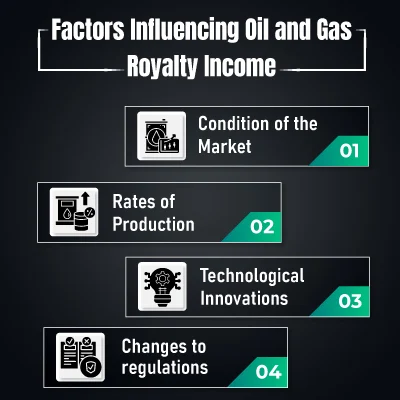
Factors Influencing Oil and Gas Royalty Income
-
Condition of the Market:
The most immediate indicators are probably the current and predicted prices for gas and oil. When prices are high, it may be a smart idea to sell, particularly if market predictions indicate a decline. Conversely, investing during a low market might yield large future profits once values rebound.
-
Rates of Production:
A property's current production rate and anticipated decline rate are crucial. Depending on an investor's approach, properties at the height of production may provide low long-term possibilities but high immediate rewards, which would reduce their appeal.
-
Technological Innovations:
Technological developments have the ability to abruptly change previously unprofitable reserves into valuable ones, drastically changing the possible returns from royalties in some sectors.
-
Changes to regulations:
Profitability may be impacted by modifications to tax laws or environmental rules. While deregulation may increase profitability, increased regulation may result in higher operational expenses.
Oil and gas royalties are vital to the energy sector, driving both the discovery and development of natural resources. These royalties guarantee that the advantages of resource extraction are equitably distributed by giving mineral owners a consistent source of revenue and encouraging investment.
The numerous sorts of royalty rights and the differences between mineral and oil and gas royalties underscore the intricacy and importance of these financial agreements. It is imperative that stakeholders possess a comprehensive comprehension of these components in order to make well-informed decisions and maximize their oil and gas royalties within the dynamic energy landscape.
Tips for Maximizing Your Oil and Gas Royalties
To maximize your investment returns in the energy sector, you can prioritize your oil and gas royalties. While royalty payments are determined by various factors beyond your control, there are strategies you can employ to enhance your income and make the most of your royalties. Here are a number of methods and ideas to help you get the most out of your oil and gas royalties.
Stay Informed and Monitor Production:
Stay current on industry trends, market circumstances, and production operations. Review the production reports that the energy provider sends you on a regular basis to make sure your royalties are calculated correctly. You can evaluate how any prospective changes in market prices or production volume will affect your royalty income and make well-informed decisions by being aware of them.
Negotiate Favorable Lease Terms:
Negotiate advantageous terms that can increase your royalty income when you sign a lease. Take into account elements like the length of the lease, the minimum royalty payments, the royalty rate, and any possible escalation provisions. Engage legal professionals experienced in oil and gas leasing to help you negotiate the best possible terms.
Diversify Your Royalty Portfolio:
Investing in a variety of locations, formations, or energy businesses can help you diversify your oil and gas royalty holdings. Diversification can assist in reducing the risks connected to decreases in output or shifts in the market in a particular area or business. By spreading your investments, you increase the likelihood of keeping a stable and diversified income stream.
Identify the Reservoir Potential and Geology:
Take the time to learn about the geology and reservoir potential of the regions in which you hold royalties. Evaluate the production and quality of the oil and gas reservoirs by conducting an in-depth study or by speaking with geological specialists. Geological knowledge can assist you in determining regions with more production potential and in making wise investment selections.
Enhance Tax Methods:
To be sure you are taking advantage of all the tax breaks and incentives that are available, speak with tax experts who are familiar with oil and gas taxes. There can be deductions for depletion allowances, intangible drilling costs, or lease operation expenditures, depending on your jurisdiction. Your net royalty income can be greatly impacted by making the most of your tax advantages.
Think about Professional Management:
It can be difficult and time-consuming to manage royalties associated with oil and gas, particularly if you have a large portfolio or several interests. Hiring specialized firms or professional royalty management organizations can help you organize your administrative work, guarantee proper accounting, and receive professional advice on how to maximize your portfolio of royalties.
Continue to Engage and Raise Questions:
Keep lines of communication open with the energy provider that manages your rented house. Attend informational sessions, inquire about production-related matters, and ask questions about any adjustments or deductions from your royalties. Maintaining involvement and initiative will enable you to spot any possible inconsistencies and ensure fair and precise royalty calculations.
It takes a proactive strategy, thoughtful consideration of your options, and continual investment management to maximize your oil and gas royalties.
You may increase your royalty income and optimize the returns on your oil and gas royalty investments by being knowledgeable, negotiating favorable conditions, diversifying your portfolio, comprehending reservoir potential, maximizing tax methods, taking expert management into consideration, and remaining involved.
Keep in mind that every investment is different, so adjust your tactics to your particular situation and, if necessary, seek professional guidance.
Conclusion:
The economic landscape of Texas and the financial security of Texas's mineral owners are significantly influenced by oil and gas royalties. They offer landowners a sizable passive revenue stream in addition to economic diversification and protection against inflation.
Knowing the nuances of royalty computations, regulatory frameworks, and market situations is crucial for optimizing financial returns as Texas maintains its position as the leader in oil production. Mineral owners who remain informed, negotiate advantageous terms, and take proactive measures can profit handsomely from their royalty investments, with the possibility of long-term income and tax benefits.