Well API Number
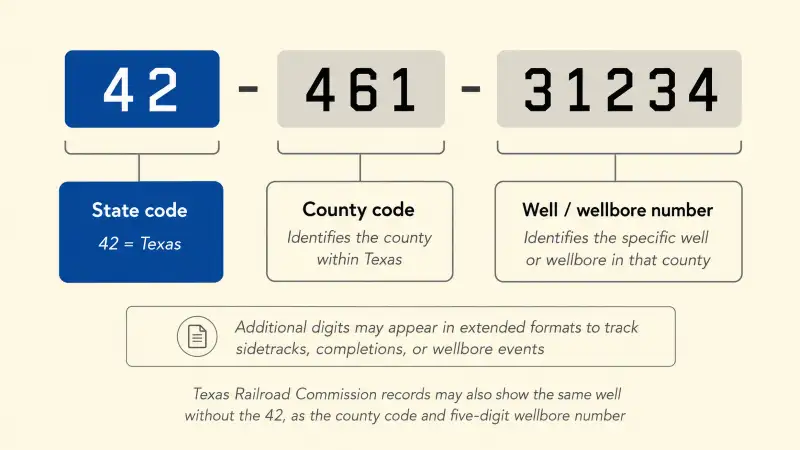
A well API number is a unique identification number assigned to an oil and gas well or wellbore for regulatory tracking and public recordkeeping. In Texas, the full API number is a 10-digit identifier that begins with 42, the Texas state code. However, Texas Railroad Commission records may display or search the number without the 42, so owners may also see the same well shown by its county code and five-digit wellbore number.
For a Texas mineral owner, the API number is a dependable way to find a well's public records, check its production and status, and confirm the well behind a royalty payment, even when the names on your statement change.
What This Means for Mineral Owners
Wells can be referred to in confusing ways. The lease name on your statement can differ from the well name, operators can sell wells to other operators, and names can change over time. The API number is usually the most stable identifier for the well or wellbore, even when names or operators change. It works like a permanent tracking number for the well or wellbore, which makes it a dependable thread for following the same asset over time.
Knowing your well's API number gives you a key to public well records and related regulatory data. With it, you can look up well records, connect the well to production and status data, roughly check royalty volumes, and follow the well even after it changes hands.
The API number is designed to be a permanent and unique identifier for a well or wellbore within the regulatory system. It generally survives operator sales, lease-name changes, and well-name changes, so it is one of the most reliable ways to identify the same well or wellbore over time.
It is not the same as API gravity. The two share the American Petroleum Institute name but are unrelated. An API number identifies a well, while API gravity measures the density and quality of the oil.
How a Well API Number Works
The API number is not random. It is built from segments that each carry meaning, which is part of what makes it useful.
The structure of the number
Reading from the left, the digits identify the well from the broadest level down to the specific well:
- The first two digits are the state code. For Texas wells, the state code is 42.
- The next three digits identify the county within that state.
- The next five digits identify the individual well or wellbore within that county.
- Additional digits may appear in extended formats to track wellbores, sidetracks, completions, or related well events, depending on the regulatory or data system.
Why it never changes
Once a well or wellbore is assigned its API number, that identifier generally stays fixed for the life of that wellbore. A new operator generally does not get a new API number for the same wellbore, and renaming the lease or well does not change the original identifier. This permanence is why the API number is usually more trustworthy for tracking a well than a lease name, well name, or operator name, which can change.
A worked example
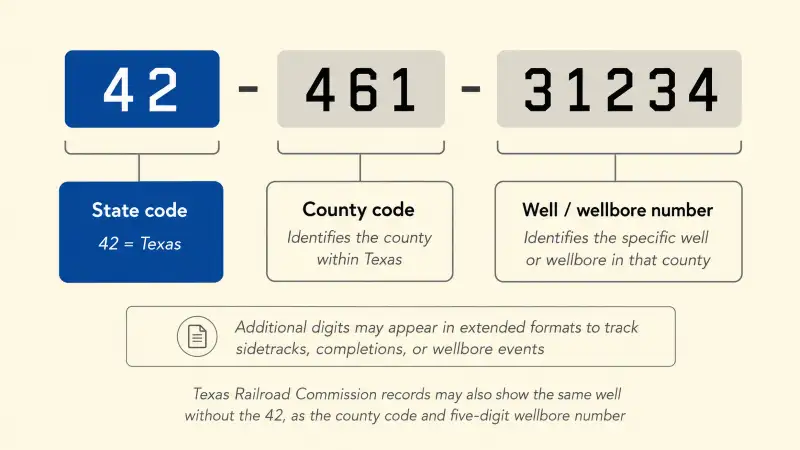
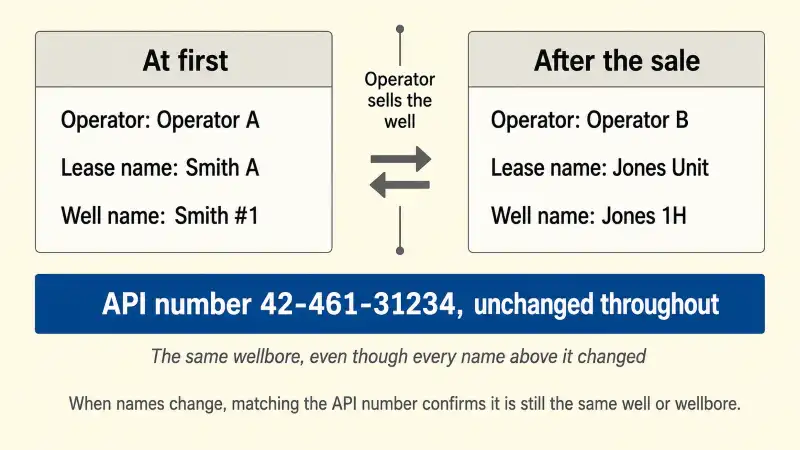
Take an illustrative Texas API number such as 42-461-31234. The 42 tells you the well is in Texas. The next three digits identify the county. The final five digits identify that specific well or wellbore within the county. If the operator later sells the well or the lease is renamed, the same API number generally still points to the same wellbore, which helps you follow it through those changes.
API Number vs Lease Name vs Well Name
Owners often try to identify a well by the name on their statement, which can create confusion. Here is how the three compare.
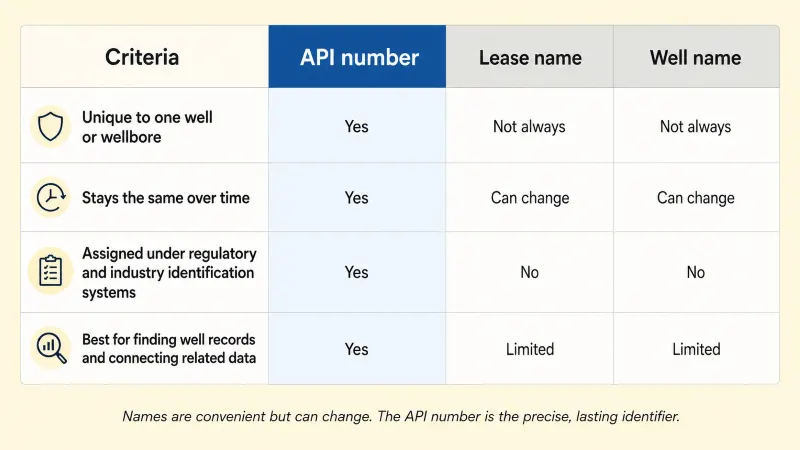
The practical takeaway is that names are convenient but can be unreliable, while the API number is the more precise and lasting identifier. When a lease name or well name on your statement does not match what you expected, the API number can help confirm which well or wellbore you are actually looking at.
Why the API Number Matters to You
For a mineral owner, the API number helps turn a confusing tangle of lease names, well names, and operator names into something you can verify. With it, you can connect the well to reported production records, which may help you roughly check whether your royalty volumes make sense.
You can confirm the well's current regulatory status, which can help explain whether production may still be active, shut in, inactive, or plugged. You can also keep tracking the same well after it is sold to a new operator, which is often when names change and owners lose the thread.
For owners who want to see a well's production history and status in one place, Mineral View's Well Report presents well-level information, which is the kind of record an API number helps you locate and follow.
A Real-World Scenario
Example: George tracking a renamed well in Reeves County
George owns a royalty interest tied to a well in Reeves County, Texas. For years, his statements listed the well under one lease name. Then the operator sold the well to another company, and later statements used a different lease name and a different well name. George worried that his old well had stopped paying and that this was a new, unfamiliar well.
When he checked the API number, the confusion started to clear up. The name had changed, but the API number matched, which indicated it was the same wellbore tied to his royalty interest, simply under new ownership and a new name. Using the API number, George was able to connect the well to public records, confirm that it appeared to be producing, and better understand why his royalty continued under the new name. The permanent number told him what the changing names could not.
Note: This example is provided for illustrative purposes only and does not represent any specific mineral owner or lease.
What to Check
Find your well's API number
The API number commonly appears on drilling permits, completion records, public regulatory records, and sometimes on royalty statements, division order, or supporting payor documents. Locating it once gives you a stable reference point for the well or wellbore that name changes generally do not affect.
Use it to confirm production and status
With the API number, you can find well records and connect them to production and status information, which helps you roughly check royalty volumes and understand whether the well is producing, shut in, inactive, or plugged. The Texas Railroad Commission's public well records can be searched by API number, which is the most direct way to pull up the official record for your specific well. Mineral View's Lease Activity tracks regulatory filings on claimed leases, which is one way to monitor status changes and related activity.
Use it to confirm the well identity behind your payment
If a lease or well name on your statement changes or looks unfamiliar, matching the API number can help confirm whether it is still the same well or wellbore. This is one of the simplest ways to separate a normal name change from a possible payment or identification issue.
Important
Mineral View can help you review well production, status, and activity. If a payment appears to be missing, a well cannot be identified, or an ownership change affects your royalty, consider speaking with a qualified landman or Texas oil and gas attorney.
Common Questions
It commonly appears on drilling permits, completion reports, and public regulatory records for the well, and it may also appear on royalty statements, division orders, or supporting payor documents. Once you have it, it is worth keeping because it is usually the most stable reference for that well or wellbore regardless of future name or operator changes.
No. They share the American Petroleum Institute name but are entirely different. A well API number identifies a specific well or wellbore, like a serial number. API gravity measures how light or heavy the oil is, which relates to its quality and price. One is an identifier; the other is a quality measurement.
Because lease names and well names can change, while the API number generally remains tied to the same well or wellbore. When an operator sells a well or a lease is renamed, the names on your statement may change and cause confusion. The API number generally stays the same, so it is a reliable way to confirm you are still looking at the same well or wellbore.
No. An API number identifies a specific well or wellbore. An RRC oil lease number or gas well ID is a Texas Railroad Commission reporting identifier. One oil lease can include more than one well, so a single lease may be connected to multiple API numbers.