API Gravity
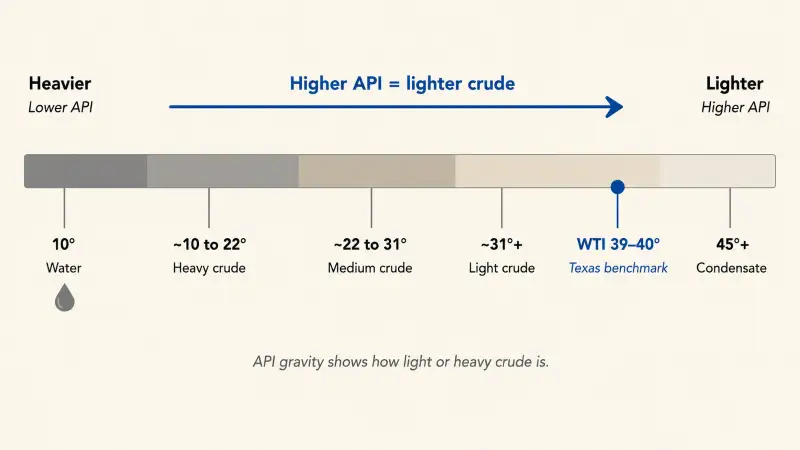
API gravity is a measure of how light or heavy a petroleum liquid is compared with water under the standard API gravity calculation. It is based on a scale created by the American Petroleum Institute, where a higher API number means a lighter petroleum liquid and a lower API number means a heavier one.
For a mineral owner, API gravity matters because it is a crude-quality measure that can affect the price your oil receives, which means it affects the revenue behind each barrel, not the number of barrels produced.
What This Means for Mineral Owners
Most owners think about oil in terms of how many barrels a well produces. API gravity is about a different thing: the density and quality profile of that oil. Two wells can produce the same number of barrels and still generate different revenue because the oil from one may receive a better price than the other based partly on API gravity, sulfur content, location, transportation, and market demand.
You are most likely to run into API gravity on a purchaser statement, run ticket, settlement detail, or in the pricing language of a purchase contract, where the price may be adjusted based partly on the gravity of your crude. It is a quality and pricing input rather than a volume measure, which is why it should be read separately from barrels produced.
API gravity can affect the price per barrel, not the number of barrels. It is one of the quality factors that can influence what a buyer pays for your oil, so it works on the revenue side of your royalty.
You may see a gravity adjustment on purchaser statements, run tickets, settlement detail, or supporting pricing documents, although not every royalty statement labels it separately. Crude is often priced against a benchmark or posted price, and the gravity of your specific oil can be one factor that moves your realized price above or below that reference.
How API Gravity Works
API gravity is calculated from a liquid's specific gravity, which compares the liquid's density with water at the standard reference temperature, commonly 60°F.
The formula is:
API gravity = (141.5 / specific gravity at 60°F) − 131.5
Because of how the formula works, lighter petroleum liquids produce higher API numbers and heavier petroleum liquids produce lower ones. Water has an API gravity of about 10° under the standard calculation, so petroleum liquids above 10° API are lighter than water and those below 10° API are heavier than water.
What light and heavy mean
Lighter crude, with a higher API number, often flows more easily and can yield a larger share of higher-value refined products, but pricing also depends on sulfur content, refinery demand, location, transportation, and blending needs. Heavier crude, with a lower API number, is thicker and often requires more complex refining, which is one reason it may sell at a discount compared with lighter crude.
For reference, West Texas Intermediate is commonly described as a light, sweet crude with an API gravity around 39° to 40°, although exact quality can vary by batch and specification.
Crude oil classifications
Petroleum liquids are commonly grouped by API gravity, but exact cutoffs can vary by source, market, and reporting convention:
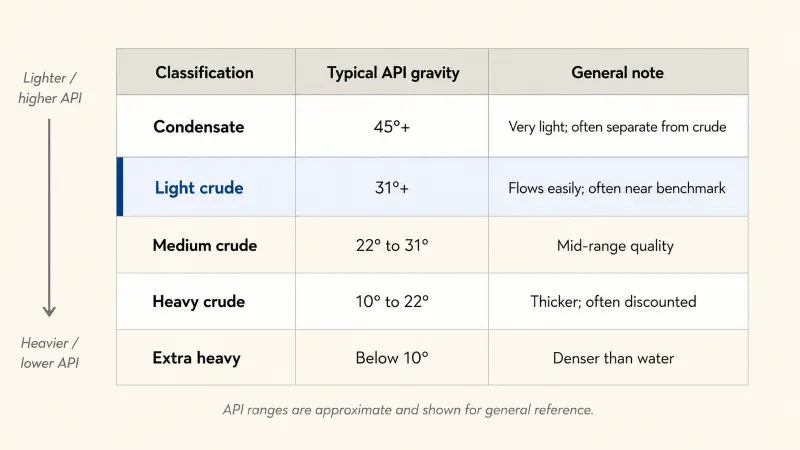
Other petroleum liquids, including condensate and some NGL products, may have their own density characteristics, but they are often priced and reported separately from crude oil.
API Gravity vs Sulfur Content (Sweet vs Sour)
Owners sometimes lump all crude quality together, but API gravity and sulfur content are two separate factors, and they are easy to confuse.
- API gravity measures density, meaning how light or heavy the petroleum liquid is compared with water.
- Sulfur content measures how much sulfur the crude oil contains. Low-sulfur oil is called sweet and high-sulfur oil is called sour.
A barrel can be light and sweet, light and sour, heavy and sweet, heavy and sour, or somewhere in between. West Texas Intermediate, for instance, is generally considered light and sweet, which is one reason it is widely used as a benchmark. When a buyer prices your oil, both gravity and sulfur can factor in, so a strong gravity number alone does not tell the whole quality story.
How API Gravity Affects Your Royalty Income
The link between API gravity and your royalty usually runs through the realized oil price. Crude is often priced against a benchmark, posted price, purchaser schedule, or contract formula, and then adjusted for quality, with gravity being one possible adjustment.
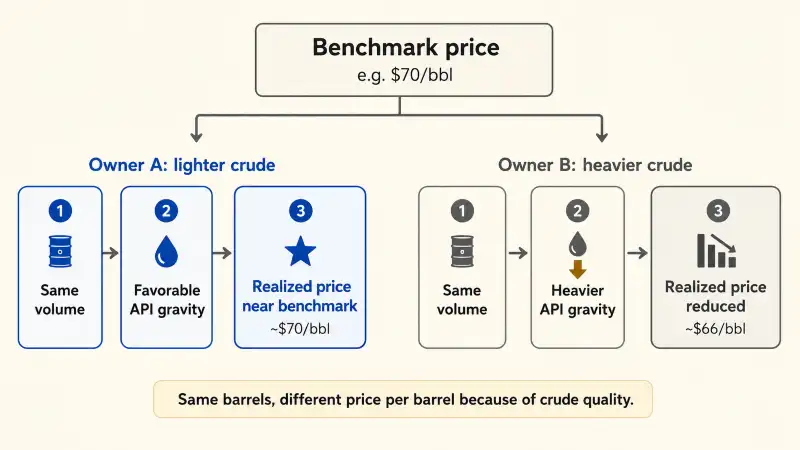
If your oil is heavier than the benchmark or outside the purchaser's preferred gravity range, the buyer may apply a gravity-related deduction or lower price. If it falls in a favorable gravity range, the price may hold closer to the benchmark or receive a premium, depending on the market and contract terms.
This is why two owners producing identical oil volumes can receive different revenue. The owner whose well produces crude in a more desirable gravity range may receive a better price per barrel.
Very heavy crude is often discounted, while very light condensate-range liquids may be priced on a different basis, so higher API gravity is not automatically better. The most valuable gravity range depends on refinery demand, location, transportation, and contract terms.
For owners who want to understand how realized oil price affects long-term income, Mineral View's MVestimate models royalty income using production and price assumptions, which is where a quality-driven price difference can show up in the numbers.
A Real-World Scenario
Example: Raymond comparing price per barrel in Ector County
Raymond owns a royalty interest in a well in Ector County, Texas. When he compared notes with a friend who owns minerals in a different field, he noticed that even though both wells produced similar volumes of oil, his friend's price per barrel was consistently a little higher.
Looking into it, Raymond learned the difference came partly from crude quality. His friend's well produced lighter, sweeter oil that priced close to the benchmark, while Raymond's crude was somewhat heavier and carried a small quality-based deduction at the point of sale. Neither owner had done anything wrong, and neither could change the gravity of their oil. But understanding that API gravity could affect price helped Raymond read his statements more accurately and recognize that the gap may reflect crude quality rather than a payment error.
Note: This example is provided for illustrative purposes only and does not represent any specific mineral owner or lease.
What to Check
Look for gravity or quality adjustments on purchaser statements, run tickets, or royalty detail
Crude pricing may be shown relative to a benchmark, posted price, or purchaser schedule with adjustments applied. One common form is a gravity adjustment, where the purchaser raises or lowers the posted price by a set amount for each degree of API gravity above or below a reference point, sometimes called a gravity bank. If you see a gravity line, quality adjustment, or price that differs from the benchmark, that difference may reflect API gravity, sulfur content, location, transportation, or other contract terms. Knowing it exists helps you understand why your price per barrel looks the way it does.
Understand how your crude prices relative to the benchmark
Your oil may be sold against a reference price such as West Texas Intermediate, a posted price, or another contract formula, then adjusted for quality and market factors. Understanding roughly where your crude's gravity sits relative to the reference crude can help explain whether you might expect a premium, discount, or price close to the reference.
Remember that lighter is not always better
Very heavy crude is often discounted, but extremely light crude or condensate can also price on a different basis. The most valuable gravity range depends on refinery demand, local market conditions, transportation, and contract terms, so do not assume a higher API number always means a higher price.
Important
Mineral View can help you see production and projected income for your minerals. For questions about how your crude's gravity is priced, what adjustments appear on your statements, or what pricing terms apply under your contract or lease, contact your purchaser or operator, or consult a qualified landman or Texas oil and gas attorney.
Common Questions
It can. API gravity is a quality factor that can affect the price per barrel, so it works on the revenue side of your royalty rather than the volume side. If your crude is heavier than the benchmark or outside the purchaser's preferred range, you may see a gravity-based or quality-based deduction in the price.
If it sits in a favorable range, your price may hold closer to the benchmark or receive a premium, depending on market and contract terms. The number of barrels is unaffected, but the realized value of each barrel can be.
Not necessarily. Heavier crude is often discounted, so up to a point a higher API number may support better pricing, all else being equal. But very light crude or condensate-range liquids are often priced differently, and the most valuable gravity range depends on refinery demand, location, transportation, and contract terms. So a higher API number can be favorable, but it is not automatically the best pricing outcome.
It may appear on purchaser statements, run tickets, settlement details, or pricing terms, but it may not appear as a headline number on a simple royalty statement. If you cannot find it and want to understand your pricing, your purchaser, operator, or statement contact is the right place to ask.