Stripper Well
A stripper well is a low-producing oil or natural gas well in the late stage of its life that still produces enough to be worth operating. As a rough guide, that often means an oil well making about 10 barrels a day or less, or a gas well making about 60 MCF a day or less, though the exact cutoff varies by program and agency.
For a mineral owner, a stripper well usually means smaller royalty income from an aging well, sometimes paid steadily and sometimes accumulated or delayed depending on the operator, payor, minimum-payment thresholds, and lease terms.
What This Means for Mineral Owners
Many older producing wells in Texas are low-producing or marginal wells, and a significant share of U.S. producing wells fall into this low-production category. If you inherited your minerals or have held them for many years, there is a real chance your royalty income comes from one. A stripper well is not a problem in itself. It is simply a well near the end of its economic life that still produces enough to be worth operating.
Owners often experience it as a modest, relatively stable royalty stream rather than the larger early-life income that a new well may produce in its first year or two.
A stripper well is more sensitive to oil and gas prices than a high-volume well. When prices fall far enough, a stripper can become uneconomic to operate and may be temporarily shut in, which can pause your royalty income until conditions improve.
If your lease is held only by a stripper well, the survival of the lease can depend on that one well continuing to produce in paying quantities. If it stops, the lease may eventually terminate, depending on the lease language, the title situation, and any savings clauses it contains. That carries both a risk and a potential opportunity for you.
How a Well Becomes a Stripper Well
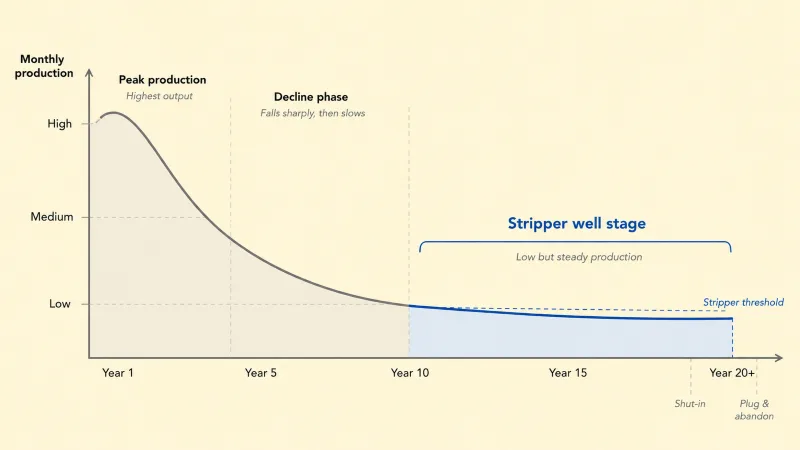
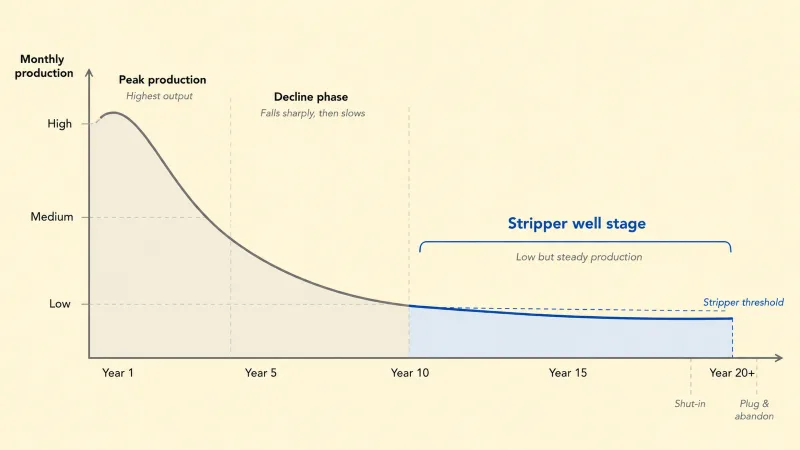
Every well's production declines over time. A new well usually starts with its highest output and falls off sharply in the first months and years. Eventually that steep early decline flattens into a long, slow tail where the well produces a small, relatively steady volume for many more years. A well in that late, low-volume stage is a stripper well.
How stripper status is defined
A common industry definition is an oil well averaging roughly 10 barrels per day or less, or a gas well averaging roughly 60 MCF per day or less, but definitions vary. Some programs use different thresholds, measurement periods, or BOE-based standards.
Different industry, state, federal, tax, and reporting programs may use different production thresholds or measurement periods. Some federal tax provisions, for example, use a threshold of 15 barrel-of-oil-equivalent (BOE) per day for certain marginal well benefits, combining oil and gas into a single daily figure. The practical point for an owner is the idea rather than the exact cutoff: a stripper well produces a small fraction of what it once did, but enough to keep operating.
Why the production looks flat
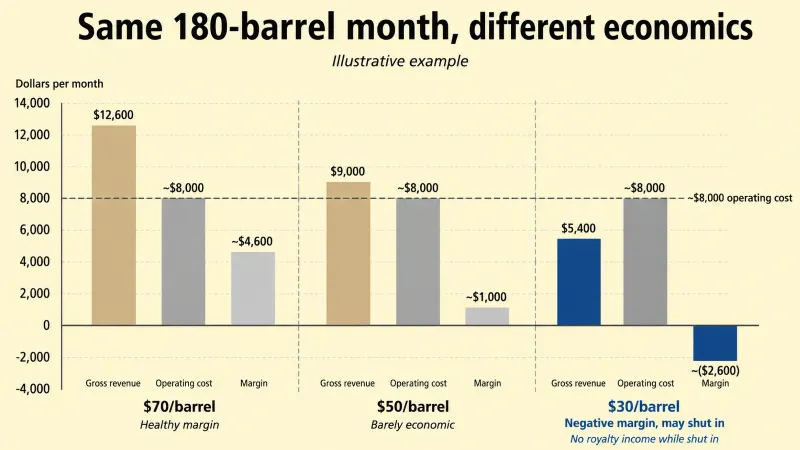
Because a stripper well is already deep into the slow tail of its decline curve, its month-to-month production tends to be low but reasonably stable. That is why stripper-well royalty checks often feel predictable, even small. As an illustration, a stripper oil well producing 6 barrels per day may generate around 180 barrels in a 30-day month, a modest volume that can still produce royalty income depending on oil price, your decimal interest, deductions, taxes, and payment thresholds.
Stripper Well vs Shut-In Well vs Plugged Well
These three terms describe different points near the end of a well's life, and owners often confuse them.
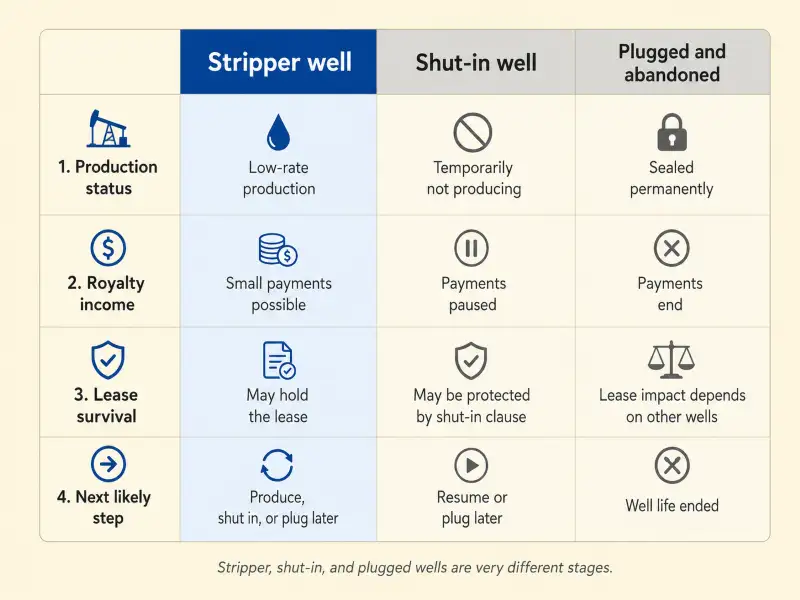
- Stripper well: Still producing, just at a very low rate. It is generating revenue and may still be paying royalty, although small amounts may be accumulated until the payor's minimum-payment threshold is reached.
- Shut-in well: Temporarily not producing. The well is capable of production but has been closed in, often because of low prices, a lack of a pipeline connection, or maintenance. It may resume later. Royalty income usually pauses while a well is shut in.
- Plugged and abandoned well: Permanently sealed and out of service. This is the end of the well's life. Royalty income from that well ends, and the lease may be affected if it was the only producing well.
A stripper well can move into either of the other two states. Low prices may push it to shut-in status, and the end of its economic life leads eventually to plugging.
How a Stripper Well Affects Your Royalty Income
For most owners, a stripper well means a smaller but more predictable royalty stream than a young, high-volume well. There are a few effects worth understanding.
Price sensitivity
Because a stripper well produces at low volumes, the operator's revenue from it may be close to the cost of operating it. When oil or gas prices drop, that margin can shrink or disappear, and the operator may choose to shut in the well, reduce activity, or delay maintenance rather than operate at a loss. That pauses your royalty until the well comes back online, if it does.
Severance tax treatment
Texas provides certain severance tax incentives or relief for qualifying low-producing oil leases and gas wells under specific price and eligibility conditions. This relief applies to the production tax on the well, so it can help you indirectly: by lowering the operator's cost of running a marginal well, it can keep that well online and your royalty flowing during low-price stretches. Whether and how it applies depends on qualification, current price conditions, tax status, operator reporting, and payment treatment, so it should be confirmed with a qualified professional rather than assumed from the royalty statement alone.
Lease survival
A stripper well that is the only producer on a lease is doing the work of holding that lease under its habendum clause. In Texas, producing in paying quantities generally means the well earns more than its operating costs over a reasonable period. As long as a stripper well clears that standard, the lease may continue to be held by production. If it stops producing in paying quantities, the lease may eventually terminate, depending on the lease terms, the title situation, and any savings provisions such as shut-in or continuous-operations clauses.
For owners who want to see how a single well's production and remaining life translate into income over time, Mineral View's Well Report presents a well-level view of production history and lifecycle, which can help you understand where a stripper well sits in its decline.
A Real-World Scenario
Example: Diane's marginal well in Shackelford County
Diane inherited a small mineral interest in Shackelford County, Texas, that includes a share in an oil well drilled in the 1980s. The well had long since settled into producing about 7 barrels per day.
Diane's royalty checks were small but arrived steadily, usually within a narrow range each month. She had assumed the well would simply keep going indefinitely. Then, during a stretch of low oil prices, two of her monthly checks did not arrive. When she looked into it, she learned the operator had temporarily shut the well in because it was no longer economic to run at those prices. A few months later, after prices recovered, the well resumed and her checks returned.
The experience taught Diane two things. Her income came from a stripper well, which made it more exposed to price swings than she had realized, and the well was the only producer holding her lease. Understanding both helped her keep a closer eye on the well's status and recognize that, if the well were ever plugged, her lease situation could change.
Note: This example is provided for illustrative purposes only and does not represent any specific mineral owner or lease.
What to Check
Watch for shut-in or plugging activity on the well
Because a stripper well sits near the end of its life, its status can change. A shut-in usually pauses income from that well, while plugging and abandonment usually ends income from that specific well. Keeping track of status changes and regulatory filings lets you respond rather than be surprised. Mineral View's Lease Activity tracks regulatory filings such as status changes and completions on claimed leases, which is one way to see when a well's situation shifts.
Confirm how much your well is actually producing
The volume on your royalty statement tells you roughly where the well sits. Very low, relatively steady production over a long period is a common sign of a stripper or marginal well. A sudden increase can signal that the operator performed a workover, remedial work that sometimes restores or extends production on an aging well. Knowing the well's normal range helps you set realistic expectations and recognize when something has changed.
Understand whether your lease depends on a single marginal well
If the only producer on your lease is a stripper well, the lease's survival may depend on that well continuing to produce in paying quantities, subject to the lease's specific savings clauses and title situation. If production stops and the lease terminates under its terms, you may eventually be able to lease the minerals again, depending on title, lease language, pooling, and any applicable savings provisions. This is a question worth understanding in advance rather than after the fact.
Important
Mineral View can help you track well status, production history, and operator activity for your minerals. For questions about whether a well still holds your lease, how severance tax relief applies, or what your options are if a well is plugged, consult a qualified landman or Texas oil and gas attorney.
Common Questions
Not by itself. A stripper well is a normal late-life stage for a well that still produces enough to be worth operating. Many owners receive steady, if modest, royalty income from stripper wells for years. The main things to be aware of are that the income is smaller, more sensitive to price swings, and that the well is closer to the end of its life than a newer well would be.
If the well is shut in, royalty income from that well usually pauses until production and sales resume, although shut-in royalty provisions or minimum-payment rules may affect what you receive. If the well is plugged and abandoned, royalty income from that specific well generally ends permanently. If it was the only producing well on your lease, the lease itself may eventually be affected, which is worth reviewing with a professional.
It can, but generally only if the well stops producing in paying quantities. As long as a stripper well continues to produce in paying quantities, it may hold the lease under the habendum clause, subject to the specific lease language and title circumstances. If production stops or falls below that standard, the lease may terminate over time, depending on the specific lease language and title situation. Whether that helps or hurts you depends on your goals, since a released lease can sometimes be leased again.