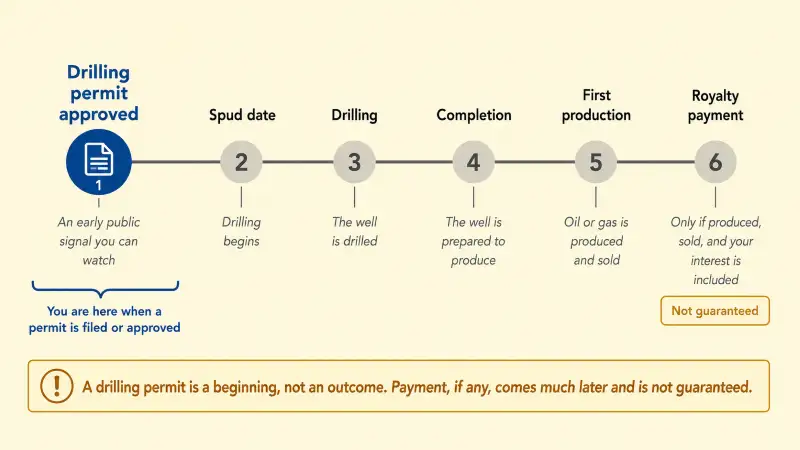
Drilling Permit
A drilling permit is official approval from a regulatory agency that allows an operator to drill an oil or gas well. In Texas, drilling permits are issued by the Texas Railroad Commission, often called the RRC.
For a mineral owner, a drilling permit is often one of the earliest public signs that drilling activity may be coming to or near your minerals. It can be an early signal of possible new or continued royalty potential, but a permit is authorization to drill, not a guarantee that a well will be drilled, completed, produce, or pay royalties.
What This Means for Mineral Owners
A drilling permit is one of the most useful early signals an owner can watch because it usually appears near the start of the development process, often before drilling, completion, production, or any possible royalty payment. When a permit application is filed or a permit is approved on or near your minerals, it may show that an operator is planning activity in your area, giving you a head start to understand what may be coming.
The catch is that a permit is a beginning, not an outcome. A permit application shows that an operator is seeking authorization, while an approved permit shows that the Texas Railroad Commission has authorized the permitted activity. Whether a well is drilled, completed, produces, or includes your minerals depends on more than the permit alone.
A drilling permit is frequently one of the first public clues that a well may be coming. Watching for permits near your minerals lets you prepare rather than be surprised.
A permit signals planned or authorized activity, not income. It does not by itself mean a well will be drilled, that production will follow, or that your specific minerals are included in the lease, pooled unit, allocation unit, or tract arrangement tied to the well.
How a Drilling Permit Works
To get a permit in Texas, an operator files a drilling permit application with the Texas Railroad Commission describing the proposed well or permitted well activity. Once the permit is approved, the well record is tied to identifying information such as the API number, permit number, operator, lease name, location, well type, and wellbore profile, and drilling may legally begin. The permit number identifies that particular filing, while the API number identifies the well itself and stays with it over time.
What a permit tells you
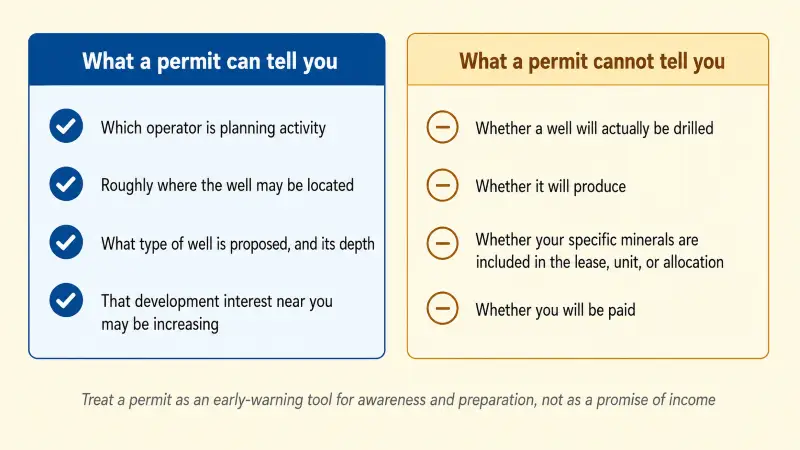
A drilling permit is a useful package of early well information. It typically identifies the operator, lease or well name, county, survey or location information, proposed depth, well type, filing purpose, wellbore profile, field, and related permit details. For an owner, that can be enough to see who is planning activity, roughly where the well may be located, and what kind of well is proposed.
Where a permit sits in the timeline
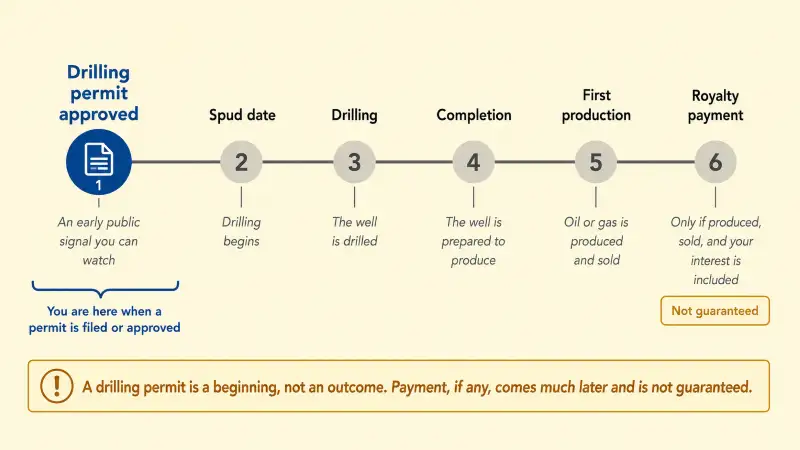
A permit usually comes near the front of the development sequence. The general order is permit approval, spud date when drilling begins, drilling, well-completion, first production, and then royalty payment if production is sold and your interest is included. Because the permit is early in that chain, it is one of your earliest public looks at what an operator may be planning.
In Texas, a standard approved drilling permit is generally valid for two years, so a permit may sit unused before the operator drills, lets it expire, amends it, or files again.
Drilling Permit vs Lease vs Production
These three are easy to blur together, but they mean very different things for your royalty.
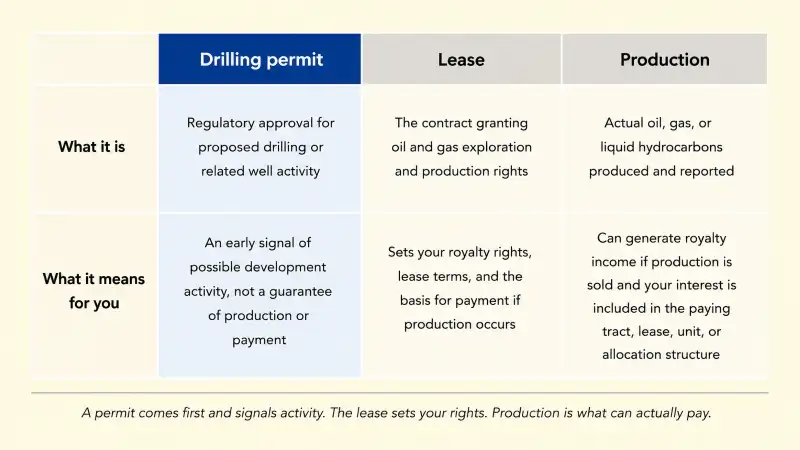
A permit does not create your lease, change your royalty rate, prove your minerals are included, or pay you by itself. It sits before production, sales, payment setup, and royalty income in the process. Seeing a permit is a reason to pay attention, not a reason to assume a royalty check is coming.
Why Drilling Permits Matter to You
The reason permits are worth watching is timing. Because permits appear early, they give you time to prepare, confirm ownership, watch nearby activity, and understand whether your minerals may be affected.
A permit near your minerals can be an early sign that operator activity or development interest in your area is increasing, which may be useful before a lease offer, purchase offer, or development update arrives. It can tell you which operators are active or planning activity near you. And it lets you follow the pace of development around your minerals over time.
What a permit cannot tell you is whether you will be paid. The well may not be drilled, it may not be completed, it may not produce, or your specific minerals may not be part of the lease, pooled unit, allocation unit, or tract arrangement tied to the well. So a permit is best treated as an early-warning tool, valuable for awareness and preparation rather than as a promise of income.
For owners who want to catch these signals earlier, Mineral View's Lease Activity can help track regulatory filings, including permits, on claimed minerals, so you can review nearby activity without manually searching each record yourself.
A Real-World Scenario
Example: Sandra preparing after a permit in Howard County
Sandra owns minerals in Howard County, Texas, that had not seen new drilling in years. One day she learned that an operator had filed a drilling permit on acreage near her tract.
Rather than assume a check was on the way, Sandra used the permit as a prompt to get prepared.
She confirmed what she owned and where, noted which operator was planning activity, and started watching for further filings, spud information, completion activity, and production updates. A permit did not mean money yet, but it told her that her quiet minerals might be entering a more active period.
When a leasing conversation did come up some months later, Sandra was already informed rather than caught off guard. The permit had given her just what it is good for: a head start.
Note: This example is provided for illustrative purposes only and does not represent any specific mineral owner or lease.
What to Check
Find out whether the permit is near, on, or tied to your minerals
Location is critical with a permit. A permit a few miles away may not affect you, while one on your tract, lease, pooled unit, allocation unit, or nearby development area could matter more. Mineral View's Map shows your minerals and nearby activity geographically, which helps you see how close a permit is to what you own.
Confirm whether your minerals are included in the well, lease, unit, or allocation area
A nearby permit only benefits you if your minerals are included in the lease, pooled unit, allocation unit, tract, or other arrangement tied to production from the well. Whether you are included depends on your ownership, lease, pooling language, unit designation, allocation structure, title, and the well's location, so a nearby permit is a reason to check, not to assume.
Remember a permit is not a payment
Treat a permit as information, not income. It is an early signal worth acting on by preparing and confirming details, but it does not mean a well will be drilled or that you will receive a royalty.
Important
Mineral View can help you track permits and activity on your minerals and see them on a map. For questions about whether your minerals are included in a unit, whether a permit will lead to a lease offer, or how it affects your specific interest, consult a qualified landman or Texas oil and gas attorney.
Common Questions
Not necessarily. A permit means an operator intends to drill, but your royalty depends on whether a well is actually drilled, whether it produces, and whether your specific minerals are part of the unit the well serves. A nearby permit is a good reason to look into those questions, but it is not a guarantee of income on its own.
Texas drilling permit records can be searched through the Texas Railroad Commission's Drilling Permit Form W-1 Query and Public GIS Viewer, which help users review filings by identifiers such as permit number, API number, district, county, operator, or location. The simpler approach for most owners is to use a tool that watches for permits on your specific minerals and surfaces them for you, so you learn about nearby activity as it is filed rather than having to search for it yourself.
No. An approved permit authorizes drilling or other permitted well activity, but operators do not always drill every well they permit. Plans change for many reasons. So a permit raises the odds of activity in your area, but it does not make a well certain.