Well Completion
Well completion is the process that turns a drilled wellbore into a producing well. It includes perforating the casing, fracturing the formation, installing production equipment, and testing the well before it begins delivering oil or gas to the surface.
What this means for mineral owners
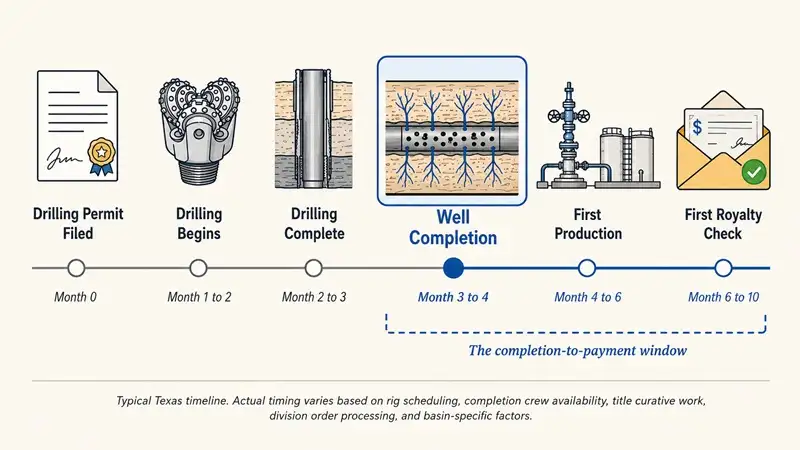
Well completion is one of the clearest signals that production may be approaching. Once the operator files a completion report with the Railroad Commission of Texas, it is a strong public signal that the well has been completed or tested, but production timing can still depend on connection, reporting, and operator schedules. Understanding where completion sits in the overall lease lifecycle tells you what to expect next and when to start watching your royalty statements.
What happens during well completion
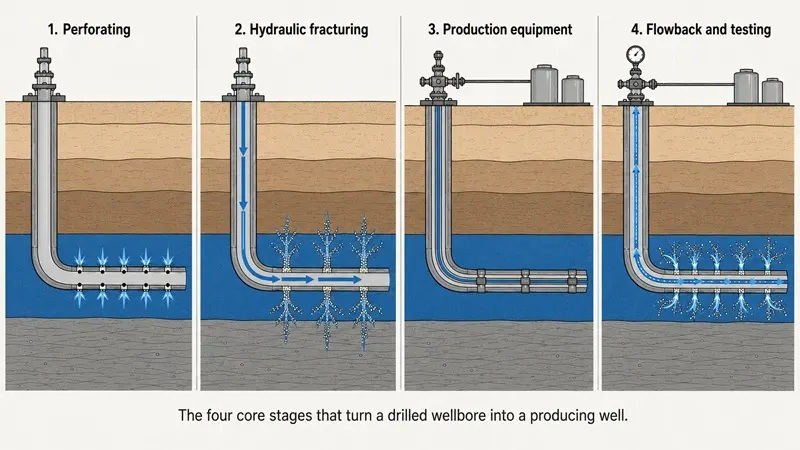
After the drill bit reaches its target depth, the wellbore itself is not yet ready to produce. Completion prepares it. The core steps for many modern Texas oil and gas wells, especially horizontal wells in formations like the Permian Basin or Eagle Ford, typically include:
Perforating
The production casing that lines the wellbore is perforated with shaped charges at the target formation. These perforations create the pathways through which oil and gas will flow into the wellbore.
Hydraulic fracturing
In tight rock formations, perforations alone are not enough. Water, sand, and additives are pumped into the well at high pressure to fracture the surrounding rock and create pathways for oil and gas to flow. The sand (proppant) holds those fractures open once the pressure is released.
Installing production equipment
Tubing is run inside the casing to carry produced fluids to the surface. A wellhead assembly is installed at the top of the well. Flow lines may connect the wellhead to tanks, separators, and gathering infrastructure.
Flowback and testing
The well is allowed to flow back the fluids used during fracturing. The operator tests the well to estimate initial production rates and evaluate whether the completion performed as expected.
Where well completion appears in the lease lifecycle
Well completion does not happen in isolation. It is one stage in a defined sequence of events that begins when a mineral owner signs a lease and ends when a well reaches the end of its productive life. Knowing where completion sits helps mineral owners understand what has already happened on their property and what comes next.
1. Leasing
The mineral owner signs an oil and gas lease. The operator pays a lease bonus. The habendum clause starts the primary term clock — the operator now has a fixed number of years to drill.
2. Permitting
The operator files a drilling permit application with the Railroad Commission of Texas. This is often the first public regulatory signal that development on the lease may be approaching. Mineral View's Lease Activity tracks new drilling permits as they are filed with the RRC, so you can see when development begins on your minerals before the rig arrives.
3. Drilling
A drilling rig arrives on site and drills the wellbore to its target depth. The formation is reached, but no production begins yet. The wellbore is cased and cemented.
4. Well completion
The operator completes the well: perforating, fracturing, and installing production equipment. A completion or recompletion report is filed with the Railroad Commission of Texas, commonly using Form W-2 for oil wells or Form G-1 for gas wells. This is usually one of the last regulatory steps before reported production begins.
5. First production
Oil or gas flows from the completed well. The lease moves into the secondary term of the habendum clause, held by production. The mineral owner's royalty income may begin after production is established and payment processing is completed.
6. Ongoing production
The well produces over months and years. Production volumes decline over time along the decline curve. The lease remains in force as long as production continues in paying quantities.
7. Workover (if needed)
If production falls significantly or a mechanical problem develops, the operator may perform a workover — remedial work on the existing wellbore to restore or improve production. This is distinct from completion, which applies only to a newly drilled well.
8. Plug and abandon
At the end of its productive life, the well is plugged and the surface is restored. The operator files a plugging report with the Railroad Commission.
Well completion vs. workover
| Well completion | Workover | |
|---|---|---|
| What it applies to | A newly drilled well, never yet produced | An existing well that has already produced |
| Purpose | Prepare the well to produce for the first time | Restore or improve production that has declined |
| Equipment used | Completion crew, fracturing equipment, production installation | Workover rig — smaller than a drilling rig |
| Royalty impact | Royalties may begin after production is established following completion | Temporary royalty gap during the workover, then restoration |
| Regulatory filing | Completion report filed with the RRC (Form W-2 or Form G-1) | Workover, recompletion, or related RRC filing may be submitted, depending on the work performed |
Understanding well completion better
Example
Elena owns mineral rights in Reeves County, Texas. In March 2025, an oil company spent three weeks drilling a deep hole on her land. Once the hole was drilled, the rig packed up and left. No oil was flowing yet — the well was drilled, but not completed.
In May, a different crew arrived to finish the job. They used hydraulic fracturing (fracking) to crack the rock and release the trapped oil. Once the oil successfully flowed, the company filed a W-2 Completion Report with the state of Texas.
That filing meant the well was officially a producer. A few months later, Elena's first royalty check arrived. It was larger than expected due to the initial surge of oil common with newly completed wells. By month nine, that initial surge naturally slowed down, and her checks leveled out.
For Elena, well completion was the exact moment a simple hole in the ground turned into a working, paying asset.
What completion means for royalty timing
Royalties do not begin the day drilling starts. They generally begin after production is established, volumes are sold, and payment processing is completed. The gap between a drilling permit being filed and a royalty payment arriving can be several months, depending on how long drilling and completion take and how quickly the operator connects the well to a gathering system.
For mineral owners in Texas, the completion report filed with the Railroad Commission of Texas is the most reliable public indicator that production is imminent. Once filed, first production volumes may already have occurred or may follow soon, depending on the operator's reporting timeline and field setup.
The first royalty payment commonly arrives one to three months after first production is sold and processed, depending on the operator or payor's payment cycle, title review, minimum pay thresholds, and lease terms.
Important
Mineral View can help you understand completion activity, operator filings, and production context from public RRC records. For questions about royalty payment timing, title review, or your specific lease terms, review your lease documents and consult a qualified professional.
What to check when completion is underway
Watch for the completion report filing
The Railroad Commission of Texas requires operators to file completion or recompletion reports — commonly Form W-2 for oil wells and Form G-1 for gas wells — after qualifying completion activity. This is a public record and confirms the well has been prepared to produce. It may include the formation or reservoir, perforation intervals, test information, completion details, and related attachments depending on the filing.
Mineral View's Lease Activity tracks oil and gas lease updates sourced from Texas RRC filings, covering new drilling permits, well completions, production data, and well status changes.
Review well details once production begins
Once a well is producing, Mineral View's Well Report shows production data, formation, operator, and completion-related details for wells on a claimed lease — including W-2 Completion Reports from the RRC document vault — helping you understand what the completed well is delivering.
Compare initial production against nearby wells
Initial production rates from a completion (known as IP rates) vary significantly depending on the formation, the completion design, and the operator. Comparing the IP rate on a new completion against nearby wells in the same formation can help show whether the completion appears stronger, weaker, or similar to nearby activity.
Common questions
Drilling creates the wellbore — the physical hole that reaches the target formation. Completion is everything that happens afterward to make that wellbore capable of producing. A drilled well that has not been completed generally cannot produce commercial oil or gas. The two operations are usually performed in sequence, often by different crews and equipment, and production must be established before a mineral owner receives royalty income.
Completion timelines vary by well type and formation. A vertical well with a simple completion may take a few days. A modern horizontal well in the Permian Basin or Eagle Ford, with multiple fracturing stages across a long lateral, may take two to four weeks or longer to complete. In areas with high drilling activity, operators may also wait for a completion crew to become available, which can extend the timeline between drilling and first production.
A completion report is the regulatory filing an operator submits to the Railroad Commission of Texas after completing a well. It may document the formation or reservoir, perforation intervals, test data, completion details, and related information reported by the operator. For mineral owners, it is the public record that confirms a well on their property has been prepared to produce, and that royalty income may be approaching if production is established and payment processing is completed.