Overriding Royalty Interest
An Overriding Royalty Interest (ORRI) is a cost-free royalty carved from the working interest in a specific oil and gas lease. It is not ownership of the minerals, and it usually ends when that lease ends.
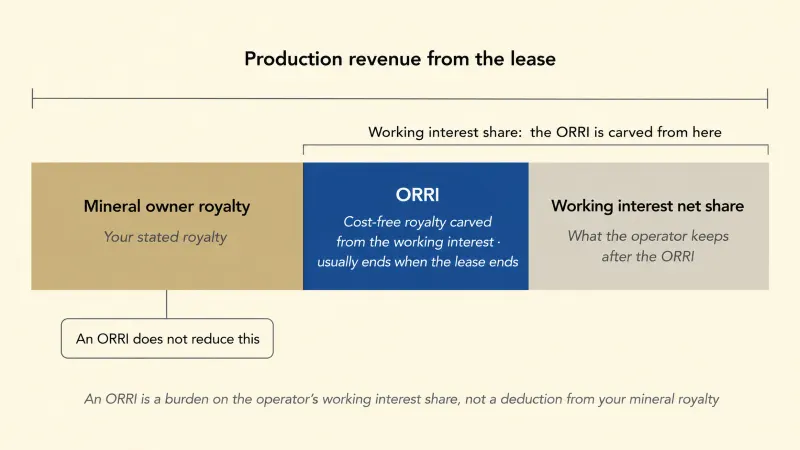
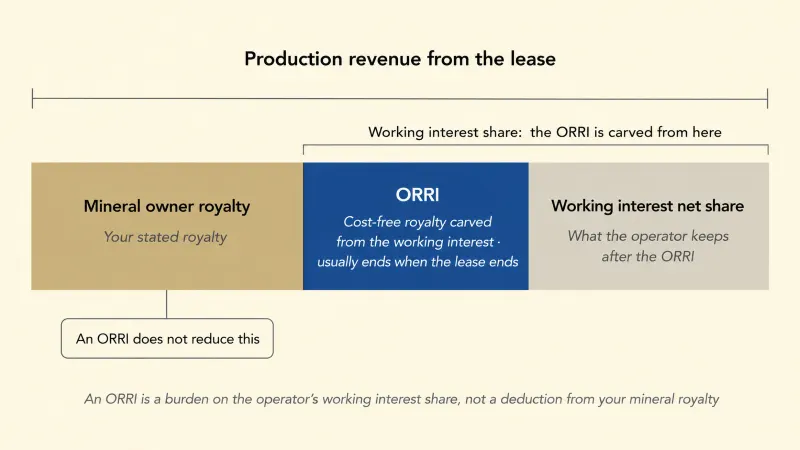
For a Texas mineral owner, the most important thing to know is this: an ORRI is a burden on the operator's share of revenue, not a deduction from your stated mineral royalty. In a typical lease structure, someone else’s ORRI should not reduce your stated mineral royalty.
How an ORRI Works
When a Texas well produces oil or gas, revenue is divided in a specific order. The mineral owner's royalty is paid first, from the top of gross revenue. What remains, the Net Revenue Interest (NRI), goes to whoever owns the working interest, typically the operator.
An ORRI is carved from that working interest share. The Overriding Royalty Interest holder receives a percentage of production revenue without paying any drilling or operating costs, but their interest exists only for as long as the underlying lease remains active.
Example
A lease has a 25% mineral royalty and a 3% ORRI. The mineral owner receives 25% of gross revenue (paid first, as guaranteed by the lease. The ORRI holder receives 3% of gross revenue) paid from the working interest side. That leaves the operator with 72% Net Revenue Interest (NRI): 100% − 25% royalty − 3% ORRI = 72%. Your royalty as the mineral owner is still 25%. The ORRI does not reduce what you receive.
A Real-World Scenario
Example
A landman named Carlos helped an operator secure a lease in Midland County in 2021. As part of his compensation, he was granted a 2% ORRI on the wells drilled under that lease. Carlos receives 2% of production revenue from those wells, without paying any drilling costs, for as long as that lease stays active. When the lease eventually expires or is released, Carlos's ORRI ends with it. He has no ongoing claim to royalties from any future lease signed on the same property.
Why Texas Mineral Owners Should Care
Many mineral owners first encounter ORRI language when reviewing old lease assignments, title notes, division-order documents, or family mineral records. Even when an Overriding Royalty Interest does not reduce your royalty, it can explain things you see in related documents:
- Title Records: ORRI language may appear in recorded assignments or conveyances at the county clerk's office. It is worth understanding what it means before assuming it affects your interest.
- Lease Economics: Lease Economics: ORRI reduces the operator's NRI, which can affect how attractive a lease is to drill. An operator carrying heavy royalty burdens may be slower to invest capital on that lease. Mineral View's Lease Report shows operator performance benchmarks and drilling activity at the lease level, which can help you gauge how actively your lease is being developed.
- Division Orders: Your royalty decimal on a division order should match your lease terms and ownership percentage. If you see additional royalty interests listed, those are likely ORRIs or other interests paid from the operator's side, not reductions from yours.
- Lease Expiration: ORRI usually disappears when the lease ends, unlike mineral or royalty interests that survive new leases. This distinction matters when reviewing family records.
- Inherited Minerals: Older family records may mention overrides, but that does not mean the family owns the mineral estate. An ORRI and a mineral interest are legally distinct, one is lease-based, the other is permanent.
ORRI vs Mineral Royalty
| Question | ORRI | Mineral Royalty |
|---|---|---|
| Carved from | Working interest | Mineral estate |
| Pays drilling costs? | No | No |
| Signs the lease? | Usually no | Often yes, if leasing rights are owned |
| Receives lease bonus? | Usually no | Often yes, if bonus rights are owned |
| Survives a new lease? | Usually no — ends with the lease | Often yes, depending on deed language |
| Common holder | Landman, geologist, broker, prior WI owner | Mineral owner, heir, royalty owner |
Key Owner Takeaway
An ORRI is lease-based and ends when the lease ends. Mineral ownership is permanent and continues regardless of which lease is in place. If a family document mentions an override, confirm whether it is an ORRI (lease-based) or a mineral or royalty interest (permanent) before drawing conclusions.
Where ORRI Appears in the Lease Lifecycle
Mineral Owner Signs a Lease
The lease creates the working interest for the operator. The mineral owner's royalty is set by the lease terms and ownership share. No ORRI exists yet at this stage.
Working Interest is Assigned or Shared
A party may reserve or receive an ORRI through an assignment, farmout agreement, or separate conveyance. This is where most ORRIs are created. The recorded document should show the percentage, the lease it applies to, the parties involved, and the county recording details.
Production Begins
The mineral royalty is paid first according to the lease. The ORRI is then paid from the working interest side of the revenue stack. In most cases, your royalty check is not affected by the existence of an ORRI.
Lease Expires, is Released, or Production Ends
The ORRI typically ends with the lease. The mineral owner's interest continues, and any future lease on the property starts fresh, without the prior ORRI attached.
What to Check if ORRI Appears in Your Documents
If ORRI language appears in a lease assignment, title note, or family mineral document, review the specifics carefully before drawing conclusions:
- Is the document a deed, lease, assignment, farmout, division order, or separate ORRI conveyance?
- Does the language say the interest is carved from working interest, or does it describe a mineral or royalty interest?
- Is the ORRI tied to one specific lease, one well, one unit, or broader acreage?
- Has the underlying lease expired, been released, or been held by production?
- Does the document affect your royalty decimal, or only the operator's NRI?
Start with the recorded assignment at the county clerk's office. Look for the lease name, the percentage stated, the effective date, and whether the document says "carved from working interest." If it says "mineral interest" or "royalty interest" instead, it may be a different type of interest entirely.
Important
Mineral View can help you understand production, operator activity, nearby development, and public regulatory context for your minerals. For legal ownership, title questions, or deed interpretation, review the documents with a qualified landman or Texas oil and gas attorney.
Common Questions
An ORRI is a royalty carved from the working interest of an active oil and gas lease, not from the minerals themselves. The holder receives a share of production revenue without paying any drilling or operating costs. The interest is tied to a specific lease, so when that lease ends, the ORRI typically ends with it. ORRI holders do not own the minerals and generally cannot sign new leases or receive lease bonus payments.
No. An ORRI comes from the operator's share of revenue (the working interest side) not from the mineral owner's stated royalty. Your royalty is calculated from your lease terms and ownership percentage, and it is paid before the operator receives anything. The ORRI is then paid from what remains. If you are reviewing a division order and your royalty decimal looks lower than expected, that is worth investigating separately, but an ORRI should not be the cause.
Even if an ORRI does not reduce your royalty check, its presence in the title history can affect lease economics. An operator carrying multiple ORRI burdens has a lower NRI, which reduces their net revenue from each barrel. This can influence how motivated they are to invest capital in drilling or completing new wells on your lease. Understanding the overall burden structure helps you read operator behavior. To see whether an operator is actually filing permits and developing your lease, Mineral View's Lease Activity tracks new drilling permits, completions, and status changes as they are filed with the Railroad Commission of Texas.
The key difference is permanence. A mineral royalty is a permanent part of the land ownership, it survives lease expirations and applies to any future lease signed on that property. An ORRI is tied to one specific lease: when that lease expires or is cancelled, the ORRI disappears with it. A new lease on the same property does not automatically carry the old ORRI forward.
ORRIs are frequently held by individuals or companies that played a role in setting up a drilling project, geologists who identified the prospect, landmen who assembled the leases, brokers who introduced parties, or prior working interest owners who sold their rights but kept an override as part of the deal. It is a form of carried compensation: revenue without cost responsibility, for the life of the lease.
Yes, recording an ORRI is standard practice and important for establishing the legal chain of ownership. ORRIs are typically documented in lease assignments or separate conveyance papers filed at the county clerk's office in the county where the land is located. These records are the primary source for confirming the percentage, effective date, and lease coverage of any override.
Generally no. Since an ORRI is carved from the working interest of a specific lease, it typically ends when that lease expires or is released. The specific language in the original assignment should be reviewed to confirm, occasionally an ORRI is structured to attach to successor leases, but this is the exception, not the rule.
Yes, though the two interests remain legally distinct. A mineral owner might acquire an ORRI through a separate transaction, for example, by reserving an override when assigning working interest rights. The mineral royalty is part of their land ownership and survives new leases. The ORRI is lease-based and ends when that lease ends. Holding both does not merge them into one interest.