Working Interest
Working interest, or WI, is an oil and gas interest that gives a person or company the right to share in production from a leased property, along with the obligation to pay a share of drilling, completion, operating, plugging, and other lease-related costs. In short, working interest is the cost-paying side of the lease, while royalty interest is usually the cost-free side.
For a mineral owner, the simplest test is this: if you only receive royalty checks and never pay drilling or operating costs, your income is usually from a royalty interest, not a working interest.
What This Means for Mineral Owners
For most ordinary mineral owners, the important thing to know is that you probably do not hold a working interest, and taking one on should be treated as a serious cost-and-risk decision. When you lease your minerals, the lessee receives leasehold rights and may hold or assign the working interest, which carries the costs and risks of drilling. You usually keep a royalty interest, which pays a cost-free share of production revenue under the lease.
That arrangement is the normal, and generally favorable, position for an owner. You mainly run into working interest in two situations: when you want to understand the operator's side of your lease, and when you are asked to take on a working interest yourself, usually through a participation offer.
Both are worth understanding, but neither changes the basic fact that a standard lease keeps you on the cost-free royalty side.
Two Things to Keep in Mind
- Working interest carries the costs and risks that a royalty owner avoids. The working-interest owner pays to drill and operate the well and absorbs the loss if it underperforms.
- You are generally not required to take on a working interest. Participation offers usually reach owners who are unleased or already on the working-interest side rather than a typical leased royalty owner, and most owners with a standard royalty lease can simply continue receiving their royalty, but any such offer should be reviewed carefully.
How Working Interest Works
When a Texas mineral owner signs an oil and gas lease, the lessee receives leasehold rights that may include the working interest. That gives the lessee, operator, or working-interest owner the right to explore, drill, complete, operate, and produce wells under the lease, depending on how the interests are assigned.
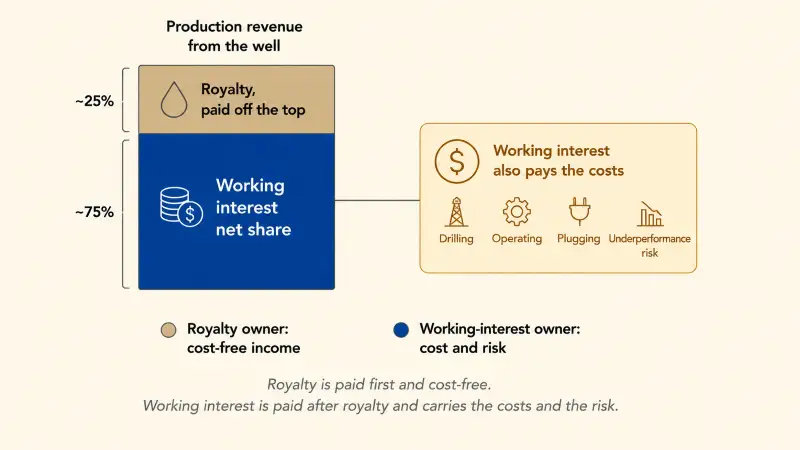
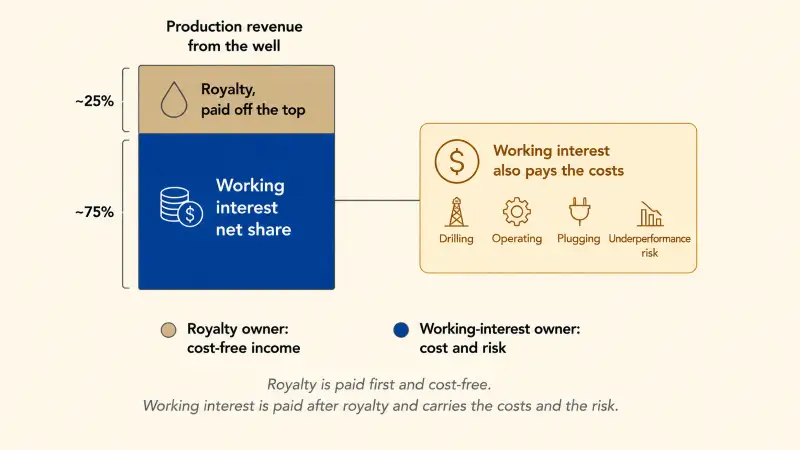
In return, the owner receives a royalty, a share of production revenue paid off the top before the operator calculates its own net revenue. The owner does not pay the drilling costs; the operator does.
A worked example
Suppose a lessee or operator holds 100% of the working interest, before any assignments or other burdens, and drills a horizontal well at a cost of around $7 million. The owner's royalty, say 22%, is generally calculated before the working-interest owner's net share, subject to sales, title, taxes, deductions, payor setup, and payment timing.
The working-interest owner's share would start at 78% before any overrides, net profits interests, assignments, or other burdens, but that owner also bears the drilling cost.
If the well underperforms or prices fall, the working-interest owner bears the cost risk, while the royalty owner generally does not pay drilling or operating costs under a standard lease. That asymmetry, cost-free income for the owner and cost-and-risk for the working interest, is the heart of the relationship.
Working Interest vs. Royalty Interest
The cleanest way to see working interest is beside the royalty interest most owners hold.
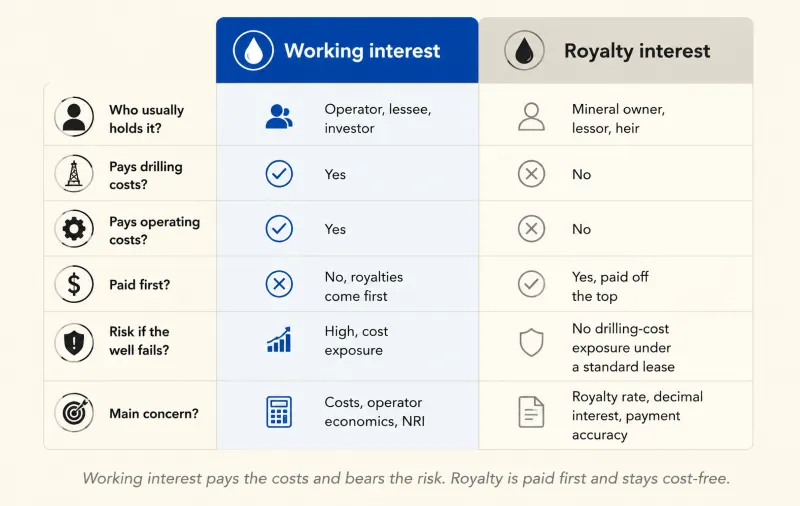
The working interest's net share after royalties is its net revenue interest. A working interest can also have other interests carved out of it, such as an overriding royalty interest or a net profits interest, which is worth knowing if you ever encounter those terms in a deal.
Why Working Interest Matters to Mineral Owners
Even if you never hold one, understanding working interests helps you read your own situation more clearly. The working-interest owner's cost exposure and net revenue interest help drive the economics behind drilling decisions that affect your minerals.
An operator with thin net revenue may be slower to commit capital to development, which can affect when your minerals get drilled. It also helps you read documents. Understanding the revenue stack, royalty off the top, then the working interest's net share, helps you make sense of how revenue is divided and spot when something in the split looks wrong.
And if an old family document mentions working interest, leasehold interest, or operating interest, it may mean an ancestor was an investor in a well rather than only a royalty owner, which carries very different obligations.
For owners who want to understand the income their own interest is projected to produce, Mineral View's MVestimate models royalty income from production and prices, which keeps your cost-free royalty in view as the baseline against which any working-interest decision should be weighed.
A Participation Offer: When You Are Asked to Take Working Interest
The most common way an owner is offered a working interest is a participation offer. An operator sends a letter saying it plans to drill and offers you the option to participate for some percentage of working interest. Taking a 5% working interest, for example, could mean paying 5% of drilling and completion costs, which on a modern horizontal well could be on the order of $350,000 to $500,000 or more, in exchange for a share of net revenue after royalties and other burdens.
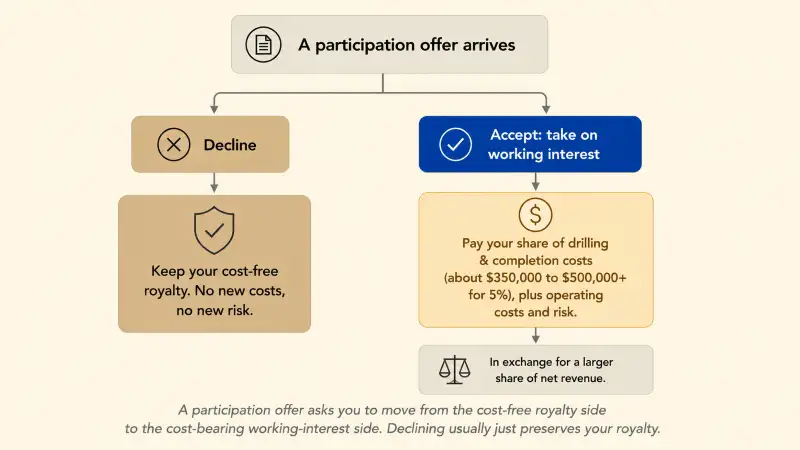
For most owners already holding a standard royalty lease, this is usually optional, but the answer can depend on the lease, title, and the exact offer. Declining typically means you simply continue receiving your royalty as before. Accepting means trading your cost-free position for a share of both the costs and the upside, which is a significant financial commitment that most royalty owners are not required to take on.
A Real-World Scenario
Example: Theresa and an old working-interest document in Howard County
While sorting through inherited family papers tied to minerals in Howard County, Texas, Theresa found an old document referring to a working interest her grandfather had held in a well decades earlier. She initially assumed it meant she was owed money.
Looking closer, she learned that a working interest is the cost-bearing, operating side of a well, not a cost-free royalty. Her grandfather had at some point participated as an investor, which carried obligations to pay costs, and that interest was tied to a lease that had since ended.
Rather than an unclaimed payment, the document reflected a past investment position that no longer produced income. Understanding the difference between the working interest in the old paperwork and the royalty interest she actually held today kept Theresa from chasing a payment that was not there and helped her focus on the interests that still mattered.
Note: This example is provided for illustrative purposes only and does not represent any specific mineral owner or lease.
What to Check
Confirm you hold royalty, not working interest
The simplest test is costs. If you receive payments without ever being billed for drilling or operating expenses, you hold a royalty interest. If you are responsible for a share of well costs, you are in working-interest territory, which carries very different obligations.
Treat any participation offer as a cost-and-risk decision
A participation offer is an invitation to move from the cost-free royalty side to the cost-bearing working-interest side. Weigh the potential upside against the real costs and the risk of loss, and remember that declining usually just preserves your existing royalty. Mineral View's Lease Activity tracks operator filings and activity on your minerals, which helps you understand the development context around such an offer.
Investigate old documents mentioning working interest
If old paperwork references working, leasehold, or operating interest, find out what it actually represents. It may be a past investment position with cost obligations, possibly tied to a lease that has long since ended, rather than a current source of income.
Important
Mineral View can help you see operator activity and projected royalty income for your minerals. For questions about whether to accept a participation offer, what an old working interest entitles you to, or the cost and liability involved, consult a qualified landman, Texas oil and gas attorney, or financial advisor, since these decisions carry real financial risk.
Common Questions
If you receive payments without paying any share of drilling or operating costs, you hold a royalty interest. Working interest owners pay costs and bear the risk of the well. The presence or absence of cost obligations is the clearest way to tell which side you are on.
Yes. A working interest owner can lose money because they are responsible for their share of drilling, completion, operating, plugging, and other well costs. If the well underperforms, prices fall, or costs exceed revenue, the working interest owner can owe more in costs than they receive in income. This is the main difference from a standard royalty interest.
Generally no. Owners holding a standard royalty lease are usually not required to participate in well costs. Declining a participation offer typically means you continue receiving your royalty as normal. Accepting is a choice to take on costs and risk in exchange for a larger share of revenue.
Yes. A working interest can be inherited or transferred like other property interests. The important point is that an inherited working interest may come with cost obligations, not just income rights. If old family documents mention working interest, leasehold interest, operating interest, joint interest billing, or AFE, the owner should confirm whether the interest is still active and whether any costs or liabilities are attached.
A working interest owner generally pays its share of the costs to drill, complete, operate, and eventually plug the well, plus related expenses. These often reach you as a joint interest billing (JIB) from the operator, and major work may first be proposed in an authorization for expenditure (AFE). The key point is that these are real, ongoing obligations: unlike a royalty, a working interest can require you to pay money out, not just receive it.
Some investors accept working interest because it can offer more upside than a royalty interest if the well performs properly. A working interest owner receives a larger share of revenue after royalties and other burdens, but that upside comes with cost exposure and operational risk. It is usually a decision for investors or sophisticated owners, not something an ordinary royalty owner should accept without professional review.