Drill Bit
A drill bit is the cutting tool attached to the bottom of the drill string that creates the wellbore as it rotates and grinds through rock. Every well drilled on Texas mineral acreage starts with a drill bit at the bottom of the hole. Bit choice and performance shape how long the drilling phase takes and, indirectly, how soon a mineral owner can expect their first royalty check.
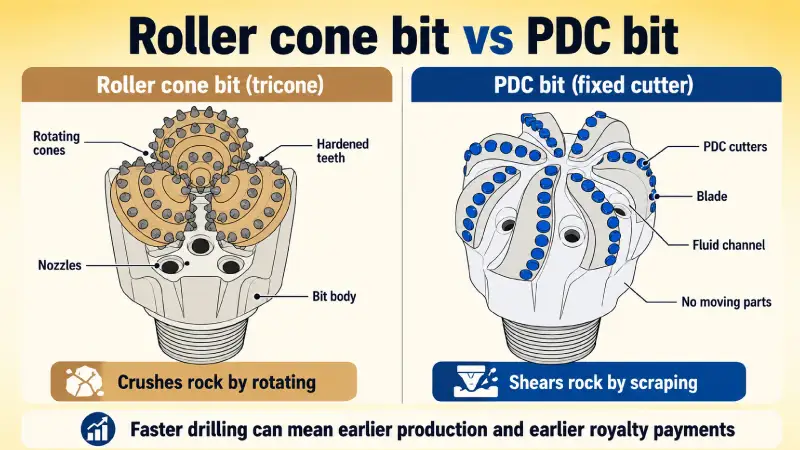
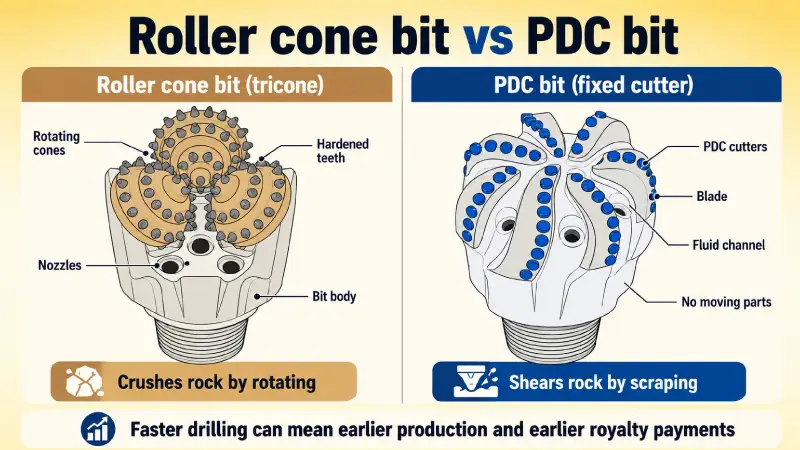
The two main types used in modern Texas drilling are roller cone bits (with rotating cones and teeth that crush rock) and fixed cutter bits (which use synthetic diamond cutters to shear rock). Each is suited to different formations and depths.
What This Means for Mineral Owners
The drill bit is not a direct input to your royalty calculation. You will not see it on a royalty statement, and you cannot influence which bit your operator chooses. However, bit performance affects one thing that matters to you: how long the drilling phase takes.
A well drilled with the right bit for the formation typically reaches total depth faster. That means well completion and first production come sooner, which means your first royalty check arrives sooner. A well drilled with the wrong bit, or with a bit that breaks down at depth, can add days or weeks to the drilling timeline. For a mineral owner watching a permit-to-payment timeline that already runs five to nine months, those delays are noticeable.
Key point for mineral owners
Understanding drill bit basics helps you read drilling activity reports and ask informed questions when you contact your operator's owner relations department. It does not change your royalty math.
How a Drill Bit Works
A drill bit sits at the bottom of the drill string: the long column of steel pipe that runs from the surface rig down to the bottom of the hole. The rig rotates the drill string, the drill string rotates the bit, and the bit grinds through rock. Drilling fluid (mud) pumps down through the drill string, exits through nozzles in the bit, and returns to the surface carrying rock cuttings up the wellbore.
Three things determine whether a drill bit performs well in a given hole:
- Formation match: different rock types respond to different cutting actions. Soft formations like shale yield best to scraping. Hard formations like granite or chert respond better to crushing. Most Texas wells pass through a mix of formations, which is why bit selection often changes as the hole gets deeper.
- Weight on bit: the rig applies downward force on the bit to keep cutters engaged with the rock. Too little weight and the bit slips and wears unevenly. Too much weight and the cutters chip or shatter.
- Rotation speed: measured in revolutions per minute (RPM). Faster rotation means faster penetration, but also faster wear. Operators adjust this throughout the drilling process.
When all three are matched to the formation, drilling proceeds efficiently. When any is mismatched, the operator may need to pull the bit out of the hole, a process called "tripping," which typically takes eight to twelve hours each way.
Types of Drill Bits Used in Texas
Two main bit families dominate modern Texas drilling, with a third hybrid category gaining adoption.
Roller cone bits (also called tricone bits)
These bits have three rotating cones with hardened teeth that crush rock as the bit turns. Roller cone bits work well in mixed formations and have been the workhorse of the industry for decades. They cost less than fixed cutter bits but typically drill more slowly and wear out faster in modern long-lateral wells.
Fixed cutter bits (PDC bits)
PDC stands for polycrystalline diamond compact. These bits have no moving parts. Synthetic diamond cutters are bonded to a tungsten carbide body, and the entire bit rotates as a single unit. PDC bits shear rock rather than crush it. They have largely replaced roller cone bits in horizontal shale drilling because they drill faster and last longer in soft-to-medium formations like the Wolfcamp, Eagle Ford, and Haynesville shales.
Hybrid bits
These combine roller cones with PDC cutters in a single tool, designed for formations that switch between hard and soft layers. Hybrid bits cost more but reduce the number of bit trips required to drill a well, which saves rig time. Texas operators use hybrid bits selectively, typically when they expect interbedded formations.
What this means in practice
Operators choose bits based on what they expect the rock to look like at each depth interval. A modern Permian Basin horizontal well might use a roller cone bit for the surface section, switch to a PDC bit for the curve and lateral, and occasionally use a hybrid bit if the formation turns out harder than expected.
Where Drill Bit Performance Fits in the Drilling Timeline
The drilling phase of a Texas well typically takes two to four weeks for a vertical well and four to eight weeks for a modern horizontal well. Bit performance affects this timeline in three ways.
| Performance factor | What it measures | Owner impact |
|---|---|---|
| Rate of penetration (ROP) | Feet drilled per hour | Higher ROP finishes the hole faster, moving the timeline forward |
| Bit life | Hours before the bit must be pulled and replaced | Longer bit life means fewer trips and less lost drilling time |
| Trip time | Hours to pull and re-run the drill string for a bit change | Each avoided trip saves close to a day of drilling time |
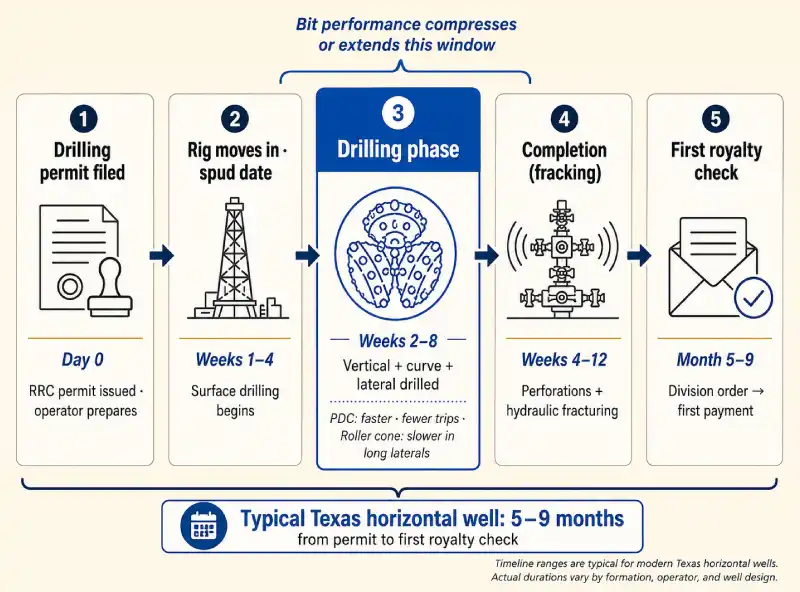
Drill bit choice is one of the operator's main levers for finishing a well faster. The mineral owner does not control this choice, but its outcome shapes when well completion begins and, by extension, when the first royalty payment arrives.
A Real-World Scenario
Example: James's horizontal well in Loving County
James owns mineral rights on a 320-acre tract in Loving County, Texas, inherited from his father. In March 2024, James received a notice that the operator had been issued a drilling permit on his lease. He began watching for activity.
The rig moved in during late April and began drilling on April 28. The well plan called for a vertical section of approximately 7,500 feet, followed by a 10,000-foot horizontal lateral through the Wolfcamp formation. James called the operator's owner relations department once a month to check on progress.
By mid-June, the operator had completed the vertical section with a roller cone bit and switched to a PDC bit for the curve and lateral. The PDC bit drilled the entire 10,000-foot lateral in about three weeks without a trip, which the operator described as on the faster end of typical for the field. Total drilling time: roughly nine weeks from spud to total depth.
The well was completed in August, first production began in September, and James received his first royalty check in November. If the bit choice had been wrong for the formation, or if multiple bit trips had been needed, his first royalty check might have arrived in January or February instead.
What to Check
Watch the spud date and drilling start
Once an operator spuds (begins drilling) a well on your lease, the drilling phase typically lasts two to eight weeks depending on whether the well is vertical or horizontal. Mineral View's Lease Report tracks drilling activity from Railroad Commission filings, giving you a view of progress without needing to call the operator.
Compare timing to nearby wells in the same formation
If your operator is taking significantly longer than nearby wells in the same field to drill a similar well, something may be slowing them down. This could be the formation, the bit selection, or other factors. It is reasonable to ask the operator about progress, especially if the drilling phase exceeds typical timelines for the area. Mineral View's Lease Activity tracks daily regulatory filings including drilling progress updates.
Know the typical permit-to-payment window
For a modern Texas horizontal well, the timeline from drilling permit filing to first royalty check is usually five to nine months. Drilling efficiency, including bit performance, makes up a meaningful portion of that window. Tracking the milestones (permit, spud, drilling complete, completion report, first production, first royalty) lets you spot delays early.
Important
Mineral View features can help you track drilling activity, regulatory filings, and production timelines for your minerals. For questions about specific drilling decisions, operator performance, or how to address concerns about your well's drilling timeline, contact a qualified landman or your operator's owner relations department directly.
Common Questions
No. Your royalty rate is set in your lease and does not change based on which drill bit the operator chooses. Bit selection affects how quickly the well is drilled, not the percentage of revenue you receive.
No. Royalty deductions, when they occur, come from gathering, processing, transportation, and marketing costs after production begins. They are not tied to drilling decisions. Drill bit performance affects when your royalty starts, not what you receive per barrel once production begins.
Bit selection is generally not public information and is not filed with the Railroad Commission of Texas. If you want to know, contact your operator's owner relations department. Most operators will share general drilling information, including bit choices, but they are not required to do so.