A mineral deed is a document that conveys the ownership of minerals that are found under a piece of land like oil, gas, and other natural resources. Mineral rights can be separated and transferred independently of surface ownership, unlike surface ownership, in which a party can only own the land but not the minerals beneath the land.
A mineral deed can contain executive rights depending on how the deed is written, which means that the owner of the minerals can lease the minerals and obtain the income from their development.
An example of this is that a landowner can sell the land to be used as housing or commercial but retain the mineral rights. When the mineral deed contains executive rights, the mineral owner has the right to lease the minerals to an energy company and receive a royalty in case some oil or gas is produced, though they no longer own the surface land.
This is a comprehensive piece in which we shall discuss what a mineral deed is and why it is important.
Key Takeaways
A mineral deed conveys the ownership of subsurface mineral rights separately from surface property to form independent ownership that may be subsequently sold or leased.
The owners of the mineral deeds can have an executive right to sign a lease with a third-party company and receive a lease bonus and royalty.
A mineral deed could also contain certain provisions or restrictions on the rights being transferred as either depth limitation, transfer rights, or the participation of the person holding the surface.
A mineral deed is not so restrictive and it gives more rights to mineral interests than the royalty deed, which does not give any more rights other than the right to receive royalty payments.
A royalty deed holder gets royalty payments made by the mining activities but does not possess the executive authority or control of the decision-making of the mining minerals about their development or leasing.
It is important that the mineral deeds are properly registered with the county clerk and that the rights are defined in legal language under the state law as to the specific rights.
To prevent conflicts in terms of vague or obsolete terminology of deeds, review by an oil and gas attorney is advised.
Understanding Mineral Deeds: Ownership and Rights
A mineral deed is a documented legal document that passes rights in minerals under a piece of land from one party (grantor) to another (grantee). This creates separate ownership on top of the surface rights, which allows the acquiring party some rights regarding mineral development and production without the acquisition of the surface estate and buildings.
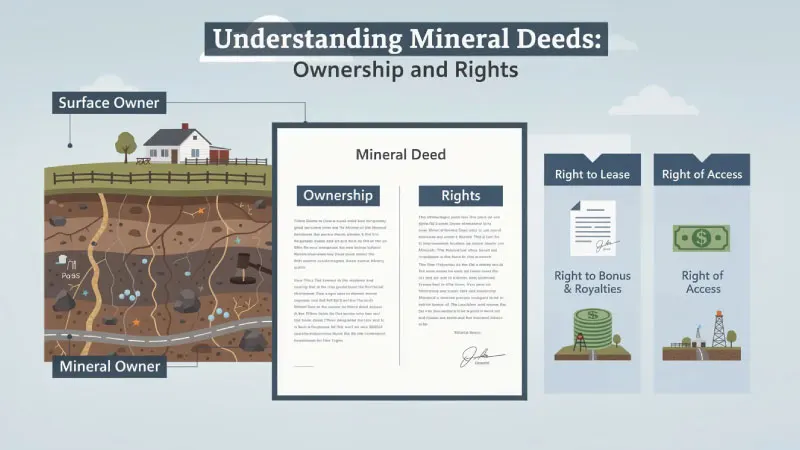
Such rights are not the ownership of the surface land but are commonly restricted or reserved by the seller. The action can provide executive authority, which might comprise the capacity to sign mineral agendas and bargain terms of lease regarding mineral development.
Mineral owners usually grant mineral development by way of a lease to the operators who drill and produce. Some of the income streams are lease bonuses, delayed rental payments, shut-in payments, and production royalties.
Mineral rights are the rights to the underground resources, including oil, gas, and minerals, and the revenues of their sale are subject to taxation.
Unless mentioned, surface rights are excluded. The owners of the minerals may have restricted the right to develop the mineral through surface use based on deed language, lease terms and the existing state law. Surface use agreements are often used to address these rights through surface use agreements with the surface owner.
Mineral deeds can transfer all the minerals or certain groups of the minerals, which are oil, gas, or hydrocarbons. Interests can also be fractional, such as an undivided one-quarter interest. Documentation of the act produces a notice that is public and makes it legally compelling upon the future owners to the severed arrangement in ownership.
Types and Variations of Mineral Deeds
Types of mineral deeds are diverse, some of them being written decades ago using the ancient legal terms. A lot of these actions were produced in the past and may be difficult to interpret since the wording was less specific or old-fashioned.
Minor variations in wording can also have a substantial impact on transferred rights and it is necessary to carefully review them. Some mineral deeds are not like other deeds like warranty or grant deeds as they specifically concern the mineral interests and in most cases need a more detailed legal analysis.
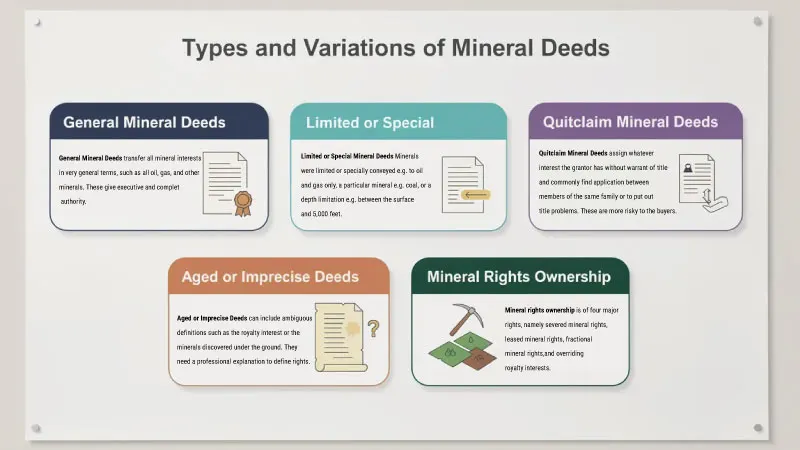
General Mineral Deeds transfer all mineral interests in very general terms, such as all oil, gas, and other minerals. These give executive and complete authority.
Limited or Special Mineral Deeds are minerals limited or specially conveyed e.g. to oil and gas only, a particular mineral e.g. coal, or a depth limitation e.g. between the surface and 5,000 feet.
Quitclaim Mineral Deeds assign whatever interest the grantor has without warrant of title and commonly find application between members of the same family or to put out title problems. These are more risky to the buyers.
Aged or Imprecise Deeds can include ambiguous definitions such as the royalty interest or the minerals discovered under the ground. They need a professional explanation to define rights.
Mineral rights ownership is of four major rights, namely severed mineral rights, leased mineral rights, fractional mineral rights, and overriding royalty interests. Severed mineral rights are where the ownership of the surface land and mineral ownership are different, where the mineral owners can sell the mineral rights without selling the land.
It is important that the professional review be done by a qualified attorney or landman so that it is done properly to avoid expensive disputes. In situations where the ambiguity exists, courts usually consider the overall intent of the parties to the case and the specific interest identified in the mineral deed.
Mineral Deed vs. Royalty Deed
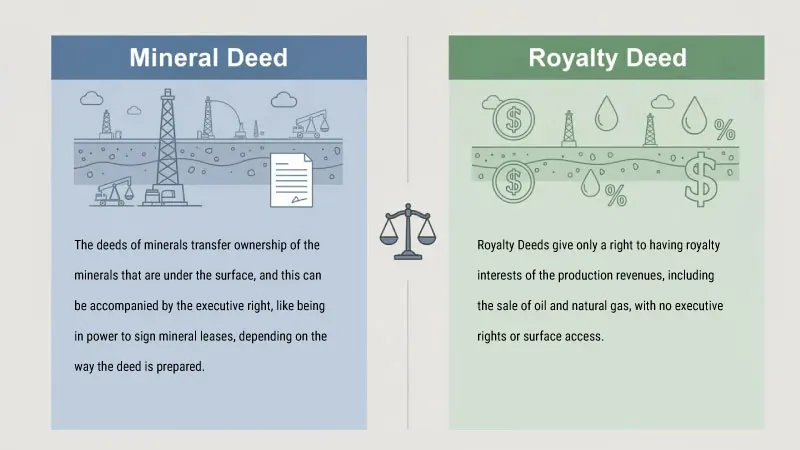
Although mineral and royalty interests are associated with interests in the subsurface, they are fundamentally different. The deeds of minerals transfer ownership of the minerals that are under the surface, and this can be accompanied by the executive right, like being in power to sign mineral leases, depending on the way the deed is prepared.
In cases where executive rights are present, the mineral owner has the option of leasing the minerals to third-party operators, receiving lease bonuses, and delaying the payment of the rents and royalties on production.
An ownership of a mineral deed does not imply the control of drilling or extraction operations that are run by operators on lease conditions and regulatory measures. Rather, the mineral deed holders enjoy the economic advantage of oil, gas and other mineral production, but surface ownership is independent unless it is otherwise stated.
Royalty deeds give only a right to having royalty interests of the production revenues, including the sale of oil and natural gas, with no executive rights or surface access. Royalty deed holders also lack the right to extract the minerals but enjoy the economic benefits should the production and sale of the minerals take place.
The owners of mineral deeds have higher long-term yield and the freedom to make their leasing decisions; however, their income is determined by the market circumstances, the activity of the leasing, and the possibility of further development. The owners of royalty deeds do not have any development or leasing responsibilities, and the income is passive.
Fractional mineral rights ownership is part ownership of mineral rights and this may make it more difficult to manage and sell since major decisions have to be agreed upon by all the owners.
What Information Is Found in a Mineral Deed?
The opening paragraph of a mineral deed usually carries very important details on the transaction in terms of answering the questions who, what, where and when.
- Parties: The name and the address of the parties involved: grantor (seller) and grantee (buyer).
- Consideration: Price or other value purchased.
- Effective Date: The time the transfer becomes effective.
- Legal Description: Legal description of the land, with metes and bounds, lot and block, or Public Land Survey System descriptions.
- Granting Clause: Provides specifications of minerals transferred, fractional interests, and depth or type of mineral restrictions.
- Reservations and Exceptions: Reserved or excluded minerals.
- Warranty Language: The type of warranty, which is a general warranty or special warranty or quitclaim.
- Acknowledgment and Recording: Notarization and registration with the county clerk to make constructive notice.
The purchase agreement and deed language used are vital, as in most states, the mineral rights can transfer to the buyer by default unless they are specifically reserved.
The rights are the ones that need to be carefully read and reviewed under the law.
How to Obtain, Record, or Verify a Mineral Deed
To procure or verify a mineral deed:
- Check or get in touch with the office of the county clerk or recorder that the surface property is situated in.
- In addition to this, you may access the related lease as well as operator activity through use of grantor-grantee indexes, online databases, or other platforms such as Mineral View to gain additional background.
- Get certified copies to use as legal copies or title copies.
- On new transactions, proper drafting, payment of fees, and recording of the transaction are necessary to have a valid ownership.
Title searches are to be made for mineral rights in particular, because a normal property search might not include the same.
This process can be facilitated by having good verified production, lease, and activity data, features designed by mineral view could be immensely helpful as well as third-party help from attorneys or landmen is usually a good idea.
Summary
A mineral deed is an important legal document that transfers ownership and executive authority of underground minerals independent of the surface estate. Owners, purchasers, and investors of minerals must be aware of the distinctions between royalty and mineral deeds, the transferable rights pertaining to the deeds, and the legal requirements for recording and understanding the deeds.
Correct interpretation of deed language; this is best achieved by having qualified attorneys review the deed language of older documents or loosely worded deed documents. Mineral work provides great financial chances and is accompanied by market conditions, title, and surface use problems.
Sometimes the value and management of mineral interests can be optimized with the help of keeping clear records and thorough title searches and consulting tax experts. In the acquisition and sale of mineral rights, awareness of mineral actions will enable the owners to get benefits and reduce the legal and financial risks.