Non-Participating Royalty Interest
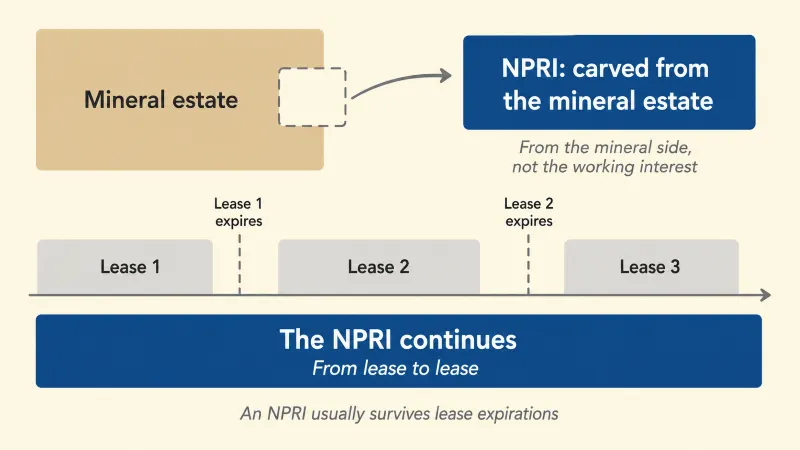
NPRI, or Non-Participating Royalty Interest, is a royalty interest carved from the mineral estate that usually continues from lease to lease, unless the creating document says otherwise. The holder receives a share of production revenue without paying drilling costs, but has no right to sign leases, negotiate lease terms, or receive lease bonus payments.
NPRI appears frequently in old Texas deeds, family conveyances, and inherited mineral records, often without explanation.
An NPRI is not the same as full mineral ownership. It is only the right to receive a royalty share described in the deed, without the right to control leasing.
Owner-First View
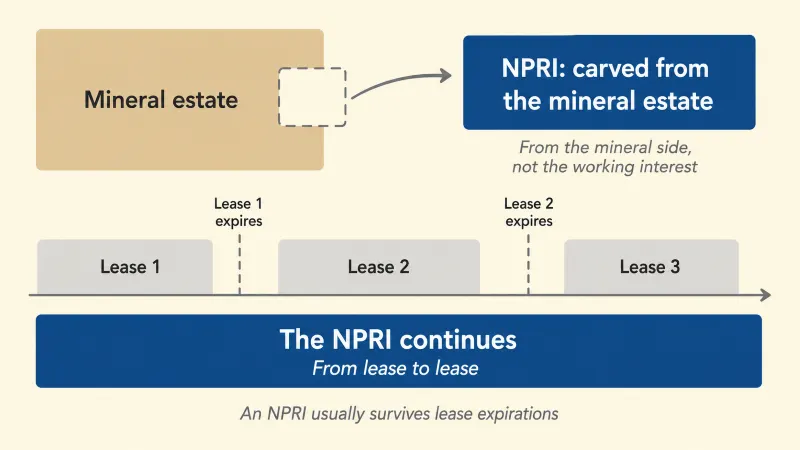
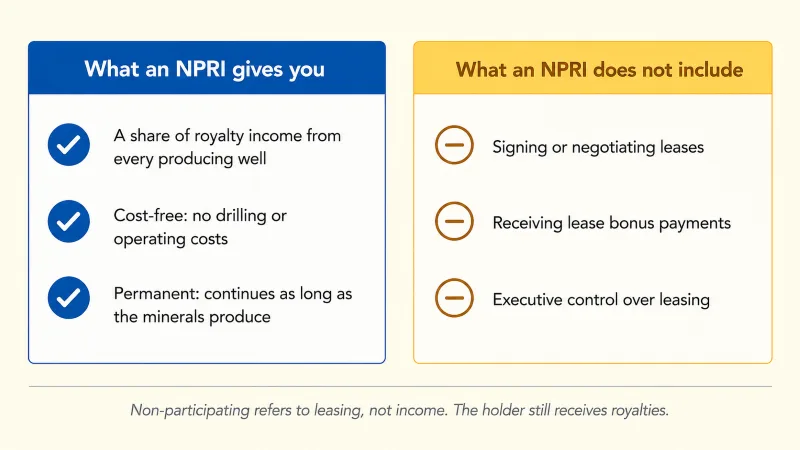
The "non-participating" in NPRI does not mean the holder receives nothing. It means the holder does not participate in leasing decisions or lease bonus payments. An NPRI holder still receives royalty income from every producing well on the property, permanently, for as long as the minerals produce.
How NPRI Works
When a Texas well produces oil or gas, the NPRI holder receives a royalty share defined by the deed or reservation that created the NPRI. This share is set in the original deed or conveyance and does not change when a new lease is signed.
NPRI comes out of the royalty side tied to the mineral estate, not from the operator's working interest. Because it comes from the mineral side, it survives lease expirations. When one lease ends and a new lease is signed on the same property, the NPRI continues.
Example
Margaret inherited a 1/8 NPRI from her grandmother in Panola County, East Texas. Her grandmother had sold the mineral rights in 1987 but reserved the NPRI, keeping the right to receive royalties permanently, without retaining the right to sign future leases.
When a new operator approached the mineral owner in 2023 to negotiate a lease:
- The mineral owner negotiated the lease terms and received the lease bonus. Margaret was not involved.
- The lease set a 25% royalty rate.
- Margaret's deed gives her a 1/8 NPRI. That means she is entitled to the royalty share described in that deed from production on the covered property, without signing the lease or paying drilling costs.
When the well began producing, Margaret received her royalty check each month automatically. When that lease eventually expires and a new one is signed, Margaret's NPRI continues. It is tied to the minerals, not to any single lease.
Why Texas Mineral Owners Should Care
NPRI appears most often in inherited mineral records and deed research. Understanding it prevents two common mistakes, assuming an NPRI means full mineral ownership, and assuming it expired along with an old lease.
- Inherited minerals: Family deeds often split executive rights (the right to lease) from royalty rights (the right to receive production income). An NPRI heir receives royalties but cannot negotiate future leases or receive bonus payments.
- Title research: NPRI language appears in recorded deeds and conveyances at the county clerk's office. Identifying whether an interest is an NPRI or a full mineral interest changes how the property is valued and who has the right to lease.
- Division orders: An NPRI holder may receive their own decimal interest on a division order or revenue statement. Reviewing that decimal confirms the NPRI percentage is being applied correctly.
NPRI vs. ORRI vs. Mineral Royalty
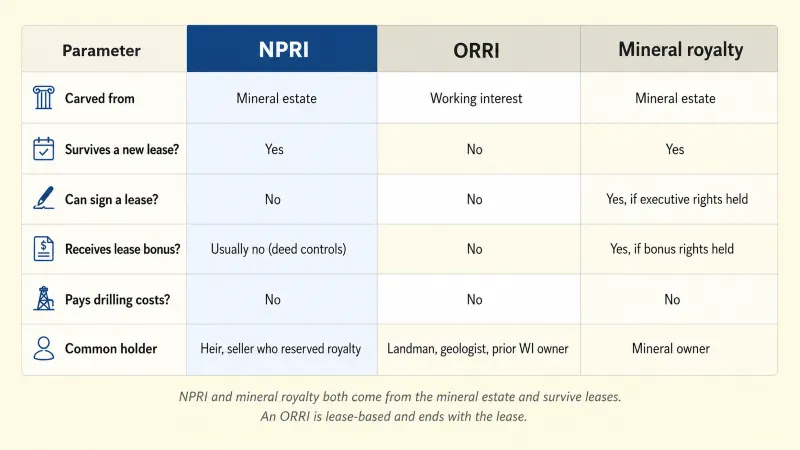
| Parameters | NPRI | ORRI | Mineral Royalty |
|---|---|---|---|
| Carved from | Mineral estate | Working interest | Mineral estate |
| Survives new lease? | Yes | No | Yes |
| Can sign a lease? | No | No | Yes, if executive rights held |
| Receives lease bonus? | An NPRI normally does not include lease bonus rights because it is non-participating in leasing, but the creating document always controls. | No | Yes, if bonus rights held |
| Pays drilling costs? | No | No | No |
| Common holder | Heir, seller who reserved royalty | Landman, geologist, prior WI owner | Mineral owner |
Key Takeaway
NPRI and mineral royalty both come from the mineral estate and both survive lease expiration. The key difference is that an NPRI holder owns only the royalty interest described in the deed, while a mineral owner may also hold executive rights unless those rights were separated. An NPRI holder receives royalties only. An ORRI is entirely different, it is lease-based and ends when the lease ends.
NPRI in the Mineral Interest Lifecycle
Original Deed
NPRI is created when a mineral owner sells the minerals but reserves the right to receive royalties. The deed states the percentage and is recorded at the county clerk's office. It runs with the land permanently.
New Lease Signed
The mineral owner negotiates and signs the lease. The NPRI holder has no role and receives no lease bonus. The operator accounts for the NPRI when calculating total royalty burden and NRI.
Production Begins
The NPRI holder may receive a division order and, once title is confirmed and payment is set up, royalty payments begin.
Lease Expires
Unlike an ORRI, the NPRI does not end. Any future lease on the same property carries the same NPRI obligation forward automatically.
What to Check if NPRI Appears in Documents
- Confirm the interest type: Does the document say "carved from working interest" (ORRI) or "reserved from the mineral estate" and "runs with the land" (NPRI or mineral royalty)? The language determines which type of interest it is.
- Check whether executive rights are included: If the deed creates an NPRI and does not grant executive rights, the NPRI holder usually does not have leasing authority. The deed language should always control.
- Review county records: The original deed or reservation at the county clerk's office shows the percentage, effective date, and property description. This is the authoritative source for confirming any NPRI.
Important
Mineral View can help you understand production, operator activity, nearby drilling, and public regulatory context. For legal ownership or cost-obligation questions, review the documents with a qualified professional.
Common Questions
Non-participating refers to the leasing process, not production income. An NPRI holder does not participate in negotiating lease terms, does not sign the lease, and does not receive the lease bonus. The holder does receive royalty checks from every producing well on the property.
It increases the total royalty burden the operator pays from gross revenue, which reduces the operator's NRI. However, the mineral owner's stated royalty percentage is not directly reduced. Both the mineral royalty and the NPRI are paid from gross revenue, but they are calculated separately.
The fundamental difference is permanence and origin. An NPRI is carved from the mineral estate and survives indefinitely through lease expirations. An ORRI is carved from the working interest of a specific lease and ends when that lease ends. A new lease automatically carries the existing NPRI forward but does not carry the old ORRI.
Generally no. The defining characteristic of an NPRI is that executive rights are held by someone else, usually the mineral owner. A true NPRI separates the royalty benefit from the leasing authority. Some deeds create unusual arrangements, so reviewing the specific deed language with a qualified landman or attorney is recommended when any doubt exists.