

Loading article
You just inherited a piece of land in Texas, and someone mentions “mineral rights.” You might wonder, “Wait, what exactly are mineral rights? Do I own the oil, gas, or other treasures beneath my land? And more importantly, how can this affect me?”
If you’ve ever found yourself scratching your head over these questions, you’re not alone. Many landowners discover that owning property isn’t just about the surface. There’s a whole underground world of valuable resources that come with their own set of rules.
This guide is here to give you a clear explanation of mineral rights, the kind that makes you nod and say, ‘Ah, that’s exactly what I needed to know!’
Imagine you own a piece of land, like a farm or a ranch. When you think about owning land, you probably picture the grass, trees, and buildings on the surface. But beneath that surface, there could be valuable things like oil, natural gas, coal, or even precious metals. Mineral rights are the legal rights to own and use those underground resources.
To put it simply, owning mineral rights means you have the power to dig up or drill for these resources and make money from them. Sometimes, the person who owns the land on the surface is not the same person who owns the minerals below. For example, you might own the land on the surface, but a company or another person owns the rights to the oil or gas underground. This means they can come onto your land to extract those minerals. However, there are usually rules and agreements to protect your land from unnecessary damage.
A real-life example: Imagine an oil and gas company owns the mineral rights under your land. If they decide to drill for oil, they have the legal right to do so. Understanding mineral rights is important because it affects who benefits from the valuable resources beneath your land and who has the right to use the surface to access those resources.
When you own mineral rights, you have the legal authority to mine or produce these minerals. This ownership is distinct from surface rights, which pertain to the land above ground. The types of minerals that can be extracted under these rights include:
Oil
Gas
Coal
Hard rock minerals such as gold and copper
One of the most interesting aspects of mineral rights is that they can be separate from surface rights. This means that the ownership of underground resources can be distinct from the ownership of the land’s surface. For instance, you might own the surface rights to your property, but someone else could own the subsurface rights underneath it. This separation often leads to independent mineral ownership and can result in complex legal and operational scenarios.
Advancements in extraction technology have enabled mineral owners to access and produce resources more efficiently and from greater depths. However, owning mineral rights typically includes the right to use the surface land as reasonably necessary to extract those minerals, although surface rights laws can vary by state, with Texas having specific regulations that may differ from other regions. Mineral rights ownership can provide significant income opportunities, especially in resource-rich areas like Texas, which is known for its abundant oil and gas reserves and active development of shale formations such as the Permian Basin.
Want to know the top operator in your area or Texas? Find the best-suited operator for your land at the Mineral View Operator Hub.
This dual ownership model, where one party owns the surface rights while another owns the mineral rights, is increasingly common. Understanding this distinction is crucial for property owners, as it can greatly affect their control over land ownership and their ownership rights from resource extraction.
Before we jump into understanding the types of Mineral Rights, let's clarify the distinction between Mineral Estate and Mineral Rights.
Mineral Estate refers to the legal ownership structure of minerals beneath a piece of land. It describes how mineral ownership is organized and held. Types of mineral estates include:
Unified (fee simple) estate: where surface and mineral rights are owned together by the same person.
Severed estate: where mineral rights and surface rights are owned separately.
Fractionalized estate: where multiple owners hold shares of the mineral estate.
These terms describe how minerals are owned, focusing on the ownership structure rather than the rights themselves.
On the other hand, Mineral Rights refer to the specific rights a mineral owner has regarding the minerals. This includes what the owner is allowed to do with the minerals or which portion of the minerals they own. Types of mineral rights include:
Mineral interest (full mineral rights): complete ownership rights to the minerals.
Royalty interest: the right to receive a portion of production or revenue without bearing extraction costs.
Non-participating royalty interest (NPRI): a royalty interest without the right to participate in lease decisions.
Working interest: the right to explore, drill, and produce minerals, typically bearing operational costs.
Overriding royalty interest (ORI): a royalty interest carved out of the working interest.
Executive rights: the right to lease or manage mineral rights on behalf of the owners.
These describe the different “pieces” or “sticks” in the mineral rights bundle.
Understanding these distinctions step by step helps clarify the complexities of mineral ownership and rights.
Mineral estates can be broadly categorized into unified estates, severed estates and fractional estate.
In a unified estate, also known as a ‘fee simple’ estate, the surface and mineral rights are held together by the same Mineral Estate owner. Owning a unified estate means you have full ownership of both the surface and the mineral rights, providing complete control over the land and its underground resources.
Example: A rancher in West Texas owns the land and the minerals beneath it. The same person owns both surface rights and mineral rights, giving them full control over the property and its resources.
On the other hand, severed estates also known as split estate occur when the mineral and surface rights are divided between different owners. This separation often happens during property sales, where the surface rights are sold but the mineral rights are retained by the original owner, or vice versa.
In a split estate, the surface owner’s control over the land is affected by the mineral rights holder’s activities. For example, the mineral rights owner can develop resources without needing permission from the surface owner, potentially leading to conflicts regarding the surface estate.
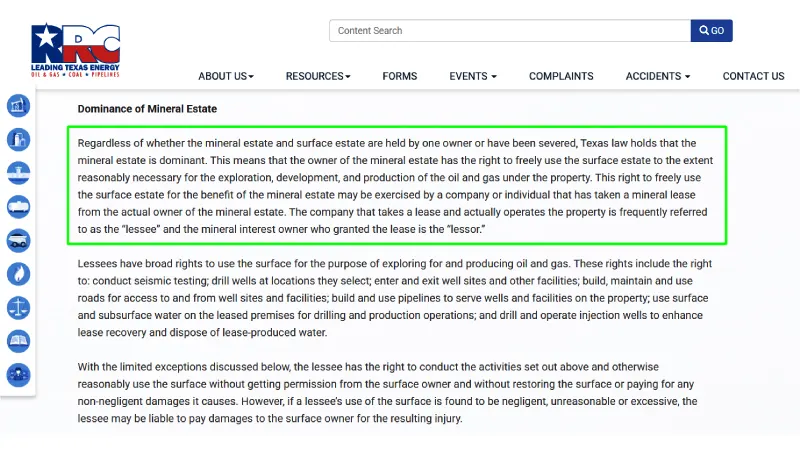
Example: You own the land, but a previous owner still owns the minerals beneath it. This means you owns the surface rights, and someone else owns the mineral rights. According to Texas law, the mineral estate dominates the surface estate, so the mineral rights owner or operator who owns the mineral rights to your land can access your land to extract minerals even without your permission.
RRC - Exploration & Surface Ownership
Fractional ownership further complicates the landscape of fractional estate mineral estates. This occurs when multiple owners hold a significant portion of the same mineral interest. In such cases, each owner has a fractional interest in the minerals, which can lead to shared responsibilities and benefits. This type of ownership is common in areas with rich mineral deposits, where the rights to extract resources are divided among several parties.
Example: A family passes land down for three generations. Now, one person owns 12.5%, another owns 25%, another owns 6.25%, and another owns 56.25%. This fractional ownership means lease negotiations become more complicated, royalties are shared among multiple owners, and signatures are required from several heirs. Fractionalization is very common in Texas due to inheritance.
Understanding these different types of mineral estates helps in making informed decisions about property and mineral rights management.
Mineral ownership isn’t just about “owning minerals.” The mineral estate can be divided into separate rights, often referred to as the “bundle of sticks.” Understanding these different types of mineral interests is essential for Texas landowners and mineral owners, as they determine who can lease the minerals, who receives royalty payments, and how property rights are managed across generations.
Here are the major types of mineral interests:
Mineral Interest (Full Mineral Rights)
This is the most complete form of ownership. A mineral interest owner typically holds the rights to explore and develop the minerals, sign leases, receive bonuses, receive royalties, receive delay rentals, and convey or sell any portion of the interest. This represents the strongest form of mineral ownership.
Royalty Interest
A royalty interest owner has the right to receive a share of production revenue (royalties) without paying drilling or operating costs. However, they do not have the right to lease, control drilling decisions, or possess executive rights. They simply receive royalty payments based on the terms of the lease.
Non-Participating Royalty Interest (NPRI)
An NPRI is a specialized form of royalty ownership where the owner receives royalty payments but does not have the right to sign leases, negotiate royalty rates, or exercise executive rights. This type of interest is common when families split rights among heirs.
Executive Rights
The executive right grants the authority to negotiate and sign oil and gas leases. The executive owner chooses the lessee, negotiates royalty rates and bonuses, and controls lease timing and terms. They do not automatically receive royalty payments unless they also own a royalty or mineral interest.
Working Interest
A working interest owner has the right to develop the minerals but must bear the costs of drilling, operating expenses, completion costs, and risk penalties. This interest is typically held by operators, exploration companies, or joint-venture partners, who share in both profits and losses.
Overriding Royalty Interest (ORRI)
An ORRI is carved out of a working interest rather than a mineral interest. The ORRI owner receives a cost-free percentage of production, but the interest ends when the lease ends. This type of interest is commonly assigned to landmen, geologists, or investors involved in a project and does not include leasing rights.
Understanding the structure of the mineral estate and the various types of mineral interests is crucial for Texas property owners. These distinctions clarify who holds leasing authority, who benefits from royalty payments, and how rights are exercised and transferred across generations.
Surface use agreements define the responsibilities and rights between mineral rights holders and surface owners. These agreements help mitigate potential conflicts during mineral extraction activities. For instance, drilling and mining operations can cause significant disruptions to the surface owner’s daily life. Therefore, surface use agreements often include provisions for safety precautions and noise reduction measures to minimize these impacts.
Compensation is another critical aspect of surface use agreements. Mineral extraction activities can lead to disruptions and potential damages to the surface property. These agreements typically include provisions for compensating the surface owner for any disruptions caused by extraction activities. Additionally, surface use agreements often require the reclamation of the land post-extraction, ensuring that the land is restored to an agreed-upon standard. This is particularly important in maintaining the property’s value and usability after the extraction activities have ceased.
Legal rights associated with mineral ownership allow mineral rights owners to access and use the land for extraction, impacting the surface owner’s property use. For instance, surface use agreements may specify the location of facilities necessary for mineral extraction, including roads and pipelines and mining rights and mineral interests.
Clearly defined surface use agreements help balance the interests of both surface and mineral rights holders, ensuring harmonious coexistence and reducing disputes.

Determining the ownership of mineral rights is a crucial step for property owners to avoid potential disputes and ensure clear ownership. The first place to check for mineral rights ownership is the property deed. This document can provide valuable information about whether the mineral rights were included in the property sale or if they were retained by a previous owner. Reviewing the property deed for the seller’s and buyer’s information can help trace the ownership back to the mineral rights.
A common question many ask is, "Who owns the mineral rights on your property?" To find the answer, a title deed search at the county records office is another effective way to verify mineral rights ownership. These records can reveal the history of mineral ownership and any transfers that have occurred over time. Many states also have online systems that allow access to digitized mineral records, streamlining the search process and making it easier for property owners to verify ownership. Hiring a title company can expedite this search and provide more accurate records, ensuring that all necessary information is obtained.
In some cases, it might be advisable to hire a professional landman or a real estate attorney to assist with the mineral rights search. These professionals have the expertise to navigate the complexities of mineral rights ownership and can help ensure that all relevant records are thoroughly examined. Since ownership of mineral rights is not automatically transferred with property titles, further verification helps avoid disputes and ensures clear ownership of the property’s mineral rights.
The lack of ownership of mineral rights can have significant financial and environmental impacts for surface owners. One of the primary financial implications is the potential loss of revenue from resource extraction. If mineral rights are owned by someone else, the surface owner does not benefit from the profits generated by the extraction activities. This can result in substantial financial losses, especially if valuable resources like oil or gas are being extracted from the property.
Environmental degradation is another major concern for surface owners without mineral rights. Mineral extraction activities can lead to significant environmental impacts, including soil erosion, water pollution, and habitat destruction on the earth’s surface. Surface owners without control over these activities might deal with the aftermath of environmental damage caused by resource extraction without having a say in the process.
Prospective property buyers should also be aware of the implications of not owning mineral rights. Purchasing a property without the mineral rights means that resource extraction could occur on their land without their consent. This potential for disruption and environmental damage can significantly affect the property’s value and usability.
Therefore, buyers should thoroughly investigate the status of mineral rights before finalizing a property purchase to avoid unexpected complications.

Buying and selling mineral rights is a complex process that requires careful consideration and detailed research. The value of mineral rights is significantly influenced by:
Market demand
The geological potential of the land
The presence of natural resources like oil, gas, or precious metals, which make areas more attractive to buyers and can command higher prices
Existing lease agreements and their terms, which play a crucial role in determining the value of mineral rights.
When buying mineral rights, consider the following steps:
Conduct thorough research and negotiate with the sellers to finalize the purchase.
Verify the title and ownership through legal considerations to ensure the transaction is legitimate.
Hire a real estate attorney or a title company to help navigate these complexities and provide accurate records.
Selling mineral rights can provide immediate cash but also means relinquishing future income from those assets. Therefore, property owners must weigh the immediate financial benefits against the long-term potential earnings from resource extraction, including producing oil. If you decide to sell mineral rights, it’s essential to consider all factors involved.
Tax implications are important to consider in transactions involving mineral rights. Capital gains tax and income tax on royalty payments must be taken into account when buying or selling mineral rights. Consulting with a tax professional can help property owners understand these implications and plan accordingly. Considering these factors helps property owners make informed decisions about buying or selling mineral rights, ensuring that their interests are protected.
Looking to Buy or Sell Mineral Rights - Understand the Mineral Development first with your easy to use Texas Oil and Gas Maps. (Easily visualize the previous 15 year mineral development with Monitor Nearby Developments feature)
Leasing mineral rights is a common practice that allows property owners to retain ownership of the minerals while providing financial benefits. A lease agreement is made between the mineral rights owner and the lessee, who is granted the right to extract resources from the property. Mineral leases can have fixed or indefinite terms, often with a primary term and secondary terms to define the duration and conditions of the lease. Oil and gas leases, for example, typically include these terms to specify the duration of the lease and the conditions under which it can be extended.
One of the immediate financial benefits of leasing mineral rights is the signing bonus paid upfront to the mineral rights owner. Additionally, royalties earned from the lease depend on the market price of the extracted resources and the agreed percentage in the lease. These royalties provide a steady income stream for the mineral rights owner, making leasing an attractive option for many property owners.
Leasing agreements can be complex and vary widely, making it essential to consult a professional for guidance. Real estate attorneys and landmen can help navigate the terms of the lease, ensuring that the agreement is fair and beneficial to the mineral rights owner.
Understanding the intricacies of mineral rights leases enables property owners to make informed decisions and increase financial benefits from resource extraction.
Mineral View empowers mineral and landowners to make smart, data-driven decisions. Whether you want to lease your mineral rights or explore opportunities, quickly find the top oil and gas operators in your county or across Texas using our tailored operator hub features designed just for mineral owners.

Mineral rights can expire under specific conditions and do not have a permanent lifespan. Failure to renew leases or non-payment of necessary fees can lead to the expiration of mineral rights. The deed language can also dictate the terms of expiration, including specific conditions like time limits or cessation of production. For instance, if drilling or production activities cease for a specified period, the mineral rights expire and can revert back to the landowner.
Unclaimed mineral rights can revert to state or federal government ownership if not maintained, potentially leaving the original owner without recourse. This reversion can occur if the mineral rights owner fails to comply with the conditions outlined in the deed or lease agreement. Knowing these conditions is crucial for maintaining long-term ownership of mineral rights and avoiding unintended expiration.
Property owners should pay close attention to the deed language and lease terms to ensure that their property owner mineral rights are protected under Texas law holds. Consulting with a real estate attorney or private landowners can help clarify these conditions and provide guidance on maintaining ownership.
Staying informed about the conditions of mineral rights expiration helps property owners avoid losing valuable resources and ensures their interests are safeguarded.
According to the Railroad Commission of Texas, mineral owners have specific responsibilities when it comes to mineral extraction activities on their property. While mineral rights grant ownership and the ability to develop underground resources such as oil and gas, owners must also ensure that these activities comply with environmental regulations and best practices to protect the land and surrounding ecosystems.
Mineral owners are responsible for leasing their mineral rights to reputable oil companies that adhere to state and federal environmental standards. This includes ensuring that operators obtain the necessary permits and follow guidelines designed to minimize surface disturbance, prevent water contamination, and control air emissions.
Check out Mineral View's Lease Notification Hub, the easiest way to stay in the loop on all the oil and gas activities happening on your lease, in your county, or anywhere across Texas. Stay informed and never miss an update!
Additionally, mineral owners should be proactive in understanding the terms of surface use agreements, which outline how the surface estate will be used during exploration and production. These agreements often include provisions for land reclamation, noise control, and compensation for any damages incurred during operations.
The Railroad Commission emphasizes the importance of mineral owners staying informed about the extraction process and maintaining communication with operators to address any concerns regarding environmental impact. By doing so, mineral owners help balance the development of valuable natural resources with the preservation of environmental quality and the rights of surface owners.
In summary, mineral owners must not only manage the economic aspects of their mineral rights but also play an active role in ensuring responsible mineral exploration and extraction practices that protect the environment and comply with regulatory requirements.
Understanding mineral rights is crucial for property owners who want to protect their investments and make well-informed decisions. From the fundamentals of what mineral rights entail to the complexities of leases and environmental responsibilities, this guide offers a thorough overview. By staying informed and working with professionals, property owners can confidently navigate the nuances of mineral rights, safeguarding their interests and managing their properties effectively.
Connecting with professionals and nearby leaseholders can be invaluable in navigating mineral rights management. Recognizing this need, Mineral View provides a dedicated platform designed especially for mineral owners to access essential data, connect with others in the community, and gain insights into mineral development around their properties. Features such as detailed operator information, mapping tools, and the MVestimate earnings projection based on historical oil and gas production data empower mineral owners to make informed decisions.
Informational only — not legal, tax, or investment advice.