Post-Production Costs
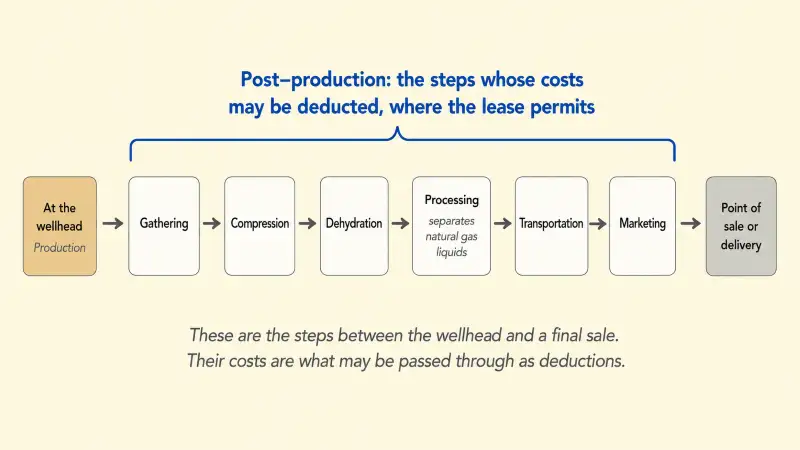
Post-production costs are expenses that arise after oil or gas is produced from the well and before it is sold or delivered to market. These costs may include gathering, compression, dehydration, processing, treating, transportation, and marketing.
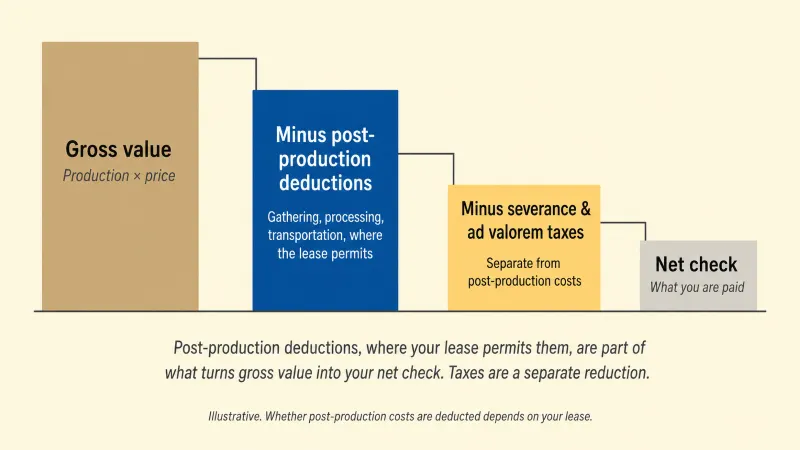
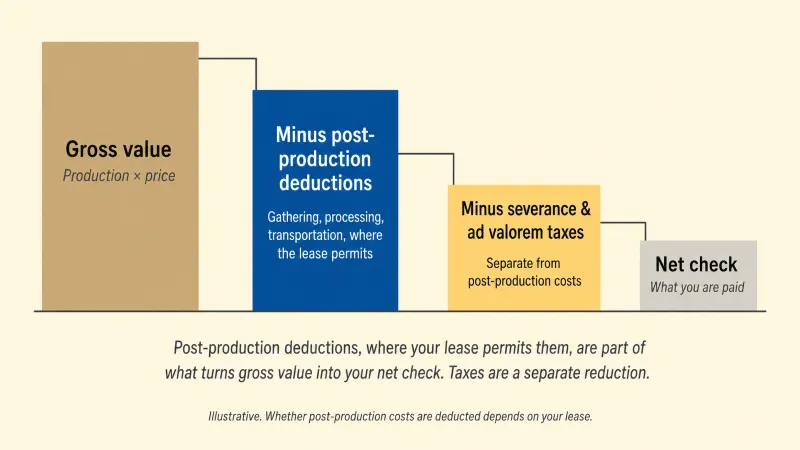
For a mineral owner, post-production costs matter because some leases allow certain costs to be deducted from royalty payments. These deductions can reduce the gross value of production to the net amount the owner actually receives. Whether these costs can be deducted depends on the wording of the lease.
What This Means for Mineral Owners
Most owners focus on how much their wells produce and what oil and gas are selling for. Post-production costs are the third factor that quietly sits between those two and your actual check. Production and price set the gross value; post-production deductions, where a lease allows them, are part of what turns that gross into the smaller net figure you are paid.
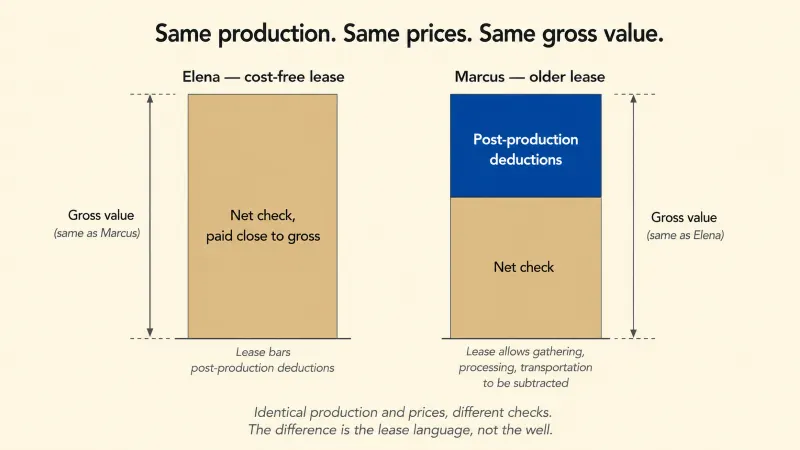
This is why two owners with the same production can receive different checks. If one owner's lease allows these deductions and the other bars them, their net royalties diverge even though the wells produced identically. The deductions, and your lease's treatment of them, are the difference.
Two Things to Keep in Mind
- Post-production costs can meaningfully reduce your check. They are deducted after the wellhead, so they shrink the gross value of your production into a smaller net payment, where your lease permits them.
- Whether they can be deducted is controlled by your lease. The same well and the same prices can produce different net royalties depending on whether your lease allows or bars these deductions.
What Are Post-Production Costs
In one line: post-production costs are costs incurred after production to move, treat, process, or deliver oil or gas from the wellhead to a point of sale or delivery. They are separate from drilling, completion, and lease operating costs, which royalty owners generally are not charged directly.
Common categories include:
- Gathering: Moving the product from the wellhead through gathering lines toward a processing point or main pipeline.
- Compression: Boosting gas pressure so it can move through the pipeline system.
- Dehydration: Removing water from the gas so it meets pipeline standards.
- Processing: Treating the gas and separating natural gas liquids from the gas stream.
- Transportation: Moving the product from the field or processing point to a downstream market or delivery point.
- Marketing: Certain costs associated with arranging or facilitating the sale of the product, where permitted by the lease.
Together, these are the steps between production and a final sale, and their costs are what may be passed through as deductions.
How They Show Up on Your Statement
On a royalty statement, post-production costs typically appear as deduction lines that reduce your gross value to your net payment. The labels are often abbreviated and not always self-explanatory. You may see lines such as gathering, compression, processing, transportation, or simply a grouped heading like deductions or deducts, sometimes alongside the line for severance taxes.
The practical effect is that your statement may start from a gross figure based on production and price, then subtract permitted deductions and taxes to arrive at the net amount you are paid. Severance taxes and ad valorem property taxes are separate from post-production costs. Taxes arise under tax law and may appear on royalty statements apart from lease-based post-production deductions, while the deductibility of post-production costs depends on the lease. Learning to recognize which lines are post-production deductions, as distinct from tax lines, is the first step to understanding the gap between your gross and your net.
Why Post-Production Costs Matter
The stakes here are simply how much of your royalty you keep. Post-production deductions can take a modest or a significant bite out of a check, and the effect is largest on products that require the most processing and transport, such as gas and the liquids pulled from it.
The deeper point is the gross-versus-net distinction. Depending on your lease language, your royalty may be calculated from a gross or net valuation basis, which affects what you ultimately receive. Because lease terms differ, post-production costs are a major reason two owners with identical production can end up with different incomes. Understanding them is understanding why your net check is what it is.
Lease Language That May Limit Post-Production Deductions
One common protection against these deductions is lease language that limits or prohibits some or all post-production deductions. A cost-free royalty clause, sometimes called a no-deductions or gross-proceeds clause, is lease language stating that the royalty is to be paid free of post-production costs, on the gross proceeds rather than on a net figure. Where such language applies and is enforceable under the lease, the owner's royalty may not be reduced by some or all gathering, processing, transportation, and similar costs. It is the single most important lease term for controlling whether these deductions can reach your check.
What Controls It: Your Lease Language
Whether post-production costs can be deducted comes down to knowing how your lease is worded. As a general pattern, language tying royalty to value at the well has often supported certain post-production deductions, while gross-proceeds or carefully drafted no-deductions language has often limited or prohibited them, depending on the exact wording.
Texas courts, including the Texas Supreme Court in Chesapeake v. Hyder, have addressed these questions, but that case is a good illustration of how fact-specific the outcomes are: the result turned on the particular royalty wording in that lease and does not set a rule you can apply to your own. Because the exact language is decisive and the case law is nuanced, the wording of your lease is what ultimately governs, and it is worth having reviewed by a qualified attorney.
A Real-World Scenario
Example: two cousins comparing royalty checks in Karnes County
Two cousins, Marcus and Elena, inherited royalty interests in neighboring tracts in Karnes County, Texas, served by similar wells producing comparable volumes of gas and liquids. When they compared their statements, Marcus consistently netted less per unit of production than Elena did.
The difference was not their production, which was nearly identical, and not the prices, which were the same. It was their lease. Elena's lease included cost-free language that barred post-production deductions, so her royalty was paid closer to gross.
Marcus's older lease allowed those deductions, so gathering, processing, and transportation costs were subtracted from his share before he was paid. Once they understood that the gap came from lease language rather than an error, Marcus knew the right question to bring to a professional, and both understood why identical production had produced different checks.
Note: This example is provided for illustrative purposes only and does not represent any specific mineral owner or lease.
What to Check
Find out whether your lease contains no-deductions, cost-free, or gross-proceeds language
The decisive question is whether your lease bars post-production deduction. Locating and understanding that language, or its absence, tells you whether these costs can reach your check at all. Because the wording is what controls, this is worth confirming with a professional rather than guessing from the deductions you see.
Make sure your deductions are itemized and documented
Where deductions are taken, they should be reviewed carefully and, if unclear, questioned or verified with the payor. Reviewing your statements for clearly labeled deduction lines and tracking them over time helps you see what is being subtracted and spot changes. Mineral View's Monthly Report summarizes revenue and deduction trends across your minerals over time, which makes patterns in your deductions easier to see than reading one statement in isolation.
Important
Mineral View can help you see your revenue and deduction trends over time. For questions about whether your lease permits post-production deductions, whether specific deductions are proper, or what your cost-free language means, consult a qualified Texas oil and gas attorney, since the lease wording and case law are decisive.
Common Questions
Drilling and operating costs are the costs of creating and running the well, and a royalty owner is generally not charged those costs directly. Post-production costs come later, after the product leaves the wellhead, and cover getting it to a saleable market. The key difference for you is that, depending on your lease, post-production costs can be deducted from your royalty, while drilling and operating costs cannot.
Most often, because their leases treat post-production costs differently. If one lease allows these deductions and the other bars them with cost-free language, the two owners net different amounts even from identical production at identical prices. Lease wording, not the well, drives the difference.
It depends on your lease. If your lease contains effective cost-free, no-deductions, or gross-proceeds language, some or all post-production deductions may be improper, depending on the exact wording and Texas law. If it does not, the deductions may be permitted. Whether a particular deduction is proper under your specific lease is a legal question best reviewed by a qualified attorney.