How Long Do Oil Wells Last? If this question has crossed your mind, you are not alone. Many mineral owners in Texas lease their land hoping to receive royalty income for years, sometimes even generations. Yet the reality is not always the same for every well. Some wells stop producing sooner than expected, while others continue generating oil and gas for decades.
The lifespan of an oil well is usually around 10–15 years, although some wells can continue producing for much longer.
The actual lifespan of an oil well depends on several factors, including:
- The Geology Beneath the Land
- The Amount of Recoverable Oil in the Reservoir
- The Drilling Technology Used to Develop the Well
As these conditions are different in every location, the lifespan of an oil well can vary widely from one area to another.
In this blog, we explore how long oil wells last and the key factors that influence their productive life. Understanding this can help mineral owners make smarter decisions about leases, royalties, and long-term investment planning.
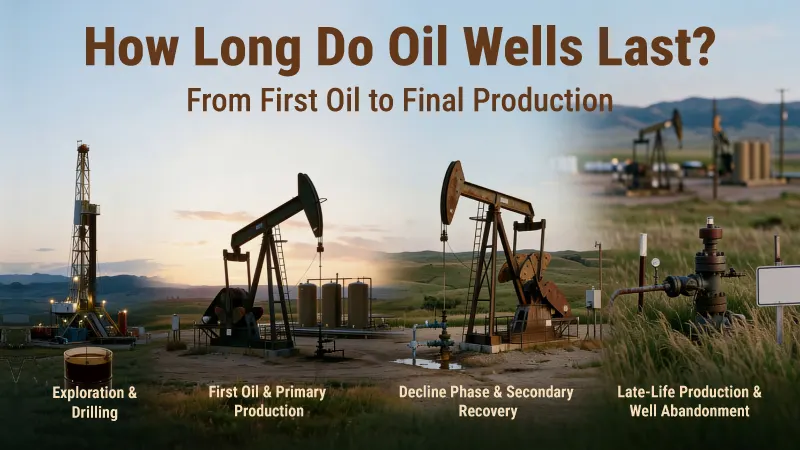
What Does “How Long Do Oil Wells Last” Really Mean?
Economic Production Life
This refers to the period during which a well remains profitable for the operator.
It ends when the revenue from production can no longer cover operating costs, taxes, and royalties.
In Texas, a well may still physically produce oil after this point, but operations often stop once the economic limit is reached.
Higher oil prices or improved recovery technology can sometimes extend this economic life.
Physical Well Life
This describes the actual operational lifespan of the well, regardless of profitability.
Even after production declines significantly, some wells continue producing very small volumes for many years.
In certain cases, wells may operate for several decades, sometimes producing only a few barrels of oil per day.
Lease-Holding Production
Many oil and gas leases require continued production to keep the lease active after the primary term.
Even minimal production can maintain the lease and prevent it from expiring.
What Industry Data Shows
Historical records from the Railroad Commission of Texas and analysis by the U.S. Energy Information Administration show that oil wells often remain active for decades, although production typically declines over time.
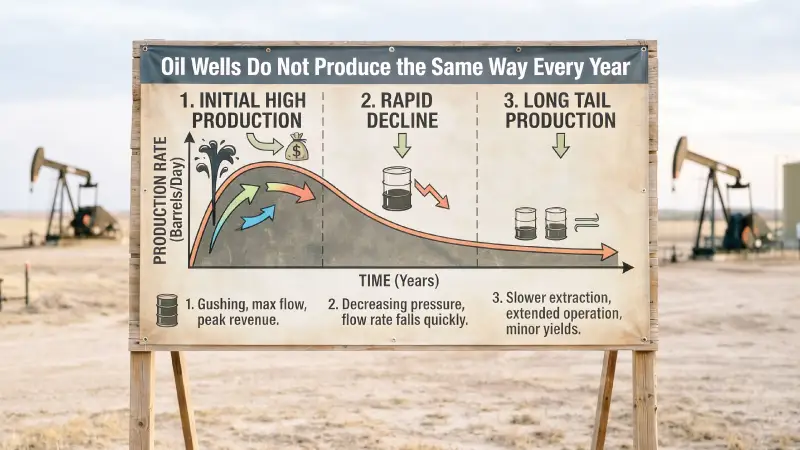
Most wells follow a pattern that looks like this:
1. Initial Production Phase: Very high output immediately after completion.
2. Decline Phase: Production falls rapidly during the first few years.
3. Long Tail Production: A slow decline that may last decades.
Due to this production pattern, the answer to how long do oil wells last depends largely on geology and drilling technology.
To understand these phases in a practical context, it is beneficial to examine how oil wells last in Texas operations, where regional variables dictate the true "reality on the ground" for owners.
How Oil Wells Last in Texas Operations: The Reality on the Ground
Texas contains several major oil-producing basins, including the Permian Basin, Eagle Ford Shale, and Barnett Shale. Each region behaves differently depending on the rock formations being developed. Historically, conventional oil fields in Texas produced oil through vertical wells drilled into porous reservoirs.
These wells often produced smaller daily volumes but declined slowly. In contrast, the modern shale revolution introduced horizontal drilling and hydraulic fracturing, which dramatically increased early production but also created steeper decline curves.
In practical terms, most wells fall into the following general lifespan patterns:
| Well Type | Expected Lifespan | Decline Rate |
|---|---|---|
| Shale (Horizontal) | 10–20 Years | High (Steep initial drop) |
| Conventional (Vertical) | 20–40+ Years | Low (Steady, slow decline) |
| Stripper Wells | Decades | Very Low (Marginal production) |
Texas alone has hundreds of thousands of wells, and many remain active long after their initial drilling.
To truly grasp the expected lifespan of a specific asset, it is essential to distinguish between the long-term endurance of vertical drilling and the high-intensity recovery typical of modern horizontal drilling methods.
Vertical Wells Versus Horizontal Wells
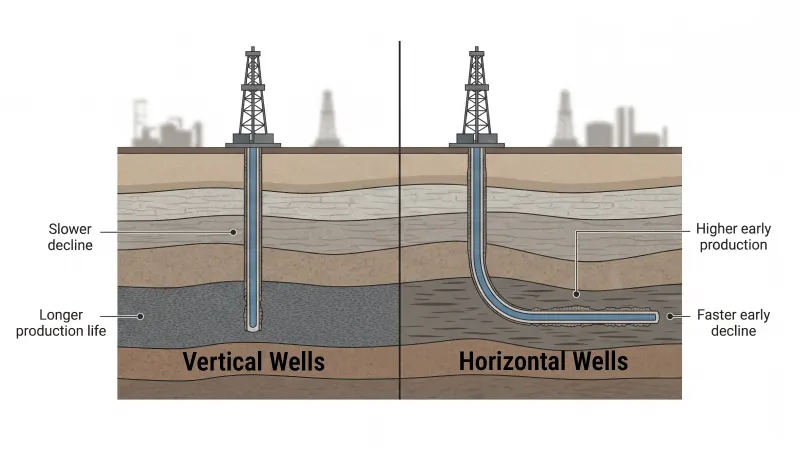
Vertical Wells (Conventional Wells)
Vertical wells are the traditional method of oil production, where the wellbore is drilled straight down into the oil reservoir. Oil flows naturally from the reservoir into the wellbore due to reservoir pressure and natural permeability.
These wells usually start with lower initial production rates compared to modern shale wells. However, the decline rate is generally slower, allowing many vertical wells to produce small volumes for decades. In Texas, numerous vertical wells drilled many years ago still produce low but steady amounts of oil.
Horizontal Wells (Modern Shale Wells)
Horizontal wells begin with a vertical section drilled to the target depth, followed by a horizontal extension through the oil-bearing formation. The horizontal section may extend thousands of feet through the reservoir, increasing contact with the oil-bearing rock.
Operators typically use hydraulic fracturing to create fractures in the rock, allowing oil and gas to flow more easily into the well. These wells often produce very high volumes during the initial production phase, and a large portion of the total lifetime production may occur in the first year.
Production Decline Characteristics
Horizontal wells usually experience a steep decline in production during the first three to five years. After this initial drop, production often stabilizes at lower levels that can continue for several additional years.
The overall lifespan depends on factors such as reservoir quality, completion design, and oil market conditions.
The Drilling Process and Its Impact on Well Life
The drilling process and its impact on well life can be understood through the following key operational factors.
Well Construction and Structural Integrity
The lifespan of an oil well is strongly influenced by the quality of drilling and completion work during construction. During drilling, multiple protective layers are installed to maintain the structural stability of the well.
Casing and Cementing
Steel casing pipes are placed inside the wellbore and cemented in place to isolate underground formations. Proper casing and cementing prevent fluid migration between geological layers and protect groundwater resources. Poor casing or cementing can lead to mechanical failures, which may shorten the productive life of the well.
Completion Design
After drilling, engineers design the completion strategy to optimize production. This includes planning the number of hydraulic fracturing stages, the amount of sand (proppant) used in each stage, and the spacing of perforations along the horizontal section of the well.
Impact on Production Performance
These technical decisions affect how efficiently oil and gas flow into the wellbore. They also influence how quickly reservoir pressure declines over time, which directly impacts the well’s long-term production profile.
Role of Modern Technology
Advances in drilling and completion technology have significantly improved well performance. As a result, many modern shale wells today achieve higher lifetime production compared to earlier generations of horizontal wells.
Common Misunderstandings Mineral Owners Have About the Life of an Oil Well
Many mineral owners believe a well will produce the same amount of oil every year. In reality, production usually declines over time.
Most wells produce the highest amount in the beginning, and then the production slowly drops. This pattern is normal and helps explain how long do oil wells last.
For example, a shale well may produce hundreds of barrels per day in the first few months. After a few years, production may drop to a much smaller amount.
This decline does not mean the well has failed. It simply means the oil reservoir is naturally producing less over time.
Another misunderstanding happens when production becomes very low. When a well no longer produces enough oil to make a profit, the operator may decide to stop operating it.
In Texas, companies must follow RRC Rule 14 regarding plugging. As of 2026, SB 1150 enforced stricter timelines for 'orphaned' wells, requiring faster decommissioning of inactive bores to protect groundwater, backed by increased federal and state environmental funding.
After that, surface equipment is removed, and the site is cleaned and restored as much as possible.
Even if a well is closed, mineral rights still remain valuable. In some cases, companies return years later and drill new wells using better technology.
Practical Implications for Royalties, Leases, and Long-Term Ownership
The financial planning is affected by the question of how long do oil wells last to the owners of the minerals. Royalty payments are usually in line with production. At the beginning of the life cycle of a well, the amount of payment can be high due to high output. In the long run, such payments will slowly reduce as the output will decrease.
This trend has a tendency of surprising new mineral owners who anticipate consistent royalty payments over several decades. Leases of oil and gas are also subject to production. The major term in most leases is the first period within which a company should start drilling. When a well starts producing, this lease can be extended to a second term that is of the same duration as the production period.
Minor quantities of production can be sufficient to sustain a lease in place.
Common Mistakes Mineral Owners Make When Evaluating Oil Well Lifespan
Assuming Uniform Production Patterns:
One of the most frequent errors is the belief that every well will follow an identical lifecycle. In the Texas oil patch, wells located just a few miles apart can perform very differently due to localized geological shifts.
Ignoring Publicly Available Data:
Many owners miss out on critical insights by overlooking production volumes reported to the Railroad Commission of Texas. Monitoring this data allows you to see the "big picture" of activity in your specific county.
Neglecting Comparative Performance:
By failing to track nearby well data over time, owners lose the ability to benchmark their own assets. Understanding how similar wells in the area are aging provides a realistic preview of your own well's future.
Misunderstanding Well Classification:
Owners often overlook the legal and financial differences between an oil well being listed as active, inactive, shut-in, or plugged and abandoned. Each of these statuses carries unique implications for the validity of your lease and future development potential.
Operating Without Visibility:
A lack of clear, consolidated data often leads to missed signs that a well is nearing its economic limit or that an operator is failing to maintain the lease properly.
How Data Visibility Helps Mineral Owners Make Confident Decisions
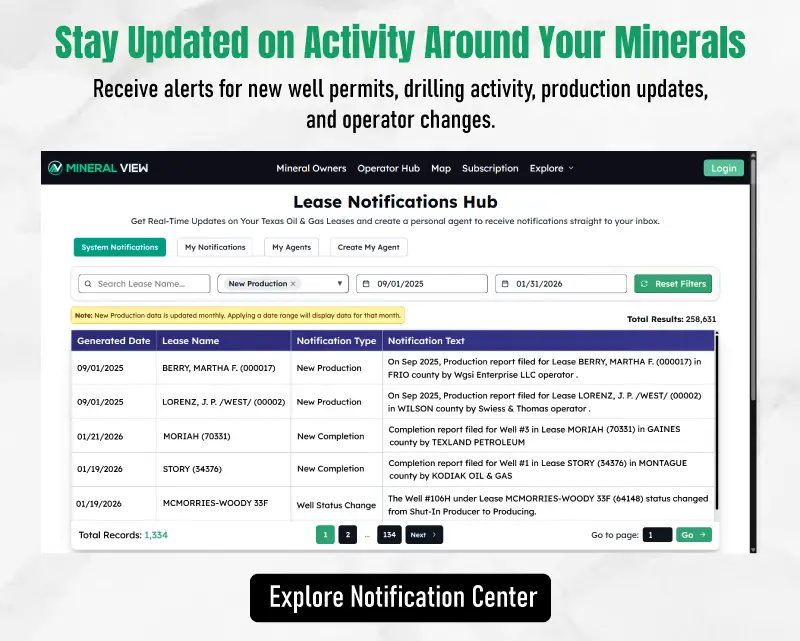
Reliable information is one of the most valuable tools a mineral owner can have. Tracking well activity, production history, and nearby drilling plans makes it easier to understand what may happen next on a property.
Modern mapping tools make this process much simpler than it was in the past. Interactive maps allow mineral owners to see nearby wells, identify operators working in the region, and understand how development is expanding across a field. Tools that analyze historical drilling trends can also provide new well probability, helping owners estimate the likelihood of additional wells being drilled in their area.
In addition, access to financial forecasting tools such as cashflow projections helps mineral owners better understand the potential income from their wells over time by analyzing production history and decline patterns. Features such as Lease Reports and portfolio tracking also help organize lease terms, royalty details, and multiple mineral assets in one place. These insights allow owners to move beyond guesswork and make more confident decisions about leases, negotiations, and long-term mineral ownership.
Wrapping Up
There is no single answer to how long do oil wells last. In Texas, many shale wells produce the most oil in their early years and then gradually decline, while conventional wells may produce smaller amounts but last for decades. A well’s lifespan depends on factors like geology, drilling methods, reservoir pressure, and oil prices. Some wells may produce for about 10 years, while others can operate for 40 years or more. For mineral owners, royalty payments are usually highest in the early years and decrease over time, making it important to understand well activity and lease terms for long-term decisions.
To put it simply, all oil wells have a natural production lifecycle. Availability of credible information will enable owners of minerals to have an easier time in knowing the trends in production, following up of nearby wells, and make superior choices regarding their mineral assets in the long run.
To manage these assets effectively, mineral owners need the same transparency as operators. Mineral View features provide the data visibility required to track these decline curves and plan for the long-term future of your property.