For any Texas landowner or heir discovering potential assets, distinguishing between Mineral Interest vs Royalty Interest is the single most important factor in determining your legal rights, tax liabilities, and wealth potential. While often used interchangeably, these terms represent distinct estates under Texas law: one offers perpetual control and lease bonuses, while the other offers passive income without the liability of ownership.
Many landowners face confusion when an oil company offers a lease, a buyer contacts them about royalties, or they discover mineral ownership through an unexpected inheritance. Even that is not enough to know the difference between a mineral interest and a royalty interest, thus resulting in loss of income, bad deals, or regret in the long run.
In this comprehensive piece you will understand all the aspects of Mineral Interest VS Royalty Interest.We will go through what each of the interests represents, how income is earned, who makes the decisions on leasing, the duration of each interest, and why it is important before you lease, sell or transfer an asset to the next generation. You are a Texas landowner or a royalty investor or an heir struggling to learn about family property, this blog will give you the clarity you require to make smarter decisions.
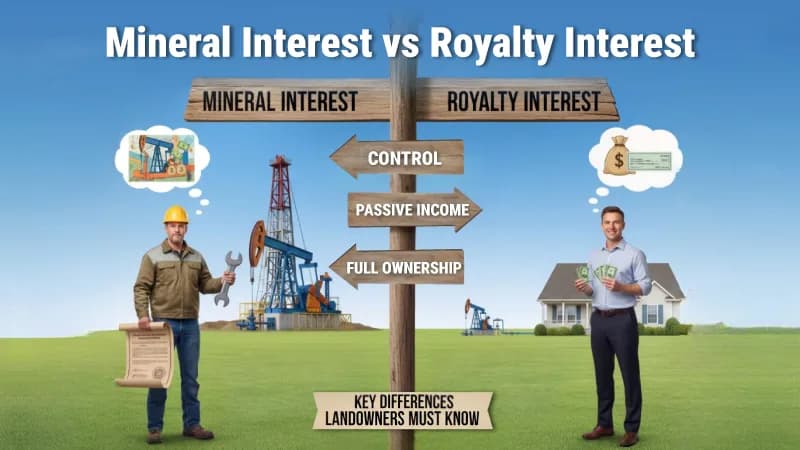
Key Takeaways
A Mineral Interest grants ownership of subsurface resources, including the executive right to lease and collect bonuses. A Royalty Interest means you earn a percentage of the revenue from oil and gas production, without having to pay any costs for drilling or operations, and without control over how the minerals are leased or developed.
In the United States, especially in states like Texas, Oklahoma, and North Dakota, mineral rights can be privately owned and legally separated from surface rights.
Mineral interest holders usually control leasing decisions and receive bonuses and rentals; royalty interest holders only receive production income.
Understanding Mineral Interest vs Royalty Interest is critical before leasing, selling, or buying oil and gas assets.
Royalty interests typically end when a lease expires or production stops, while mineral interests continue indefinitely, allowing owners to earn income from future leases or drilling operations.
Mineral Interest vs Royalty Interest
Suppose you are a West Texas landowner with 100 acres. One of the oil companies contacts you regarding drilling. You have to know the distinction between the mineral and royalty interest you may hold before you inscribe any signature on a piece of paper.
An oil and gas under your land is a mineral interest. It puts you in control of leasing out those minerals, who drills and you negotiate on the terms of the lease. A Working Interest is the ownership percentage that grants the right to drill; however, the Working Interest owner is liable for 100% of the drilling and operating costs.
Here’s a simple example:
You lease your minerals at a 25% royalty (the standard for modern Permian Basin deals). If a well generates $10,000 in monthly revenue, you receive $2,500 cost-free. If a family member holds a 3% Non-Participating Royalty Interest (NPRI), their payment comes out of your share first. They receive $300, leaving you with a net total of $1,700. The operator retains the other 80% and is liable for all the costs.
This simple point of example brings the gist of Mineral Interest vs Royalty Interest: control and income only.
Quick Comparison: Mineral Interest vs Royalty Interest
| Factor | Mineral Interest | Royalty Interest |
|---|---|---|
| Control | Full leasing control | No control |
| Costs | No costs unless working interest | Always cost-free |
| Duration | Perpetual | Often lease-dependent |
| Income | Bonuses, rentals, royalties | Royalties only |
What Is a Mineral Interest?
A mineral interest is a real property interest in subsurface minerals. Under U.S. oil and gas law, it is legally separate from surface ownership and treated as its own estate.
Mineral owners typically hold the dominant estate, meaning the right to reasonably use the surface to develop minerals. State laws favor mineral development, but the May 2025 Myers-Woodward ruling changed the landscape by confirming that Surface Owners retain 'pore space' ownership, meaning they—not mineral owners—collect revenue for Carbon Capture (CCS) and wastewater injection.
Mineral interest owners usually have:
- Executive rights to sign leases
- Bonus rights for upfront lease payments
- Rental rights under older lease forms
- Royalty rights from production
- Full authority to sell or transfer ownership
Mineral interests often become fragmented over time. A single ranch owned in the 1950s may now have dozens of mineral owners due to inheritance. Each owner holds a fractional interest with proportional rights and income.
Mineral ownership is governed by state law, and rules vary widely across states like Texas, Colorado, and Pennsylvania.
Common Types of Mineral Interests
Full (100%) Mineral Interest Ownership
Owning 100% of the minerals means full control over leasing and 100% of bonus, rental, and royalty income attributable to the tract.
Fractional or Undivided Mineral Interest
Many owners hold only a percentage. For example, a 1/4 mineral interest in 160 acres equals 40 net mineral acres. Income and control scale accordingly.
Non-Executive Mineral Interest (NEMI)
A Non-Executive Mineral Interest (NEMI) owner holds title to the minerals and receives bonuses and royalties but lacks the Executive Right to negotiate or sign the lease. This structure is common in estate planning, where income is shared but control is retained by one party.
Producing vs Non-Producing Mineral Interest
Producing interest generates income today. Non-producing interests may still hold value based on future drilling potential.
What Is a Royalty interest?
A royalty interest is a cost-free share of production revenue. It exists only as long as a valid lease and production continue.
Royalty owners:
- Pay no drilling or operating costs
- Have no control over operations
- Depend entirely on operator performance
Most landowners become royalty owners when they lease their minerals. Typical royalty rates range from 12.5% to 25%.
Royalty interests are passive. You collect income but cannot influence drilling decisions or timing.
Main Types of Royalty Interest Ownership
Lessor’s Royalty (Landowner Royalty)
Reserved in a standard lease and tied to the lease’s duration.
Non-Participating Royalty Interest (NPRI)
A Non-Participating Royalty Interest (NPRI) is a special type of royalty that only receives a percentage of production income, but not bonuses or upfront payments from leasing. It continues to earn income if the lease changes, as long as it's set up correctly.
Overriding Royalty Interest (ORRI)
Carved from the working interest and ends when the lease ends.
Term Royalty Interests
Limited to a fixed time or condition and may expire even if minerals remain.
Mineral Interest vs Royalty Interest
Understanding Mineral Interest vs Royalty Interest helps align ownership with financial goals.
Control: Mineral owners control leasing. Royalty owners do not.
Costs and Risk: Mineral owners bear leasing risk. Royalty owners face production and price risk only.
Income Profile: Minerals generate multiple income streams. Royalties generate production income only.
Duration and Flexibility: Mineral interests last forever. Many royalty interests do not.
| Characteristic | Mineral Interest | Royalty Interest |
|---|---|---|
| Legal nature | Real property | Limited real property |
| Executive rights | Yes | No |
| Bonuses | Yes | Usually no |
| Operating costs | No | No |
| Duration | Perpetual | Often limited |
| Survives lease | Yes | Usually no |
How the Two Interests Work Together
Maria owns 100 net mineral acres in the Permian Basin. She leases at $750 per acre (reflecting the tighter 2026 capital market) but successfully negotiates a higher 25% royalty to maximize long-term monthly revenue.
- Bonus: $200,000
- First-year production: $500,000
- Royalty income: $112,500
An ORRI granted to a geologist expires when the lease ends. Maria’s minerals remain.
This illustrates why Mineral Interest vs Royalty Interest matters for long-term wealth.
Practical Considerations for Landowners and Investors
Due Diligence Steps & Statutory Warnings (SB 17):
Effective Sept 1, 2025, sellers must verify that buyers are not citizens of restricted nations (China, Russia, Iran, North Korea) under Texas Senate Bill 17, as selling minerals to prohibited foreign entities is now a felony.
Staying informed about drilling activity matters. Tools like notification systems that alert owners to new permits, well status changes, or production updates help owners stay aware of what’s happening beneath their land—especially when ownership is spread across family members or multiple counties.
Why Sellers Choose Different Strategies
Some sell minerals for lump-sum cash. Others sell royalties while keeping minerals.
Common Contract and Valuation Issues
Post-Production Deductions (Ensure your lease expressly forbids deductions for regulatory compliance, specifically the new July 2025 RRC Chapter 4 Waste Rules, which significantly increased operator disposal costs that they may try to pass on to you.)
Pooling Clauses
Depth Severances
Commodity Price Swings
Get Professional Help
Oil and gas transactions deserve professional review, especially when multiple generations are involved.
How Ownership Structure and Operations Affect Long-Term Value
Understanding how oil and gas companies view your ownership interest is critical to protecting long-term value. Many landowners hold a fractional mineral interest, meaning their share of gas production or mineral production depends on both acreage and percentage ownership.
When you sign a gas lease, how your mineral rights are structured will determine whether you're responsible for costs like drilling or if you'll only receive royalty payments based on production. In most cases, the ownership interest owns the minerals as real property, while operators cover operational costs and development risk under modern oil and gas deals.
However, missed delay rental payments, unclear legal ownership, or errors involving mineral rights owners can delay income or reduce value. Because each property’s mineral interest is tied to subsurface resources beneath the surface estate, conflicts can arise between mineral development and the surface interest, especially when natural gas wells require surface use. Clear documentation of mineral assets, lease terms, and ownership percentages helps ensure that income flows correctly and that mineral owners fully benefit from their rights without unexpected disputes.
Final Words
Knowing the Mineral Interest vs Royalty Interest is not merely a legal fact—it determines how much control one has, the amount of money earned and the financial performance in the long term. Owning minerals provides you with unlimited rights and options over a number of lease cycles. Passive income is offered by ownership of royalty but usually terminates with a lease.
Understanding exactly what you own before leasing or selling is crucial for protecting your interests and ensuring your family’s financial future. Keep records organized. Keep track of activity on your minerals. The decisions you make today are informed, which helps in securing your income and assets for your family even decades later.