You must not look at the horizon anymore; you must look underneath it to really see land ownership in Texas. Texas, on the ground and the rocks way down in the ground are, in a way, two absolutely distinct legal worlds. This is how it is with the split estate, a notion that has been controlling the Texas land for more than 100 years.
You may have inherited family property, or you may be trying to confirm whether your land includes oil, gas, or mineral rights that were passed down through previous generations.
And it is not just a normal property check but a historical detective case and has to involve a trail of ownership dating back to the Republic of Texas.
In this guide, we’ll strip away the legal jargon and walk you through the exact process of uncovering who really owns the oil, gas, and minerals beneath a property.

Step 1: Start with What You Know
Before you drive to a county courthouse or pay for an online subscription, you need to organize your "home base." The biggest mistake beginners make is starting their search in the middle of the timeline rather than at the end.
Gather Your "Paper Trail"
Collect every document you have related to the property. Even a faded letter from an oil company in the 1970s can be a vital clue. You are looking for:
- The Most Recent Deed: Whether it’s a Warranty Deed or a Quitclaim Deed, this is your starting point.
- Title Insurance Policies: Check the "Schedule B" exceptions. Title companies often list mineral reservations there to protect themselves from liability.
- Probate Records: If the land was inherited, the "Judgment of Possession" or "Executor’s Deed" is critical.
- Tax Statements: Under the 2025 Texas Tax Code revisions, most active counties now mandate separate appraisal accounts for producing mineral interests. Check for 'R' (Real) account prefixes in counties like Midland or Reeves.
Decode the Legal Description
You cannot search for mineral rights by a street address like "123 Main St." Texas property is tracked by a system of Surveys and Abstracts. You need to find a string of text that looks like this:
| "Abstract 452, Survey 12, Block 4, T&P RR Co., containing 160 acres, more or less, in Midland County, Texas." |
This description is the "Social Security Number" of the land. Without it, you’re just guessing.
Step 2: Understanding the "Split Estate" in Texas Law
To find the true owner, you must understand how ownership gets broken apart. In Texas, the Mineral Estate is considered the "dominant" estate, though its power is increasingly balanced by the Accommodation Doctrine (a "compromise rule" that forces oil companies to move their equipment if it blocks your current use of the land), which requires operators to respect existing surface uses when possible. This means the mineral owner has the legal right to use as much of the surface as is reasonably necessary to extract their resources.
How Severance Happens
Ownership usually splits in one of two ways:
- Reservation: A landowner sells the surface but keeps (reserves) the minerals for themselves.
- Conveyance: A landowner keeps the surface but sells the minerals to someone else.
If a deed is "silent"—meaning it doesn’t mention minerals at all—Texas law generally assumes the minerals stay with the surface. However, this only applies if the person selling the land actually owned the minerals to begin with.
If a previous owner in 1940 reserved the minerals, every deed written after 1940 is effectively "hollow" regarding subsurface rights, even if the later deeds don't mention the 1940 reservation.
Step 3: Building the Chain of Title
The heart of a mineral rights title search is the "Chain of Title." Think of this as a relay race where the baton is the property ownership. Your job is to make sure the baton was actually passed and not dropped or stolen along the way.
The Grantor-Grantee Index
In the County Clerk’s office, records are kept in a Grantor-Grantee Index.
- Grantor: The person selling or giving the property.
- Grantee: The person receiving it.
To build a chain, you work backward. You look up the current owner as a Grantee to see who they bought it from. Then, you take that seller's name and look them up as a Grantee to see who they bought it from. You repeat this until you reach the Sovereign (the original land grant from the State of Texas).
What to Look for in Every Document
As you pull copies of these deeds, you are scanning for "Red Flag" phrases:
- "Save and except all oil, gas, and other minerals..."
- "Subject to all prior mineral reservations of record..."
- "Grantor conveys an undivided 1/2 interest in the mineral estate..."
Expert Tip: In Texas, certain deed mistakes, especially involving non-participating interests, can cause ownership disputes under what is known as Duhig Rule, which determines who actually owns the minerals when the math in a deed does not add up. This is an important legal term used when a grantor over-conveys mineral interests they don’t actually own. If you see a deed that seems to reserve minerals but the math doesn’t add up, you may need a title attorney to interpret the “Duhig” implications.
Step 4: Knowing Important Mineral Instruments
Not all documents in a mineral rights title search are deeds. You may probably come across a variety of legal "instruments" that have different impacts on your ownership.
The Mineral Deed vs. The Royalty Deed
This is a point of massive confusion for many.
Mineral Deed: This gives the owner the right to sign leases, collect "signing bonuses," and the right to the actual minerals in the ground.
Royalty Deed: This is a "passive" interest. The owner gets a check if oil is produced, but they have no right to negotiate a lease or decide if a well is drilled. They are essentially passengers on the ship, not the captain.
Oil & Gas Leases and Memorandums
If you see an Oil, Gas, and Mineral Lease (OGML) recorded, it means a company is currently (or was previously) exploring the land. Look for a Memorandum of Lease.
While it doesn't show the full contract, it proves that an oil company’s landmen already did their own title search and determined the person who signed that lease was the rightful owner at that time.
Step 5: Common "Chain Breakers" and Complications
A title search is hardly a linear path. The chain is often broken, and then you need to fill the gap.
The Probate Gap
This is the #1 issue in Texas. Grandpa owned the minerals; he died in 1960, and the family just "knew" the land belonged to his kids. But if his will was never probated in the county where the land sits, there is no legal record of the transfer. To a title examiner, the minerals are still owned by a dead man.
The Fix: You may need an Affidavit of Heirship, a document signed by people who knew the family history, to "link" the generations.
Fractionalization
A 100% mineral stake could be divided over a century among four children, followed by their offspring, and so on. By 2026, you might find that you own an "undivided 1/64th interest."
Net Mineral Acres (NMA): If you own a 1/4 interest in a 100-acre tract, you own 25 Net Mineral Acres. Knowing how much your check should be if a business agrees to purchase your rights depends on an accurate calculation.
Foreclosures and Tax Sales
Did the property go through a tax sale in the 1930s? In Texas, if minerals were already "severed" (separated) before the tax lien, a surface tax foreclosure usually does not take the minerals. However, if the estate was still "unified," the minerals might have been lost to the state or a new buyer.
Pro Tip: If your search uncovers an abandoned well, you may be eligible for the 2026 Severance Tax Exemption for Restimulated Wells, potentially saving thousands in taxes if you return the well to production.
Step 6: Using Modern Tools (GIS and Online Portals)
You don't always have to sit in a dusty courthouse basement anymore. Texas has some of the best digital resources for mineral research in the world.
The Texas Railroad Commission (RRC) GIS Viewer
The RRC regulates the oil and gas industry. Their Public GIS Viewer allows you to:
- Search by your Abstract and Survey number.
- See every well ever drilled on your land.
- Identify the "Operator" (the oil company) currently producing.
- Find "API Numbers", the unique ID for every well.
The General Land Office (GLO)
The Texas GLO maintains the original "Land Grants." If your chain of title gets murky in the 1800s, the GLO’s online archives can show you the original maps and patents that started it all.
TexasCourthouse.com and County Portals
Many counties (like Harris, Tarrant, or Midland) have digitized their records back to the mid-1900s. You can often pay a small fee ($1-$5 per page) to download the deeds you need directly to your laptop.
Using Mineral View Texas Map (Integrated Well Insights)
While Mineral View does not directly conduct a mineral rights title search for you, it is a powerful secondary tool for identifying mineral owners. Using its interactive map feature, you can easily locate specific wells and the operators associated with them, providing vital clues for your title research.
Step 7: Professional Help – When to Call the Pros
At some point, you have to ask: Is my time worth more than a professional's fee?
A Professional Landman is a specialist in "running title." They are the boots-on-the-ground experts who live in courthouse records.
When to hire: When you need a "Runsheet" (a list of every document affecting the title) but don't need a formal legal opinion.
Cost: Usually $500 to $1,500 for a standard search, depending on complexity.
The Title Attorney
An attorney doesn't just find the documents; they interpret them.
When to hire: When there is a dispute, a complex "Duhig" issue, or when an oil company is asking you to sign a high-value lease. They provide a Formal Title Opinion, which is a "gold standard" document that banks and oil companies rely on.
Cost Breakdown: What Should You Budget?
Doing a mineral rights title search isn't free, even if you do the legwork yourself. Here is a realistic look at the 2026 costs in Texas:
| Expense Category | Self-Directed Search | Professional Landman |
|---|---|---|
| Document Copies | $50 – $200 | Included in the fee |
| Online Subscriptions | $100 – $300 | Included in the fee |
| Labor/Time | 20 – 40 hours | $90 – $175 per hour |
| Travel (Gas/Hotel) | Variable | Usually billed as an expense |
| Total Estimate | $200 – $600 | $1,500 – $4,000 |
Organizing Your Mineral Rights Information
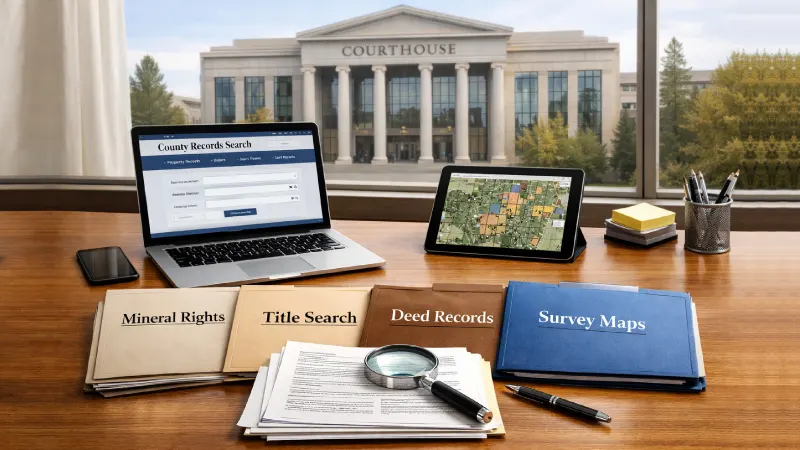
Before you finalize your search, it is helpful to consolidate the technical steps into a practical roadmap. For most property owners, the path begins at the local county records office. This is where the "ground truth" of your ownership chain is archived.
While the tax assessor’s office is excellent for verifying the current property description and identifying who is paying the ad valorem taxes, it rarely contains the detailed records necessary to prove subsurface ownership. For that, you must dig into the historical filings.
To ensure your specialized mineral rights research is accurate, you must cross-reference your property deed with every subsequent instrument filed against the land. Remember that mineral rights deeds and royalty deed grants function differently under the law; the former conveys the right to execute leases, while the latter only provides a right to a portion of the production revenue.
Misinterpreting these legal terms is one of the most common challenges faced by researchers. As you collect mineral rights information, pay close attention to the transfer details in every document. A slight error in the legal land description, such as a typo in the Abstract number or a missing directional call, can create a "break" in the chain that requires a curative filing to fix.
Fortunately, many county offices have digitized their archives, making it easier to track changes over time. By maintaining a clear file of your findings, you ensure that you and all future mineral rights owners have a transparent and indisputable record of what lies beneath the surface.
Conclusion: Why Your Search Matters
The mineral rights title search is not only about the money, but it is also about legal clarity. An unclaimed mineral interest is a challenge in Texas. It may result in suspended money in a purse that the oil company holds in an escrow deposit account, in which they cannot confirm that you are the owner. It may also cause 'clouds on the title' or trigger Statutory Durable Power of Attorney issues, complicating the sale of your home or ranch.
It is a step-by-step process that confirms legal ownership, corrects gaps in the record, and ensures you are properly recognized as the mineral owner. You guard the heritage of your family and make sure that in the event that the next big Texas oil plunge occurs in your backyard, it is you who will hold the pen upon which the lease will be signed.
You can be digging through 19th-century ledger books or analyzing the most recent 3D seismic map on a GIS viewer, but keep in mind that in the world of Texas property, information is the one and most precious resource that a person can possess.
Disclaimer: The information provided in this guide is for informational purposes only as of February 2026 and does not constitute legal, financial, or tax advice. Texas mineral laws and tax codes, including the application of HB 3159, are subject to change and specific site-by-site certification by the Railroad Commission of Texas and the Comptroller.
Always consult with a licensed Texas oil and gas attorney or a Certified Public Accountant (CPA) before making financial decisions or signing legal instruments.