The process of inheriting the property is usually a bittersweet experience, but when the inheritance is the subsurface, then this process may soon turn into a puzzle.
Inherited mineral rights in Texas are one of the rare types of real estate that possess their own regulations, customs, and legal norms of operation.
Mineral rights are not visible, like a house or a parcel of land that can be walked around, but they are important and expensive in their financial and legal consequences.
This guide provides a clear roadmap for anyone who has recently discovered they own a piece of the Texas energy landscape. We will cover how these rights are identified, how the legal title is established, and what you can expect in terms of income and management.
Key Takeaways for Mineral Heirs
If you are just starting this process, these are the core concepts to keep in mind:
- Severed Ownership: In Texas, it is common for the minerals to be owned by someone different than the person who owns the surface.
- The Chain of Title: To receive royalty payments, you must prove your ownership through recorded documents like probate orders or affidavits of heirship in the specific county where the minerals are located.
- Fractional Interests: Because rights are passed down through generations, you likely own a "fractional" interest alongside many other relatives.
- Income Variability: Royalties are not fixed; they fluctuate based on oil prices, well production, and the specific terms of your lease.

Defining Inherited Mineral Rights in Texas
To understand what you own, you first have to understand how Texas views the earth beneath our feet. The state recognizes a "split estate," meaning the land is divided into two distinct parts: the surface estate and the mineral estate.
The Mineral Estate vs. Surface Estate
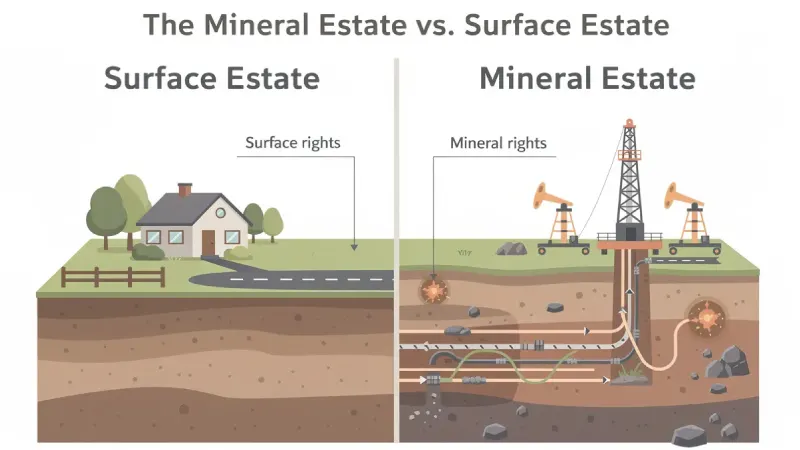
In Texas, the mineral estate is the dominant estate, granting the owner or their lessee the right to use the surface as reasonably necessary for exploration and production.
However, this is balanced by the Accommodation Doctrine, which requires mineral owners to minimize interference with existing surface uses when reasonable alternatives exist.
| Feature | Surface Estate | Mineral Estate |
|---|---|---|
| Primary Use | Farming, ranching, residential development | Exploration and production of oil, gas, etc. |
| Key Rights | Right to possess and improve the surface | Right to sign leases and receive royalties |
| Legal Status | Generally, "servient" to the minerals | Generally "dominant" in Texas |
| Income | Usually comes from land use or sales | Comes from bonuses and production royalties |
Fractional and Undivided Ownership
It is rare for one person to own 100% of the minerals under a large tract of land. Over the decades, as parents leave interests to multiple children, those interests become fractionalized.
You might see a decimal on a document like 0.00156250. This represents your undivided interest—meaning you own that specific percentage of every square inch of the mineral estate in that tract, rather than a specific corner of the field.
How Heirs Discover Inherited Mineral Rights in Texas
Some individuals fail to realize that they own something, and after many years, they only discover this ownership when a specific event occurs. Since mineral owners in Texas have no 'central registry,' the discovery is often left to the heir or a third party.
For those who want to conduct thorough research, utilizing the Mineral View map feature can be a vital step; these maps help you identify the current well status, the exact location of the property, and the owner data associated with that specific lease.
Having access to this visual and technical data helps bridge the gap left by missing public records. Here are some ways for heirs to discover inherited mineral rights in Texas.
1. The Landman’s Outreach
A Landman performs a 'stand-up' title search, meaning visiting the county office to verify the county records to establish a clear chain of title. If they contact you, they are likely attempting to 'cure' a title defect or secure a lease for an upcoming drilling project.
You may get a telephone call or a letter giving you a lease or requesting your signature on a "Ratification. (A document in Texas oil and gas confirms that a mineral or royalty owner approves and adopts an existing lease or agreement as legally binding.)
2. The "Suspense" Notification
In case an oil company is aware that the minerals belong to a deceased person, they will deposit the royalty amount in a suspense account. They retain this royalty amount until the heirs present the legal proof of ownership.
You may discover your inherited mineral rights in Texas because an operator sends a letter asking for estate documentation to "clear" these suspended funds.
3. Family Royalty Checks: Changes
When the relative was getting monthly checks, and after death, the checks are no longer given, then it is a definite indication that the account has been flagged by the operator for a title change.
Legal Requirements and Title Basics
In Texas minerals are treated as real property. This means "handshake deals" or simple mentions in a letter aren't enough to transfer ownership. The transfer must be part of the official public record in the county where the land is located.
Here are some primary legal requirements you need to understand before claiming the inherited mineral rights:
Probate and the Texas Estates Code
In Texas oil and gas ownership, when mineral rights pass through inheritance, the Texas Estates Code generally requires probate to legally transfer those minerals into an heir’s name and establish clear title for leasing, royalty payments, or drilling.
If the owner had a will, a Texas court must validate it through probate; if the owner lived outside Texas, an Ancillary Probate (A legal process used to recognize an out-of-state will in Texas so inherited mineral interests can be properly transferred under the Texas Estates Code) must be filed in the Texas county where the minerals are located so the out-of-state will is recognized and becomes part of the Texas chain of title.
Affidavits of Heirship
In cases where a formal probate isn't practical—often because the estate is small or the death occurred many years ago—an Affidavit of Heirship may be used.
This is a document where people familiar with the family history swear to the identity of the heirs. Although it's quicker than probate, some buyers or oil companies would still need a formal court order for larger interests.
Common Documents in the Chain of Title
To secure your inherited mineral rights in Texas, you will likely encounter these documents:
- Mineral Deed: The formal document that has records of ownership transfer from one person to another.
- Division Order: A contract from the oil company where you confirm your decimal interest and provide your tax information so they can pay you.
- Executor’s Deed: A deed signed by the person managing the estate to move the minerals into the heirs' names.
Identifying Your Earnings: Royalties and Leases
Not every mineral interest produces a check every month. Whether or not you receive income depends on the status of the "play" in your specific area.
Types of Interests
| Interest Type | What You Own | What You Receive |
|---|---|---|
| Mineral Interest | The full "fee" ownership | Bonus, royalties, and the power to sign leases |
| Royalty Interest | A right to production | Only a share of the revenue from oil/gas sold |
| NPRI | Non-Participating Royalty | Revenue share, but no "executive rights" to sign leases |
| ORRI | Overriding Royalty | A share carved out of a company's lease; expires with the lease |
Royalty Calculation: How is it Calculated?

Your monthly check is the result of a specific formula. It involves your Net Mineral Acres (NMA), the size of the total drilling unit, and the royalty rate agreed upon in the lease (often 20% or 25%).
Your Decimal Interest = (Net Mineral Acres / Total Unit Acres) × Lease Royalty Rate × Your Share of the Tract
Example:
If you own 10 Net Mineral Acres in a 640-acre unit, have a 25% lease royalty, and own 100% of the tract, your decimal interest would be
(10 ÷ 640) × 0.25 × 1.00 = 0.00390625
This decimal is then multiplied by the well’s monthly revenue to calculate your royalty payment.
While understanding this math is helpful for verifying your current statements, manual forecasting can quickly become overwhelming as production rates fluctuate. Instead of spending time on these complex royalty calculations, you can simply use the MVestimate feature.
It directly shows the projected future value and the estimated income you can expect from your oil and gas leases over the next six years, providing a clear financial outlook without the need for any manual math.
Tax Considerations for Inherited Mineral Rights in Texas
Ownership of mineral assets carries specific federal and state tax obligations. While Texas does not have a state income tax, the federal government views your royalties as taxable income.
- Step-Up in Basis: This is perhaps the most important tax benefit for heirs. When you inherit minerals, your "basis" (the value for tax purposes) is reset to the fair market value on the date the previous owner died. This can highly minimize the capital gains tax you owe if you decide to sell the rights later.
- Depletion Deduction: Because oil and gas are "wasting assets" (at some point they end), the IRS permits owners to claim Percentage Depletion, allowing you to deduct 15% of your gross royalty income to account for the gradual exhaustion of the mineral reserves.
- Ad Valorem Taxes: If your minerals aren't producing, you generally won't receive a tax bill. Furthermore, as of 2026, Texas has increased exemptions for small-value interests, meaning many heirs with low-producing or non-producing minerals may be exempt from these property taxes entirely.
The Big Decision: To Keep or To Sell?
Once you have documented your inherited mineral rights in Texas, you have to decide what to do with them. Depending on your economic objectives, there isn't a single "right" response.
Why Many Heirs Choose to Keep
For many, minerals are a "lottery ticket" that pays out over time. There is a sense of family history in holding onto the rights. If the area sees a new drilling boom (such as the Permian Basin has seen recently), a small interest can turn into a significant monthly income for years or even decades.
Why Some Heirs Choose to Sell
Managing minerals can be a headache. You have to track tax payments, monitor oil companies, and deal with difficult paperwork. A sale delivers a lump sum of cash now, which can be used to pay off a mortgage, fund a child’s education, or spend on stable assets.
Selling also "cleans up" the title for the next generation, preventing the interest from being separated into even smaller, less manageable fractions.
Common Errors You Should Avoid
- Overlooking the County Records: Never assume that because a will says you own it, the oil company knows it. You must record your documents in the county clerk’s office.
- Signing the First Offer: If you receive an unexpected offer to buy your mineral rights, it is often priced lower than their true value. Take time to research your ownership and consider a professional’s consultation before signing, and you can use various online platforms like Mineral View for additional information about your minerals.
- Losing the Paperwork: Keep every check stub and every division order, as these documents are essential to prove your asset's value to banks, future buyers, or tax authorities.
To avoid such errors, you must be aware of all the notifications associated with your mineral interests. The Mineral View notification feature of Mineral View This proactive approach helps you stay informed, reducing the risk of missing critical details or losing track of the paperwork needed to manage your interests effectively.
This proactive approach ensures you stay informed with the latest updates, reducing the risk of missing critical details or losing track of the paperwork needed to manage your interests effectively.
Next Steps for New Mineral Owners
If you have just realized you have inherited Texas mineral rights, don’t panic. Start by gathering every document you can find, old leases, probate records, death certificates, division orders, or correspondence from oil and gas companies. Establishing clear ownership is essential for protecting your interests and ensuring accurate royalty payments.
Next, verify whether the minerals are producing by using the Texas Railroad Commission (RRC) Public GIS Viewer. By entering your Section, Block, and Survey information, you can identify active wells, permitted locations, and historical production associated with your acreage.
If production exists, contact the operator’s Owner Relations department to begin the ownership transfer process under Texas oil and gas law. This step ensures future royalty checks are properly issued and that your interest is correctly reflected in the operator’s records.
Managing inherited or purchased mineral interests requires organization and patience, but by staying informed, maintaining proper documentation, and asking the right questions, you can protect your ownership and preserve your family’s long-term mineral legacy.