
Loading article
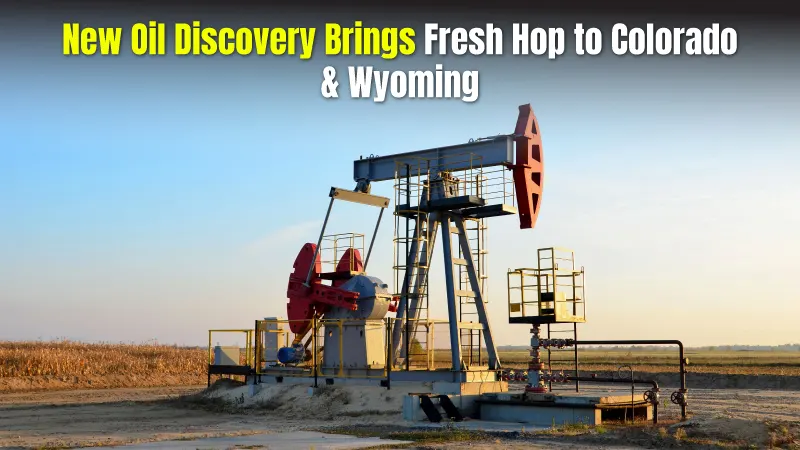
Now and again we get a story of the nature of how the energy landscape never stands still. One of those stories hit the news this week- new oil and gas resources have been discovered in northern Colorado and southern Wyoming. To oil news aficionados, this is not simply that other news article concerning an industry. It is an indication that areas, believed to have been cooling, still harbor new opportunities.
The U.S. Geological Survey (USGS) has established the fact that the phosphoria total petroleum system still holds millions of barrels of oil and high amounts of natural gas yet to be unlocked. The sizes may not compare to the greatest oil fields of all time but the significance of having such an oil discovery is not all about the figures. This comes as positive news to the mineral owners, investors, and energy firms, particularly those that are close to southwest Denver, in that the energy saga in the Rocky Mountain region is yet to fully develop.
This blog will unpack the discovery, discuss what it means to the sector, and explain what is good news about oil to landowners, investors and those communities. We will then also link this update to the broader US energy trends, and how new finds even smaller ones can reverberate throughout the market, employment and investor confidence.
Phosphoria formation forms a long oil and gas story in America. It was first tapped in the early 20th century and has yielded billions of barrels due to its production over decades. As any aging oil play, however, yield ebbed, and the guess increased that there was not much left worthy of refinement.
But the assumption has been criticized. USGS report showed:
Phosphoria system continues to hold 3 million barrels of oil.
Together with the oil, there are a potential 666 billion cubic feet of natural gas that is yet to be recovered.
Meaningful quantities of hydrocarbons are also still generated in other formations, including the Lance Formation, the Lewis Shale, and the Mesaverde Group.
In the case of investors and owners of land that involves discovery of natural resources, a discovery has direct value. Although 3 million barrels is not huge in comparison to Texas, or the Gulf of Mexico, in an area where people has felt that the opportunities were becoming endangered it brings an additional life to wells, royalties, and development partnerships.
It’s easy to look at 3 million barrels and dismiss it as small in the global picture. After all, the U.S. produces around 12 million barrels of oil per day. But in the right context, this is still very important.
For Colorado and Wyoming communities, especially around southwest Denver and rural counties, even modest new oil finds can mean jobs, royalties, and tax revenue.
Positive oil news helps maintain a favorable outlook for energy stocks and exploration companies. Investors who may have hesitated on Douglas barrels investments might see renewed opportunity.
Thousands of landowners hold rights in these regions. For them, new drilling activity means checks in the mail, often from partnerships with mid-sized operators like those connected to northwest energy.
Every barrel produced domestically reduces reliance on imports. Even “small” additions strengthen U.S. resilience.
For oil and gas investors, the news translates into real possibilities. Let’s consider a few scenarios.
At today’s average price of $75 per barrel, 3 million barrels equals $225 million in gross value.
Natural gas at $3 per MCF turns 666 billion cubic feet into about $2 billion of value.
Together, the discovery could represent billions in potential revenue, spread across years of development.
Now, not all of that money flows directly to companies or landowners—extraction costs, transportation, and regulatory factors cut into returns. But the signal is clear: this find adds real wealth to the region.
For companies with ties to discovery natural resources, or those looking to expand portfolios like northwest energy operators, the find is encouraging. For individual investors, it provides yet another reason to stay tuned to the latest oil news headlines.
To put the new Colorado-Wyoming numbers in perspective:
Earlier this year, USGS estimated 473 million barrels of oil and 27 trillion cubic feet of natural gas in Wyoming’s Mowry Composite system.
Compared to that, the Phosphoria discovery looks smaller. But scale isn’t everything. Smaller reserves can be easier to access, less risky, and more profitable in certain market conditions.
That’s why both large and modest discoveries matter. Each one fills a different role in the nation’s energy mix. For Douglas barrels traders, small fields can sometimes mean faster cycles of drilling and return. For landowners, they often mean new lease payments in areas long thought inactive.
What has southwest Denver to do in the midst of an oil discovery story? Since the ripple effects of the economy and the energy source do not remain within the perimeter of the rural Wyoming. Denver has been a locus of energy since time immemorial with oil and gas firms, service providers and investors based in the city.
Incidents of discovery in the immediate area attract attention to offices in Denver. Recruitment can increase. Firms can build up budgets on exploration. Information is disseminated to service providers such as drilling contractors, engineers, and equipment suppliers who may be able to gain more business.
To the investors in the Denver area this oil news is a reminder that the Rockies is still an energy story to keep on the radar screen.
Mineral rights ownership is often overlooked in energy reporting, but it’s one of the most direct ways individuals benefit from discoveries like this.
For families and ranchers holding rights in Wyoming and Colorado, the Phosphoria assessment could mean:
New lease offers from oil companies.
Bonus payments upfront for signing those leases.
Royalties down the line if wells are drilled and produce.
Even modest monthly royalty checks can add up to meaningful supplemental income. For many, that’s life-changing, especially in rural areas.
This is why oil news like today’s is more than a corporate headline—it can affect household budgets, college funds, and retirement security.
Discovery natural resources and northwest energy are the two names that come to mind when discussing this region.
These two companies, among others, are interested in the drilling, production and the management of resources in the state of Colorado and Wyoming. They are not necessarily the biggest companies in the country but they are agile, flexible, and sometimes in a good position to exploit such a play as this one.
The mid-sized operators can be profitable to monitor by investors as much as the giants. They tend to move more quickly, respond more readily and give returns at a time when larger companies are directed elsewhere.
When someone mentions Douglas barrels the first thing that tends to happen is specifically confusion. A barrel in energy lingo is 42 gallons of oil. So when the USGS says there is 3 million barrels left that is 126 million gallons worth of energy.
To investors or landowners, each Douglas barrel is worth something- either by being sold in today terms with the market rates, or as a store of value.
That is why even such small discoveries of oil are still so important. Each barrel means national income, investor yields, and local well, writes.
No modern oil news story is complete without discussing the environment. Critics may point out that extending oil and gas development prolongs dependence on fossil fuels. That’s true—but balance is key.
Colorado and Wyoming are also leaders in renewable energy development, particularly wind and solar. By blending continued oil production with renewable expansion, the region can create jobs, strengthen economies, and transition responsibly.
This discovery doesn’t derail clean energy—it complements it by providing reliable supply during the shift.
As we close, let’s step back. This latest USGS announcement may not rank as one of the biggest discoveries of the decade. But for communities, investors, and mineral owners across southwest Denver, Colorado, and Wyoming, it’s a welcome headline.
It reassures landowners that discovery natural resources still hold value.
It highlights the ongoing importance of every Douglas barrel.
It gives northwest energy companies fresh reason to stay active.
And it provides investors a reason to keep following oil news closely.
For all these reasons, the story is one of optimism. It’s proof that even in mature basins, surprises remain. For investors, it’s a reminder that opportunity often lies where few expect it. And for mineral owners, it’s a chance to see new benefits from rights that might have seemed forgotten.
Energy stories are rarely about just oil or gas. They’re about people, communities, and futures. This one—though modest in numbers—represents all three.
Yes, Colorado has a strong oil and gas industry. The state is one of the top energy producers in the U.S., with thousands of active wells and major drilling operations in areas like the Denver-Julesburg Basin. Oil and natural gas production plays a key role in Colorado’s economy, supporting jobs, tax revenue, and local communities.
The largest oil and gas producer in Colorado today is Chevron, which acquired Noble Energy in 2020. Chevron operates heavily in the Denver-Julesburg Basin, one of the state’s most productive regions. Other major producers include Occidental Petroleum (Oxy) and PDC Energy, making Colorado a leading player in U.S. oil and natural gas output.
Yes, Wyoming has extensive oil and gas resources and ranks among the top U.S. producers. Oil was first discovered in the state in 1884 near Dallas Dome in Fremont County, and Wyoming has remained a major energy hub ever since.
The Powder River Basin, Green River Basin, Wind River Basin, and Big Horn Basin are the largest producing regions. Wyoming consistently ranks in the top 10 states for oil production and the top 5 for natural gas, making oil and gas a cornerstone of the state’s economy. Revenue from the industry supports public schools, infrastructure, and local communities across Wyoming.
Informational only — not legal, tax, or investment advice.