Payout in Oil and Gas (BPO and APO)
Payout in oil and gas is the point when a well has recovered the costs specified in the agreement that created the payout arrangement.
In simple terms:
Money is spent on the well. The well begins producing. Revenue is credited against the agreed costs. When the required amount has been recovered, payout occurs.
Payout is important because some oil and gas agreements use it as a trigger.
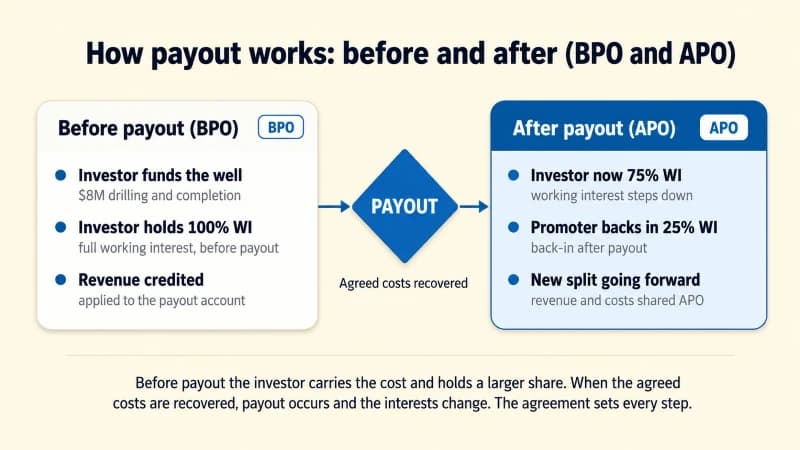
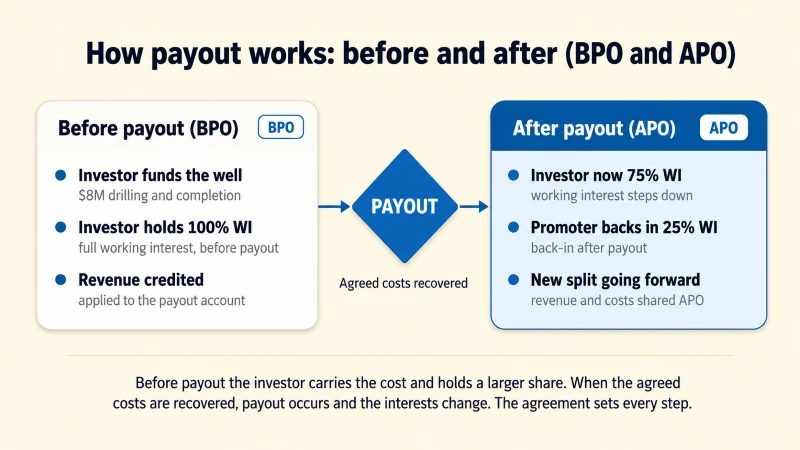
Before payout, one party may receive a larger share of the well because it paid or carried more of the cost. After payout, another party may receive or regain an interest.
This is why the terms BPO and APO matter:
- BPO = Before Payout
- APO = After Payout
The exact payout calculation always depends on the agreement. There is no single formula or industry rule that applies to every well.
Quick Reference
| Field | Detail |
|---|---|
| Term | Payout |
| Common Abbreviations | BPO and APO |
| BPO | Before Payout |
| APO | After Payout |
| Category | Well economics / cost recovery / interest change |
| What it Marks | Recovery of the costs defined in the agreement |
| What may Change | Working interest, net revenue interest, or another economic interest |
| Defined by | The agreement that creates the payout arrangement |
| Common Contexts | Farmouts, non-consent, promoted deals, and back-in interests |
| Government Filing? | No |
| Commonly Confused with | Simple investment payback or a cash distribution |
How Does Payout Work?
A payout arrangement usually has three basic parts:
- Costs to Recover
- Revenue Credited Toward those Costs
- A Change that Happens when Payout is Reached
For example, one party may pay the cost of drilling and completing a well.
Under the agreement, that party may receive a larger share of the well’s revenue before payout. The agreed revenue is then credited against the costs that must be recovered.
When the payout account reaches the point defined in the agreement, payout occurs.
At that point, an interest may:
- Revert to Another Party
- Back in to the Well
- Change from One Percentage to Another
- Return to a Non-Consenting Party
The agreement controls every step.
What Do BPO and APO Mean?
Before Payout (BPO)
BPO means the period before the required costs have been recovered.
During this period, the party carrying the financial risk may hold a larger interest or receive a larger share of the well’s economics.
After Payout (APO)
APO means the period after payout has occurred.
At this point, the ownership or economic split may change according to the agreement.
For example:
| Types of Interests | BPO | APO |
|---|---|---|
| Investor working interest | 100% | 75% |
| Promoter working interest | 0% | 25% |
In this example, the investor holds 100% of the working interest before payout. After payout, the promoter receives a 25% working interest.
This type of change is often called a back-in after payout.
Not every payout arrangement follows this structure. The actual BPO and APO interests must be taken from the governing agreement.
What Is a Payout Account?
A payout account is the record used to track progress toward payout.
It generally tracks:
- The Costs that May be Recovered
- The Revenue Credited Toward Recovery
- Allowed Operating Expenses
- Taxes or Other Deductions
- Adjustments
- The Remaining Unrecovered Balance
The payout account answers one key question:
Has the amount required by the agreement been recovered yet?
The party responsible for maintaining the payout account depends on the agreement.
Because a change in ownership or economics may depend on the answer, payout accounts should be accurate, current, and supported by clear records.
How Is Payout Calculated?
The exact payout calculation comes from the governing agreement.
For simple planning, an operator may estimate:
For example:
- Costs to recover: $8,000,000
- Net monthly cash flow credited to payout: $730,000
Estimated payout:
$8,000,000 ÷ $730,000 = about 11 months
This is only a simple estimate.
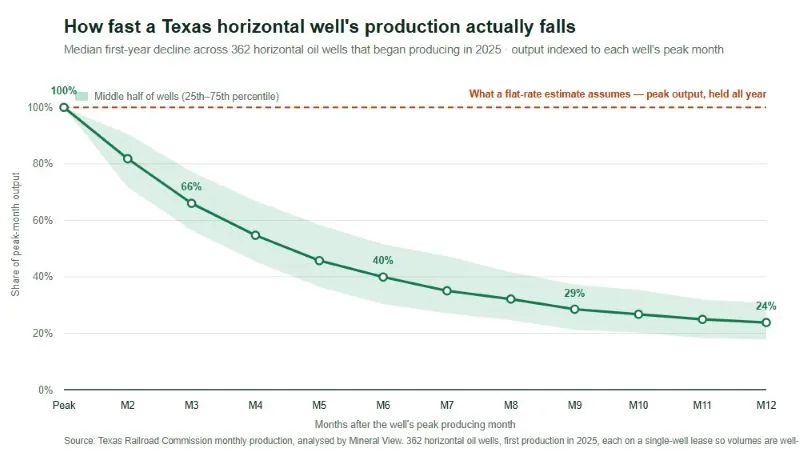
Real wells usually decline. A well may produce strongly in the first few months and then produce less each month. If the calculation assumes the same $730,000 of cash flow every month, payout may appear earlier than it actually occurs.
A better payout forecast uses:
- Expected Production Decline
- Oil and Gas Prices
- Royalties
- Taxes
- Operating Costs
- Exact Payout Rules in the Agreement
This calculator provides a simplified planning estimate only. Actual payout is determined by the costs, revenue, and rules defined in the governing agreement. Production decline, commodity prices, operating expenses, and allowed deductions will affect the real payout date.
What Costs Count Toward Payout?
There is no universal payout cost list.
Depending on the agreement, recoverable costs may include:
- Drilling
- Completion
- Equipping
- Facilities
- Workovers
- Lease Operating Expenses
- Taxes
- Overhead
- Other Specifically Allowed Costs
Some agreements may include only certain well costs. Others may allow additional expenses during the recovery period.
The key questions are:
- Which Costs can be Recovered?
- Whose Revenue is Credited?
- What Deductions are Allowed?
- When does the Payout Calculation Begin?
- What Exactly Happens when Payout Occurs?
What Changes at Payout?
Payout itself does not automatically create the same result in every deal.
Depending on the agreement, payout may trigger:
- A Working-Interest Change
- A Net Revenue Interest Change
- A Back-In Interest
- A Reversion of an Interest
- The End of a Carry
- The Return of a Non-Consenting Party’s Interest
- A Change in How Future Revenue and Costs are Shared
When an interest changes, the operator’s land, division order, revenue accounting, and joint interest billing teams may need to update their records.
The effective date matters because using the wrong BPO or APO ownership can lead to incorrect revenue payments or cost allocations.
Where Is Payout Used?
Farmout Agreements
In a farmout, one party may earn an interest by drilling or paying for a well.
The party taking the financial risk may hold a larger interest before payout. After payout, the original owner may receive or regain an interest.
The exact structure depends on the farmout agreement.
Non-Consent Under a JOA
Under some Joint Operating Agreements, a party that elects not to participate in an operation may temporarily give up certain revenue from the operation.
The participating parties may recover amounts defined by the JOA before the non-consenting party’s interest returns.
In this situation, payout may involve more than simple cost recovery because the agreement may include a risk-charge or penalty structure.
The exact percentages and recovery rules must be taken from the executed JOA.
Promoted Deals
In a promoted deal, investors may fund more than their final long-term share of a well.
Before payout, they may receive a larger economic interest. After payout, the promoter may back in for an agreed interest.
What Is a Back-In After Payout?
A back-in after payout is a right to receive or regain an interest after payout occurs.
It may also be described using the abbreviation BIAPO.
For example, a party may:
- Keep an Overriding Royalty before Payout
- Have the Right to Convert or Back in for a Working Interest After Payout
The agreement should explain:
- The Size of the Back-In Interest
- How Payout is Calculated
- Whether an Election is Required
- When the New Interest Becomes Effective
- Who is Responsible for Updating Ownership Records
Why Is Payout Important to Operators?
Payout is important because it can change both the economics and the ownership of a well.
Operators may use payout analysis to:
- Evaluate Farmout Terms
- Model Promoted Drilling Deals
- Track Non-Consent Recovery
- Forecast Interest Changes
- Prepare BPO and APO Ownership Records
- Avoid Revenue-Payment Errors
- Update Joint Interest Billing Correctly
- Compare Expected Payout with Actual Well Performance
A small error in the payout date can affect months of revenue and cost allocation.
For that reason, payout should not be treated as only a finance calculation. It also affects land, division orders, revenue accounting, and joint interest billing.
Latest Payout Update: Operators Are Moving From Simple Payback Math to Dynamic Payout Forecasting
The latest payout trend in 2026 is a stronger focus on dynamic capital planning instead of relying on one fixed production and price forecast.
Oil and gas operators are making investment decisions in an environment where commodity prices, well costs, production decline, and operating expenses can change quickly. A payout estimate based on one flat monthly cash-flow number can become outdated before a well reaches payout.
Newer planning methods allow operators to test multiple scenarios for:
- Oil and Gas Prices
- Drilling and Completion Costs
- Production Decline
- LOE
- Downtime
- Different Development Schedules
AI-assisted scenario modeling is also becoming more relevant to upstream capital decisions. Instead of asking only, “When should this well reach payout?”, an operator can test how the payout date changes under dozens of different cost, price, and production assumptions.
Value for operators:
A payout forecast should be treated as a moving range, not a fixed date. Operators should compare the original forecast with actual production, actual costs, and current prices throughout the recovery period.
A well that looked likely to reach payout in 12 months may move much later if production declines faster than expected or costs rise. The opposite can happen if the well outperforms or prices improve.
The best payout tracking process connects the agreement, the payout account, actual production, actual costs, and updated forecasting in one review.
Practical Application: How Operators Track Payout
Assume an investor funds $8 million to drill and complete a horizontal well.
The agreement gives the investor:
- 100% working interest BPO; and
- 75% working interest APO.
The promoter receives a 25% working interest after payout.
The well initially generates about $730,000 per month of net cash flow credited to the payout account.
Simple math suggests payout in about 11 months:
$8,000,000 ÷ $730,000 = about 11 months
But the well declines after the first few months.
Instead of relying on the original 11-month estimate, the operator updates the forecast using actual monthly production and the remaining payout balance.
The final payout date may be later than the original estimate.
When payout occurs, the operator updates the applicable ownership and accounting records according to the agreement.
The key lesson is simple:
The agreement defines the finish line. Actual well performance determines how quickly the well reaches it.
See It in the Data
A payout account is private, but the production driving it is public. Mineral View surfaces a well's producing history and an operator's well results, so the shape of the decline — the thing that decides whether payout lands in month 11 or month 20 — can be read from the data even when the dollars cannot.
You can run this yourself for any county in Texas. Mineral View's production data covers 256 counties and 383,918 leases, with monthly oil and gas volumes as filed with the Railroad Commission — start with Midland County, Martin County, or Karnes County, or filter the full production dataset by county, operator, and date. A free account unlocks the production figures — no card required.
What first-year decline actually looks like
Does the Texas Railroad Commission Track Payout?
No. Payout is a contractual and accounting matter. It is not tracked as a payout account by the Texas Railroad Commission (RRC).
The RRC may show public information such as:
- The Operator of Record
- Drilling Permits
- Well Status
- Production Volumes
Those records can help show how a well is performing, but they do not show:
- The Private Payout Balance
- The Costs being Recovered
- The BPO/APO Agreement
- Whether Contractual Payout has Officially Occurred
A well’s actual production history can also be reviewed in Mineral View.
The final payout determination must come from the governing agreement and the payout account.
Payout Records and Governing Documents
| Reference | Why It Matters |
|---|---|
| Farmout Agreement | May define cost recovery and a back-in interest |
| Assignment | May create or describe BPO and APO interests |
| Joint Operating Agreement (JOA) | May control non-consent recovery and reversion |
| Payout Account | Tracks recoverable costs and credited revenue |
| Division of Interest (DOI) | Shows the ownership used before and after payout |
| Production Records | Help measure the well performance driving recovery |
Common Payout Mistakes
- Assuming Payout has One Standard Definition
- Using total Well Cost without Checking which Costs the Agreement Allows
- Using Gross Revenue instead of the Revenue Defined in the Agreement
- Forecasting Payout with Flat Monthly Cash Flow on a Declining Well
- Assuming BPO and APO Change only Working Interest
- Failing to Prepare the APO Ownership Records before Payout Occurs
- Updating Revenue Ownership but not Joint Interest Billing
- Ignoring Multiple Payout or Reversion Events on the Same Well
- Treating a Forecasted Payout Date as the Actual Payout Date
- Assuming the Texas Railroad Commission Determines Payout
Frequently Asked Questions
BPO means Before Payout. APO means After Payout. Some agreements use different ownership or economic interests before and after payout.
Not always. Payout means recovering the costs included in the agreement’s payout definition. Some costs may be included and others may be excluded.
A payout account tracks the costs to be recovered, the revenue credited toward recovery, allowed deductions, and the remaining balance.
No. The basic idea involves recovery before an interest changes, but the calculation and consequences can be very different. The controlling agreement must be reviewed.
A forecasted payout date can change as production, prices, costs, and operating conditions change. The actual payout date is determined by the payout calculation required by the agreement.
A declining well usually generates less revenue over time. If production falls faster than expected, recovery may take longer and payout may occur later.
Important: Payout definitions vary between agreements. The governing instrument controls which costs count, which revenue is credited, when payout occurs, and what changes afterward. This page explains common industry usage and is not legal or accounting advice.