Net Revenue Interest
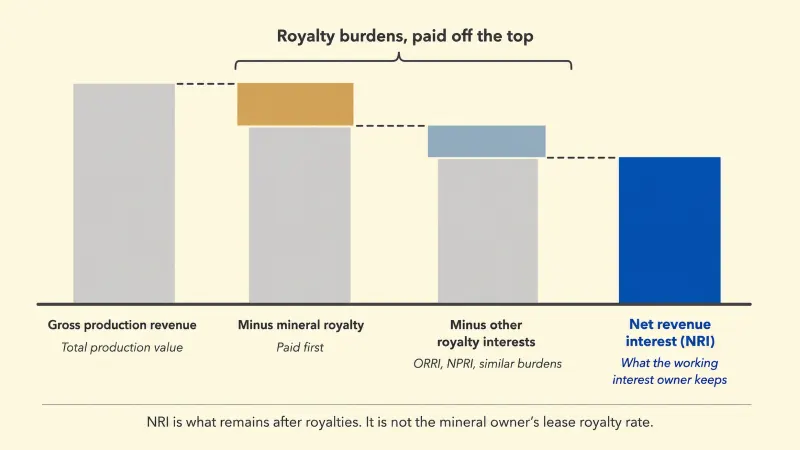
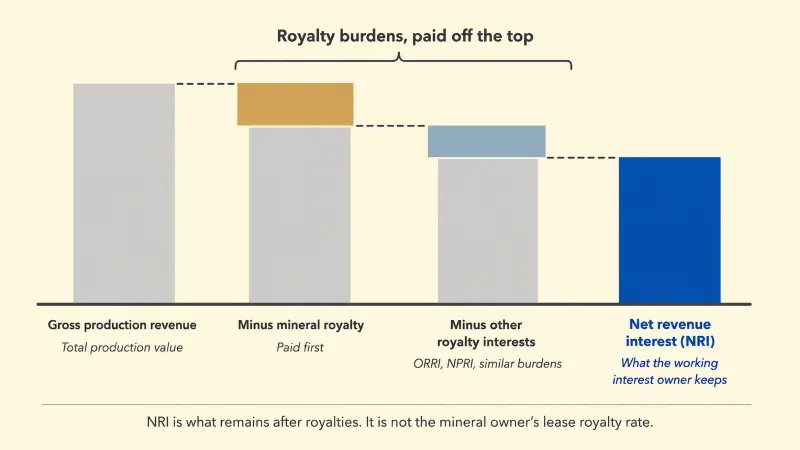
Net Revenue Interest (NRI) is the share of production revenue a working interest owner actually receives after all royalty burdens are paid. It is the operator's real take, what remains after the mineral royalty and any other royalty interests come off the top.
NRI is not the same thing as the mineral owner’s lease royalty rate, such as 20% or 25%, but a mineral owner’s division order decimal may sometimes be described as NRI. The mineral royalty is the share under the lease or division order and it is paid before the operator receives anything. NRI describes what the operator keeps after paying all royalty holders. Knowing the difference prevents confusion when NRI appears in lease documents or title records.
How NRI Works
The formula is straightforward:
Think of it in dollars. Imagine a well produces $100 of revenue in a month:
Example
The well produces $100 of revenue. The mineral royalty (25%) is paid first: $25 goes to the mineral owner. The remaining $75 represents the 75% working interest NRI before that revenue is divided among the working interest owners.
• If one operator owns 100% of the working interest, they receive the full $75 NRI. They also pay 100% of the drilling and operating costs.
• If two partners each own 50% of the working interest, each receives $37.50 NRI. Each partner also pays 50% of the drilling and operating costs.
So: 100% WI on a 25% royalty lease = 75% NRI and 50% WI on a 25% royalty lease = 37.5% NRI each.
If additional royalty burdens exist, such as an Overriding Royalty Interest (ORRI), they reduce the working interest owner's NRI further. A 25% mineral royalty plus a 3% ORRI leaves the operator with only 72% NRI. This does not affect your mineral royalty, which is paid first regardless.
Why Texas Mineral Owners Should Care
Even if you do not own working interest, NRI appears in documents you will encounter as a mineral owner:
- Division Orders: Your decimal interest should reflect your net mineral acres, unit or tract participation, and lease royalty rate.
- Lease Offer Context: A higher lease royalty rate generally lowers the working interest owner’s NRI, which can affect how the lease is valued during negotiations.
- Title and Assignment Records: NRI may appear in lease assignments, well economics summaries, or operator reports. Knowing it describes the working interest side prevents it from being confused with your royalty.
- Royalty Check Verification: If your royalty check seems lower than expected, first compare your division order decimal, production volumes, price, taxes, deductions, and payment period. The working interest NRI may provide context, but your own decimal is the key number.
Common NRI Examples for Texas Operators
| Lease Royalty Rate | Operator WI | Resulting NRI |
|---|---|---|
| 25% (1/4) | 100% | 75% |
| 25% (1/4) | 50% | 37.5% |
| 18.75% (3/16) | 100% | 81.25% |
| 20% | 100% | 80% |
| 25% royalty + 3% ORRI | 100% | 72% |
These examples are common teaching examples in Texas oil and gas, but actual NRI depends on the lease, title, ORRI, NPRI, unit structure, tract participation, and working interest ownership.
NRI vs Royalty Interest
| Question | NRI | Royalty Interest |
|---|---|---|
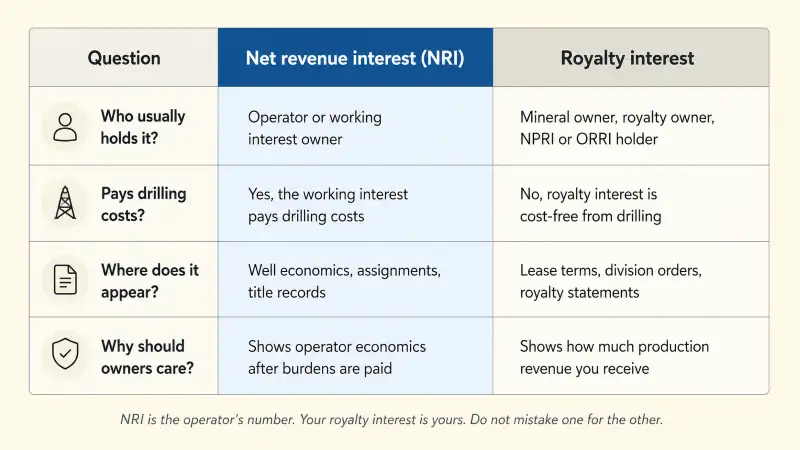
| Who usually holds it? | Operator or working interest owner | Mineral owner, royalty owner, NPRI or ORRI holder |
| Pays drilling costs? | Yes. Working interest carries cost responsibility | No. Royalty interest is cost-free from drilling |
| Where does it appear? | Well economics, assignments, title records | Lease terms, division orders, royalty statements |
| Why should owners care? | Explains operator economics after burdens are paid | Determines exactly how much production revenue you receive |
What to Check if NRI Appears in Your Documents
If you see NRI referenced in a lease packet, division order, assignment, or title summary, confirm what the number refers to before assuming it is your royalty decimal:
- Lease Royalty Rate: Confirm the royalty percentage stated in the signed lease. This is your number, not NRI.
- Division Order Decimal: Compare the decimal to your net acres, tract participation, and lease royalty. If NRI appears on the same document, it applies to the working interest owner.
- Royalty Burdens: Look for ORRI, NPRI, or other burdens that may affect the working interest side and reduce the operator's NRI.
- County Records: Review recorded assignments or conveyances if ownership changed hands. NRI may shift when working interest is sold or assigned.
- RRC Production Context: Compare reported well activity, lease or well identifiers, and production periods with the revenue month shown on your royalty statement.
NRI in the Mineral Interest Lifecycle
Lease Offer: The royalty rate is negotiated. Whatever rate is agreed becomes part of the total burden that reduces the operator's NRI once the lease is signed.
Lease Signed: Working interest is created under the lease. NRI can now be calculated: it equals the working interest percentage multiplied by (1 minus the total royalty burden).
Production Begins: Revenue is allocated. Royalty owners receive their royalty share first. Working interest owners receive their NRI share from what remains. This is where NRI becomes practical, it shows how the production revenue is split after royalty obligations are applied.
Ongoing Assignments: NRI can change if working interest ownership changes through assignment, farmout, sale, or partner adjustment. This normally does not affect your mineral royalty, which is paid according to the lease terms, it is tied to the lease, not to who owns the working interest.
Lease Ends: When a lease terminates, the lease-based working interest and related working interest NRI generally end. Your mineral ownership may continue, and any new lease may create a different NRI structure.
Common Questions
Usually not. Texas mineral owners generally hold mineral interest, royalty interest, NPRI, or ORRI, not working-interest NRI. In that sense, NRI is usually a calculated revenue decimal rather than a separate ownership right held directly by the mineral owner.
However, a mineral owner may still see NRI used on a division order, royalty statement, lease packet, or title summary to describe their net revenue decimal for a well, lease, or unit. Always check the document carefully. In one context, NRI may refer to the operator or working interest owner’s revenue share after royalty burdens. In another context, it may refer to the mineral owner’s decimal used to calculate royalty payments.
The calculation starts with working interest ownership, then subtracts the total royalty burden. For example, an operator with 100% working interest on a lease with a 25% royalty has a 75% NRI. If that operator shares the working interest 50/50 with a partner, each has a 37.5% NRI, and each pays 50% of the drilling and operating costs. If an ORRI also exists, it reduces NRI further: 25% royalty + 3% ORRI = 28% total burden, leaving 72% NRI.
Working interest is your gross ownership percentage of a lease, it determines your share of costs and your voting rights on drilling decisions. NRI is the net revenue you actually receive after the royalty side is paid. The gap between them is the total royalty burden. An operator with 100% working interest on a 25% royalty lease owns 100% of the decisions and costs but receives only 75% of the revenue.
Your royalty check is based on your specific decimal interest and the royalty rate in your lease, the operator's NRI does not change what you are owed. But if your check seems lower than expected, understanding the NRI calculation for the well can help you confirm that the revenue is being divided correctly between the royalty stack and the working interest stack. An error on either side can affect your payment.
Yes, though your mineral royalty stays fixed as long as the lease terms remain unchanged. NRI changes when working interest ownership shifts—through assignments, farmout agreements, or sales between operators. When this happens, the revenue decimals assigned to the operators change, but the royalty paid to you remains the same. Review your division order periodically to confirm your decimal has not changed.
It depends on the royalty rate in the basin and the number of working interest partners. A 100% working interest owner on a 1/4 royalty lease (25%) receives a 75% NRI. On a 3/16 royalty lease (18.75%), the NRI rises to 81.25%. Add an ORRI of 3% to a 25% royalty lease and the NRI drops to 72%. These figures decrease further if the operator shares working interest with partners.
Related glossary terms
- Working Interest: the ownership share NRI is calculated from. NRI is simply what the working interest keeps after royalties, so this is the closest term of all.
- Overriding Royalty Interest: a royalty burden carved from the working interest that lowers the operator's NRI. Your page already uses it in the 72% NRI example.
- Non-Participating Royalty Interest: another burden that comes off the top before NRI is figured. It already appears in your "NRI vs Royalty Interest" table, so linking it closes the loop.