Joint Interest Billing (JIB)
Joint Interest Billing (JIB) is the process of dividing actual oil and gas costs among the working-interest owners who share those costs.
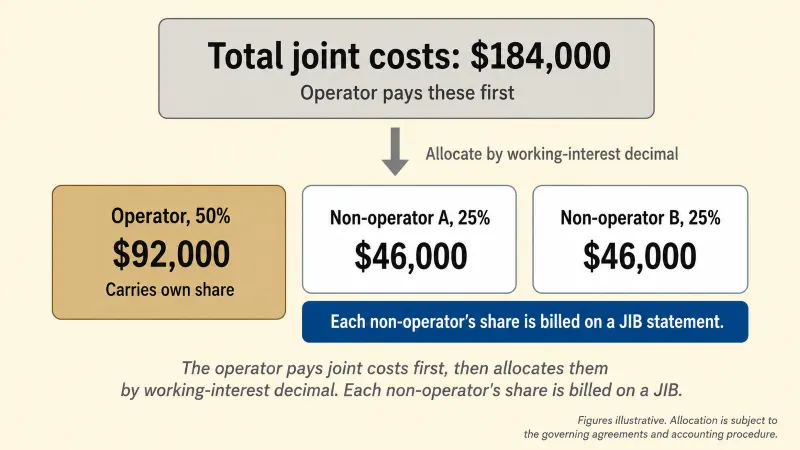
In simple terms, when several companies own a working interest in the same well, the operator usually pays the bills first. The operator then calculates each owner's share and sends a JIB statement showing what that owner owes.
- For example, if a non-operating owner has a 25% working interest, it generally pays 25% of the joint costs allocated to that property, subject to the governing agreements and accounting procedure.
- A JIB may include costs for drilling, completion, workovers, equipment, field services, lease operating expenses, and approved overhead.
The easiest way to understand JIB is: the operator pays and records the joint costs; the JIB divides those actual costs among the working-interest owners.
Quick Reference
| Term | Joint Interest Billing |
| Abbreviation | JIB |
| Category | Oil and gas accounting / cost allocation |
| Usually prepared by | The operator |
| Usually sent to | Non-operating working-interest owners |
| Common timing | Monthly |
| Usually governed by | The JOA and its accounting procedure |
| Government filing? | No |
| Commonly confused with | AFE and revenue statement |
| Main purpose | Allocate actual joint costs among working-interest owners |
How Does Joint Interest Billing Work?
The JIB process starts when the operator receives costs related to a jointly owned well or property.
The operator's accounting team generally:
- Reviews vendor invoices, field tickets, and other costs
- Assigns each cost to the correct well, property, or project
- Applies the ownership percentages in the division of interest
- Adds any charges allowed by the governing accounting procedure
- Prepares the JIB statement
- Sends each working-interest owner its share of the costs
The process repeats as new costs are incurred.
A non-operator should review each JIB to confirm that the costs were charged to the correct property and that the correct working-interest decimal was used.
What Is Included on a JIB Statement?
A JIB statement may include:
- Owner information: the name or account of the working-interest owner
- Property information: the well, lease, unit, or facility being billed
- Working-interest decimal: the percentage used to allocate costs
- Direct charges: materials, services, labor, equipment, and operating costs
- Capital costs: drilling, completion, workover, or facility costs
- Overhead: charges allowed under the applicable accounting procedure
- AFE reference: the related authorization for expenditure, when applicable
- Previous balance and payments: unpaid amounts or prior credits
- Revenue credits: if the operator nets revenue against costs
- Net amount due or credited: the final amount for the billing period
The exact format varies by operator and accounting system.
How to Review a JIB Statement
A non-operating working-interest owner should check:
- Does the working-interest decimal match the ownership records?
- Does the statement cover wells or properties the owner actually has an interest in?
- Are major capital costs connected to the correct AFE?
- Are overhead charges consistent with the governing accounting procedure?
- Are any unusual or duplicate charges present?
- Has a well changed operators or ownership?
- Is revenue being credited separately or netted against costs?
- Is there a contractual deadline for questioning or disputing the charges?
The most important first step is simple: confirm the property and the working-interest decimal before reviewing the individual costs.
JIB vs. AFE vs. Revenue Statement
These documents are related, but they serve different purposes.
| Document | What it shows | When it is used |
|---|---|---|
| AFE | Estimated cost and authorization for an operation | Before or during planning |
| JIB | Actual costs allocated to each working-interest owner | After costs are incurred |
| Revenue statement | Income from the sale of oil or gas | After production is sold |
The easiest way to remember the difference is:
- AFE = expected cost
- JIB = actual cost
- Revenue statement = income
A non-operator can compare JIB charges with the approved AFE to understand where actual spending differs from the original estimate.
What Is COPAS and How Does It Relate to JIB?
Many U.S. oil and gas joint operations use an accounting procedure associated with COPAS, the Council of Petroleum Accountants Societies.
The accounting procedure is commonly attached to or incorporated into the Joint Operating Agreement (JOA). It can address matters such as:
- Which costs may be charged to the joint account
- How costs are allocated
- Overhead charges
- Materials and equipment
- Billing practices
- Audits
- Adjustments or exceptions to charges
The executed agreement and accounting procedure control. Operators and non-operators should not assume that every JIB follows the same rules.
COPAS Overhead on a JIB
A JIB may include overhead charges allowed under the governing accounting procedure.
Depending on the agreement, overhead may be calculated using methods such as:
- A drilling-well rate
- A producing-well rate
- Another method stated in the accounting procedure
The purpose of overhead is generally to allocate certain administrative and supervision costs connected with joint operations.
A non-operator should compare the overhead shown on the JIB with the method and rate allowed by the applicable agreement.
How Long Do You Have to Question a JIB Charge?
Some COPAS accounting procedures include a time limit for taking written exception to a JIB charge.
A commonly encountered framework is a 24-month adjustment period, but the exact deadline, starting point, notice requirements, and effect of missing the deadline depend on the accounting procedure incorporated into the parties' agreement.
Do not assume that every JIB dispute follows the same 24-month rule.
Operators and non-operators should:
- Identify the accounting procedure that applies
- Track the relevant deadlines
- Review charges before the period expires
- Make any required exception clearly and in writing
An audit may not automatically extend a contractual deadline. The actual agreement should always be checked.
Why Is Joint Interest Billing Important to Operators?
JIB is how an operator recovers the other owners' shares of joint costs.
A strong JIB process helps an operator:
- Allocate costs accurately
- Recover partner costs on time
- Keep ownership records current
- Connect actual costs with the correct well and AFE
- Reduce billing disputes
- Maintain a clear audit trail
- Understand whether operations are running above or below budget
Poor JIB data can create cash-flow problems, partner disputes, and time-consuming corrections.
For operators, accurate billing depends on more than accounting. The well, operator, ownership, and project data behind every charge must also be correct.
Latest JIB Update: This Year's COPAS Overhead Factor
Overhead is one of the lines on a JIB, and for many joint operations the rate behind it adjusts once a year. If the accounting procedure uses COPAS fixed-rate overhead for drilling and producing wells, that rate is adjusted by a factor COPAS publishes effective April 1.
This year stands out. Effective April 1, 2026, the COPAS overhead adjustment factor is negative 0.3 percent, a slight decrease, after a positive 6.3 percent the year before. Overhead rates that follow this factor should tick down a little in 2026, not up.
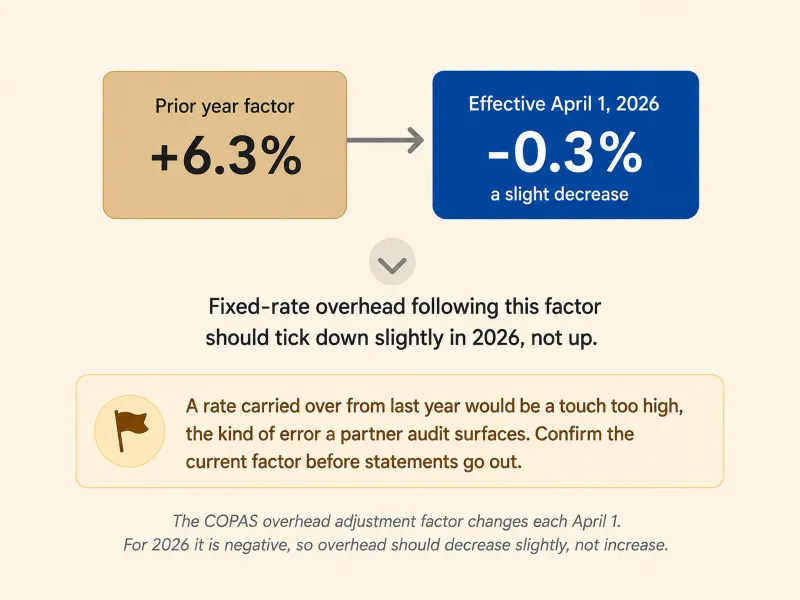
Most people assume overhead only rises, so a rate carried forward from last year would now be a touch too high. For an operator, that means the fixed-rate overhead billed on drilling and producing wells should be adjusted down for 2026 before this cycle's statements go out, since billing last year's higher rate is the kind of error a partner audit will surface.
For a non-operator, it means checking that the overhead on a received statement reflects the current factor rather than the prior year's rate.
Either way, COPAS publishes the factor, but the base rate is set in the accounting procedure attached to the JOA, not by COPAS. If the overhead looks off, it is a line worth resolving before the exception window closes.
Confirm the current figures on the COPAS Economic Factors page.
See It in the Data
A JIB charges for work on specific wells operated by a specific operator of record. The dollar figures stay inside the joint account, but the operator and its wells are visible in public on Mineral View Maps.
That lets a non-operator confirm the operator behind a statement and the wells it covers, and catch a mismatch when a well has changed hands and billing has not caught up.
Is a JIB Filed With the Texas Railroad Commission?
No. A JIB is generally a private accounting statement between an operator and its working-interest partners. It is not filed with the Texas Railroad Commission (RRC).
The RRC also does not serve as the accounting system for allocating private joint costs between working-interest owners.
However, the wells connected to a JIB may appear in public records. The operator of record, permits, completions, and production activity can help a non-operator confirm which wells and operator are connected to the statement.
The wells and leases covered by a statement can also be reviewed geographically using the Mineral View interactive map.
JIB Standards and Governing Documents
| Reference | Why it matters |
|---|---|
| Joint Operating Agreement (JOA) | Governs the relationship between the operator and non-operators |
| COPAS accounting procedure | Addresses joint-account charges, allocation, overhead, billing, and audit rights |
| Division of Interest (DOI) | Shows the ownership decimals used to allocate costs |
| Authorization for Expenditure (AFE) | Provides the estimated cost baseline for certain operations |
| Texas RRC records | Help identify the operator of record and public well activity |
The executed agreement and accounting procedure always matter more than a general industry rule.
Common JIB Mistakes
- Treating a JIB as an AFE or a revenue statement: an AFE estimates and approves cost before work, a JIB bills actual cost after it is incurred, and a revenue statement reports income from production, not costs.
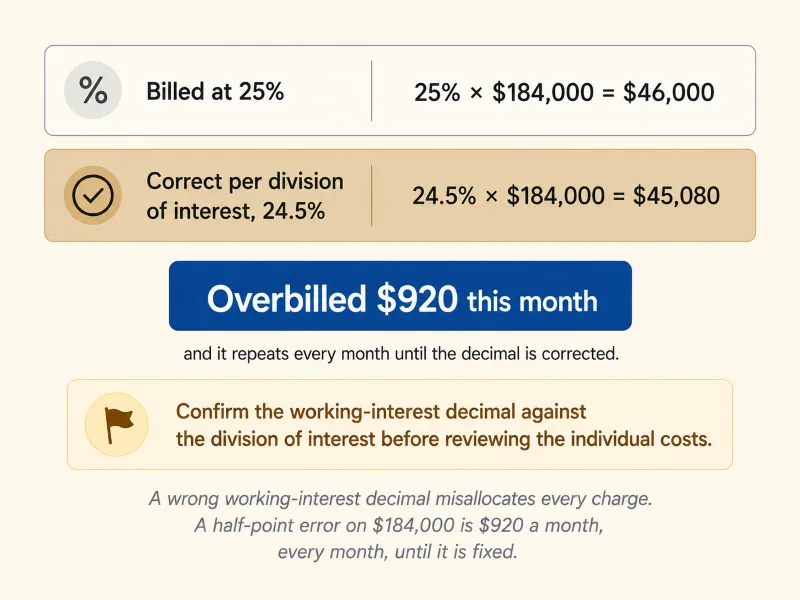
- Paying a JIB without checking the working-interest decimal first: the wrong decimal misallocates every charge on the statement, so it should be confirmed against the division of interest before the individual costs are reviewed.
- Charging costs to the wrong well or property: a JIB is only correct if the charges belong to the specific well or unit named on it, which is why the property is checked before the numbers.
- Not tying capital charges back to an AFE: large drilling, completion, or workover costs should trace to an approved AFE, and a capital charge with no matching AFE is a flag, not a routine line.
- Applying overhead that the agreement does not support: overhead is only valid at the rate and method in the governing accounting procedure, so a rate carried over from a prior year or taken from the wrong method should be questioned.
- Missing the contractual exception deadline: the right to dispute a charge expires under the accounting procedure, and a valid objection raised after the window closes may no longer be recoverable.
- Not updating billing after an operator or ownership change: when a well changes hands, statements from the former operator or against an outdated decimal keep flowing until the records are corrected.
- Assuming every JIB follows the same COPAS rules or is filed with the RRC: the applicable accounting procedure controls each statement, and a JIB is a private document that is never filed with the Texas Railroad Commission even though its wells appear in RRC records.
Worked JIB Example
A well has three working-interest owners: the operator at 50 percent, and two non-operators at 25 percent each.
For the month, the joint account shows:
- Direct and operating costs: $180,000
- Allowed overhead: $4,000
- Total joint costs: $184,000
What the operator does. The operator pays these costs first, then allocates them by each owner's decimal:
- Operator, 50 percent: $92,000
- Non-operator A, 25 percent: $184,000 × 25% = $46,000
- Non-operator B, 25 percent: $46,000
The operator issues a JIB to each non-operator for $46,000, recovering $92,000 from its partners while carrying its own $92,000 share. If a non-operator also has production revenue from the well, the operator may bill costs and pay revenue separately or, in some arrangements, show a net position.
What a non-operator checks. Before paying the $46,000, the receiving owner confirms:
- the statement covers the correct well and property
- the 25 percent decimal matches the division of interest
- the charges relate to that property
- the overhead follows the applicable accounting procedure
Why the decimal check matters
If the operator billed 25 percent but the division of interest says 24.5 percent, the difference on $184,000 is $920 for the month, and it repeats every month until it is corrected. A JIB shows actual joint costs, but the property, the decimal, and the allocation still have to be checked, and a wrong decimal is real money.
Frequently Asked Questions
Joint Interest Billing is the process an operator uses to divide the actual costs of a well or property among its working-interest owners. The operator pays the costs first, then bills each owner its share, based on the ownership decimal and subject to the governing agreements.
No. An AFE estimates and approves costs before work begins. A JIB bills actual costs after they are incurred. A revenue statement reports income from selling oil and gas. In short: an AFE is expected cost, a JIB is actual cost, and a revenue statement is income.
They measure different things. Your working-interest decimal sets your share of costs and is used on the JIB. A royalty decimal sets your share of revenue with no cost obligation. An owner can hold both, so the two decimals often differ and should not be compared directly.
COPAS overhead is the administrative and supervision charge an operator is allowed to bill the joint account under the accounting procedure that governs the operation. COPAS publishes an annual factor that adjusts the rate, but the base rate itself is set in the agreement, not by COPAS.
The deadline depends on the governing agreement and accounting procedure. A 24-month adjustment period is common in some COPAS procedures, but the exact deadline, its starting point, and the notice required must be confirmed in the agreement that applies. An audit does not automatically extend the deadline.
Yes. Actual costs can come in above the AFE estimate. Whether the overrun requires additional approval, notice, or a supplemental AFE depends on the governing agreement and the facts of the operation, not on the AFE alone.
Non-payment has consequences set by the governing agreement, which may include interest, suspension of revenue, or lien and default remedies under the joint operating agreement. An owner who disputes a charge should follow the required objection process rather than simply withholding payment, since the two are treated differently.
The well may have changed operators. When operations transfer, billing should move to the new operator of record, but statements from the former operator or against an outdated decimal can keep flowing until records are corrected. The change of operator is evidenced by the P-4 filing in the well's RRC records.
No. A JIB is a private accounting statement between an operator and its working-interest partners. The related wells, permits, and operator activity appear in Texas Railroad Commission (RRC) records, but the JIB itself is not filed with the RRC.
Important
This page explains common oil and gas industry practice. The executed JOA, accounting procedure, and other governing documents control the rights and obligations of the parties. This page is not legal, tax, or accounting advice.