Joint Operating Agreement (JOA)
A Joint Operating Agreement, or JOA, is a contract between working-interest owners in an oil and gas property. It explains who will operate the wells, how major decisions are made, how costs are shared, and how money from production is divided.
One party is named the operator and handles day-to-day operations. The other parties are non-operators. They usually pay their share of costs and may have approval rights on major decisions.
Quick Reference
| Term | Joint Operating Agreement |
| Abbreviation | JOA |
| Category | Land / commercial agreement (operations governance) |
| Used by | Operators, non-operated working-interest owners, landmen, division-order and JIB accountants, oil and gas attorneys |
| Standard form | AAPL Form 610 Model Form Operating Agreement (1989 most used for Texas onshore; also 1956, 1977, 1982, 2015) |
| Filed with the RRC? | No. A JOA is a private contract and is generally not filed with the Texas Railroad Commission (RRC). The RRC regulates operators and wells, but it generally does not resolve private lease, royalty, JOA, or contract disputes. |
| Commonly confused with | Unit/unitization agreement, farmout agreement, pooling/communitization agreement, joint development agreement (JDA) |
| Why it matters | It decides who controls operations, how costs are billed, and what happens when a party declines to participate (non-consent) |
In Operator Terms
A JOA exists because separately leased tracts, assignments, and shared leasehold ownership can leave multiple companies owning working interests in the same lease, unit, or contract area. Under Texas cotenancy principles, one mineral cotenant may generally develop without every other cotenant's consent, but the producing cotenant must account to the nonproducing cotenants based on their proportionate share of production, less legally recoverable and reasonable costs. A JOA replaces or modifies many of these default relationships among the parties who sign it.
The JOA addresses that by designating an operator, setting the accounting and billing rules, and defining the consequences when a party consents to or declines a proposed operation. For an operator, the JOA is the core contract governing AFEs, consent elections, JIB billing, COPAS charges, audit rights, liens, default remedies, and operatorship itself.
How Does a JOA Work?
Working-interest owners usually sign the JOA before major joint operations begin, although existing wells, later assignments, and acquired interests may bring parties under an existing JOA. The agreement assigns each party a working-interest percentage, names the initial operator, and adopts an accounting procedure (the COPAS exhibit) that controls how the operator charges costs and overhead to the joint account.
When the operator proposes a new operation, such as a well, recompletion, sidetrack, or deepening, it circulates an AFE, commonly called an authorization or authority for expenditure, with estimated costs and election deadlines.
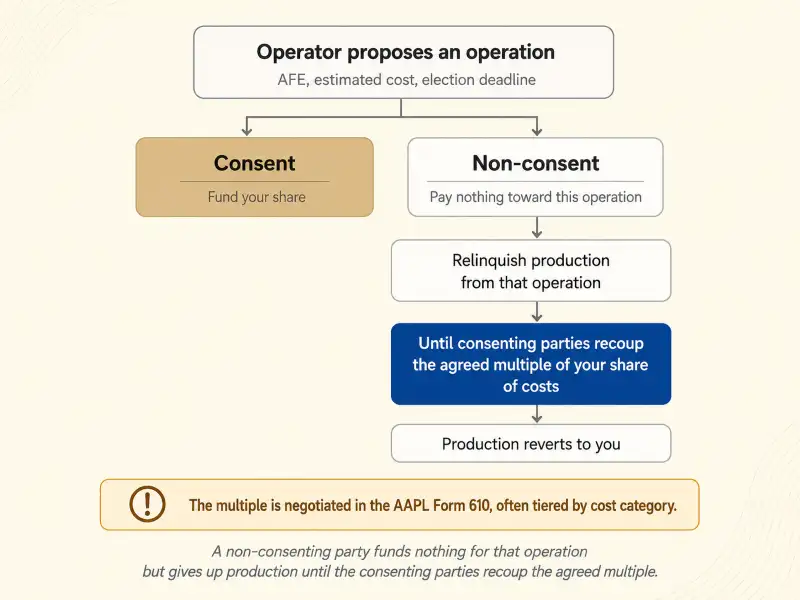
Each non-operator elects to consent, decline, or be deemed non-consent according to the notice and election terms in the JOA. Consenting parties fund the work in proportion to their participating shares. A non-consenting party does not pay its share of that operation's costs, and under most JOA forms it relinquishes its share of production from that operation until the consenting parties have recouped the agreed multiple of those costs. The terms of that election are covered in detail on the Mineral View non-consent page.
The operator runs day-to-day operations within the JOA's limits, while liability among the parties is usually several, not joint, with JOA liens and security rights used to secure each party's share of the joint account.
Key Articles of the AAPL Form 610 JOA
The AAPL Form 610 is built around a standard article structure. For operators, the most operationally important provisions are:
| Article | Governs |
|---|---|
| Article III (Interests of Parties) | Working-interest percentages; ownership of oil and gas and of costs |
| Article V (Operator) | Designation, duties, resignation, and removal of the operator |
| Article VI (Drilling and Development) | Initial well, subsequent operations, and the non-consent / non-participation mechanism |
| Article VII (Expenditures and Liability) | Several (not joint) liability, liens, AFE procedure, and accounting via Exhibit C (COPAS) |
| Article VII.D.3 (Limitation of Expenditures) | The AFE requirement and the dollar threshold above which the operator must obtain partner approval before committing to a project |
| Article VIII (Acquisition, Maintenance or Transfer of Interest) | Surrender, renewal and extension, maintenance of uniform interest, waiver of the right to partition, and preferential right to purchase |
| Exhibits | A: lands and interests. B: form of lease. C: COPAS accounting procedure. D: insurance. E: gas balancing agreement. Executed 1989-form JOAs commonly add Exhibit F (non-discrimination certification) and Exhibit G (tax partnership) |
Many JOA disputes arise under Article VII and Exhibit C, especially over overhead, direct charges, COPAS interpretation, default remedies, and non-operator audit rights. The billing mechanics themselves are covered on the joint interest billing page.
Operator vs Non-Operator
| Role | Controls | Funds | Appears in RRC data? |
|---|---|---|---|
| Operator | Conducts day-to-day operations within the JOA's limits, files permits and reports as operator of record, bills the joint account, and funds its own working-interest share | Its own working-interest share | Yes: as operator of record |
| Non-operator | Votes or elects on proposed operations where the JOA allows, exercises consent/non-consent, audit, and inspection rights, and funds its participating share through JIBs, but is usually not shown as the RRC operator of record | Its proportionate share via JIB | No: not shown as the RRC operator, despite owning working interest |
The operator may hold a minority working interest and still be the designated operator. Operatorship, voting rights, and ownership percentage are related but separate questions under the JOA.
How Operators Use a JOA
Operators use the JOA to convert shared leasehold ownership into a workable operation: to propose wells, require elections, bill partners, manage defaults, protect cost recovery, and document who bears each operation's risk.
It affects capital planning because the non-consent terms determine whether the operator can move a well forward with partial participation and recoup the non-consenting party's share of costs at the agreed multiple before that party's revenue resumes.
Before committing capital, an operator usually checks the other working-interest parties, their ownership, their operating history, and their activity in nearby leases or counties. Mineral View's oil and gas companies directory can help compare operator, well, lease, and county-level activity.
See it in the Data
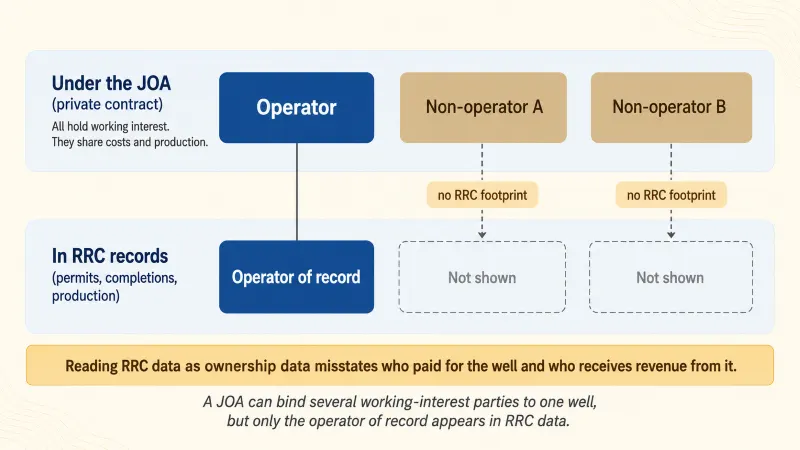
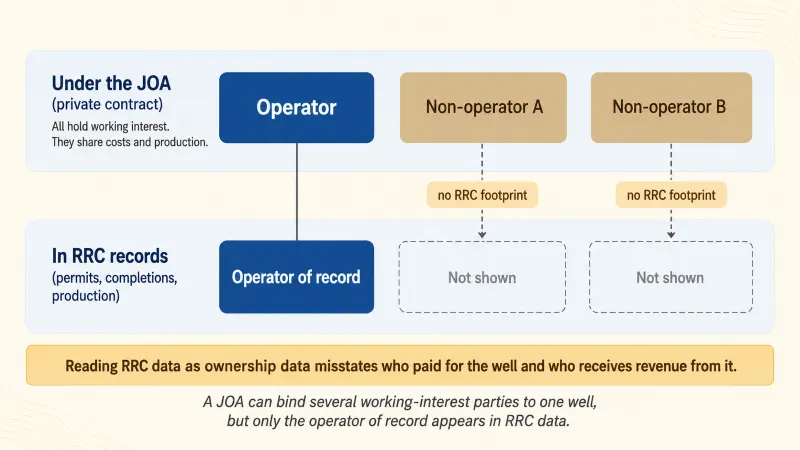
A Texas horizontal drilling permit shows a single operator of record, even when several working-interest parties are bound to that well by a JOA. Non-operated parties hold real interest but generally do not appear anywhere in RRC permit, completion, or production records. Mineral View Notifications Center narrows that gap by surfacing the operator of record, permit activity, and lease footprint, so operator activity can be read against contract and title information.
How Does a JOA Operator Become the RRC Operator of Record?
A JOA is a private contract, so it is not filed with the RRC, and the RRC generally does not adjudicate JOA disputes. Lease, royalty, contract, and property-rights matters sit outside its authority. What the JOA does is designate the operator among the parties.
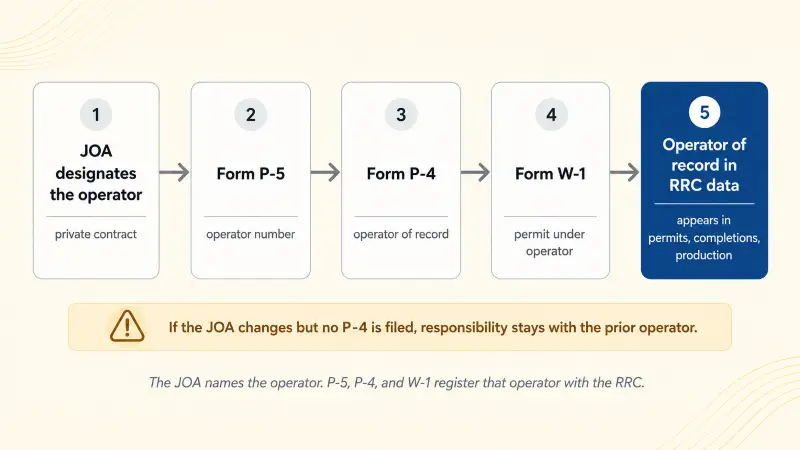
That party generally becomes the operator of record with the state only through the required RRC filings:
- The designated operator must maintain an active P-5 Organization Report and RRC operator number to conduct operations and make required filings within the Commission's jurisdiction.
- The operator establishes or transfers operator-of-record status on an oil lease, gas well, or other well through Form P-4, which also certifies regulatory responsibility, including plugging responsibility under RRC rules.
- The operator files the Form W-1 drilling permit under its own name and operator number; the permit, completion, and production records then appear under that operator.
So the JOA designates the operator among the working-interest parties, while the P-5, P-4, and W-1 filings identify and register the operator for RRC regulatory purposes.
If operatorship changes under the JOA but no P-4 transfer is filed, regulatory responsibility stays with the prior operator.
Standards, Forms, and References
| Source | What it governs or defines |
|---|---|
| AAPL Form 610 Model Form Operating Agreement (1989) | The standard JOA form for U.S. onshore, including most Texas operations |
| COPAS Accounting Procedure (JOA Exhibit C) | How the operator charges costs and overhead to the joint account |
| Texas RRC Form P-5 (Organization Report) | Annual operator registration; required to file permits and reports |
| Texas RRC Form P-4 (Producer's Transportation Authority and Certificate of Compliance) | Establishes or transfers operator of record, and certifies regulatory and plugging responsibility |
| Texas RRC Form W-1 | Application for permit to drill, recomplete, or re-enter, filed by the operator |
Specific JOA terms (non-consent percentages, operatorship removal, preferential rights) should be read in the executed agreement and confirmed with a qualified Texas oil and gas attorney or a Certified Professional Landman. This page explains the term; it is not legal advice.
Common Mistakes and Field Notes
- The RRC does not enforce private JOAs. JOA, lease, royalty, title, and contract disputes generally must be handled through the contract, negotiation, arbitration if required, or court.
- The operator of record may hold a minority working interest; being the operator is not the same as owning the most interest.
- Going non-consent is not cost-free. The non-consenting party avoids the cash call but gives up its share of that operation's production until the consenting parties recoup the agreed multiple.
- Several, not joint, liability still carries exposure. The JOA grants liens and security interests among the parties to secure each party's share of the joint account.
- A JOA usually disclaims any partnership, but Texas courts have found a mining partnership on specific facts, generally where the parties held a joint interest in the property, agreed to share profits and losses, and cooperated in developing it. A finding of that kind can change tax and liability outcomes and should be reviewed with counsel.
- Cost and overhead disputes almost always trace back to Exhibit C (COPAS); the audit right is the non-operator's main check on the operator's billing.
- A change of operator under the JOA does not move regulatory responsibility until a Form P-4 transfer is approved by the RRC.
- Assuming the JOA form covers data ownership. The AAPL model forms are generally silent on who owns or may share real-time drilling and production data. Where the parties did not negotiate a data provision, the question usually falls back on the operator's reporting duties, audit rights, and confidentiality terms in the signed agreement.
Worked Field Scenario
Three parties hold working interest in a Midland County contract area under a 1989-form JOA: the operator at 50%, a second party at 30%, and a third at 20%. The operator proposes a Wolfcamp horizontal and circulates an AFE estimating $9.4 million in drilling and completion costs, with a 30-day election window.
The 30% party consents. The 20% party elects non-consent.
The consenting parties now carry the full $9.4 million between them, rebalanced to their relative shares: the operator funds 62.5% and the second party 37.5%. A non-consenting party generally does not advance its share of the costs covered by that election. During the recoupment period, the consenting parties receive the non-consenting party's share of production from that operation as provided in the executed JOA.
The operator still files the W-1 permit under its own name and operator number. The RRC record shows one operator on the well. Nothing in the state's records reflects that a fifth of the working interest sat the operation out.
The takeaway: the election determines who funds the well, but not who appears in the state's records. Reading RRC data as ownership data will misstate who paid for the well and who is receiving revenue from it.
Does AI Change the Joint Operating Agreement?
Not the contract itself. The newest AAPL model form is the Form 610-2015, adopted in December 2015. Neither it nor the 1989 form says anything about artificial intelligence, automated decisions, or who owns the data that software collects from a well. No newer form has been announced.
What has changed is the work around the contract. Software now helps draft and review JOAs, and it helps operators run the billing. Partners often receive drilling and production data as it comes in, instead of waiting for a monthly report. That changes how the agreement gets written and how the joint account gets watched. It does not change what the agreement says.
The difference shows up when a partner asks for data. A JOA answers that question through provisions it already has: what the operator must report, the non-operator's right to audit under the Exhibit C accounting procedure, the records-access terms, and whatever confidentiality language the parties agreed to. The 2015 form did tighten a non-consenting party's access to records for an operation it declined to join. It did not set rules for who owns well data or who may share it.
Operators who want live data sharing, data ownership, or the cost of new technology spelled out among the partners usually have to negotiate those terms into the agreement or add them as a rider. The model forms are silent, so the answer generally comes from the signed document. Contract interpretation and legal-enforceability questions should be reviewed by a qualified Texas oil and gas attorney. A Certified Professional Landman can assist with land, ownership, contract-area, and agreement-administration matters.
Frequently Asked Questions
Working-interest owners sign a JOA when two or more of them hold an interest in the same contract area. It names the operator, sets the AFE and election procedure for proposed operations, adopts a COPAS accounting exhibit, and defines liens, defaults, and transfer restrictions. It is widely described as the most commonly used oil and gas instrument after the lease itself.
The operator is the party the JOA designates to conduct day-to-day operations, file permits and reports, and bill the others. The operator can hold a minority working interest; designation, not ownership size, decides who operates. The agreement also sets how the operator can resign or be removed.
No. A JOA is a private contract, and the Texas Railroad Commission generally does not have jurisdiction over lease, royalty, title, or contract disputes. The JOA designates the operator among the working-interest parties, but it does not by itself make that party the RRC operator of record. The organization must maintain a current P-5. For an existing lease or well, operator-of-record status is generally established or transferred through an approved P-4. For a new drilling, recompletion, or re-entry operation, the operator files the applicable W-1 permit application.
When a party declines a proposed operation, it pays nothing toward that operation and gives up its share of the resulting production until the consenting parties recoup an agreed multiple of its costs. The AAPL Form 610 leaves that multiple as a blank for the parties to negotiate, and it is often tiered by cost category.
A JOA governs joint operations and cost-sharing among working-interest owners in a contract area. A unit or unitization agreement reorganizes ownership across combined leases for field-wide or secondary-recovery operations; a JOA can sit underneath a unit to govern the operations themselves.
Most JOAs state that the parties do not intend to create a partnership, joint venture, or agency relationship. Under Texas law, operating under a JOA does not by itself establish a partnership. However, the parties' broader agreements and actual conduct may create separate legal issues, so the executed documents and operating relationship should be reviewed by counsel.
The AAPL model forms do not. Neither the 1989 nor the 2015 version of Form 610 mentions artificial intelligence or says who owns the data software collects from a well. What a partner can see is set by the operator's reporting duties, the audit rights in the Exhibit C accounting procedure, and any data or confidentiality terms the parties wrote into the signed agreement.