Lease Operating Expense (LOE)
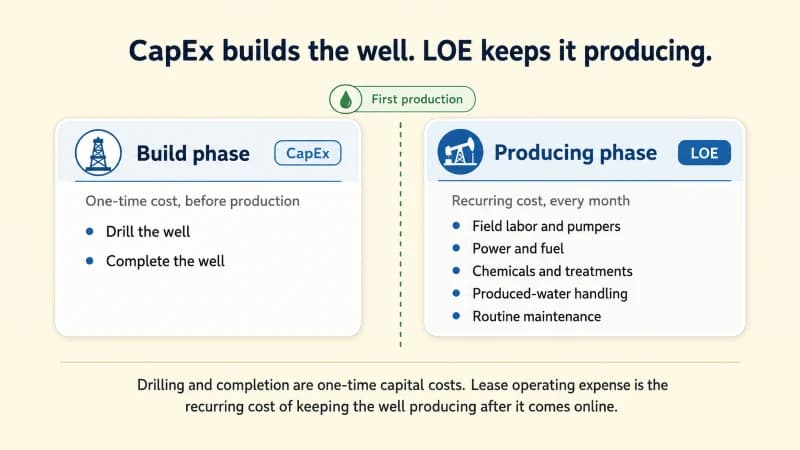
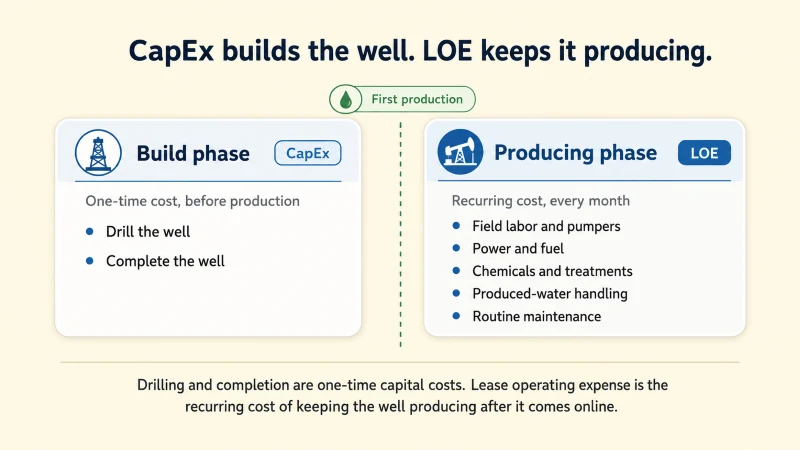
Lease Operating Expense (LOE) is the day-to-day cost of keeping an oil or gas well producing. In simple terms, drilling and completing a well gets it ready to produce. LOE is what it costs to keep that well running after production begins.
For example, an operator may need to pay for:
- Field Labor and Pumpers
- Equipment Repairs
- Electricity or Fuel
- Chemicals and Treatments
- Produced-Water Handling and Disposal
- Routine Operating and Compliance Work
LOE is an operating cost, not the cost of drilling or completing a new well. The easiest way to understand it is:
CapEx gets the well built. LOE keeps the well producing.
Quick Reference
| Field | Detail |
|---|---|
| Term | Lease Operating Expense |
| Abbreviation | LOE |
| Category | Oil and gas operating cost |
| What it measures | Cost of keeping a producing well or asset operating |
| Key metric | LOE per BOE |
| Common timing | Monthly |
| Usually tracked by | Well, lease, field, or asset |
| Usually paid by | Working-interest owners |
| Usually excludes | Drilling and completion CapEx |
| Commonly confused with | CapEx and post-production costs |
| Government filing? | No |
What Costs Are Included in LOE?
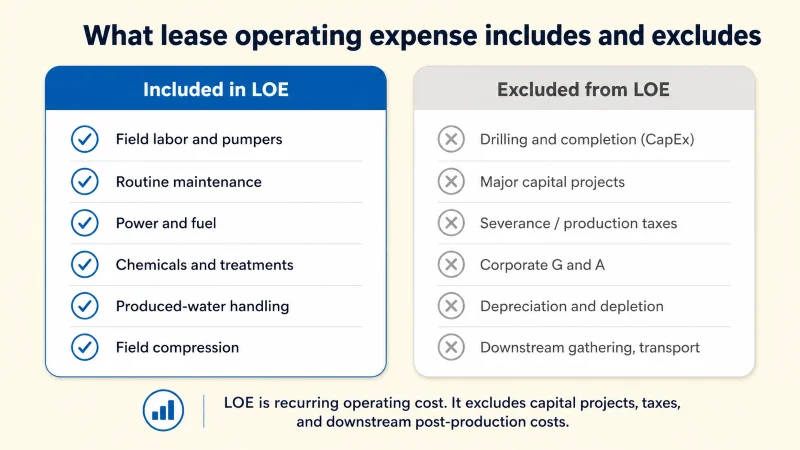
LOE generally includes recurring costs directly connected with operating producing wells and related lease equipment.
Common examples include:
- Field Labor and Pumpers
- Routine Maintenance and Repairs
- Electricity and Fuel
- Chemicals and Well Treatments
- Produced-Water Handling and Disposal
- Compression used in Field Operations
- Materials and Supplies
- Surface Equipment Operation
- Certain Environmental and Regulatory Operating Costs
The exact cost classification can vary by company, accounting policy, contract, and reporting method.
Fixed vs. Variable LOE
Operators often separate LOE into fixed and variable costs.
| Type | What It Means | Examples |
|---|---|---|
| Fixed LOE | Costs that remain even when production changes | Field labor, routine maintenance, inspections |
| Variable LOE | Costs that rise or fall with production or operating conditions | Power, chemicals, water handling, disposal |
This distinction matters because oil and gas wells usually decline over time.
A well may have nearly the same monthly fixed costs while producing fewer barrels. When that happens, the LOE per BOE rises even if the total monthly LOE stays the same.
What Is Not Included in LOE?
LOE generally does not include:
- The Cost to Drill and Complete a New Well
- Major Capital Projects
- Exploration Costs
- Lease Acquisition Costs
- Corporate General and Administrative Costs
- Interest
- Depreciation and Depletion
- Severance or Production Taxes
- Downstream Gathering, Processing, Transportation, and Marketing Costs
However, cost classifications are not always identical across every operator or agreement. A repair may be treated as an operating expense, while a major project that significantly restores or extends productive capacity may be treated as capital.
The applicable accounting rules and company policies should be checked when the classification matters.
LOE vs. CapEx
LOE and capital expenditure (CapEx) are different.
| LOE | CapEx | |
|---|---|---|
| Purpose | Keep an existing asset operating | Create or significantly improve an asset |
| Timing | Recurring | Usually project-based |
| Example | Routine chemical treatment | Drilling a new well |
| Cost treatment | Operating expense | Capital investment |
| Common approval method | Operating budget | Often an AFE |
A simple rule is:
- LOE Keeps the Current Operation Running
- CapEx Creates or Materially Improves the Asset
The line can become less clear for workovers, repairs, and equipment replacements. The facts and applicable accounting policy determine the final treatment.
Routine LOE runs through the operating budget and shows up on the monthly Joint Interest Billing (JIB) statement without a separate election. A capital project is usually circulated on an Authorization for Expenditure (AFE) that partners approve before the money is committed — so if a cost required an AFE, it was probably being treated as capital.
What Is LOE per BOE?
LOE per BOE measures how much it costs to operate a well or asset for each barrel of oil equivalent produced.
The formula is:
This metric allows operators to compare operating costs with production.
A lower LOE per BOE generally means the asset is producing more efficiently from an operating-cost perspective. A higher LOE per BOE may signal:
- Declining Production
- Rising Water Volumes
- Higher Power Use
- More Maintenance
- Aging Equipment
- Unusual Operating Problems
A high LOE per BOE does not automatically mean a well is poorly operated. Cost levels vary by basin, well age, production mix, water handling, infrastructure, and operating conditions.
The best comparisons are usually:
- The Same Well Over Time
- Similar Wells of the Same Age
- Similar Assets in the Same Area
- The Operator’s Actual Performance against its Own Budget
How Is LOE per BOE Calculated?
Assume a well produces in one month:
- 4,000 Barrels of Oil
- 12,000 Mcf of Gas
- $54,000 of LOE
Using the common energy-equivalent conversion of 6 Mcf of gas = 1 BOE:
- Gas Production: 12,000 Mcf ÷ 6 = 2,000 BOE
- Total Production: 4,000 BOE + 2,000 BOE = 6,000 BOE
- LOE per BOE: $54,000 ÷ 6,000 = $9.00 per BOE
This means the well had $9 of lease operating expense for each BOE produced during the period.
The 6:1 conversion is an energy-equivalent convention. It does not mean six Mcf of gas always has the same market value as one barrel of oil.
Why Does LOE per BOE Rise as a Well Ages?
Most oil and gas wells produce less over time.
Some operating costs, however, do not decline at the same rate.
A well may still need:
- Field Visits
- Inspections
- Maintenance
- Electricity
- Chemicals
- Surface Equipment
As production falls, those costs are spread across fewer BOE.
For example, a well with $30,000 in monthly LOE will have:
- $3/BOE at 10,000 BOE per month; but
- $10/BOE at 3,000 BOE per month.
The monthly cost did not change. The production did.
This is why LOE per BOE often rises as wells mature.
Why Is LOE Important to Operators?
LOE is one of the most important measures of producing-asset efficiency.
Operators use it to:
- Track Operating Costs
- Compare Wells and Assets
- Find Unusual Cost Increases
- Identify Water-Handling Problems
- Evaluate Maintenance Needs
- Measure Cost-Saving Projects
- Support Budgets and Forecasts
- Decide whether a Mature Well still Makes Economic Sense
The lowest LOE is not always the best result.
Cutting maintenance may reduce costs for a short time but create equipment failures, lost production, or larger costs later. Good LOE management means controlling unnecessary costs without damaging production or asset reliability.
Water Management and Automation Are Becoming Major Cost-Control Tools
The latest LOE trend for U.S. operators is a stronger focus on the costs that can be controlled without sacrificing production—especially produced-water handling, power, maintenance, and field labor. This matters because many mature shale wells are producing less oil while still requiring regular operating work. As production declines, fixed costs are spread across fewer BOE, which can push LOE per BOE higher. Produced water is one of the clearest examples. Operators that build or share water pipelines, recycling systems, and disposal infrastructure may reduce trucking, freshwater use, and repeated handling costs. Automation is also changing how operators manage LOE. Remote monitoring, predictive maintenance, and automated field data can help teams identify equipment problems, production losses, and abnormal costs earlier.
Value for Operators: The strongest LOE strategy is not simply “cut every cost.” It is to identify which costs are rising, understand why they are rising, and reduce avoidable expense before it causes lost production or a larger repair. The most useful question is no longer only: “What is Our LOE per BOE?” It is also: “Which Wells, Cost Categories, and Operating Problems are Causing it to Change?”
Who Pays Lease Operating Expenses?
Working-interest owners generally bear their share of the costs required to operate the property, subject to the governing agreements.
Working-Interest Owners
A working-interest owner generally bears its proportionate share of operating costs. A non-operating working-interest owner may see those costs through Joint Interest Billing (JIB).
Royalty Owners
A traditional royalty interest is generally free of the costs of production. This means ordinary lease operating expenses are generally not charged directly against the royalty interest.
This should not be confused with post-production costs, which are a separate issue and may depend on the lease language and applicable law.
Net Profits Interest Holders
A net profits interest is based on a defined measure of net profits. Depending on the agreement, operating costs such as LOE may reduce the amount used to calculate the payment.
The governing instrument controls.
LOE vs. Post-Production Costs
LOE and post-production costs are not the same.
| LOE | Post-Production Costs | |
|---|---|---|
| Where incurred | At or around the producing property | After production, downstream of the wellhead or other valuation point |
| Purpose | Operate and maintain production | Gather, process, compress, transport, or market production |
| Usually borne by | Working-interest owners | Depends on the contract or lease |
| Examples | Maintenance, field labor, power, water disposal | Gathering, processing, transportation |
The exact treatment of post-production costs can depend heavily on contract and lease language.
Practical Application: How Operators Use LOE
An operator may compare LOE across wells to find assets that need attention.
Suppose two similar wells each produce 5,000 BOE per month:
- Well A has LOE of $30,000, or $6/BOE
- Well B has LOE of $55,000, or $11/BOE
The difference does not automatically prove that Well B is poorly managed.
The operator should ask:
- Is Well B Producing more Water?
- Does it Need more Compression?
- Is Equipment Failing?
- Are Electricity Costs Higher?
- Is the Well in a more Expensive Operating Area?
- Was there an Unusual Repair During the Month?
LOE is most valuable when it helps the operator find the reason behind the number.
See It in the Data
The LOE dollars sit inside an operator's accounting, but the production that turns them into a per-BOE figure is public. Mineral View surfaces an operator's producing wells and volumes, while features like Operator Comparison, Maps, and Operator Presentation provide additional context to evaluate how those volumes compare across operators, where the wells are located, and how an operator's overall footprint has evolved.
Together, the BOE denominator, the operator's mix of oil and gas, and how mature its wells are can all be read from the data—the context that tells you whether a given LOE level is likely efficient or strained.
Is LOE Reported to the Texas Railroad Commission?
No. LOE is an accounting figure and is not reported as a lease operating expense line item to the Texas Railroad Commission (RRC).
- The Operator of Record
- Producing Wells
- Oil Production
- Gas Production
- Well Status
That information provides the production side of the LOE-per-BOE calculation, but it does not reveal the operator’s private operating costs.
Producing wells and volumes by operator can also be reviewed in Mineral View.
LOE Standards and Related Records
| Reference | Why It Matters |
|---|---|
| Lease operating statement | Tracks operating revenue and expenses by property |
| Joint Interest Billing (JIB) | Allocates joint operating costs to working-interest owners |
| Authorization for Expenditure (AFE) | Commonly used for major capital projects rather than routine LOE |
The exact accounting treatment depends on the applicable agreements, accounting policies, and facts.
Common LOE Mistakes
- Confusing LOE with the Cost of Drilling and Completing a Well
- Assuming Every Repair is Automatically LOE
- Comparing Unrelated Basins or Well Types Using One Universal LOE Benchmark
- Looking only at Total LOE without Checking Production
- Assuming Rising LOE per BOE always Means Total Costs Increased
- Ignoring Produced-Water Costs
- Cutting Maintenance in a Way that Causes Lost Production or Larger Failures
- Confusing LOE with Post-Production Costs
- Assuming LOE is Reported to the Texas Railroad Commission
Worked LOE Example
An operator reviews a mature well across two years.
| Two years ago | Now | |
|---|---|---|
| Production | 18,000 BOE/month | 7,000 BOE/month |
| Total LOE | $63,000/month | $59,500/month |
| LOE per BOE | $3.50 | $8.50 |
Total LOE fell about 6%. LOE per BOE rose about 143%. Nothing went wrong with cost control — the operator did reduce spending. The denominator collapsed faster than the numerator, exactly as the fixed-cost share predicts.
Instead of looking only at the $8.50/BOE figure, the operator compares the following:
- The Well’s LOE History
- Production Decline
- Water Volumes
- Similar Nearby Wells
- The Remaining Operating Margin
The key lesson is simple: LOE per BOE becomes most useful when cost and production are reviewed together over time.
Frequently Asked Questions.
LOE commonly includes field labor, routine maintenance, electricity, fuel, chemicals, produced-water handling, disposal, and other direct operating costs. It does not include drilling and completion capital, major capital projects, corporate G&A, depreciation, interest, and downstream post-production costs.
There is no single number that is good for every well or operator. LOE varies by basin, well age, production mix, water handling, infrastructure, and operating conditions. The best comparison is usually against similar wells or the same asset over time.
Many operating costs remain even when production falls. As those costs are spread across fewer BOEs, the cost per BOE increases.
A traditional royalty interest is generally free of the costs of production, so ordinary LOE is generally borne by the working-interest side. Post-production costs are a separate issue.
No. LOE is the recurring cost of operating an existing producing asset. CapEx is money spent to create or significantly improve an asset, such as drilling a new well.
No. LOE is associated with producing and operating the property. Post-production costs generally relate to activities such as gathering, processing, compression, transportation, and marketing after production.
No. LOE is a private accounting figure. Public RRC records may show the operator and production volumes, but not the operator’s LOE.
Important: This page explains common oil and gas industry usage. Cost classification and payment obligations can depend on accounting policies, contracts, and other governing documents. This page is not legal, tax, or accounting advice.