Non-Consent (Oil & Gas)
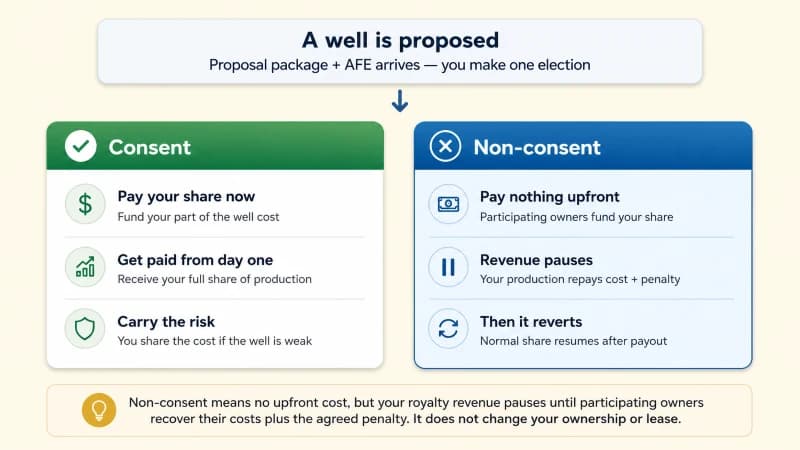
Non-consent in oil and gas is a formal choice by an owner not to take part in, and not to pay upfront for, a proposed well or operation. It usually comes up under a Joint Operating Agreement (JOA) when the operator asks owners to either pay their share (consent) or decline (go non-consent).
It applies only to working-interest owners or unleased mineral owners. Leased royalty owners do not make this election.
Owner-First View
Which non-consent applies to you?
The word "non-consent" is used for two very different situations, and most owner confusion comes from mixing them up. Sort out which one you are in before reading anything else.
| Your situation | What "non-consent" means here | Where the rules come from |
|---|---|---|
| You never leased your minerals (unleased mineral owner) | You decline to lease or participate, and another co-owner may still develop the minerals | Texas cotenancy law (common law) |
| You signed a lease or operating agreement and hold a working interest | You elect not to fund a specific proposed operation under a Joint Operating Agreement (JOA) | The private contract you signed |
What this means for mineral owners
For many owners, non-consent first shows up as a letter in the mail: an operator is proposing a well, there is an estimated cost attached, and you are being asked to pay a share you may not have expected. It can feel like a bill. It isn't. It's a decision.
You generally have two paths.
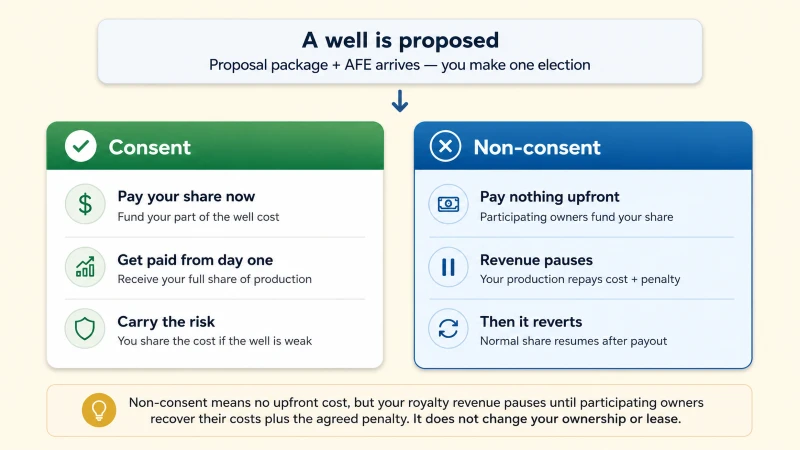
- Consent: Pay your share of the well costs and receive your full share of production.
- Non-consent: Pay nothing upfront, but temporarily give up your share of revenue until the consenting owners recover their costs, plus the agreed non-consent penalty.
In some cases you can also lease your interest instead, or lease part and go non-consent on the rest.
The reassuring part is what this decision does not touch. Going non-consent does not convey away your minerals, amend your lease, or change your decimal interest. It is a one-well funding choice. What it does affect is simple: whether you pay for this particular operation and whether you receive that well's revenue for a while. Once the participating owners recover what the agreement allows, your interest reverts and your normal share resumes.
Non-consent is a choice, not a bill
You are electing not to fund a well. You are not being charged for something you already owe. Your ownership, your decimal interest, and your lease terms stay the same.
Going non-consent has a price
You give up the well's revenue until the participating owners recover their costs (plus a penalty) from your share. A strong well reaches payout faster. A weak one can tie up your revenue longer.
How Non-Consent Works
When an operator wants to drill a new well or perform major work on an existing one, and more than one owner shares the interest, each owner is asked to elect whether to participate. That election is where non-consent happens.
The proposal and election notice
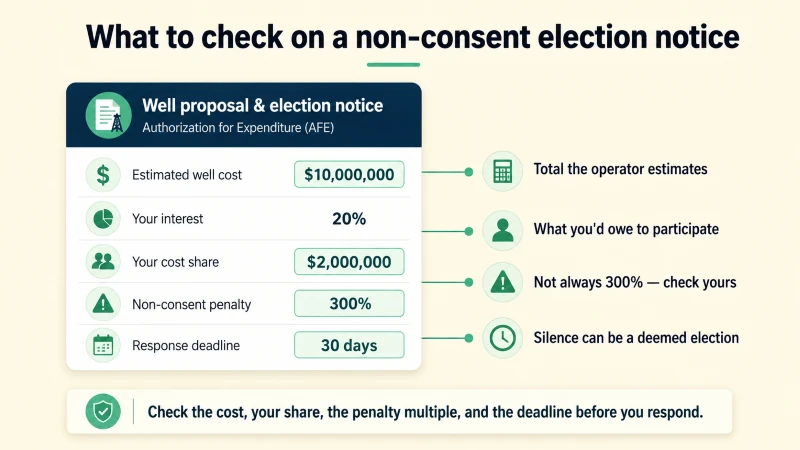
The process usually starts when the operator sends you a proposal package. It typically includes a description of the proposed operation, an Authorization for Expenditure (AFE) showing the estimated cost, an election notice with a response deadline, and any other information your agreement or a pooling order requires.
You then make your election by the deadline. If you consent, you normally pay your share of the cost and take your share of production. If you go non-consent, you pay nothing now, and the participating owners cover your share.
What happens after you go non-consent
Once you go non-consent, the participating owners fund your share of the operation, and the production that would have been yours is applied toward paying them back: your cost share plus the penalty the agreement allows. The operator tracks the well through this recoupment period. When the agreed amount has been recovered, your interest is treated under the agreement's after-payout or reversion terms, and you begin receiving your normal share again.
What Is the Non-Consent Penalty?
The non-consent penalty (often called a risk penalty) is what you give up for letting the other owners carry your cost and risk. It is not a government fine. It is a private recovery mechanism written into the JOA or the pooling terms.
Depending on your agreement, the participating owners may recover from your share your part of certain well costs, plus an additional multiple of specified drilling, completion, reworking, or other costs. People often talk about a "300% penalty," but do not assume every agreement uses 300%.
The exact multiple, the cost categories it applies to, and the reversion terms all come from your executed agreement or pooling order, not from a general industry rule of thumb. One important exception: if you are an unleased Texas owner governed by common-law cotenancy, there is usually no penalty multiplier at all. The developing owner simply recovers your share of the actual costs from your production. A penalty applies only where a JOA or a pooling order imposes one.
How a 300% penalty works
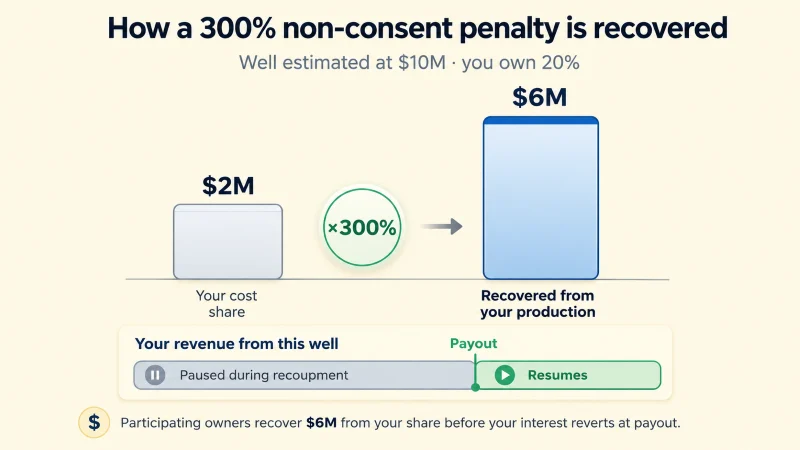
Say a well is proposed at an estimated $10 million, and you own a 20% interest.
- If you consent, your share is 20% × $10 million = $2 million. You pay it and receive your full share of production.
- If you go non-consent and the agreement applies 300% recovery to your $2 million cost share, the participating owners recover $2 million × 300% = $6 million.
They collect that $6 million out of the production that would have been yours. Until they do, you receive nothing from that well. Once they have recovered it, your interest reverts and your normal share resumes. This is a simplified example. Real agreements may treat different cost categories differently.
What Changes and What Stays the Same
Because a proposal letter can feel alarming, it helps to separate what going non-consent actually affects from what it leaves alone.
| Item | Affected if you go non-consent? |
|---|---|
| Your obligation to pay upfront | Removed. That is the point of the election. |
| Your revenue from this well | Paused during recoupment, then resumes at payout |
| Your mineral ownership | No change |
| Your decimal interest | No change |
| Your lease terms | No change |
| An overriding royalty interest or other burden on the interest | May be affected. Check the documents. |
The central point is clear: going non-consent changes whether you fund and are paid for one operation. It does not alter your title, your lease, or your ownership decimal.
Why Non-Consent Matters to You
The main reason this matters is money and timing. Going non-consent means no upfront cost but no income from that well until the participating owners are made whole, and a penalty multiple decides how long that takes. In effect, the election is a bet on a specific well run by a specific operator.
That is why it pays to look before you decide. The election itself stays private inside the owner group, but the operator's wells, permits, and production history are in the public record.
Before you choose to fund a well or step back, you can review the operator's track record and nearby activity (how their wells have produced, how this well fits their program, and what is happening around your tract) on Mineral View's map. It is a practical way to judge a proposal instead of deciding blind.
Non-Consent in Texas: A Recent Court Decision Owners Should Know
In May 2025, the Supreme Court of Texas ruled in Cromwell v. Anadarko E&P Onshore, LLC, that production by one cotenant may keep another cotenant's oil and gas lease alive when the lease says it continues as long as minerals are produced "from the land" and does not specifically require production "by the lessee." The Court refused to add a personal-production requirement that the parties had not written into the lease.
Why this matters in 2026
A leasehold or working-interest owner should not assume an interest expired merely because that owner did not drill the well, operate it, or enter a JOA. Production by another cotenant may preserve the interest, depending on the exact wording of the lease's habendum clause.
Before accepting a claim that your interest terminated, check:
- Whether the lease requires production specifically "by the lessee"
- Whether production in paying quantities continued from the covered land
- Whether the operator sent AFEs, joint-interest statements, or other ownership communications
- Whether you previously asked to participate in the wells
The practical lesson is that a few words in the lease can determine whether an interest remains valid. This is separate from the calculation of non-consent costs or penalties and should be reviewed as its own title question. The ruling applies to the specific lease language involved and does not mean every non-operating owner's lease continues by default.
What to Check
Confirm whether a JOA or a pooling order governs your interest
The penalty, the recovery, and the payout terms are very different under a private JOA than under a state pooling order. If your minerals are unleased and the operator drills anyway, you may be under a pooling order rather than a contract. Pin down which one governs before you respond, because the numbers from one do not apply to the other.
Review the AFE and election terms before you decide
Check the estimated cost, your share of it, the penalty multiple and which cost categories it covers, the response deadline, and what the agreement says happens if you do not reply. Compare your interest against your lease, prior division orders, and title records rather than assuming the operator's figure is final.
Watch the election deadline and what silence means
Silence is not always safe. An agreement can treat a missed deadline as a "deemed" election. Keep a copy of the proposal, the AFE, the notice, your response, and the dates. To see when a proposal or related filing shows up on your minerals, Mineral View's Lease Activity tracks regulatory filings on claimed leases, so you learn of activity rather than being surprised by it.
Important
Mineral View can help you research an operator's wells and see activity on your minerals before you make an election, and track your revenue over time. For questions about whether an operation was properly proposed and the election notice was valid, how the non-consent penalty is calculated, or when your interest reverts to normal participation after payout, contact the Railroad Commission of Texas or consult a qualified Texas oil and gas attorney.
Common Questions
It means an operator has proposed a well and is asking whether you will pay your share and participate, or step back. Read the deadline carefully, review the AFE, and confirm whether a JOA or a pooling order governs your interest before you respond.
Usually no. The whole point of going non-consent is that you do not fund your share upfront. Instead, the participating owners recover their costs plus a penalty out of the production that would have been yours.
It is a contractual recovery multiple applied to specified costs. The participating owners recover your cost share several times over before your interest reverts. It is not a universal rule or a flat fee. The exact figure comes from your agreement.
Until the well reaches payout, when the participating owners have recovered the amount your agreement allows. A strong well reaches payout faster. A weak one keeps your revenue on hold longer.
Sometimes, depending on your lease, the governing documents, and state law. It can be a way to balance guaranteed income against upside, but it is worth professional review before you commit.
It depends on your state. In Texas, an unleased cotenant is generally governed by common-law cotenancy: the developing owner recovers your share of the reasonable and necessary costs out of your production first (with no penalty multiplier), and you owe nothing if the well fails.
In forced-pooling states, by contrast, your interest may be included by a state order and charged your share of costs plus a statutory risk penalty, though some states let you elect to participate instead. Confirm which framework governs your minerals early.
No. Non-consent is a choice not to participate in a proposed well. Not paying a bill you already owe is a separate default issue with different, and usually harsher, consequences.
No. Non-consent is usually contractual and comes from a JOA. Forced pooling is created by state law or a regulatory order.
Please note
A non-consent decision can have major financial and legal consequences. Your executed JOA, lease, or pooling order (and the applicable state law) control what actually happens to your interest. This page explains common industry practice and is not legal, tax, or accounting advice. Consider having a qualified oil and gas attorney or landman review any proposal before you respond.